
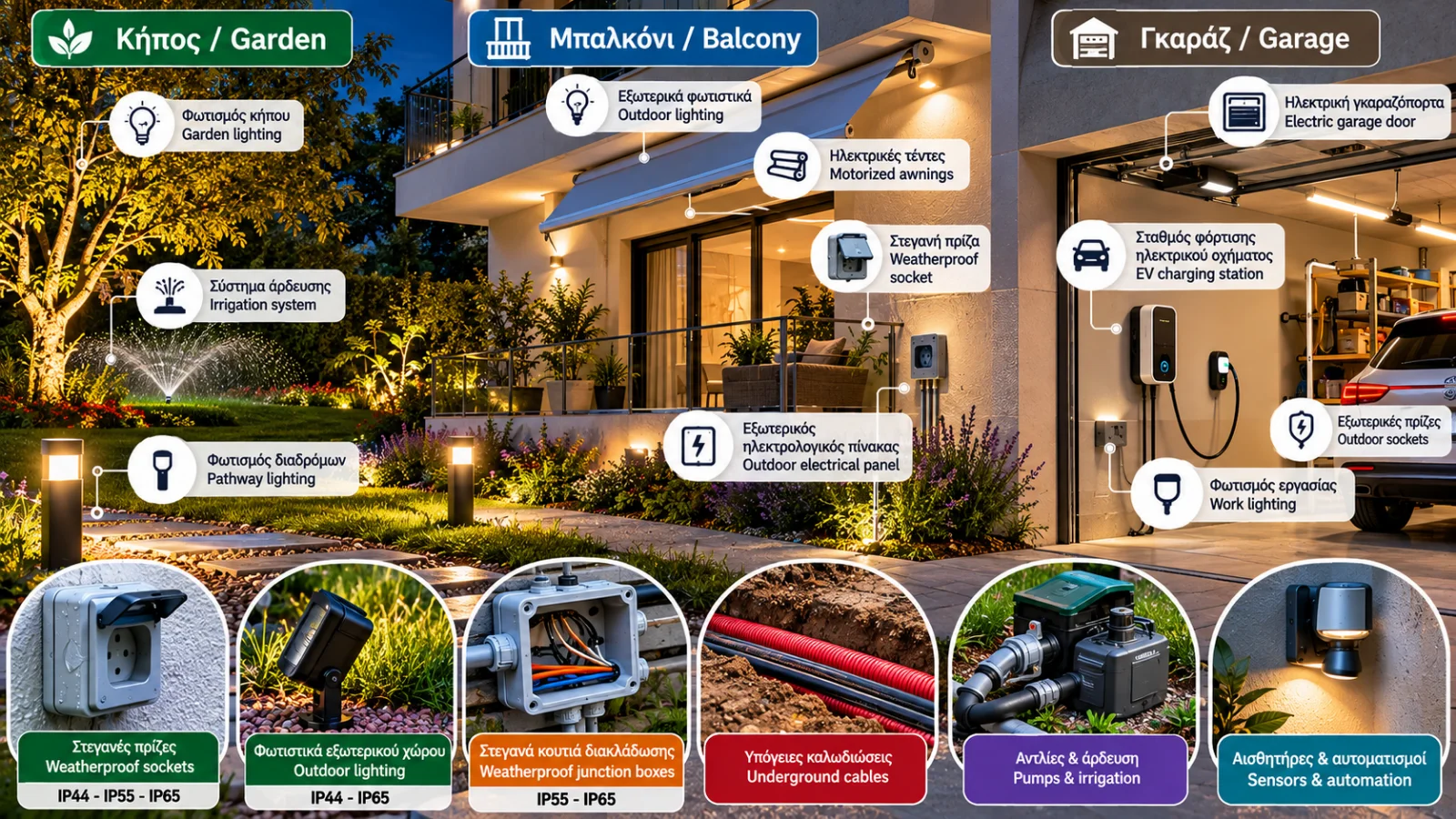
Outdoor Electrical Installations: Garden, Yard, Balcony and Garage
Outdoor electrical installations require a different approach from electrical systems installed inside a home.
Electrical cables, sockets, lighting fixtures and distribution boards located in gardens, yards, balconies and garages may be exposed to rain, moisture, sunlight, dust and mechanical damage.
At the same time, modern homes increasingly rely on outdoor electrical equipment, including garden lighting, automatic irrigation systems, electric garage doors, water pumps, security equipment and electric vehicle charging stations.
A properly designed outdoor electrical installation must provide suitable power distribution, protection and equipment for the actual operating conditions.
This guide explains the main components of outdoor residential electrical installations, the available wiring methods, protection requirements and common installation mistakes.
1. What Does an Outdoor Electrical Installation Include?
Depending on the property and its intended use, an outdoor electrical installation may include:
Garden and yard lighting.
Entrance and pathway lighting.
Outdoor electrical sockets.
Garage electrical supplies.
Electric garage door systems.
Water pumps.
Irrigation valves and controllers.
Security lighting.
CCTV and monitoring equipment.
Outdoor electrical distribution boards.
Electric vehicle charging equipment.
Not every property requires the same electrical infrastructure.
The installation should be designed according to current requirements while also considering potential future expansion.
2. Why Are Outdoor Electrical Installations Different?
Indoor electrical equipment is generally protected from direct exposure to weather conditions.
Outdoor installations may be affected by:
Rainfall.
Condensation.
Ground moisture.
Direct sunlight.
High and low temperatures.
Dust and mud.
Mechanical impacts.
Garden maintenance equipment.
Rodents and other environmental factors.
For this reason, electrical materials must be selected not only for their electrical characteristics but also for their suitability for the installation environment.
A cable designed for indoor use is not necessarily suitable for direct sunlight exposure or underground installation.
3. How Should a Garden Electrical Supply Be Designed?
Electrical design begins with identifying the required loads and their locations.
The following factors should be considered:
Locations requiring electricity.
Electrical power requirements of each appliance.
Equipment that may operate simultaneously.
Distances from the main electrical distribution board.
Environmental conditions.
Electrical protection requirements.
Potential future extensions.
For example, a garden containing a few LED lighting fixtures has very different requirements from a property with a water pump, automatic garage door and EV charger.
The design must account for total electrical demand and the available capacity of the existing supply.
4. Outdoor Electrical Wiring: What Are the Options?
Outdoor electrical cables can be installed using different methods depending on the environment and technical requirements.
Surface-Mounted Wiring
Cables may be installed using suitable conduits, trunking systems or other protective supports.
Potential advantages include:
Easier access for inspection.
Greater flexibility for future modifications.
Reduced construction work in certain situations.
However, the materials must be suitable for outdoor conditions and protected against mechanical damage.
Underground Wiring
Electrical cables can be installed below ground using an appropriate installation method.
Potential advantages include:
Reduced visible wiring.
Improved appearance.
Suitable routing for certain garden installations.
However, underground installation requires careful planning and appropriate protection.
Wiring Within Building Structures
In some situations, electrical cables may pass through walls or other structural elements.
Suitable mechanical protection and sealing of cable penetrations may be necessary.
The appropriate installation method must be determined by a qualified electrician.
5. Underground Electrical Cables in Gardens
Underground electrical wiring is commonly used for:
Garden lighting.
Remote outdoor sockets.
Water pumps.
Auxiliary buildings.
Landscape electrical equipment.
The design must consider:
Cable type.
Mechanical protection.
Installation depth.
Potential excavation work.
Ground conditions.
Moisture exposure.
Separation from other underground services.
Identification of the cable route.
How Deep Should Underground Electrical Cables Be Installed?
There is no single installation depth that should be applied to every situation.
The required depth and protection measures depend on the installation method, ground use, mechanical risks and applicable technical requirements.
For example, wiring beneath a flower bed may require a different approach from wiring beneath a driveway.
Is Protective Conduit Necessary?
The need for conduit or other mechanical protection depends on the cable type and installation conditions.
Not every conduit is suitable for underground electrical installations.
The selected system must provide appropriate mechanical resistance and environmental compatibility.
6. How Is the Correct Cable Size Selected?
Electrical cable size must not be selected based only on the rated power of the connected appliance.
Important factors include:
Design current.
Installation method.
Ambient temperature.
Cable grouping.
Cable length.
Voltage drop.
Overcurrent protection.
Fault withstand requirements.
Voltage Drop in Long Cable Runs
A lighting fixture installed far from the main distribution board may require a different cable arrangement from an equivalent fixture located close to the house.
Long cable runs can result in significant voltage drop.
Therefore, a particular conductor size should not be assumed suitable for every outdoor installation.
Cable selection must be supported by appropriate electrical calculations.
7. Outdoor Electrical Sockets: What Should You Consider?
Outdoor sockets are commonly used for:
Garden tools.
Cleaning equipment.
Seasonal lighting.
Small outdoor appliances.
Maintenance equipment.
Their selection must consider:
Rain exposure.
Installation location.
Possible water accumulation.
Mechanical protection.
IP rating.
Enclosure suitability.
Circuit protective devices.
A socket with a protective cover is not automatically suitable for every outdoor location.
Its protection level may depend on whether the cover is closed or a plug is connected.
The manufacturer's technical documentation should be checked.
8. Understanding IP44, IP55 and IP65 Protection Ratings
The IP rating describes the protection provided by an enclosure against the ingress of solid objects and water, according to IEC 60529.
IP Rating | Protection Against Solids | Protection Against Water |
|---|---|---|
IP44 | Objects larger than 1 mm | Splashing water |
IP54 | Limited dust ingress | Splashing water |
IP55 | Limited dust ingress | Water jets |
IP65 | Dust-tight | Water jets |
IP67 | Dust-tight | Temporary immersion under specified conditions |
Is IP65 Always Better?
Not necessarily.
The appropriate rating depends on actual exposure conditions.
An electrical accessory installed beneath a sheltered roof may have different requirements from a fixture exposed to heavy rainfall or possible water accumulation.
Additionally, the IP rating does not independently describe resistance to ultraviolet radiation, corrosion or mechanical impacts.
All relevant equipment characteristics must be evaluated.
9. Garden and Yard Lighting
Outdoor lighting can serve several different purposes.
Functional Lighting
Functional lighting is commonly used for:
Entrances.
Pathways.
Steps.
Parking areas.
Access points.
Decorative Lighting
Decorative lighting can highlight:
Plants.
Trees.
Walls.
Architectural features.
Landscaped areas.
Lighting With Sensors and Automation
Outdoor lighting systems may include:
Motion sensors.
Photocells.
Timers.
Smart lighting controllers.
Equipment selection should consider electrical safety, energy consumption, reliability and environmental conditions.
10. Low-Voltage Garden Lighting
Some outdoor lighting systems operate at lower voltages.
For example, certain products use 12 V or 24 V supplies.
These systems may offer advantages in specific applications, but they still require appropriate electrical design.
Important considerations include:
Rated voltage.
Total connected power.
Power supply characteristics.
Voltage drop.
Cable size.
Moisture protection.
Manufacturer requirements.
Important: Not every 12 V or 24 V circuit automatically qualifies as a SELV circuit.
The SELV classification depends on the power source and the applicable electrical separation and protection requirements.
11. Electrical Installations on Balconies
A balcony may contain:
Wall-mounted lighting.
Ceiling lighting.
Outdoor sockets.
Motorized awnings.
Automation equipment.
Electrical supplies for other building systems.
The presence of a roof or canopy does not necessarily mean that the equipment is fully protected from moisture.
Wind-driven rain and condensation may still affect electrical accessories.
Suitable materials, appropriate cable routing and correct sealing are essential.
12. Garage Electrical Installations
A garage may function as a parking area, storage space or small workshop.
Its electrical installation may include:
General lighting.
Task lighting.
Electrical sockets.
Electric garage doors.
Charging equipment.
Auxiliary appliances.
The design must consider electrical demand and the intended use of the space.
Where tools are used or vehicles move, particular attention must be given to the mechanical protection of cables and electrical accessories.
13. Electric Garage Doors and Automation
Electric garage doors require an appropriate electrical supply and installation according to the manufacturer's instructions.
Important factors include:
Motor electrical power.
Supply location.
Circuit protection.
Environmental conditions.
Automation safety requirements.
Electrical protection and the mechanical safety functions of the garage door are separate but complementary considerations.
A proper installation must address both.
14. Electrical Supplies for Water Pumps and Irrigation Systems
Gardens and yards may contain:
Irrigation pumps.
Pressure booster systems.
Drainage pumps.
Solenoid valves.
Irrigation controllers.
Electrical requirements depend on the type and characteristics of the equipment.
For electric motors, relevant considerations include:
Rated current.
Starting current.
Protection requirements.
Starting method.
Supply configuration.
Operating conditions.
Pumps operating in wet environments require equipment specifically suitable for the application.
15. Is a Separate Outdoor Electrical Distribution Board Necessary?
In some installations, a local sub-distribution board may be useful.
This may be considered when:
Several outdoor circuits are required.
Loads are located far from the main distribution board.
An independent auxiliary building is present.
Organized local electrical distribution is needed.
However, a separate outdoor distribution board is not necessary for every home.
The decision depends on the number of circuits, connected loads and overall electrical design.
If a distribution board is installed outdoors, its enclosure must be suitable for the environmental conditions.
16. RCD Protection for Outdoor Electrical Circuits
Protection against electric shock is particularly important in outdoor environments.
Relevant electrical installation standards require additional protection using suitable residual current devices (RCDs) for specified circuits and applications.
In many cases, an RCD with a rated residual operating current not exceeding 30 mA is required.
However, the selection of protective devices depends on:
The earthing system.
Circuit characteristics.
Connected equipment.
Applicable electrical standards.
Operating conditions.
An RCD does not replace overcurrent protection or protective earthing.
17. Earthing and Equipotential Bonding
Protective earthing is an essential element of electrical safety.
Its suitability must be assessed together with the supply system and protective devices.
Outdoor installations may contain metal structures, equipment enclosures and other conductive parts.
Whether these parts require protective bonding depends on their electrical characteristics and the applicable requirements.
Metal objects should never be connected to the earthing system through improvised arrangements.
18. Weatherproof Junction Boxes and Electrical Connections
Junction boxes are used to protect and organize electrical connections.
For outdoor installations, they must be suitable for:
Moisture.
Dust.
Water exposure.
Temperature variations.
The intended installation method.
Cable entries are particularly important.
An enclosure with a high IP rating may lose its intended protection if cable glands or entries are installed incorrectly.
Connections must use suitable terminals and comply with manufacturer instructions.
19. Common Outdoor Electrical Installation Mistakes
Using Indoor Cables Outdoors
Not all electrical cables are suitable for direct outdoor exposure.
Choosing Sockets Only Because They Have Covers
Actual suitability depends on the complete technical specification.
Improper Underground Wiring
Insufficient mechanical protection can create hazards during future excavation work.
Ignoring Voltage Drop
Long cable runs require appropriate calculations.
Poorly Sealed Electrical Connections
Water ingress can cause corrosion and electrical faults.
Inadequate Overcurrent Protection
Each circuit requires suitable protection according to its characteristics.
Failing to Plan for Future Loads
Adding a pump, garage system or EV charger later may require substantial modifications.
20. Frequently Asked Questions
What IP Rating Is Required for an Outdoor Socket?
The appropriate rating depends on the location and exposure conditions. Equipment must be selected according to the environment and manufacturer specifications.
Can Electrical Cables Be Installed Underground?
Yes, provided suitable cables, installation methods and protective measures are used in accordance with applicable requirements.
Does Garden Lighting Need a Separate Electrical Circuit?
That depends on the electrical design, connected loads and installation requirements.
Is 12 V Garden Lighting Safe?
It can be a suitable solution when the system is correctly designed with an appropriate power source and protective arrangements.
Can I Use an Ordinary Power Strip on a Balcony?
An ordinary indoor power strip should not be used in environmental conditions for which it was not designed.
Is RCD Protection Required for Garden Circuits?
Requirements depend on the circuit and applicable standards. Additional protection using an appropriate RCD is required for many outdoor applications.
Can an Electrical Distribution Board Be Installed Outside?
Yes, provided the equipment and installation are suitable for the environmental conditions and meet applicable requirements.
Does a Water Pump Need a Dedicated Electrical Circuit?
The electrical supply must be designed according to the pump's characteristics and manufacturer requirements.
Who Should Install Outdoor Electrical Wiring?
Electrical installation work should be carried out by an appropriately qualified professional.
Conclusion
Outdoor electrical installations are an important part of a home's overall electrical infrastructure.
Proper design must consider not only electrical power requirements but also environmental conditions, distances, wiring methods and protection requirements.
In gardens and yards, underground cables, lighting and outdoor sockets require particular attention.
On balconies, equipment selection must account for moisture and weather exposure.
In garages and auxiliary buildings, the electrical supply must match the connected loads and actual operating conditions.
Selecting suitable electrical equipment, using professional installation methods and performing the required inspections are essential for a reliable and safe outdoor electrical system.
Thermosphere.gr — Technical knowledge for safer and more efficient installations.
Disclaimer: This article provides general technical information and does not replace professional electrical design, inspection or the requirements of applicable standards. Electrical installation work must be carried out by appropriately qualified professionals.
Technical References
ELOT 60364 — Requirements for Electrical Installations in Greece.
IEC 60364-4-41 — Protection Against Electric Shock.
IEC 60364-5-52 — Selection and Erection of Wiring Systems.
IEC 60364-5-54 — Earthing Arrangements and Protective Conductors.
IEC 60364-6 — Verification.
IEC 60529 — Degrees of Protection Provided by Enclosures (IP Code).
IEC 62262 — Degrees of Protection Provided by Enclosures Against External Mechanical Impacts (IK Code).
HEDNO — Hellenic Electricity Distribution Network Operator: https://www.deddie.gr/
ELOT — Hellenic Organization for Standardization: https://www.elot.gr/