
Electrical Safety at Home: 10 Dangerous Warning Signs You Should Never Ignore
Your home’s electrical installation operates every day, often without attracting much attention. However, electrical faults can create serious risks, including electric shock, overheating and fire.
A socket that smells of burning plastic, an overheating switch or a circuit breaker that repeatedly trips should never be ignored.
Some electrical problems produce warning signs before developing into more serious incidents. Others may exist without any visible symptoms.
In this guide, we examine 10 important electrical warning signs, their possible causes and the safe actions homeowners should take.
1. Burning Smell From an Electrical Outlet or Switch
A smell resembling burning plastic or overheated electrical equipment is a serious warning sign.
Possible causes include:
Overheating electrical contacts.
Loose or deteriorated connections.
A faulty electrical socket.
An overloaded circuit.
A defective electrical appliance.
Excessive heat can damage insulation and increase the risk of an electrical fire.
What Should You Do?
Stop using the affected appliance or circuit.
If the electrical supply can be isolated safely using an appropriate switch without approaching the hazardous area, do so.
Do not touch an overheated socket or switch, and do not attempt repairs.
If smoke, flames or an immediate fire hazard is present, evacuate and contact emergency services.
In Greece and across the European Union, the emergency number is 112.
2. Electrical Socket Becoming Unusually Hot
Some electrical components may experience a small temperature rise during normal operation.
However, excessive heat, deformation or a burning smell is not normal.
Possible causes include poor electrical connections, deteriorated contacts or circuit overload.
Overheating can continue even while the connected appliance appears to function normally.
What Should You Do?
Stop using the socket until it has been inspected by a qualified electrician.
Do not touch or forcibly remove a plug that appears severely overheated or damaged.
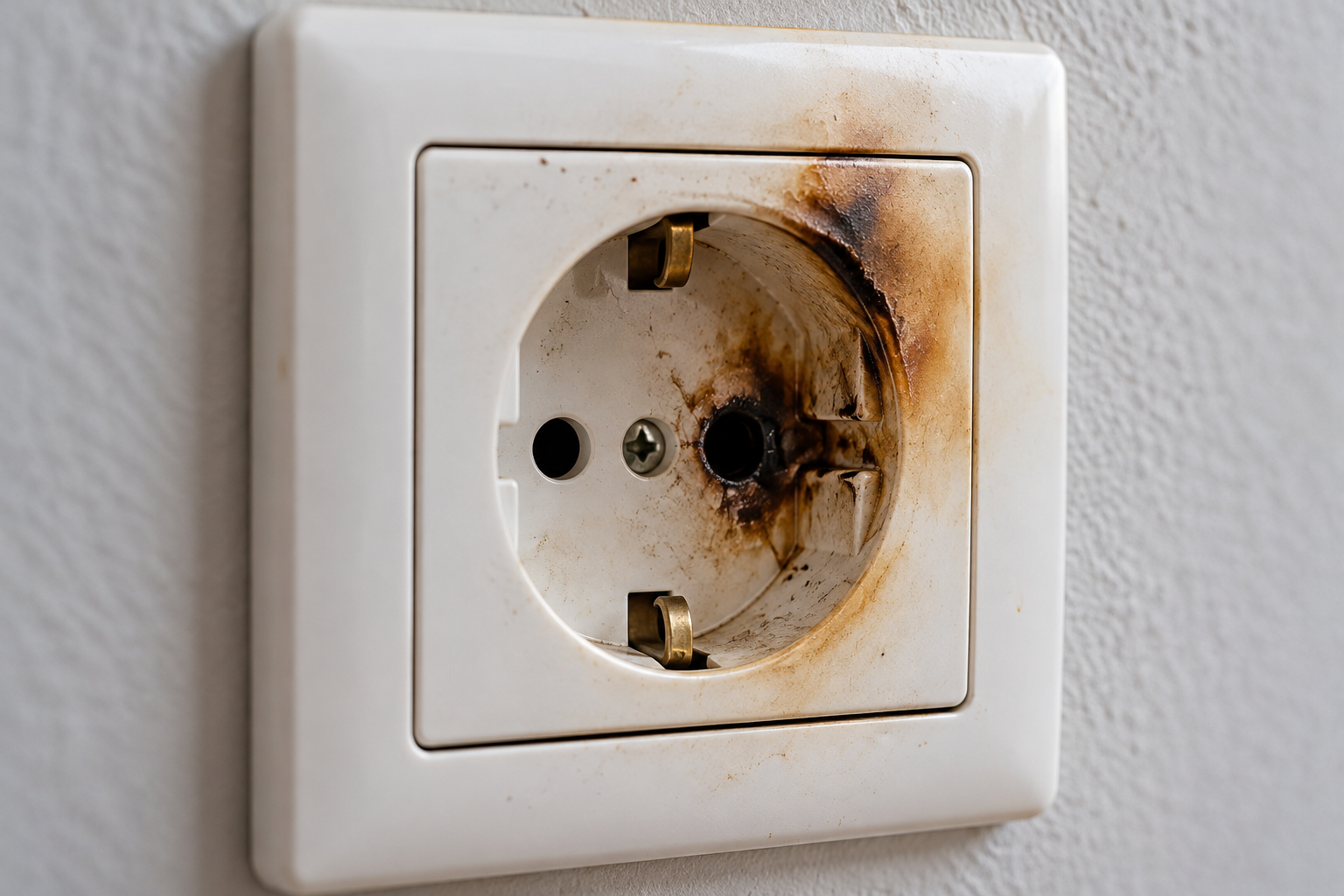
3. Blackened, Burnt or Melted Electrical Outlet
Black marks, brown discoloration and melted plastic may indicate overheating or electrical arcing.
The damage may extend beyond the visible socket cover to internal contacts and wiring.
Replacing only the external cover may leave the underlying fault unresolved.
What Should You Do?
Do not use the damaged socket.
Arrange a professional inspection of the socket and its associated circuit.
4. Sparks Coming From a Socket or Switch
A small, brief spark may sometimes occur when connecting or disconnecting certain electrical loads.
However, this does not mean that every spark is harmless.
Repeated, intense or sustained sparking, particularly when accompanied by noise, heat or a burning smell, requires investigation.
Potential causes include poor electrical contacts and arcing faults.
What Should You Do?
Stop using the affected electrical point and contact a qualified electrician.
Never open the socket to investigate the fault yourself.
5. Circuit Breaker Keeps Tripping
Circuit breakers are designed to disconnect electrical circuits under specified overcurrent conditions.
Repeated tripping may indicate:
Circuit overload.
Short circuit.
Faulty electrical equipment.
Unsuitable protective device.
Damaged wiring.
Repeatedly resetting a circuit breaker without identifying the cause can be dangerous.
What Should You Do?
Avoid repeated resets.
Never replace the breaker with a higher-rated device simply to prevent it from tripping.
A qualified electrician should investigate the underlying cause.
6. Residual Current Device (RCD) Trips Frequently
A residual current device monitors the balance of current flowing through the active conductors of a circuit.
When residual current reaches the device’s specified operating conditions, the RCD disconnects the supply.
Frequent tripping may be associated with:
Leakage current from electrical equipment.
Moisture.
Damaged insulation.
Installation faults.
Combined leakage currents from several appliances.
An RCD that trips repeatedly is not necessarily defective.
It may be responding to a genuine electrical problem.
What Should You Do?
Never bypass or disable the RCD.
Arrange professional fault investigation if the device repeatedly trips.
7. Tingling Sensation or Electric Shock From an Appliance
If you experience tingling, a mild shock or an electric current sensation when touching an appliance, treat it as a potential electrical hazard.
Possible causes include:
Insulation failure.
Defective protective earthing.
Faulty electrical equipment.
Other dangerous electrical conditions.
Even a seemingly minor electric shock should not be dismissed.
What Should You Do?
Stop using the appliance and avoid touching it again until it has been professionally inspected.
If someone is receiving an electric shock, do not touch them while they may still be in contact with electricity.
Contact emergency services and follow their instructions.
8. Lights Flickering or Changing Brightness
Occasional flickering can sometimes result from the characteristics of a lamp or its electronic driver.
However, frequent or significant changes in brightness may indicate problems with the electrical supply or connections.
Particular attention is required when several circuits are affected simultaneously.
For example, some lights becoming unusually bright while others become dimmer can indicate a potentially serious supply or neutral-related fault.
What Should You Do?
Arrange an electrical inspection.
If the changes are severe or widespread, stop using sensitive electrical equipment and promptly contact a qualified electrician or the electricity network operator, as appropriate.
9. Buzzing or Crackling Sounds From the Electrical Panel
Some electrical equipment produces normal operating sounds.
However, persistent buzzing, crackling or noises resembling electrical discharges from a distribution board should be investigated.
Possible causes include:
Deteriorated electrical contacts.
Faulty protective devices.
Overheating.
Electrical arcing.
What Should You Do?
Do not open the electrical panel or attempt to tighten internal connections.
Contact a qualified electrician.
If smoke, strong burning smells or visible fire are present, evacuate and contact emergency services.
10. Damaged Cables, Power Strips and Extension Leads
Electrical cords, plugs and extension leads experience wear during everyday use.
Warning signs include:
Cut or damaged insulation.
Exposed conductors.
Deformed plugs.
Overheating power strips.
Loose connections.
Burn marks.
Connecting several high-power appliances to a single power strip can create an overload.
Some extension leads may also overheat if used while coiled, depending on their construction, loading and manufacturer’s instructions.
What Should You Do?
Stop using damaged equipment.
Replace it with a suitable product that complies with the applicable safety requirements.
Do not attempt temporary repairs using ordinary adhesive or insulating tape.
Which Electrical Warning Signs Require Immediate Action?
Some electrical problems should be treated as emergencies.
Warning Sign | Recommended Action |
Smoke or flames from electrical equipment | Evacuate and call emergency services |
Strong burning smell | Stop use, isolate supply if safe and arrange urgent inspection |
Electric shock from an appliance | Avoid further contact and seek urgent assistance |
Melted or blackened socket | Stop using it and arrange professional inspection |
Circuit breaker repeatedly trips | Avoid repeated resets and investigate the cause |
RCD repeatedly trips | Never bypass the device; arrange fault investigation |
Never use water on an electrical fire involving equipment that may still be energised.
How Can You Reduce Electrical Hazards at Home?
Electrical safety depends on appropriate installation design, maintenance and everyday precautions.
Avoid Overloading Electrical Outlets
Do not connect several high-power appliances to a single power strip or unsuitable extension lead.
Inspect Cables Visually
Stop using plugs, cords and sockets that show signs of damage, overheating or deterioration.
Never Bypass Protective Devices
Circuit breakers and RCDs are installed for specific safety purposes.
They should never be removed, bypassed or replaced arbitrarily.
Take Extra Care Around Water
Bathrooms, outdoor areas and other damp locations require appropriate electrical equipment and installation measures.
Electrical appliances should be used according to their manufacturer’s safety instructions.
Arrange Professional Electrical Inspections
Electrical installations should be inspected according to the applicable requirements and whenever signs of deterioration or faults appear.
Electrical Safety in Homes With Children
Additional precautions are important in households with young children.
These include:
Using suitable socket outlets with appropriate safety features.
Keeping damaged electrical cords out of reach.
Positioning power strips safely.
Preventing access to electrical appliances near water.
Supervising children around electrical equipment.
Any additional socket safety accessories should be compatible with the specific socket design and should not introduce new hazards.
What About Electrical Safety in Older Homes?
Older properties may contain electrical installations that have deteriorated or been modified over time.
Potential issues include:
Ageing cable insulation.
Worn sockets and switches.
Inadequate protective devices.
Defective earthing arrangements.
Undocumented circuit extensions.
An older installation is not automatically unsafe.
However, its age, condition and modification history are relevant factors when deciding whether professional inspection is necessary.
Frequently Asked Questions
Is a burning smell from an electrical outlet dangerous?
Yes. It may indicate overheating or an electrical fault. Stop using the outlet and arrange professional inspection.
Why does an electrical outlet turn black?
Possible causes include overheating, poor electrical contacts and arcing. A blackened socket requires professional assessment.
Is it normal for a circuit breaker to trip frequently?
No. Repeated tripping indicates that the cause should be investigated.
Can I use an outlet if the plastic is slightly melted?
No. Melted plastic may indicate serious overheating, even if the outlet still works.
Is it safe to connect an electric heater to a power strip?
High-power appliances must be used according to their manufacturer’s instructions. Many portable electric heaters should not be connected through power strips or extension leads.
Can an electrical fault occur without tripping the circuit breaker?
Yes. Certain faults, such as local overheating caused by a poor electrical connection, may not generate enough current to operate an overcurrent protective device.
How often should a home’s electrical installation be inspected?
Inspection intervals depend on national regulations, the type of installation and its condition. Additional inspections may be necessary after significant modifications or when warning signs appear.
Conclusion
Electrical safety at home begins with recognising potential warning signs.
Burning smells, overheating outlets, electrical sparks, tingling sensations and repeated operation of protective devices should never be ignored.
The correct response is not a temporary repair or bypassing a protective device.
Instead, stop using the affected equipment, isolate the supply where it is safe to do so and arrange professional assessment.
A properly designed, inspected and maintained electrical installation plays an essential role in protecting people and property.
thermosphere.gr — Practical technical knowledge for safer electrical installations.
Disclaimer: This article is intended for general information only. It does not replace professional electrical inspection, repair or emergency service instructions.
Technical References
IEC 60364-4-41 — Protection against electric shock.
IEC 60364-4-42 — Protection against thermal effects.
IEC 60364-4-43 — Protection against overcurrent.
IEC 60364-6 — Verification of electrical installations.
ELOT 60364 — Requirements for electrical installations in Greece.
Hellenic Fire Service — Fire safety and emergency guidance.