
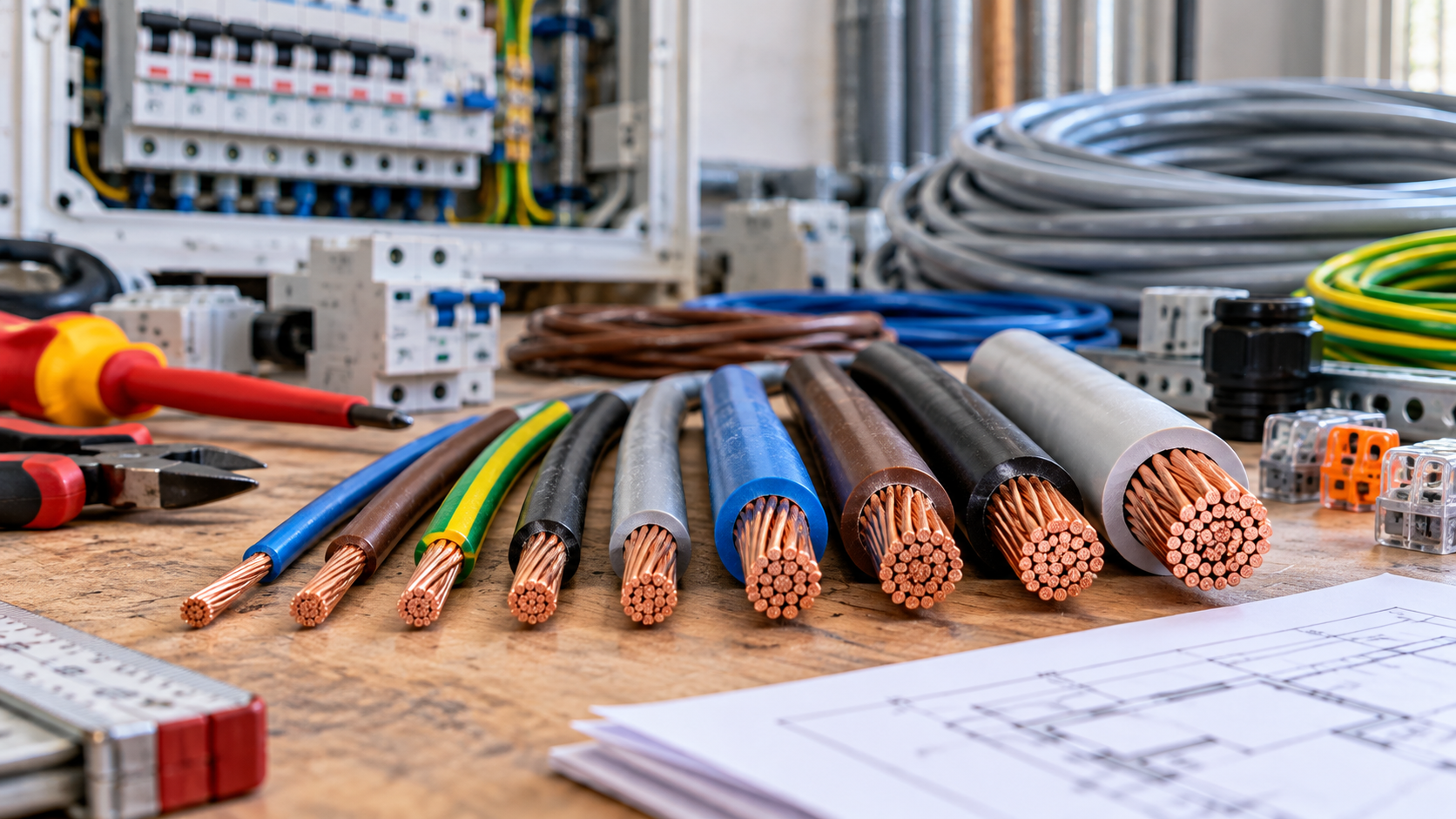
Electrical Cables and Wire Sizes: Types, Current Capacity and Selection Guide
Electrical cables are essential components of every electrical installation. They carry electrical energy from distribution boards to lighting circuits, socket outlets, appliances, heating equipment and other electrical loads.
Choosing the correct cable type and conductor size is critical for electrical safety, reliability and long-term performance.
One of the most important characteristics of an electrical conductor is its nominal cross-sectional area, expressed in square millimetres (mm²).
Common conductor sizes used in residential electrical installations include 1.5 mm², 2.5 mm², 4 mm², 6 mm² and 10 mm².
However, no single conductor size is suitable for every circuit or appliance.
Cable selection depends on electrical demand, installation method, ambient temperature, circuit length, voltage drop and protective device characteristics.
This guide explains the main types of electrical cables, common conductor sizes, current-carrying capacity and the technical factors that determine safe cable selection.
1. What Is the Difference Between an Electrical Wire and a Cable?
The terms wire, conductor and cable are often used interchangeably, but they have different technical meanings.
An electrical conductor is a conductive element that carries electric current.
It may be bare or insulated, depending on its intended application.
An electrical cable is a manufactured assembly that may contain one or more insulated conductors, often enclosed within an outer sheath or additional protective layers.
For example, a multicore cable may contain phase, neutral and protective conductors within a common outer sheath.
The construction, marking and technical specifications of a cable determine its intended applications.
2. What Does Cable Size in mm² Mean?
The nominal cross-sectional area describes the size of the metallic conducting element.
Common standardized conductor sizes include:
1.5 mm²
2.5 mm²
4 mm²
6 mm²
10 mm²
16 mm²
25 mm²
For conductors made from the same material and having the same length, a larger cross-sectional area generally means lower electrical resistance.
However, current-carrying capacity does not depend on conductor size alone.
It is also affected by cable insulation, heat dissipation and installation conditions.
A larger conductor may be capable of carrying more current under comparable conditions, but its suitability must still be verified.
3. Common Electrical Cable Sizes in Residential Installations
Different conductor sizes are used depending on circuit requirements.
Conductor Size | Typical Applications |
1.5 mm² | Certain lighting circuits |
2.5 mm² | Certain general socket outlet circuits |
4 mm² | Selected higher-load circuits |
6 mm² | Certain circuits supplying powerful appliances |
10 mm² | Selected supply circuits and larger electrical loads |
16 mm² and above | Feeders and installations requiring larger conductors |
Important: These examples are illustrative, not universal cable-sizing rules.
They do not mean that every lighting circuit must use 1.5 mm² conductors or that 2.5 mm² is automatically suitable for every socket outlet circuit.
The correct conductor size must be established through electrical design and applicable standards.
4. How Many Amps Can an Electrical Cable Carry?
This is one of the most frequently asked questions about electrical wiring.
There is no single universal current rating for each conductor size.
The allowable current depends on several factors:
Conductor material.
Conductor cross-sectional area.
Insulation type.
Maximum permissible conductor temperature.
Installation method.
Ambient temperature.
Number of loaded conductors.
Grouping with other cables.
Surrounding thermal insulation.
For example, a cable installed where heat cannot dissipate effectively may have a lower allowable current than an identical cable installed under more favourable conditions.
Why Are Simple Cable Ampacity Charts Sometimes Misleading?
A chart stating that a particular conductor size can carry a fixed number of amperes may be misleading if it does not specify the installation conditions.
The correct current-carrying capacity must be determined using the applicable standard, reference installation method and relevant correction factors.
For European low-voltage installations, IEC 60364-5-52 provides an important technical framework.
5. How Are Cable Size, Current and Electrical Power Related?
Electrical power and current are related, but they are not interchangeable.
For a single-phase AC circuit with sinusoidal voltage and current, active electrical power can be expressed as:
P = U × I × cosφ
Where:
P: Active electrical power, in watts (W).
U: RMS voltage, in volts (V).
I: RMS current, in amperes (A).
cosφ: Power factor for sinusoidal conditions.
For a purely resistive load, the power factor is approximately 1.
Example: A 2,300 W Electrical Appliance
Consider a resistive appliance operating at 230 V.
Its approximate current is:
I = 2,300 ÷ 230 = 10 A
This calculation provides the nominal current under the stated assumptions.
It does not, by itself, determine the required cable size or protective device.
Motors, electronic equipment and variable operating loads may require additional assessment.
For equipment with non-sinusoidal currents, a simplified power-factor expression may not adequately describe the electrical behaviour.
6. What Is Voltage Drop in Electrical Cables?
Voltage drop occurs when electrical current flows through conductors with electrical resistance and impedance.
The amount of voltage drop depends on:
Cable length.
Electrical current.
Conductor size.
Conductor material.
Operating temperature.
Load characteristics and power factor.
Longer cable runs and higher currents generally increase voltage drop.
Increasing conductor cross-sectional area can reduce voltage drop when other conditions remain unchanged.
Voltage drop is particularly important in:
Long electrical feeders.
Outdoor lighting installations.
Pump supply circuits.
Detached buildings.
Remote technical equipment.
Long cable routes serving high-power loads.
Electrical installations must be designed to comply with applicable voltage-drop requirements.
7. What Are H07V-U, H07V-R and H07V-K Wires?
H07V-U, H07V-R and H07V-K are designations for specific types of PVC-insulated conductors used in suitable electrical installations.
H07V-U
H07V-U is a PVC-insulated conductor with a solid conducting core.
It is commonly associated with appropriate fixed wiring applications.
H07V-R
H07V-R has a rigid stranded conductor and PVC insulation.
Its construction differs from that of a solid conductor.
H07V-K
H07V-K has a flexible stranded conductor with PVC insulation.
It may be used in suitable applications requiring greater conductor flexibility.
The correct application depends on the product specification, installation conditions and manufacturer instructions.
Flexible stranded conductors must be connected using terminals and connection methods suitable for their construction.
8. What Are NYM Electrical Cables?
NYM is a designation associated with certain sheathed installation cables.
These cables typically contain insulated conductors within a common outer sheath.
Their exact construction and permitted applications must be confirmed using the manufacturer’s documentation and applicable product specifications.
They are commonly associated with suitable fixed electrical installations.
However, not every sheathed cable is suitable for:
Direct burial in soil.
Continuous exposure to sunlight.
Permanent immersion in water.
All outdoor environments.
The intended use and environmental suitability must be verified before installation.
9. What Do Electrical Wire Colours Mean?
Modern electrical installations use standardized conductor identification colours.
Common European colour conventions include:
Colour | Typical Function |
Green-yellow | Protective conductor (PE) |
Blue | Neutral conductor (N) |
Brown | Phase conductor |
Black | Phase conductor |
Grey | Phase conductor |
These conventions must be applied according to the relevant standards.
Older installations may use different colour arrangements.
Wire colour alone must never be treated as proof of a conductor’s electrical function.
Proper identification and verification are essential, particularly when working with older wiring.
10. Copper vs Aluminium Electrical Conductors
Copper and aluminium are widely used conductive materials.
Copper Conductors
Copper is commonly used in residential electrical installations.
It offers high electrical conductivity and is suitable for many wiring applications.
Aluminium Conductors
Aluminium is also used in electrical networks and selected installations.
It has different electrical and mechanical properties compared with copper.
Aluminium conductor installations require appropriate conductor sizing, terminals and connection methods.
Copper and aluminium must not be connected using unsuitable components.
Connections between dissimilar metals require compatible products and appropriate technical assessment.
11. How Does Temperature Affect Cable Selection?
Temperature influences a cable’s ability to carry electrical current without exceeding its permitted thermal limits.
Important factors include:
Ambient temperature.
Insulation temperature rating.
Installation method.
Presence of thermal insulation.
Grouping of loaded cables.
For example, several loaded cables installed close together may experience reduced heat dissipation.
This can affect their allowable current-carrying capacity.
Relevant correction factors must be applied when required by the applicable design method.
12. Electrical Cables Installed in Thermal Insulation
Electrical wiring installed within or near thermal insulation requires particular consideration.
Thermal insulation may reduce the amount of heat that cables can release into their surroundings.
As a result, the permissible current-carrying capacity may be reduced.
Cable selection must account for the actual installation arrangement and relevant standard requirements.
A conductor size that is suitable in one installation method may not be appropriate in another.
13. Which Electrical Cables Are Suitable for Outdoor Use?
Outdoor electrical installations may be exposed to:
Ultraviolet radiation.
Rain.
Moisture.
Temperature variations.
Mechanical damage.
Chemical or environmental exposure.
Cable selection must reflect the expected operating conditions.
A cable designed for indoor installation is not automatically suitable for direct outdoor exposure.
Similarly, placing a cable inside conduit does not necessarily make it suitable for every outdoor environment.
The cable, conduit, accessories and installation method must be evaluated as a complete system.
14. What Should Be Considered for Underground Electrical Cables?
Underground installations require cables and installation methods suitable for the surrounding environment.
Important considerations include:
Suitability for underground installation.
Moisture exposure.
Mechanical protection.
Soil conditions.
Installation method.
Relevant electrical protection requirements.
Identification and documentation of cable routes.
Not every electrical cable is designed for direct burial.
The correct product must be selected according to its specifications and the applicable installation requirements.
15. How Does Cable Size Relate to Circuit Breaker Selection?
Overcurrent protection must be coordinated with the current-carrying capacity of the electrical conductors.
For applicable circuit arrangements, an important design relationship is:
Ib ≤ In ≤ Iz
Where:
Ib: Circuit design current.
In: Rated current of the protective device.
Iz: Current-carrying capacity of the conductor under the applicable installation conditions.
This relationship is only one part of the overall protection assessment.
Other relevant requirements include the operating characteristics of protective devices, overload protection, short-circuit protection and fault conditions.
For example, the conventional operating current of an overload protective device may also need to satisfy the applicable relationship with the conductor’s current-carrying capacity.
Replacing a circuit breaker with a higher-rated device without assessing the wiring can compromise conductor protection.
16. What Cable Size Is Required for a Heat Pump?
There is no single conductor size suitable for every heat pump.
The appropriate cable depends on:
Electrical supply characteristics.
Maximum electrical current.
Manufacturer requirements.
Auxiliary electric heating elements.
Cable length.
Installation method.
Protective device requirements.
A heat pump’s thermal output is not the same as its electrical input.
For example, a heat pump with a rated heating capacity of 12 kW does not necessarily draw 12 kW of electrical power.
Cable sizing must be based on the actual electrical specifications of the equipment.
17. What Cable Size Is Required for an EV Charger?
Electric vehicle chargers can introduce substantial electrical loads.
Cable selection depends on:
Charging power.
Single-phase or three-phase supply.
Design current.
Cable length.
Voltage drop.
Installation method.
Electrical protection requirements.
Manufacturer specifications.
Electric vehicle charging installations are subject to additional requirements, including those addressed in IEC 60364-7-722.
Cable size must not be selected solely from the charger’s advertised power rating.
A complete electrical assessment is necessary.
18. Common Mistakes When Choosing Electrical Cables
Selecting Cable Size Based Only on Amperes
Installation method, ambient temperature and cable grouping are ignored.
Ignoring Voltage Drop
Long cable routes are not properly evaluated.
Using an Unsuitable Cable Type
The cable is not designed for the environmental or mechanical conditions.
Incorrect Circuit Protection
The protective device is not properly coordinated with the wiring.
Inappropriate Electrical Connections
Terminals or connectors are incompatible with the conductor type or material.
Ignoring Future Electrical Demand
Potential additional electrical loads are not considered.
Missing Technical Documentation
Cable characteristics, circuit identification and routing information are not properly recorded.
19. Frequently Asked Questions
What Is the Difference Between 1.5 mm² and 2.5 mm² Cable?
The main difference is the nominal conductor cross-sectional area.
This affects electrical resistance and, together with installation conditions, current-carrying capacity.
How Many Amps Can a 2.5 mm² Cable Carry?
There is no universal value.
The allowable current depends on conductor construction, insulation, installation method and environmental conditions.
Can I Install a Larger Circuit Breaker on Existing Wiring?
Not without an appropriate technical assessment.
The protective device must be suitable for the circuit and its conductors.
Is a Larger Cable Always Better?
Not necessarily.
Cable selection must meet technical requirements while considering terminal compatibility, installation practicality and cost.
What Cable Size Is Needed for an Electric Cooker?
The required size depends on the appliance’s electrical specifications, supply arrangement, circuit length and installation conditions.
What Cable Size Is Required for a Heat Pump?
The correct size depends on the specific heat pump’s electrical requirements and the installation design.
Can Indoor Electrical Cable Be Used Outdoors?
Only when the cable and installation method are suitable for the intended environmental conditions.
What Does a Blue Electrical Wire Mean?
In modern European installations, blue is commonly used to identify a neutral conductor.
However, conductor function must be verified rather than assumed from colour alone.
Does a Longer Cable Need a Larger Cross-Section?
Sometimes.
Longer cable runs can increase voltage drop and may influence the required conductor size.
The final selection depends on the complete electrical design.
Are Flexible and Solid Conductors Interchangeable?
Not automatically.
Their suitability depends on the installation method, terminals, connection equipment and applicable product requirements.
Conclusion
Choosing electrical cables and conductor sizes is a fundamental part of designing a safe and reliable electrical installation.
Nominal conductor cross-sectional area is an important characteristic, but it cannot independently determine whether a cable is suitable.
Current-carrying capacity, installation method, temperature, voltage drop, environmental exposure and circuit protection must all be considered.
Correct conductor sizing and appropriate cable selection contribute to long-term electrical safety and reliable equipment operation.
Thermosphere.gr — Technical knowledge for safer and more efficient installations.
Disclaimer: This article provides general technical information and is not a DIY electrical installation guide. Electrical cable selection, installation and verification must be performed by appropriately qualified professionals in accordance with applicable standards.
Technical References
IEC 60364 — Low-voltage electrical installations.
IEC 60364-5-52 — Selection and erection of wiring systems.
IEC 60364-4-43 — Protection against overcurrent.
IEC 60364-5-53 — Devices for protection, isolation, switching, control and monitoring.
IEC 60364-7-722 — Supplies for electric vehicles.
IEC 60228 — Conductors of insulated cables.
EN 50525 — Electric cables: Low-voltage energy cables.
IEC 60445 — Identification of equipment terminals, conductor terminations and conductors.
ELOT 60364 — Requirements for electrical installations in Greece.