
Ground-Source Heat Pumps: How They Work, Installation, Costs and Benefits
Ground-source heat pumps are heating systems that use thermal energy from the ground or, in suitable applications, groundwater.
Unlike air-to-water heat pumps, which extract heat from outdoor air, ground-source systems use the ground as their heat source.
The relatively stable temperature of the ground at sufficient depth can provide favourable operating conditions, particularly during winter.
However, ground-source heating requires careful design, suitable land or boreholes, and a substantial initial investment.
1. What Is a Ground-Source Heat Pump?
A ground-source heat pump transfers heat from the ground or another suitable source into a building’s heating system.
It uses a refrigeration cycle similar to other heat pumps.
The main difference is the source from which heat is extracted.
A typical closed-loop system includes:
Ground heat exchanger.
Heat transfer fluid circuit.
Heat pump.
Circulation pumps.
Heat exchangers.
Controls.
Building heating distribution system.
2. How Does It Work?
During heating operation, a suitable fluid circulates through the ground heat exchanger and absorbs heat from the surrounding soil or rock.
The heat is transferred to the heat pump’s evaporator.
The compressor raises the refrigerant’s temperature level, allowing heat to be delivered to the building’s heating-water circuit.
The heated water may supply:
Underfloor heating.
Suitable radiators.
Fan coil units.
Domestic hot water storage, where supported.
The system does not produce heat through combustion. It uses electricity to transfer thermal energy.
3. Types of Ground-Source Systems
Common configurations include:
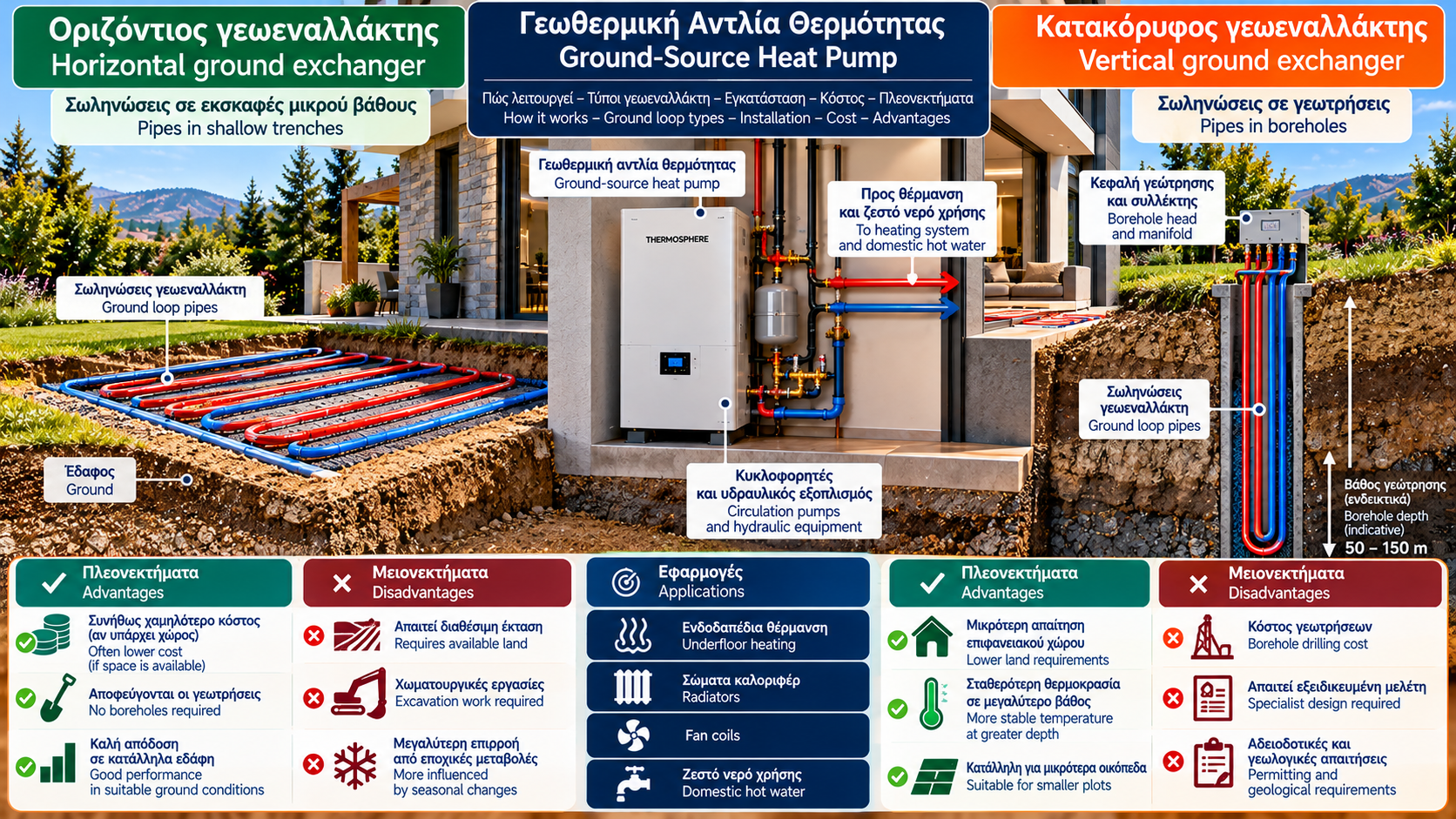
Horizontal ground loops: Pipes installed in relatively shallow excavations.
Vertical ground loops: Pipes installed in drilled boreholes.
Open-loop systems: Systems that use suitable groundwater, subject to technical and regulatory requirements.
The choice depends on land availability, geology, heating demand and local regulations.
4. Horizontal Ground Heat Exchangers
Horizontal systems use buried pipes installed in excavated trenches or prepared ground areas.
The required land area depends on:
Building heating demand.
Ground thermal conductivity.
Soil moisture.
Installation depth.
Pipe spacing.
Annual operating pattern.
Advantages
Deep boreholes are generally unnecessary.
May offer lower installation costs where suitable land is available.
Installation can be integrated with planned groundworks.
Disadvantages
Requires available land.
Excavation work is necessary.
Shallow ground temperatures are more affected by seasonal changes.
Future land use must be considered.
5. Vertical Ground Heat Exchangers
Vertical systems use drilled boreholes containing heat transfer pipes.
The number and depth of boreholes must be established by engineering design.
There is no universal borehole depth suitable for every project.
Advantages
Lower surface-area requirements.
Access to deeper ground conditions.
Potential suitability where horizontal loops are impractical.
Disadvantages
Borehole drilling costs.
Specialist design requirements.
Drilling equipment access.
Possible geological and permitting constraints.
6. What Is an Open-Loop Groundwater System?
Open-loop systems can use groundwater as a thermal source.
Their operation requires suitable water flow, water quality and compliance with abstraction and discharge or reinjection requirements.
They are not suitable for every location.
Hydrogeological and environmental conditions must be assessed before installation.
7. Why Can Ground-Source Heat Pumps Be Efficient?
At suitable depths, ground temperature generally varies less than outdoor air temperature.
During winter, the ground may therefore provide a more favourable source temperature than outdoor air.
This can reduce the temperature lift required by the refrigeration cycle.
Actual performance depends on:
Source temperature.
Heating-water supply temperature.
Ground loop design.
Circulation pump consumption.
Part-load behaviour.
Seasonal control strategy.
A properly designed ground-source installation can achieve high seasonal efficiency, but this is not guaranteed for every project.
8. Ground-Source vs Air-to-Water Heat Pumps
Feature | Ground-Source | Air-to-Water |
Heat source | Ground or groundwater | Outdoor air |
Ground loop | Required for closed-loop systems | Not required |
Boreholes | Required for vertical loops | Not required |
Initial cost | Often higher | Often lower |
Outdoor fan unit | Usually not required | Usually required |
Efficiency | Depends on design | Depends on equipment and climate |
Space requirements | Depends on ground exchanger | Outdoor space for unit |
Comparisons should use specific equipment and equivalent heating requirements.
9. How Much Does a Ground-Source Heat Pump Cost?
The total project cost extends beyond purchasing the heat pump.
It may include:
Building heat-loss assessment.
Geological or geotechnical investigation.
Ground loop design.
Excavation or borehole drilling.
Pipes and manifolds.
Heat pump equipment.
Circulation pumps and hydraulic components.
Electrical installation.
Pressure testing.
Commissioning.
Groundworks and drilling can represent a significant portion of the total investment.
A reliable installed price cannot be provided without information about the building and site.
10. When Is Ground-Source Heating Economically Attractive?
Economic feasibility should be assessed over the system’s expected operating life.
Relevant factors include:
Initial investment.
Annual electricity consumption.
Maintenance costs.
Potential repairs.
Expected service life.
Financing costs.
Available incentives.
Ground-source systems may be attractive for projects with substantial annual heating demand and suitable ground conditions.
However, higher upfront costs may reduce economic attractiveness in smaller homes or buildings with low heating demand.
11. Are Permits Required for Boreholes?
Permitting requirements depend on the country, location, system configuration and borehole depth or purpose.
In Greece, requirements must be checked against the current regulatory framework and competent authorities.
Open-loop groundwater systems may involve additional water abstraction and environmental obligations.
A qualified engineer should verify the relevant requirements before work begins.
12. Is Ground-Source Heating Suitable for a Detached House?
It may be suitable when:
Sufficient land or borehole access is available.
Ground conditions are appropriate.
Annual heating demand supports the investment.
Suitable indoor equipment space exists.
Technical and economic studies confirm feasibility.
It is not automatically the best option for every home.
13. Can It Work With Radiators?
Yes, provided the heat pump can meet the required supply temperatures and heating capacity.
Efficiency may decrease when higher water temperatures are required.
Radiator performance should therefore be assessed before installation.
14. Is It Suitable for Underfloor Heating?
Underfloor heating can be an excellent distribution system for ground-source heat pumps.
Relatively low supply temperatures can support efficient operation.
However, success depends on correct sizing of both the heat pump and the ground heat exchanger.
15. What Maintenance Is Required?
Maintenance depends on the equipment and system type.
Typical tasks may include:
Heat pump operating checks.
Circulation pump inspection.
Pressure checks.
Hydraulic connection inspection.
Ground loop fluid checks.
Filter inspection.
Control system checks.
Open-loop systems may require additional checks of water quality, heat exchangers and pumping equipment.
16. Five Common Mistakes
1. Installing without proper ground loop design.
An undersized exchanger can cause performance problems.
2. Underestimating geological conditions.
Ground thermal properties vary between locations.
3. Comparing only heat pump equipment prices.
Drilling and excavation can substantially affect project cost.
4. Ignoring circulation pump electricity use.
Auxiliary electricity consumption matters when evaluating total seasonal performance.
5. Beginning installation without checking permits.
Required approvals should be confirmed before construction.
17. Frequently Asked Questions
Do Ground-Source Heat Pumps Work in Winter?
Yes, when properly designed and operated within their specified limits.
Are Boreholes Always Necessary?
No. Horizontal closed-loop systems use excavations instead of deep boreholes.
Are They Cheaper to Run Than Air-to-Water Heat Pumps?
They may achieve higher seasonal efficiency in some conditions, but overall economics depend on installation costs and usage.
How Deep Should Boreholes Be?
Depth is determined by engineering design and geological conditions.
Can They Be Installed on Small Plots?
Potentially, using a suitable vertical system where technically feasible and permitted.
Do They Require Specialist Maintenance?
Yes. Maintenance should follow manufacturer instructions and the requirements of the ground-source circuit.
Conclusion
Ground-source heat pumps can provide efficient heating by using thermal energy from the ground.
Relatively stable source temperatures may offer operating advantages, but installation requires proper engineering design, geological assessment and substantial initial investment.
Ground-source heating is worth considering when site conditions, heating requirements and economic analysis justify the solution.
Thermosphere.gr — Technical knowledge for heating and building systems.