
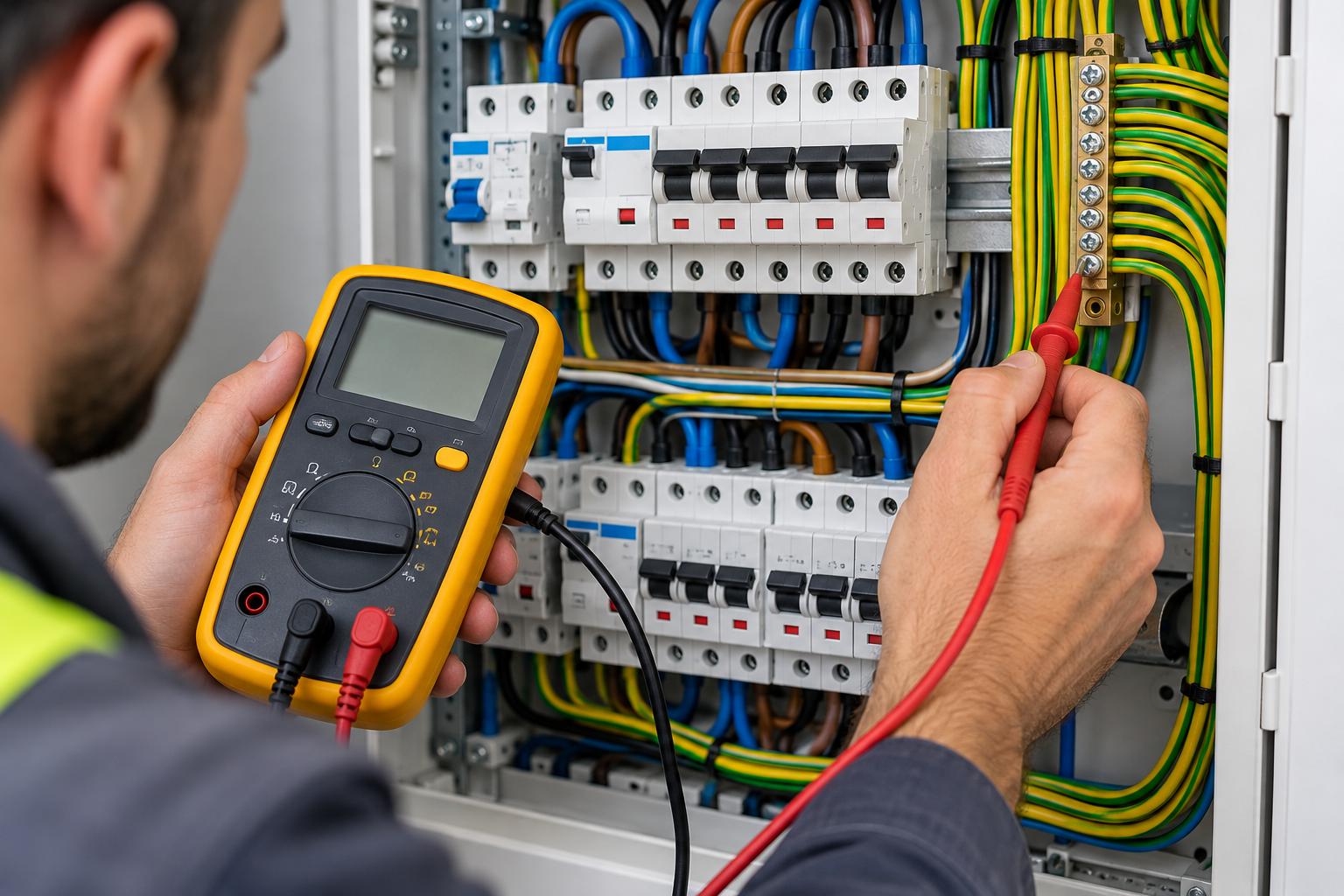
Home Electrical Earthing and Electric Shock Protection: Complete Guide
Electrical earthing, also known as grounding, is one of the most important safety measures in a building’s electrical installation.
Although the earthing system is usually hidden from view, it plays a critical role in protecting people against dangerous touch voltages and reducing the risks associated with electrical faults.
Many homeowners believe that having a residual current device (RCD) is enough to guarantee electrical safety. In reality, effective protection depends on several coordinated measures, including protective earthing, protective conductors, equipotential bonding and automatic disconnection of the power supply.
This guide explains how electrical earthing works, why it matters, how it relates to RCD protection and when professional inspection is necessary.
What Is Electrical Earthing?
Electrical earthing is the connection of designated parts of an electrical installation to the general mass of earth through an appropriate earthing arrangement.
In low-voltage electrical installations, the protective conductor, commonly identified as PE (Protective Earth), connects exposed conductive parts of electrical equipment to the protective earthing system.
The purpose of this arrangement is to contribute to protection against electric shock when an insulation fault occurs.
Earthing is not simply a wire connected to the ground. It forms part of a wider electrical protection system that must be correctly designed, installed and verified.
How Does Earthing Protect Against Electric Shock?
Consider an electrical appliance with a metal enclosure.
Under normal operating conditions, its accessible metal enclosure should not present a dangerous touch voltage.
However, if insulation fails and a live conductor contacts the metal enclosure, the enclosure may become hazardous.
In a properly designed installation, protective conductors and suitable protective devices work together to reduce this risk.
Depending on the earthing system and fault conditions, protection may be achieved through automatic disconnection of the supply.
For example, a protective device may disconnect the affected circuit when a fault creates the conditions required for its operation.
However, earthing alone does not guarantee that every dangerous fault will be disconnected quickly enough.
The complete protective arrangement must meet the relevant electrical safety requirements.
What Is a Protective Earth (PE) Conductor?
The protective earth conductor is a fundamental component of electrical safety.
In modern installations following applicable European conductor identification rules, protective conductors are normally identified by a green-and-yellow colour combination.
The PE conductor connects designated exposed conductive parts to the protective earthing arrangement.
Its purpose is protective rather than operational.
Unlike a neutral conductor, a PE conductor is not intended to carry normal load current.
Correct connections, continuity and appropriate conductor sizing are essential.
A disconnected or damaged protective conductor can create a serious hazard even when electrical equipment appears to operate normally.
What Is the Difference Between Neutral and Earth?
Neutral and protective earth have different functions.
Neutral (N) is part of the electrical circuit and may carry current during normal operation.
Protective Earth (PE) is provided for electrical safety purposes.
The relationship between neutral and earth depends on the supply and earthing arrangement, such as TT, TN or IT.
In some systems, neutral and protective functions are combined in designated parts of the supply arrangement using a PEN conductor.
However, this does not mean that neutral and earth can be connected together arbitrarily.
Improper connections between neutral and protective earth at sockets or distribution boards can create dangerous conditions.
Any connection or separation must comply with the applicable system design and electrical standards.
What Is Equipotential Bonding?
Protective equipotential bonding is another important electrical safety measure.
Its purpose is to reduce potentially dangerous differences in electrical potential between designated conductive parts.
Depending on the installation, bonding may involve certain metallic service systems and other extraneous conductive parts.
The need for bonding and the correct connection method must be determined according to the electrical installation requirements.
Equipotential bonding does not mean connecting every metal object in a building to an earth wire.
The arrangement must be properly designed and installed.
Electrical Earthing vs RCD: What Is the Difference?
Earthing and residual current devices perform different but complementary functions.
Protective earthing and PE conductors form part of the installation’s protection against electric shock.
An RCD monitors the balance of current flowing through the active conductors of a circuit.
When the residual current reaches the device’s specified operating conditions, the RCD disconnects the supply.
An RCD may operate even if an effective protective earth connection is absent.
However, this does not mean that the installation is safe without earthing.
The presence of an RCD does not eliminate the requirement for protective conductors where they are necessary.
Electrical safety relies on the correct combination of protective measures.
Can an Electrical Appliance Work Without Earthing?
Yes, some appliances may continue operating even when their protective earth connection is missing or defective.
This can be particularly dangerous because the fault may remain unnoticed.
Normal operation is not evidence that an electrical appliance is properly protected against electric shock.
It is also important to distinguish between equipment protection classes.
Class I Equipment
Class I electrical equipment relies on basic insulation and protective earthing of accessible conductive parts as part of its electric shock protection.
Its protective earth connection must be correctly provided.
Class II Equipment
Class II equipment uses double or reinforced insulation and does not rely on a protective earth connection in the same way as Class I equipment.
The required protection depends on the appliance’s design, classification and manufacturer’s instructions.
What Are the Warning Signs of an Earthing Problem?
A defective earthing system does not always produce obvious symptoms.
However, several situations require immediate attention:
A tingling or electric shock sensation when touching an appliance.
Suspected voltage on a metal appliance enclosure.
Damaged electrical connections.
Unauthorised alterations to wiring.
Missing or uncertain inspection records in an older installation.
Visible deterioration of protective connections.
These signs do not necessarily prove that the earthing system itself is defective.
Other electrical faults may produce similar hazards.
If you feel an electric shock or tingling sensation from an appliance, stop using it and avoid further contact. Arrange an urgent inspection by a qualified electrician.
How Is Electrical Earthing Tested?
Professional verification of an electrical installation involves appropriate inspections, tests and measurements.
Depending on the earthing arrangement and applicable requirements, these may include:
Continuity testing of protective conductors.
Earth electrode resistance measurement, where relevant.
Earth fault loop impedance measurement.
Testing of residual current devices.
Insulation resistance testing.
Inspection of protective bonding connections.
These tests require suitable instruments, technical knowledge and safe working procedures.
A simple voltage tester or basic plug-in socket tester cannot provide a complete assessment of an installation’s earthing safety.
What Should the Earthing Resistance Be?
There is no single earth resistance value that is suitable for every electrical installation.
The relevant requirements depend on the earthing system, protective devices and method of protection.
For example, in a TT installation where protection is provided by an RCD, an applicable condition under IEC 60364 is:
RA × IΔn ≤ 50V
Where:
RA: The resistance of the earth electrode and protective conductors associated with the exposed conductive parts, as defined by the applicable standard.
IΔn: The rated residual operating current of the protective device.
50V: The conventional touch voltage limit used for the relevant ordinary conditions.
The application of this relationship depends on the installation and the requirements of the applicable standard.
A single resistance measurement is therefore not enough to establish that an entire electrical installation is safe.
What Is Foundation Earthing?
Foundation earthing is an earthing arrangement incorporated into a building’s foundation structure.
When correctly designed and installed, it can provide an effective connection to earth and form part of the building’s overall protective infrastructure.
Its performance depends on factors such as:
Design and installation quality.
Materials and connections.
Ground and environmental conditions.
Structural characteristics.
Long-term condition of the earthing arrangement.
The presence of foundation earthing does not remove the need for inspection and verification.
Are Older Homes More Likely to Have Earthing Problems?
Older electrical installations may have been constructed under different technical requirements.
Some may also have been modified over time without adequate documentation.
Potential issues include:
Missing or inadequate protective conductors.
Deteriorated electrical connections.
Unsuitable protective devices.
Incomplete bonding arrangements.
Unverified wiring modifications.
The age of an installation does not automatically prove that it is unsafe.
However, it is an important factor when determining whether a professional inspection is needed.
A qualified electrician can assess the actual condition and identify necessary corrective work.
Does a Heat Pump Need Protective Earthing?
Heat pumps must be installed according to the manufacturer’s electrical instructions and the applicable safety requirements.
Where the equipment is classified as Class I, an appropriate protective earth connection is required.
The installation must also consider the power supply circuit, protective devices and earthing arrangement.
The fact that a heat pump operates normally does not prove that its protective earth connection is adequate.
Does an Electric Water Heater Need Earthing?
An electric water heater must have the electrical protection required by its equipment classification and installation conditions.
For Class I equipment, this includes a suitable protective earth connection.
Electrical installations in bathrooms and other locations containing a bath or shower may also be subject to additional requirements.
These must be assessed according to the applicable electrical installation standards.
How Often Should Electrical Earthing Be Inspected?
Inspection intervals depend on national regulations, the type of premises, installation conditions and any changes made to the electrical system.
In Greece, electrical installation verification is associated with the applicable requirements for the Electrical Installation Declaration, known as the YDE, and periodic reinspection obligations.
The required interval is not identical for every category of installation.
Additional inspection may also be necessary after significant modifications or when electrical safety concerns arise.
Property owners should follow the requirements applicable to their particular installation.
Frequently Asked Questions
Can you still receive an electric shock if your home is earthed?
Yes. Earthing reduces specific electrical risks but does not eliminate every possibility of electric shock.
Does an RCD replace electrical earthing?
No. RCD protection and protective earthing serve different functions and are often required to work together.
If all sockets work, does that mean the earthing is correct?
No. A socket can supply electricity even when its protective earth connection is defective or absent.
Can I test the earthing myself?
A reliable assessment requires suitable testing equipment, technical knowledge and appropriate safety procedures. It should be performed by a qualified professional.
Is a small electric shock from an appliance normal?
No. Any electric shock or tingling sensation from an appliance should be treated as a potential electrical safety hazard.
Is an earth resistance measurement enough to confirm safety?
No. Electrical safety verification may also require protective conductor continuity, fault loop impedance, RCD operation and other relevant tests.
Conclusion
Electrical earthing is a fundamental part of protecting people against electric shock.
However, effective electrical safety does not depend on a single wire or protective device.
It requires appropriate protective conductors, equipotential bonding, suitable protective devices, correct installation design and professional verification.
An electrical installation can appear to function normally while still containing serious safety defects.
Professional inspection is the appropriate way to evaluate its condition and confirm compliance with the relevant requirements.
thermosphere.gr — Practical technical knowledge for safer electrical installations.
Disclaimer: This article is intended for general information only. It does not replace professional electrical design, inspection, testing or installation.
Technical References
IEC 60364-4-41 — Protection against electric shock.
IEC 60364-5-54 — Earthing arrangements and protective conductors.
IEC 60364-6 — Verification of electrical installations.
ELOT 60364 — Requirements for electrical installations in Greece.
Applicable Greek regulations concerning electrical installation inspections and YDE documentation.