
Natural Gas Burner Gas Train: Components, Operation and Inspection
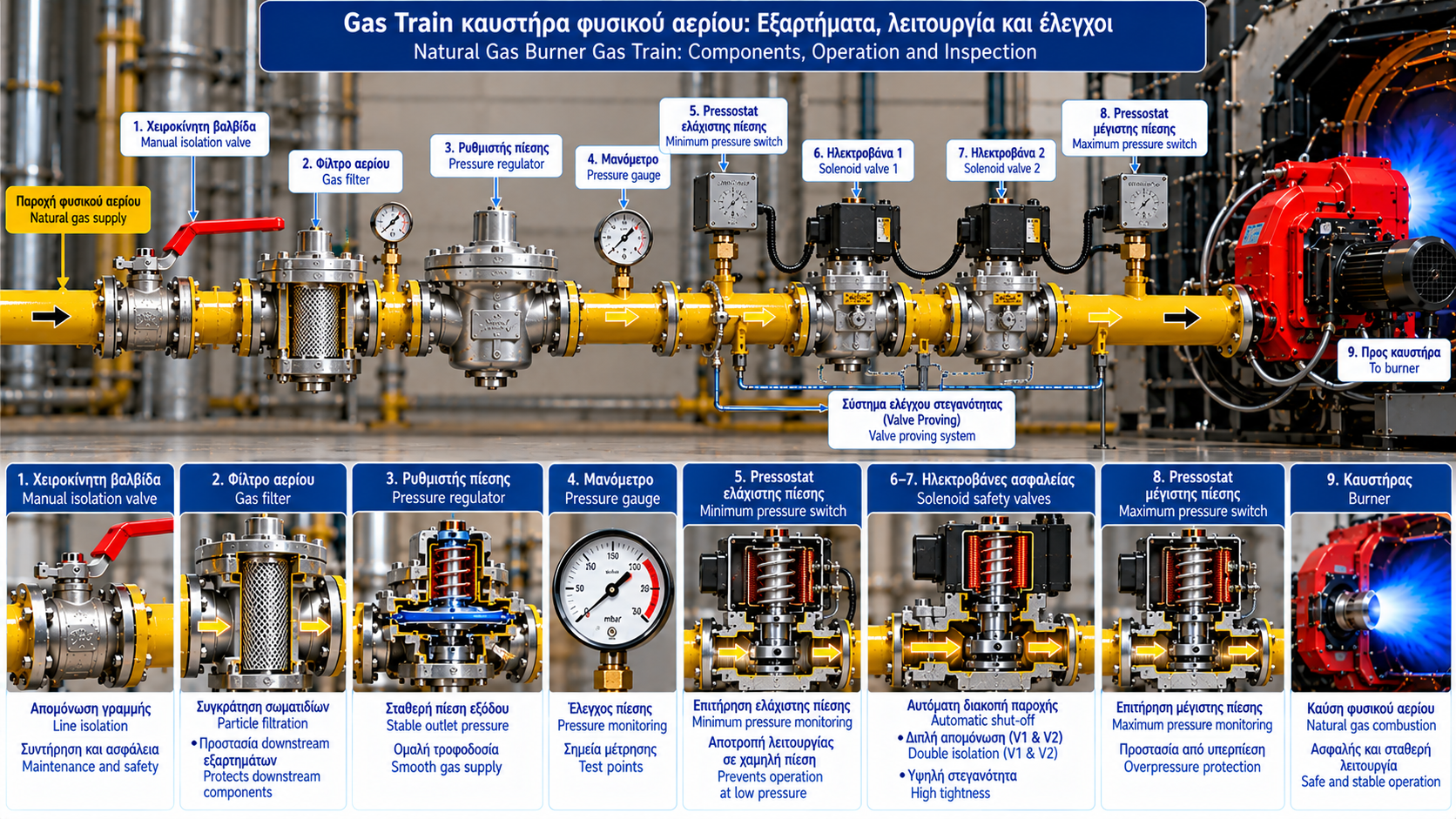
A gas train is an assembly of components used to supply natural gas safely and reliably to a burner.
Its purpose is to establish suitable gas pressure and flow conditions, provide control and monitoring functions, and interrupt fuel supply whenever the burner safety system requires shutdown.
Correct gas-train design and operation directly influence burner reliability and safety.
1. What Is a Gas Train?
A gas train connects the natural gas supply installation to the burner.
Depending on the application, it may contain isolation valves, filters, pressure regulators, pressure switches, automatic safety shut-off valves and valve proving equipment.
There is no universal component arrangement suitable for every burner.
The correct design depends on burner capacity, supply pressure, burner type and applicable safety requirements.
2. Manual Isolation Valve
A manual isolation valve provides a means of shutting off the gas supply for maintenance and other specified activities.
It must be suitable for natural gas and the installation’s operating conditions.
Its location must meet the approved design and accessibility requirements.
3. Gas Filter
The gas filter removes particles that may otherwise reach sensitive downstream components.
Filters help protect pressure regulators and automatic shut-off valves.
A clogged filter can create excessive pressure drop, particularly at high gas flow rates.
Possible symptoms include insufficient downstream pressure and burner shutdowns under load.
Maintenance must follow manufacturer instructions.
4. Gas Pressure Regulator
A pressure regulator maintains downstream gas pressure within the required operating range.
Selection depends on inlet pressure, required outlet pressure, flow range, allowable pressure losses, load variation and safety requirements.
A pressure regulator does not replace automatic safety shut-off valves.
Additional independent overpressure protection may be required in some applications.
5. Minimum and Maximum Gas Pressure Switches
Gas pressure switches monitor specified pressure limits.
A minimum pressure switch can prevent operation when gas pressure is insufficient.
A maximum pressure switch can initiate the required protective response when pressure exceeds the permitted limit.
Pressure switches do not regulate pressure; they provide electrical signals to the burner management system.
Their installation points and switching settings must follow the approved design.
6. Automatic Safety Shut-Off Valves
Automatic shut-off valves interrupt fuel supply whenever burner operation is not permitted.
Many installations use two valves in series.
Their operation is coordinated with startup sequencing, flame supervision and other safety interlocks.
Required shut-off performance and tightness must be verified using approved procedures.
7. Valve Proving Systems
Some gas trains include valve proving equipment.
These systems may monitor pressure in a defined volume between two shut-off valves to detect unacceptable internal leakage.
The proving sequence depends on the specific equipment.
Valve proving failures must be treated as safety-related conditions.
8. Pressure Gauges and Test Points
Pressure gauges and approved test points allow measurements at selected locations within the gas train.
Comparing pressures across components can help identify excessive pressure losses.
Measuring instruments must have an appropriate range and accuracy.
9. Burner Startup Sequence
The exact startup sequence depends on the burner management system and installation design.
A general sequence may include:
Verification of safety permissives.
Confirmation of acceptable fuel pressure.
Valve proving where required.
Required pre-purge operations.
Ignition system activation according to the specified sequence.
Controlled opening of the appropriate gas valves.
Flame establishment and supervision.
Transition to normal controlled operation.
The actual sequence must follow the manufacturer’s approved design.
10. Common Gas Train Problems
Low Gas Pressure
Possible causes include insufficient supply pressure, clogged filters, incorrect regulator settings and regulator malfunction.
High Gas Pressure
Potential causes include regulator faults and abnormal supply conditions.
Shut-Off Valves Fail to Open
The cause may be a missing control signal, electrical fault or mechanical failure.
Valve Proving Failure
The valves, intermediate pipework and proving system require investigation.
Unstable Operation Under Load
Pressure fluctuations, excessive pressure losses and inadequate gas flow capacity may contribute.
11. Troubleshooting and Inspection
Troubleshooting must be performed by qualified and authorized personnel.
A structured inspection includes reviewing alarm history, verifying supply pressure, measuring pressure at designated points, checking pressure switch responses, verifying shut-off valve operation and evaluating valve proving performance.
Approved external tightness checks and documentation of findings are also important.
Safety interlocks must never be bypassed to force burner operation.
12. Preventive Maintenance
Preventive maintenance includes inspecting components, checking connections and verifying specified safety functions.
Gas filters, pressure regulators, automatic valves and pressure switches require particular attention.
Inspection intervals depend on manufacturer instructions, operating conditions and applicable requirements.
13. Technical Standards
Relevant references include:
EN 161: Automatic gas shut-off valves.
EN 88-1: Pressure regulators and associated safety devices within specified pressure ranges.
EN 1854: Pressure sensing devices for gas burners and gas appliances.
EN 1643: Valve proving systems.
EN 676: Forced draught burners for gaseous fuels, within the standard’s scope.
The applicability of each standard must be verified for the specific equipment.
Conclusion
A gas train is an integrated system that manages the natural gas supply to a burner.
Each component performs a defined function, including isolation, filtration, regulation, monitoring or safety shut-off.
Reliable operation depends on correct engineering, suitable component selection, systematic inspection and compliance with applicable safety requirements.