
# RO Membrane Fouling, Scaling and CIP: Diagnosis and Chemical Cleaning
## Introduction
The performance of an industrial reverse osmosis (RO) system depends significantly on the condition of its membranes.
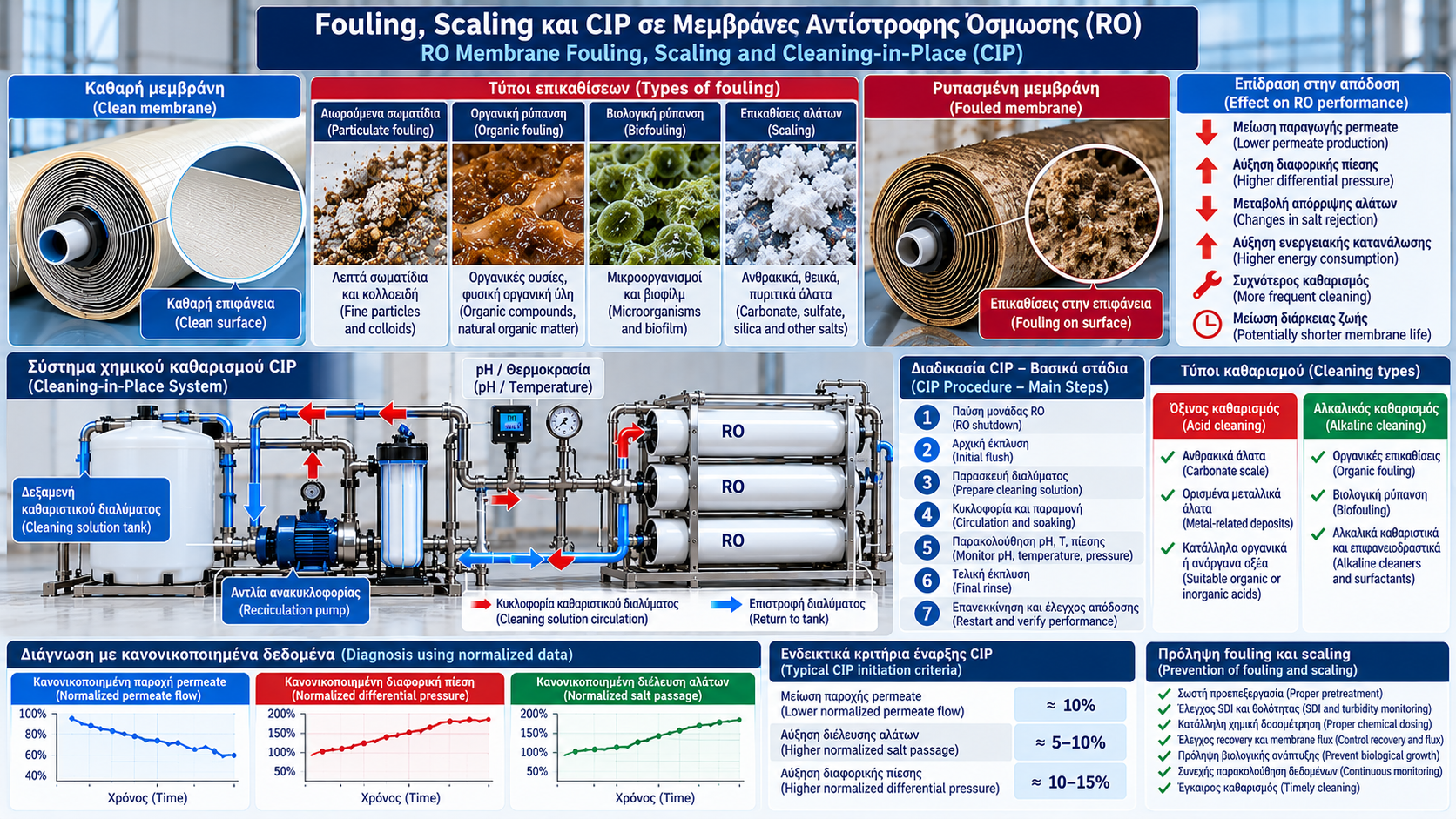
During operation, suspended particles, organic compounds, microorganisms and sparingly soluble salts can accumulate on membrane surfaces or within feed channels.
These deposits may reduce permeate production, increase differential pressure and affect treated water quality.
Accurate diagnosis and appropriate cleaning-in-place (CIP) procedures are essential for maintaining reliable membrane performance.
## 1. What Is Membrane Fouling?
Membrane fouling refers to the accumulation of unwanted material on membrane surfaces or within flow channels.
The main categories include particulate, colloidal, organic and biological fouling.
### Particulate and Colloidal Fouling
This type of fouling involves suspended solids, fine particles and colloidal materials.
It is frequently associated with inadequate pretreatment, increased feedwater turbidity or filtration failures.
### Organic Fouling
Organic fouling occurs when organic substances accumulate on membrane surfaces.
Examples include natural organic matter, certain oils and organic polymers.
Its severity depends on the chemical characteristics of the contaminants and their interactions with the membrane.
### Biological Fouling
Biofouling occurs when microorganisms grow and form biological deposits or biofilms.
Biofilms can increase hydraulic resistance in feed channels and contribute to substantial differential pressure increases.
## 2. What Is Membrane Scaling?
Scaling is the precipitation and accumulation of sparingly soluble inorganic compounds when local saturation conditions are exceeded.
Common scaling compounds include:
- Calcium carbonate (CaCO₃).
- Calcium sulfate (CaSO₄).
- Barium sulfate (BaSO₄).
- Strontium sulfate (SrSO₄).
- Silica-related deposits, depending on water chemistry.
As system recovery increases, the concentration of many dissolved substances rises on the concentrate side.
This can lead to supersaturation and mineral precipitation.
Scaling should not be confused with the normal concentration of dissolved salts in the concentrate stream.
## 3. How Fouling and Scaling Affect Performance
Membrane deposits may cause:
- Reduced normalized permeate flow.
- Increased feed-to-concentrate differential pressure.
- Higher pressure requirements.
- Changes in salt rejection.
- Increased energy consumption.
- More frequent cleaning.
- Potentially reduced membrane service life.
Not all symptoms necessarily occur simultaneously.
Their severity depends on the type, location and extent of deposits.
## 4. Diagnosis Using Normalized Performance Data
Comparing raw permeate production between different operating days can be misleading.
Temperature, salinity, operating pressure and recovery all affect membrane performance.
Therefore, industrial RO monitoring commonly uses normalized indicators such as:
- Normalized Permeate Flow.
- Normalized Salt Passage.
- Normalized Differential Pressure.
These indicators allow performance comparisons against defined reference conditions.
Normalization should follow an appropriate methodology or the membrane manufacturer's recommended software.
## 5. When Is CIP Required?
Many membrane manufacturers provide indicative cleaning criteria such as:
- Approximately 10% reduction in normalized permeate flow.
- Approximately 5–10% increase in normalized salt passage.
- Approximately 10–15% increase in normalized differential pressure.
These values are not universal cleaning limits.
The final decision must follow the specific membrane manufacturer's recommendations and the operating history of the installation.
Delaying necessary cleaning may make some deposits more difficult to remove.
## 6. What Is Cleaning-in-Place?
Cleaning-in-place is a chemical cleaning procedure performed without removing membrane elements from their pressure vessels.
A typical CIP system includes:
- Cleaning solution tank.
- Recirculation pump.
- Protective cartridge filter.
- Connecting piping and valves.
- Pressure, flow, temperature and pH instrumentation.
Cleaning is normally performed with an appropriate chemical solution at controlled flow and low pressure to minimize permeate production during cleaning.
## 7. Acid Cleaning
Acid cleaning is commonly used for selected inorganic deposits, particularly carbonate scale and certain metal-related deposits.
Suitable organic or inorganic acids may be used according to membrane manufacturer instructions.
However, not all inorganic deposits are equally soluble in acidic solutions.
Certain sulfate and silica-related deposits may require different treatment methods and can be difficult to remove.
## 8. Alkaline Cleaning
Alkaline cleaning is frequently used for organic and biological deposits.
Cleaning formulations may contain compatible alkaline agents, surfactants or other approved additives.
Chemical selection depends on deposit characteristics and membrane compatibility.
For mixed deposits, the order of alkaline and acid cleaning should be determined from the diagnosis and the manufacturer's approved procedure.
## 9. Main CIP Procedure
A general membrane cleaning procedure may include:
1. Safely shutting down the RO system.
2. Isolating equipment and applying required safety procedures.
3. Performing an initial flush with suitable water.
4. Preparing an approved cleaning solution.
5. Circulating the solution at the specified flow and pressure.
6. Allowing controlled soaking where recommended.
7. Monitoring pH, temperature and solution condition.
8. Managing spent cleaning chemicals according to applicable requirements.
9. Rinsing until acceptable conditions are achieved.
10. Restarting the system and evaluating normalized performance.
The exact procedure must follow the installed membrane manufacturer's instructions.
## 10. Critical Cleaning Limits
Important cleaning parameters include:
- Permitted pH range.
- Maximum cleaning temperature.
- Chemical compatibility.
- Recirculation flow rate.
- Differential pressure.
- Chemical contact time.
- Cleaning solution water quality.
There is no single universally safe cleaning pH or temperature for all RO membranes.
Permitted values depend on membrane specifications and frequently on the combined effects of pH and temperature.
## 11. Chemical Safety
Membrane cleaning chemicals may be corrosive or hazardous when mixed incorrectly.
Appropriate personal protective equipment, ventilation, chemical compatibility checks and safety data sheet procedures are essential.
Incompatible chemicals must never be mixed.
In particular, contact between acids and hypochlorite solutions can release toxic chlorine gas.
Suitable rinsing and verification of safe conditions are necessary before changing cleaning chemicals.
## 12. Why Can CIP Fail?
Cleaning may provide limited recovery when:
- The wrong cleaning chemical is selected.
- Deposits have remained for an extended period.
- Recirculation flow is inadequate.
- Cleaning solution becomes exhausted or excessively contaminated.
- Irreversible chemical or mechanical membrane damage is present.
- The original fouling or scaling cause remains unresolved.
Repeated cleaning without proper diagnosis can increase operating costs and membrane stress.
## 13. Preventing Fouling and Scaling
Effective prevention requires:
- Properly designed pretreatment.
- Turbidity and SDI monitoring.
- Appropriate chemical dosing.
- Controlled recovery and membrane flux.
- Biological fouling prevention.
- Normalized performance monitoring.
- Early investigation of abnormal trends.
- Correct shutdown and membrane preservation procedures.
Continuous monitoring helps identify problems before they develop into significant performance losses.
## Conclusion
Fouling and scaling are major causes of performance deterioration in industrial reverse osmosis systems.
Cleaning-in-place can restore membrane performance when deposits are removable and the correct procedure is applied.
The most effective strategy combines prevention, accurate diagnosis, timely cleaning and continuous evaluation of normalized operating performance.
Thermosphere.gr – Technical Knowledge for Professionals.