
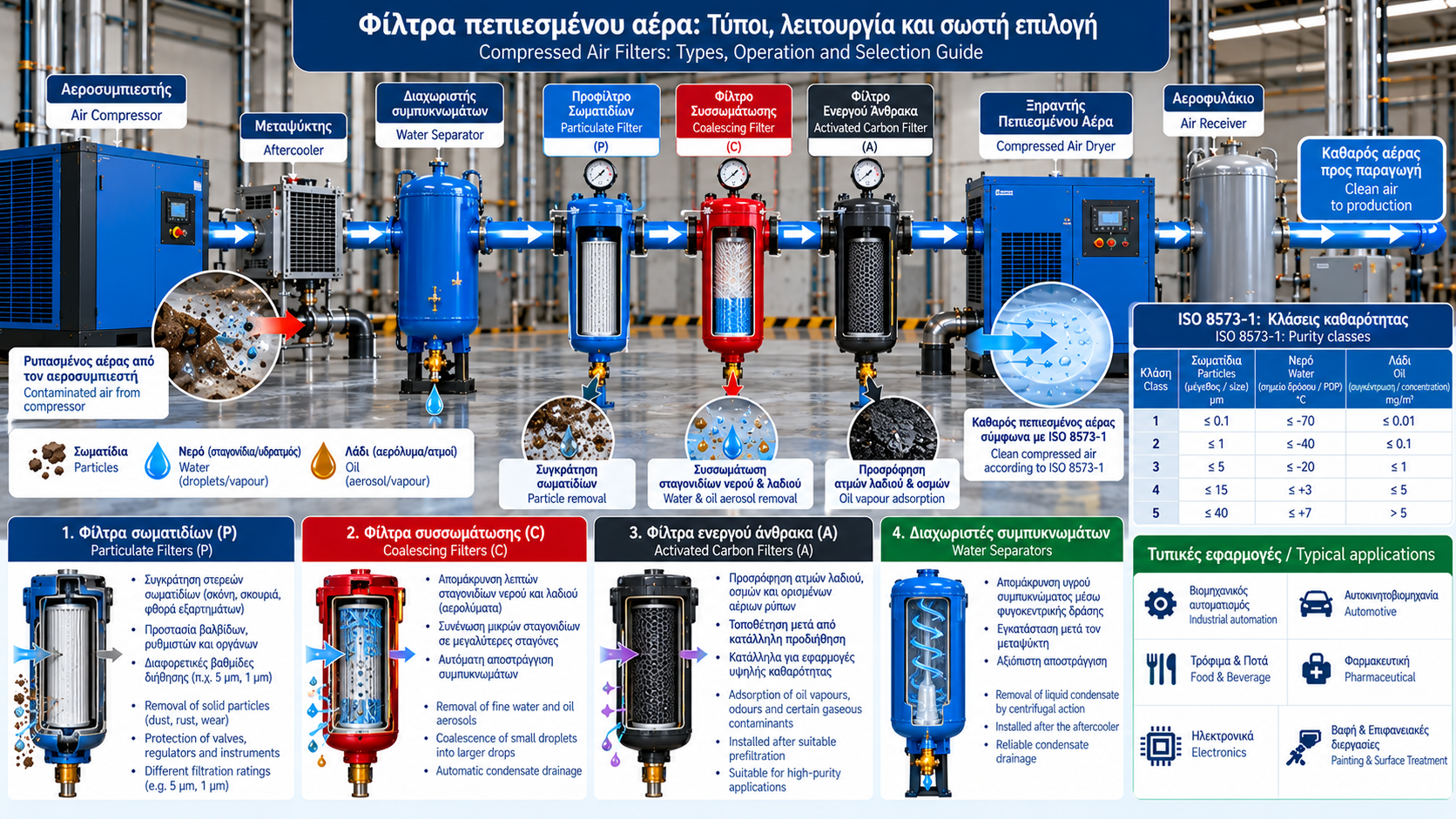
Compressed Air Filters: Types, Operation and Selection Guide
Compressed air is widely used in industrial automation, pneumatic tools, control systems and manufacturing processes. However, even when a compressor operates correctly, the delivered air may contain contaminants that affect equipment reliability and product quality.
The main contaminant categories are solid particles, water and oil. Some applications may also require control of microbiological or other gaseous contaminants.
Effective compressed air treatment combines condensate separation, filtration and drying according to the requirements of the application.
Why Compressed Air Filtration Is Necessary
Solid particles may originate from atmospheric air, pipe corrosion and component wear.
Water may be present as vapour, liquid condensate or aerosol. Conventional filters cannot replace a compressed air dryer because they do not independently establish the required pressure dew point.
Oil contamination may occur as liquid aerosol or vapour. These forms require different removal technologies.
Insufficient filtration may cause pneumatic valve malfunction, equipment wear, product contamination and increased maintenance costs.
Particulate Filters
Particulate filters remove solid contaminants using suitable filtration elements.
They protect valves, regulators, instrumentation and other components sensitive to contamination.
Filtration performance depends on particle size, filter media, airflow and operating conditions.
A nominal micron rating alone is insufficient for filter selection. Verified filtration performance, rated airflow and pressure drop must also be considered.
Coalescing Filters
Coalescing filters are primarily designed to remove fine liquid aerosols of water and oil.
Small droplets are captured and combined within the filter media, forming larger droplets that can be drained.
Effective operation requires suitable airflow velocity, correct installation and reliable condensate drainage.
Coalescing filters are not designed to remove water vapour or oil vapour.
Activated Carbon Filters
Activated carbon filters use adsorption to reduce selected gaseous organic contaminants, including oil vapours.
They are normally installed downstream of suitable prefiltration and liquid aerosol removal to protect the adsorbent.
Performance depends on contaminant concentration, temperature, humidity, contact time and adsorbent condition.
Activated carbon filtration alone does not make compressed air suitable for breathing, food processing or pharmaceutical manufacturing.
Condensate Separators
Water separators remove liquid condensate from compressed air, commonly through centrifugal action or changes in flow direction.
They are typically installed downstream of aftercoolers or at suitable points in the system.
Reliable drainage and operation within the specified airflow range are essential.
Water separators do not replace dryers because they cannot adequately remove water vapour.
ISO 8573-1 and Compressed Air Purity
ISO 8573-1 establishes compressed air purity classes for particles, water and oil.
Purity is commonly expressed using three independent classes in the order particles : water : oil.
For example, ISO 8573-1 [2:4:2] identifies the corresponding purity requirements.
Water class 4 corresponds to a pressure dew point of +3°C or lower, while water class 2 corresponds to -40°C or lower.
Filter selection must be based on the actual process requirements rather than a general claim of clean compressed air.
Correct Installation Sequence
A typical compressed air installation may include a compressor, aftercooler, condensate separator, air receiver, prefilter, dryer and final filters.
The exact arrangement depends on dryer technology, contamination characteristics and manufacturer instructions.
Desiccant dryers often require suitable upstream filtration to protect the adsorbent and downstream particulate filtration to remove potential desiccant dust.
For refrigerated dryers, filter positioning depends on the system design and required air purity.
Pressure Drop and Energy Consumption
Every compressed air filter creates some resistance to airflow.
As pressure drop increases due to contamination or incorrect sizing, higher compressor discharge pressure may be required to maintain sufficient pressure at points of use.
This can increase electricity consumption.
Differential pressure monitoring helps identify blocked filter elements, but replacement must also follow manufacturer service-life limits.
Selecting the Correct Compressed Air Filter
Selection begins by defining the required compressed air purity and the contaminants to be removed.
Engineers should then evaluate actual airflow, operating pressure, temperature, contaminant loading and allowable pressure drop.
Manufacturer rated capacities are based on specified reference conditions. Appropriate corrections are necessary when operating conditions differ.
For high-purity applications, verified filter performance according to relevant ISO 12500 test methods should be considered.
Maintenance and Common Problems
Maintenance includes differential pressure inspection, drain checks, filter element replacement and leakage inspection.
Common problems include excessive pressure drop, condensate carryover, damaged filter elements and operation outside rated conditions.
Equipment must be safely isolated and depressurized before maintenance.
Replacement elements must meet manufacturer specifications.
Conclusion
Compressed air filters are essential components of industrial air treatment systems.
Particulate, coalescing and activated carbon filters address different forms of contamination and are not interchangeable.
Correct selection requires defined purity requirements, suitable sizing, controlled pressure losses and systematic maintenance.