
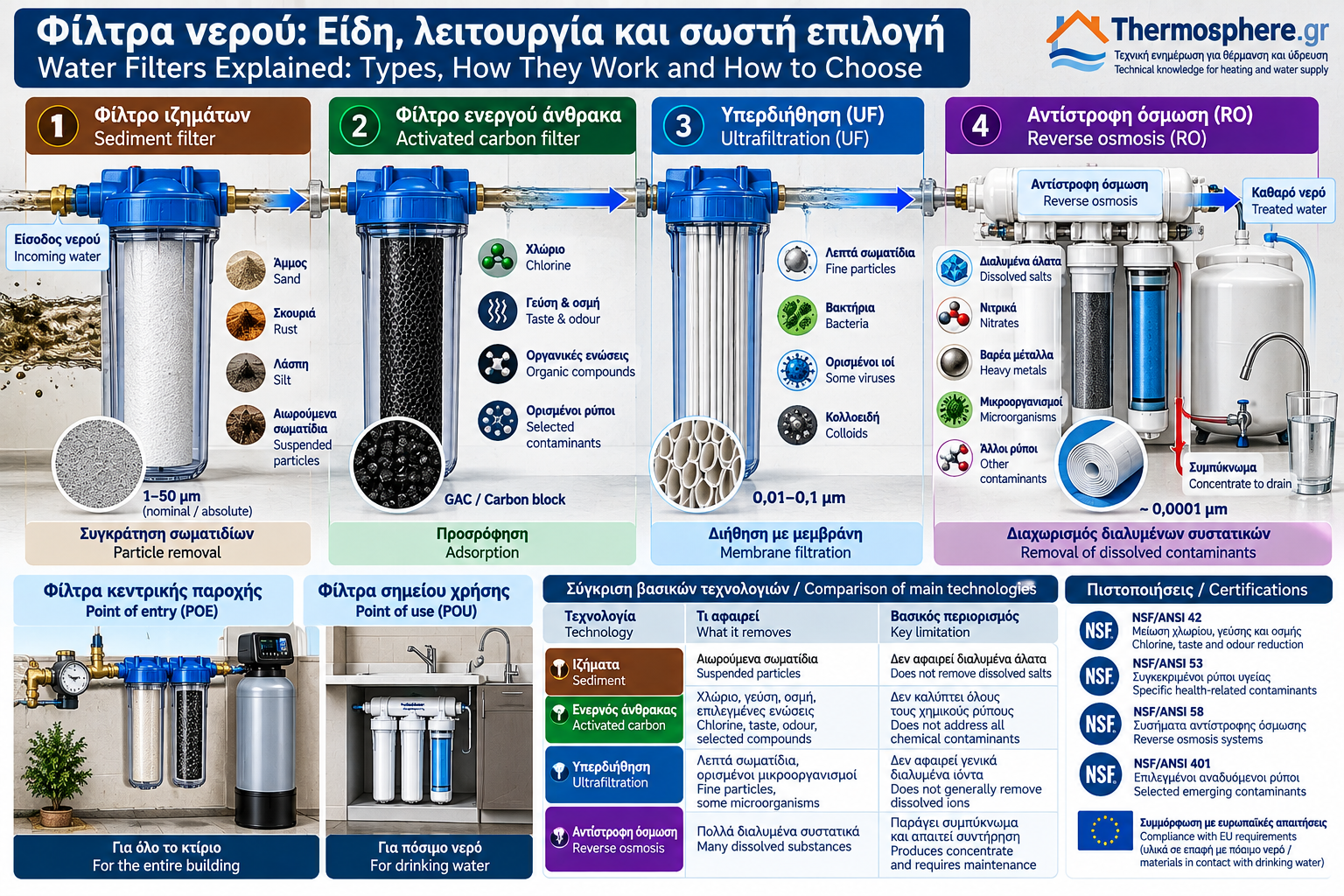
Water Filters Explained: Types, How They Work and How to Choose
Water quality is an important consideration for human health, everyday use and the protection of plumbing systems.
Although public drinking water supplies are monitored and must meet applicable water quality requirements, distribution conditions, internal plumbing and the characteristics of individual water sources can create different treatment needs.
Water filters are designed to remove or reduce specific substances and particles. However, filtration technologies operate differently, and no single filter should be assumed to address every possible water quality problem.
Selecting the right system requires an understanding of the incoming water quality, the intended treatment objective, the required flow rate and the equipment’s verified performance.
1. What is a water filter and how does it work?
A water filter is a device that uses physical or physicochemical processes to retain or reduce selected components in water.
Depending on the technology, treatment may involve:
Mechanical particle retention.
Adsorption using activated carbon.
Membrane filtration.
Ion exchange.
A combination of different treatment stages.
Some systems are primarily designed to improve taste and odour, while others are intended to reduce specific chemicals, suspended particles or microbiological risks.
Performance must be verified for the particular contaminants of concern.
2. Sediment filters
Sediment filters are among the most widely used forms of mechanical water filtration.
They are designed to retain suspended solid particles such as:
Sand.
Rust.
Silt.
Particles originating from pipework.
Other solid debris of suitable particle size.
What does the micron rating mean?
Filter retention capability is often expressed in micrometres (μm).
Common ratings include 1, 5, 10, 20 and 50 μm.
Generally, smaller ratings indicate the ability to retain finer particles when the filter is appropriately designed.
However, nominal and absolute filtration ratings are not equivalent.
A nominal rating does not mean that 100% of particles of the stated size will be removed. Even an absolute rating must be interpreted according to the manufacturer’s test method and stated retention efficiency.
Where are sediment filters used?
Typical applications include:
Building water supply inlets.
Pretreatment before activated carbon filters.
Pretreatment before reverse osmosis.
Protection of valves, instruments and other equipment from particulate contamination.
Important: An ordinary sediment filter does not reliably remove dissolved salts, chemical contaminants or microorganisms merely because it has a small nominal pore rating.
3. Activated carbon filters
Activated carbon has a highly developed porous structure and a large internal surface area.
It is primarily used to adsorb selected organic compounds and improve certain aesthetic characteristics of water.
What can activated carbon reduce?
Depending on the carbon type, system design and certified performance, activated carbon filters may be used for:
Free chlorine reduction.
Taste and odour improvement.
Reduction of certain organic compounds.
Reduction of selected contaminants where specific performance claims have been verified.
Not every activated carbon filter removes lead, nitrates, PFAS or all organic contaminants.
Capabilities vary considerably between products.
Granular activated carbon and carbon block
Granular activated carbon (GAC) consists of carbon granules through which water flows.
Carbon block filters use compressed activated carbon media and may combine adsorption with mechanical particle retention.
Actual performance depends on construction, contact time, flow rate and the total volume of water treated.
An important limitation
Reducing residual chlorine may affect the microbiological stability of water downstream of the filter, particularly where stagnation or inadequate maintenance occurs.
Proper replacement and hygienic operation are therefore essential.
4. Ultrafiltration (UF)
Ultrafiltration uses specialised membranes to separate fine particles and other components from water.
Depending on membrane characteristics and integrity, UF systems can retain very small particles and many microorganisms.
Advantages
High retention capability for fine particles.
Potential reduction of bacteria in appropriately designed and verified systems.
Operation without the extensive dissolved salt removal associated with reverse osmosis.
Limitations
Ultrafiltration is not a general solution for removing dissolved ions such as nitrates or hardness minerals.
Virus retention depends on the particular membrane and the verified performance of the system.
Microbiologically unsafe water may require a comprehensive treatment strategy, including appropriate disinfection where necessary.
5. Reverse osmosis (RO)
Reverse osmosis is a water treatment technology that uses a semipermeable membrane and applied pressure to separate a substantial proportion of dissolved components from water.
It is used when specific dissolved substances need to be reduced and conventional sediment or activated carbon filtration is insufficient.
What can reverse osmosis reduce?
Depending on system design and certified performance, RO can reduce:
Many dissolved salts.
Certain heavy metals.
Nitrates in suitable systems.
Other specific dissolved contaminants.
Actual performance varies with membrane characteristics, pressure, temperature and incoming water composition.
How does a typical RO system work?
A reverse osmosis system may include:
Sediment prefiltration.
Activated carbon pretreatment.
Reverse osmosis membrane.
Storage tank or direct-flow configuration.
Final treatment stage where specified.
The process produces treated water and a separate concentrate stream that is discharged.
Disadvantages and limitations
Water consumption associated with concentrate production.
Regular maintenance requirements.
Possible need for adequate inlet pressure or a booster pump.
Reduction of mineral content.
Performance sensitivity to feedwater quality.
Reverse osmosis is not necessary in every household.
Its selection should be based on a clearly identified treatment requirement.
6. Whole-house and point-of-use filters
Water filtration systems can also be classified by their installation location.
Point-of-entry (POE) systems
Point-of-entry filters are installed near the incoming water supply to a building.
They may serve multiple outlets and are commonly used for sediment retention or other whole-building treatment applications.
Flow capacity and pressure loss are particularly important design considerations.
Point-of-use (POU) systems
Point-of-use filters are installed near an individual outlet, usually in the kitchen.
Examples include:
Under-sink filters.
Faucet-mounted filters.
Reverse osmosis systems.
Other suitable drinking water treatment units.
The appropriate system depends on the specific water quality issue.
7. How to choose the right water filter
Filter selection should begin with actual water quality rather than product marketing descriptions.
Step 1: Identify the water source
Determine whether the water comes from:
A public water supply.
A private borehole.
A well.
A storage tank.
Another private source.
Treatment requirements may differ significantly.
Step 2: Assess water quality
For public water supplies, official water quality reports from the responsible utility can provide useful information.
Where a particular contamination issue is suspected, targeted testing by a suitable laboratory may be necessary.
For private sources, appropriate chemical and microbiological testing is especially important.
Step 3: Define the treatment objective
The key question is:
Which specific substance or problem must the treatment system address?
Suspended particles, chlorine-related taste and odour, and dissolved chemical contaminants require different treatment approaches.
Step 4: Verify flow capacity and pressure loss
A filter may provide suitable contaminant reduction but still be hydraulically unsuitable.
Design flow rate and pressure drop should be assessed using manufacturer performance data.
Step 5: Verify certified performance claims
Specific product performance claims should be checked rather than relying solely on general references to certification.
8. Water filter standards and certifications
NSF/ANSI standards are widely used to evaluate particular characteristics of drinking water treatment systems.
Examples include:
NSF/ANSI 42: Primarily addresses aesthetic effects, including chlorine reduction and taste and odour claims, where certified.
NSF/ANSI 53: Addresses specific health-related contaminant reduction claims.
NSF/ANSI 58: Applies to reverse osmosis drinking water treatment systems and specified performance requirements.
NSF/ANSI 401: Addresses reduction claims for selected emerging contaminants.
A reference to a standard does not mean that a filter removes every contaminant associated with that standard.
The exact model, certification organisation and certified contaminant reduction claims must be verified.
Within the European Union, the suitability of materials in contact with drinking water and compliance with applicable requirements must also be considered.
9. Pressure drop and hydraulic performance
Every filter introduces some resistance to water flow.
Pressure loss depends on:
Flow rate.
Filter construction.
Condition of the cartridge or medium.
Accumulated particles.
Water viscosity and temperature where relevant.
As a filter becomes clogged, pressure loss may increase significantly.
In installations with booster pump systems, the additional resistance must be included in the overall hydraulic design.
An undersized filter serving a high flow rate may result in inadequate pressure at downstream outlets.
10. When should water filters be replaced?
Replacement frequency depends on:
Filter technology.
Incoming water quality.
Total volume of water treated.
Operating flow rate.
Manufacturer instructions.
Any increase in pressure drop.
A change in taste or odour is not a reliable standalone indicator that a filter has exhausted its ability to reduce specific chemical contaminants.
Similarly, the absence of noticeable problems does not prove that the filter is still providing its rated performance.
Cartridges and treatment media must be replaced according to the manufacturer’s specified service life, capacity and maintenance instructions.
11. Common mistakes when choosing water filters
Selecting a filter without water quality information
This may result in installing equipment that does not address the actual problem.
Assuming all filters remove everything
Every filtration technology has specific capabilities and limitations.
Insufficient flow capacity
A filter with an inadequate rated flow may cause unwanted pressure loss.
Neglecting maintenance
A poorly maintained filter may lose its intended performance and create hygiene concerns.
Confusing softening with filtration
Removing suspended particles does not remove dissolved hardness minerals.
Water softening requires an appropriate process, such as ion exchange. Reverse osmosis can also reduce hardness ions in the treated water.
12. Comparison of major water treatment technologies
Technology | Main application | Key limitation |
Sediment filtration | Suspended solid particles | Does not remove dissolved salts |
Activated carbon | Chlorine, taste, odour and selected compounds | Does not address all chemical contaminants |
Ultrafiltration | Fine particles and certain microorganisms | Does not generally remove dissolved ions |
Reverse osmosis | Reduction of many dissolved components | Produces concentrate and requires maintenance |
Ion exchange | Selected dissolved ions, including hardness | Requires appropriate regeneration or media replacement |
This comparison is indicative. Actual performance must be verified for the specific product.
13. Does every home need a water filter?
Not necessarily.
When public drinking water meets applicable quality requirements and no specific problem exists, installing a treatment system is not automatically necessary.
A filter may still be selected for a defined improvement, such as reducing chlorine-related taste.
However, the decision should be based on a clear objective.
Where contamination is suspected, installing an arbitrary filter is not a safe substitute for investigating the problem.
The source and nature of the issue must be identified and addressed appropriately.
Conclusion
Water filters are useful tools for water treatment and plumbing system protection when selected for a specific purpose.
Sediment filtration, activated carbon, ultrafiltration, reverse osmosis and ion exchange rely on different treatment mechanisms and are not interchangeable technologies.
Correct selection requires knowledge of water quality, assessment of hydraulic requirements, verification of certified performance and consistent maintenance.
The best water filter is not necessarily the most expensive or complex. It is the system that reliably addresses the specific water quality problem with documented performance.
This article provides general technical information. Drinking water safety concerns require appropriate testing and evaluation by qualified professionals.
Thermosphere.gr — Technical knowledge for heating, water supply and modern plumbing systems.