
Whole-House Water Filters: Installation, Maintenance and Replacement
Whole-house water filters are important components for protecting plumbing systems against suspended particles and, depending on the technology, addressing specific water quality problems.
They are generally installed near the incoming water supply so that water passes through the treatment system before reaching individual outlets.
Proper selection requires careful consideration of flow rate, operating pressure, construction materials, pressure drop and maintenance requirements.
An incorrectly sized or poorly maintained filter may significantly restrict water flow, reduce downstream pressure or create hygiene concerns.
This guide explains the main technical principles of whole-house water filter installation, operation and maintenance.
1. What Is a Whole-House Water Filter?
A whole-house water filter, also known as a Point-of-Entry (POE) filter, is a treatment device installed at the water supply entrance to a building or a designated hydraulic zone.
Depending on its technology, it may be used for:
Retaining sand, silt and suspended particles.
Reducing particulate rust.
Protecting valves, instruments and other plumbing equipment.
Reducing selected chemical substances when suitable, verified treatment media are used.
A basic sediment filter does not remove dissolved salts or automatically make water of unknown quality safe to drink.
2. Main Types of Whole-House Water Filters
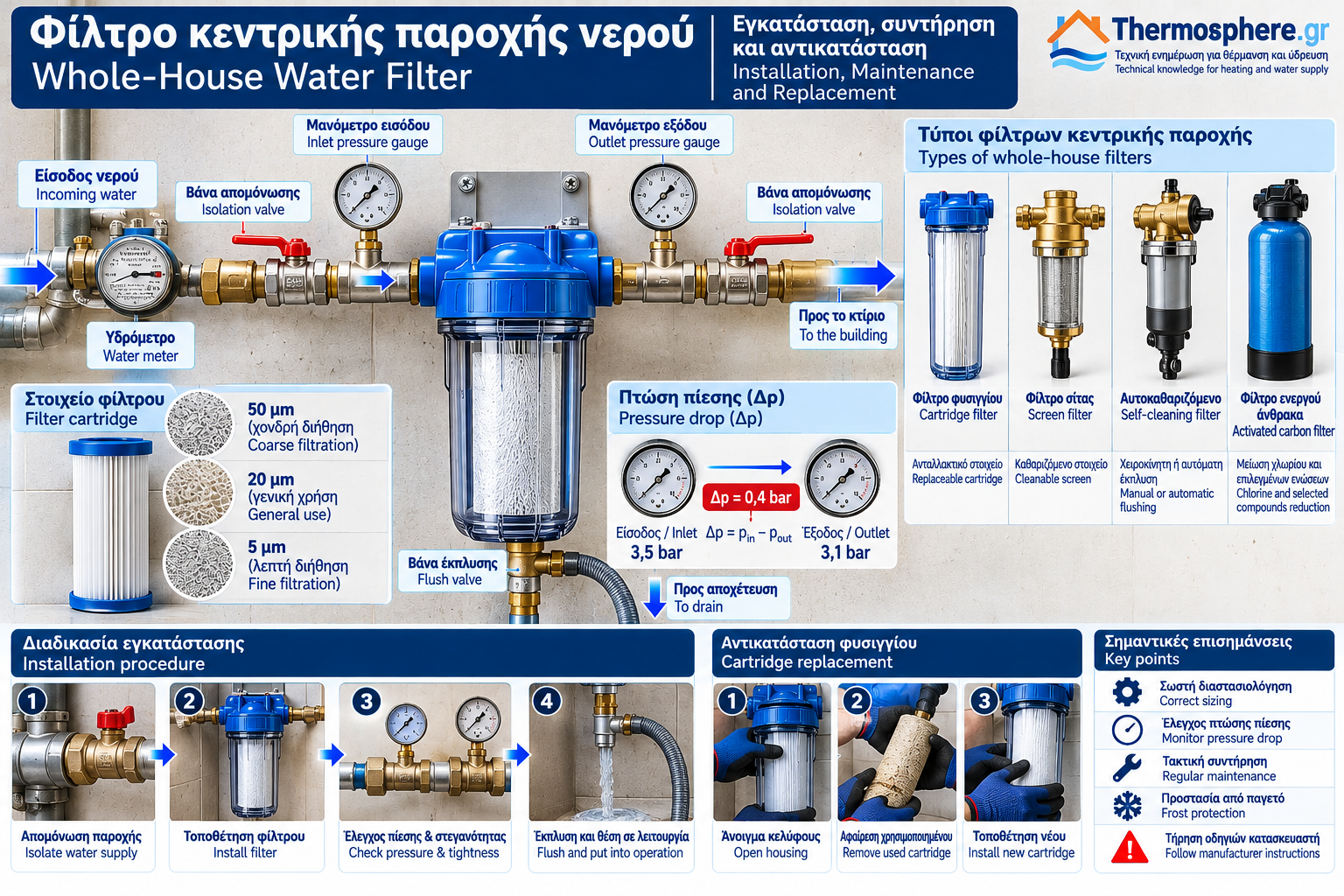
Cartridge Filters
These systems consist of a filter housing containing a replaceable filtration element.
Cartridges may be manufactured from polypropylene, pleated synthetic materials or other suitable filtration media.
They are primarily used to retain suspended solids.
Replacement intervals depend on rated capacity, pressure loss and manufacturer recommendations.
Screen Filters
Screen filters contain a metal or synthetic mesh that retains particles according to the specified filtration rating.
Some designs allow the screen to be cleaned and reused.
Self-Cleaning Filters
Self-cleaning filters incorporate a flushing or cleaning mechanism.
Depending on the model, cleaning may be manually or automatically activated.
These systems can reduce the need for frequent dismantling but still require inspection and maintenance.
Whole-House Activated Carbon Filters
Activated carbon systems may be used for applications such as reducing free chlorine or selected organic compounds.
Their performance depends on carbon characteristics, contact time, flow rate and verified treatment claims.
Removing residual disinfectant from an entire building’s water supply requires careful consideration because it may affect microbiological stability within the downstream plumbing network.
3. Where Should the Filter Be Installed?
The usual location is downstream of the designated water metering point and any required supply arrangements, but upstream of the branches that require protection.
The exact location depends on:
The plumbing layout.
Water utility regulations.
Pressure-reducing valves.
Storage tanks and booster pump systems.
Filter design requirements.
Equipment protection objectives.
Special care is required when considering filtration on a pump suction line.
Additional hydraulic resistance may reduce available NPSH and increase the risk of cavitation.
4. Correct Hydraulic Arrangement
A typical installation may include:
An upstream isolation valve.
The appropriately selected filter.
Pressure measurement points upstream and downstream.
A downstream isolation valve.
Suitable drainage or flushing arrangements where specified.
Some installations include a bypass for maintenance.
However, a bypass must not allow uncontrolled delivery of untreated water where treatment is essential for safety or regulatory compliance.
Pipework must be independently supported to avoid placing excessive mechanical loads on the filter housing.
5. Selecting the Correct Filter Size and Flow Capacity
Filter selection should not be based solely on the nominal connection diameter.
Important parameters include:
Maximum design flow rate in m³/h.
Available inlet pressure.
Acceptable pressure drop.
The filter’s flow-versus-pressure-loss performance curve.
Filtration element capacity.
Maximum operating pressure and temperature.
For example, a filter with a 1-inch connection is not necessarily suitable for every plumbing system using 1-inch pipework.
Its actual hydraulic capacity must be verified against manufacturer data.
6. Understanding Micron Ratings
Filtration ratings are commonly expressed in micrometres (μm).
Examples include 1, 5, 10, 20, 50 and 100 μm filters.
Smaller ratings may provide finer particle retention but can also require greater attention to pressure drop and maintenance frequency.
Nominal and absolute retention ratings must be distinguished.
Actual performance depends on the applicable test method and the manufacturer’s declared retention efficiency.
7. Pressure Drop Across the Filter
Every filter creates resistance to water flow.
The pressure difference between the inlet and outlet is called pressure drop.
Δp = Inlet pressure − Outlet pressure
For example:
Pressure upstream of the filter: 3.5 bar.
Pressure downstream of the filter: 3.1 bar.
Pressure drop = 0.4 bar.
Measurements should be taken at a known and reasonably stable flow rate.
As particles accumulate, pressure drop generally increases at the same flow rate.
Acceptable pressure loss depends on manufacturer specifications and the hydraulic design of the installation.
8. Installation Procedure
Installation should be carried out by appropriately qualified personnel.
A typical procedure includes:
Checking water quality and filter suitability.
Selecting an accessible installation location.
Safely shutting off and depressurising the water supply.
Providing proper pipe support and connections.
Installing the filter in the specified flow direction.
Checking seals and fittings.
Gradually restoring the water supply.
Venting or flushing according to the manufacturer’s instructions.
Checking for leaks.
Recording initial operating pressures.
Operating pressure and temperature limits must be respected.
Plastic filter housings must be protected against unsuitable temperatures, ultraviolet exposure and mechanical stress according to their specifications.
9. Whole-House Water Filter Maintenance
Maintenance requirements depend on the filter design and incoming water quality.
Cartridge Filters
Cartridges should be replaced when the specified service interval or treatment capacity has been reached, or when pressure drop exceeds the manufacturer’s recommended limit.
Screen Filters
Screens should be cleaned according to the manufacturer’s procedure.
They should also be inspected for wear, deformation or damage.
Self-Cleaning Filters
The flushing mechanism, drain connection, seals and cleaning effectiveness should be checked periodically.
Activated Carbon Filters
Replacement cannot be determined solely by pressure drop.
Adsorption capacity may become exhausted without a noticeable change in hydraulic resistance.
The specified treatment capacity and replacement schedule must therefore be followed.
10. How to Replace a Filter Cartridge
The exact procedure varies by manufacturer and model.
In general:
Isolate the water supply.
Completely depressurise the housing.
Open the housing using the specified tool, if required.
Remove the used cartridge.
Inspect the housing and seals.
Perform the recommended cleaning and hygiene procedures.
Install a compatible replacement cartridge.
Reassemble the housing according to the instructions.
Gradually restore pressure.
Flush the system and check for leaks.
Never open a pressurised filter housing.
Sealing rings should be replaced when necessary, and only suitable materials should be used in accordance with the manufacturer’s instructions.
11. Common Problems and Troubleshooting
Reduced Downstream Water Pressure
Possible causes include accumulated particles, insufficient filter capacity or excessive flow demand.
Water Leaking from the Housing
Possible causes include incorrect assembly, a damaged seal or housing failure.
Cracked or deformed housings must be taken out of service.
Frequent Cartridge Replacement
This may indicate a high suspended-solids load or an unsuitable filter type.
Particles Appearing Downstream
The filter element, installation arrangement and possible contamination originating from downstream pipework should be examined.
12. Whole-House Filters and Booster Pump Systems
In installations incorporating booster pumps, filter location is particularly important.
A filter causing excessive suction resistance may reduce pump inlet pressure and worsen operating conditions.
The correct installation arrangement depends on:
Pump requirements.
Incoming water quality.
Equipment protection objectives.
Available pressure.
Maintenance requirements.
Where particle protection is required upstream of a pump, the solution must be designed to avoid unacceptable suction losses.
13. Does Every Building Need a Whole-House Filter?
Not necessarily.
The need depends on incoming water quality, pipework conditions and equipment protection requirements.
A filter may be beneficial where suspended solids are present or where specific equipment requires protection.
However, installation should not proceed without assessing hydraulic performance and maintenance requirements.
Chemical or microbiological water quality problems require specific evaluation and appropriate treatment technologies.
Conclusion
Whole-house water filters can provide valuable protection for plumbing installations when properly selected, installed and maintained.
Their effectiveness depends not only on the filtration rating but also on flow capacity, pressure drop, installation location and regular maintenance.
A correctly selected filter protects the plumbing system without unnecessarily restricting water flow.
This article provides general technical information and does not replace manufacturer instructions, project-specific engineering or installation work by qualified professionals.
Thermosphere.gr — Technical knowledge for heating, water supply and modern plumbing systems.