
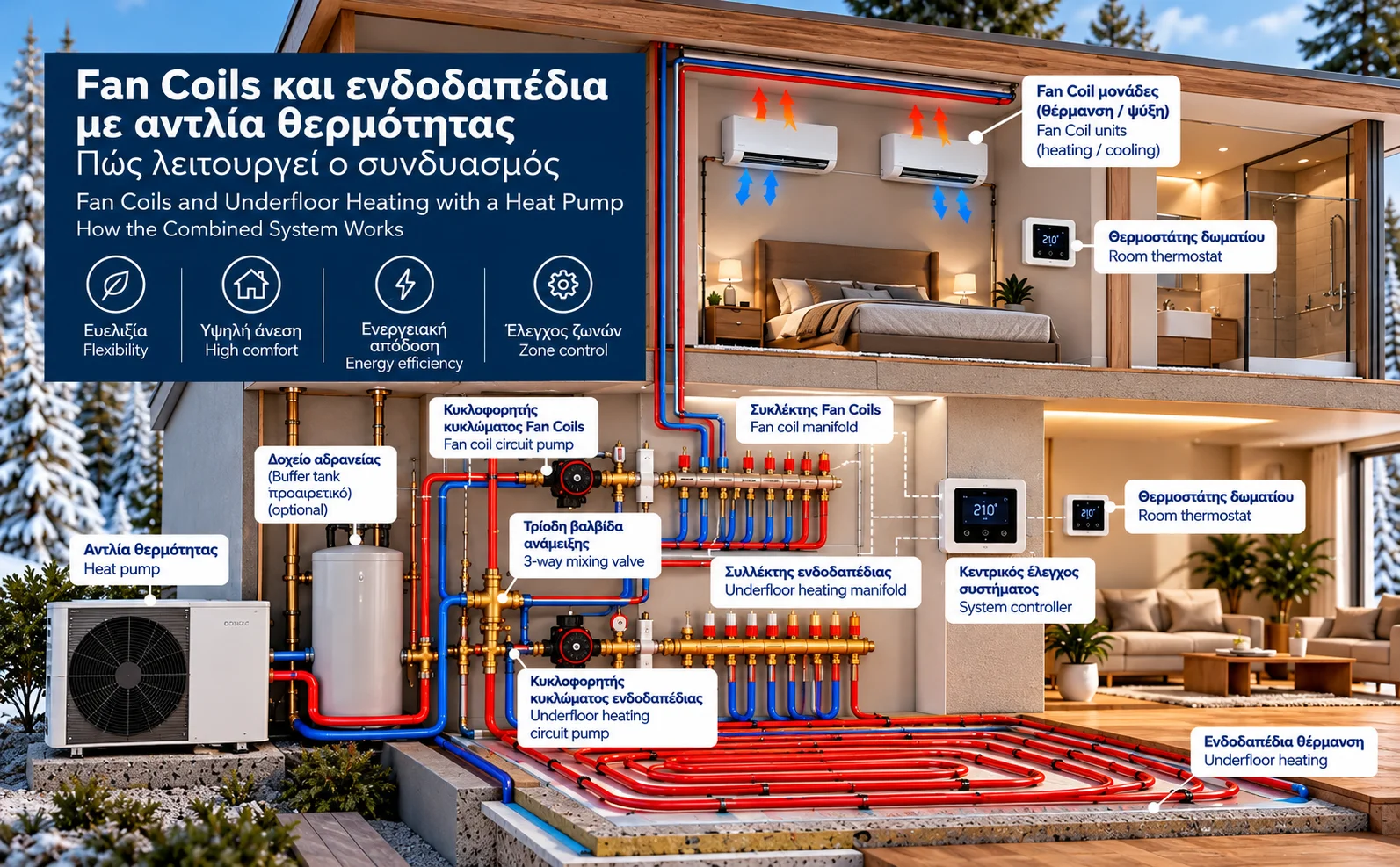
Fan Coils and Underfloor Heating with a Heat Pump: How the Combined System Works
A heat pump can supply different types of hydronic heating terminals. Two common options are underfloor heating and fan coil units.
Underfloor heating distributes heat through a large floor surface, while fan coil units use a water-to-air heat exchanger and a fan to warm the room air.
Combining these systems can offer flexibility in residential and commercial buildings.
However, they have different operating characteristics and cannot always be connected without additional hydraulic equipment.
This guide explains how fan coils and underfloor heating can operate with a single heat pump, what water temperatures may be required and which design considerations are essential.
1. How Does Underfloor Heating Work?
Hydronic underfloor heating consists of pipes installed within or beneath the floor construction.
Warm water circulates through the pipes, transferring heat to the floor surface.
The floor then releases heat into the room through radiation and natural convection.
Because the heat-emitting surface is large, the system can operate at relatively low water temperatures.
Many residential installations use supply temperatures of approximately 30–40°C, depending on heat losses and system characteristics.
Underfloor heating provides relatively uniform heat distribution, although traditional screed-based systems respond slowly to temperature changes.
2. How Do Fan Coil Units Work?
Fan coil units are hydronic terminal devices containing a heat exchanger and a fan.
Warm water from the heat pump flows through the heat exchanger.
The fan moves room air across the heat exchanger and delivers warmer air into the occupied space.
Unlike underfloor heating, fan coils can respond relatively quickly to changing room temperatures.
Their heating capacity depends on:
Supply-water temperature.
Water flow rate.
Airflow rate.
Room temperature.
Heat exchanger characteristics.
Fan operating speed.
Not all fan coil units deliver the same heating capacity at low water temperatures.
Selection must therefore be based on manufacturer performance data at the actual design conditions.
3. Can One Heat Pump Supply Both Systems?
Yes. A correctly sized heat pump can supply both underfloor heating and fan coil units.
Two main approaches are possible.
Common Supply-Water Temperature
If the fan coils are selected to provide sufficient heat output at the same low water temperature required by the underfloor heating, both systems may operate with a common supply temperature.
For example, a system might be designed to operate at approximately 35°C.
This is only feasible when the fan coils provide the required heating capacity at that temperature.
Different Supply-Water Temperatures
In other installations, fan coils may require warmer water than the underfloor heating system.
A separate low-temperature circuit for the floor may then be necessary, using suitable mixing and temperature control.
The exact hydraulic arrangement depends on the design and heat pump manufacturer's requirements.
4. Example: A Two-Story House
Consider a two-story home.
The ground floor uses underfloor heating, while the upper floor uses fan coil units.
A single heat pump produces warm water for both systems.
The ground-floor circuit supplies the underfloor heating manifold, which distributes water through the embedded floor pipes.
The upper-floor circuit supplies the fan coil units.
Each system can have independent zone controls.
If the fan coils require a different supply temperature, the hydraulic installation must provide the appropriate operating conditions for each circuit.
A shared heat source does not mean that all circuits require identical flow rates or controls.
5. What Water Temperatures Are Required?
Operating temperatures depend on the system design.
System | Indicative Supply Temperature |
|---|---|
Underfloor heating | 30–40°C |
Low-temperature fan coils | Approximately 35–45°C |
Fan coils with higher temperature requirements | May require warmer water |
These values are examples, not universal specifications.
Actual requirements depend on room heating demand and terminal unit performance.
For heat pumps, lower supply-water temperatures generally support better energy efficiency.
6. Is a Buffer Tank Necessary?
A buffer tank is not mandatory in every installation.
The requirement depends on:
Minimum system water volume.
Minimum heat pump flow rate.
Defrosting requirements.
Number of heating zones.
Valve operation.
System control strategy.
When multiple zones can close independently, the system must maintain the minimum circulation conditions required by the heat pump.
A buffer tank or another suitable hydraulic arrangement may be necessary depending on the design.
Manufacturer instructions must be followed.
7. Circulation Pumps and Manifolds
Circulation pumps move water through the heating circuits.
The underfloor heating manifold distributes water to individual floor zones.
Fan coil units may connect to a separate distribution network with suitable control valves.
Hydraulic design must consider:
Required flow rates.
Pressure losses.
Circuit balancing.
Interaction between circuits.
Minimum heat pump flow requirements.
Separate circulation pumps are not automatically required for every group of terminal units.
The appropriate arrangement depends on the hydraulic schematic.
8. How Do Thermostats Work?
Underfloor heating and fan coils can be controlled independently.
For example, a ground-floor thermostat may control the underfloor heating zones, while separate thermostats control the upstairs fan coils.
The controls must coordinate with the heat pump.
It is important to prevent situations where all zone valves close while the heat pump still requires water circulation.
Weather compensation can adjust supply-water temperature according to outdoor conditions.
9. Advantages of Combining Both Systems
Installation Flexibility
Underfloor heating can serve areas where uniform thermal comfort is desired, while fan coils can serve spaces with different operating requirements.
Different Thermal Response
Fan coils respond relatively quickly to temperature changes.
Underfloor heating generally provides slower but more stable thermal response.
One Heat Source
A single heat pump can supply different heating zones when correctly sized and configured.
Energy Efficiency
When both systems operate effectively at low water temperatures, the heat pump can benefit from favourable operating conditions.
10. Disadvantages and Technical Challenges
The combination also introduces some challenges.
More complex hydraulics: Additional circuits, valves and controls may be required.
Different temperature requirements: Higher fan coil supply temperatures may reduce heat pump efficiency.
Different thermal inertia: Underfloor heating responds more slowly than fan coils.
Control requirements: Zones must operate without causing minimum-flow problems or excessive heat pump cycling.
Fan noise: Fan coil units generate airflow noise, which should be considered during equipment selection.
11. Common Design Mistakes
Selecting Fan Coils by Nominal Capacity Alone
Nominal heating capacity may be specified at water temperatures different from the actual installation.
Performance must be checked at design conditions.
Excessively High Supply Temperature
Using warmer water to compensate for undersized fan coils can reduce overall heat pump efficiency.
Poor Hydraulic Balancing
Without correct balancing, some circuits may receive more water than required.
Incorrect Zone Control
Independent thermostats and valves must be coordinated with the heat pump's operating requirements.
12. Frequently Asked Questions
Can fan coils and underfloor heating operate simultaneously?
Yes, provided the heat pump and hydraulic network are designed for the combined load and required flow rates.
Are two heat pumps necessary?
Not necessarily. One appropriately sized heat pump can supply both systems.
Is a three-way mixing valve always required?
No. If both systems operate correctly at the same supply-water temperature, mixing may not be necessary.
Is the combined system cheaper to operate?
Not automatically. Operating costs depend on design, supply temperature, building usage and equipment efficiency.
Conclusion
Combining fan coil units and underfloor heating with a single heat pump can provide a flexible heating solution for homes and commercial buildings.
Successful operation depends on selecting suitable terminal units, determining the correct water temperatures, designing the hydraulic circuits and coordinating the controls.
Fan coils should ideally be selected to meet the required heating demand at the lowest practical supply-water temperature.
With correct design and installation, both systems can operate effectively using one shared heat source.
Thermosphere.gr — Technical knowledge for heating and building systems.