
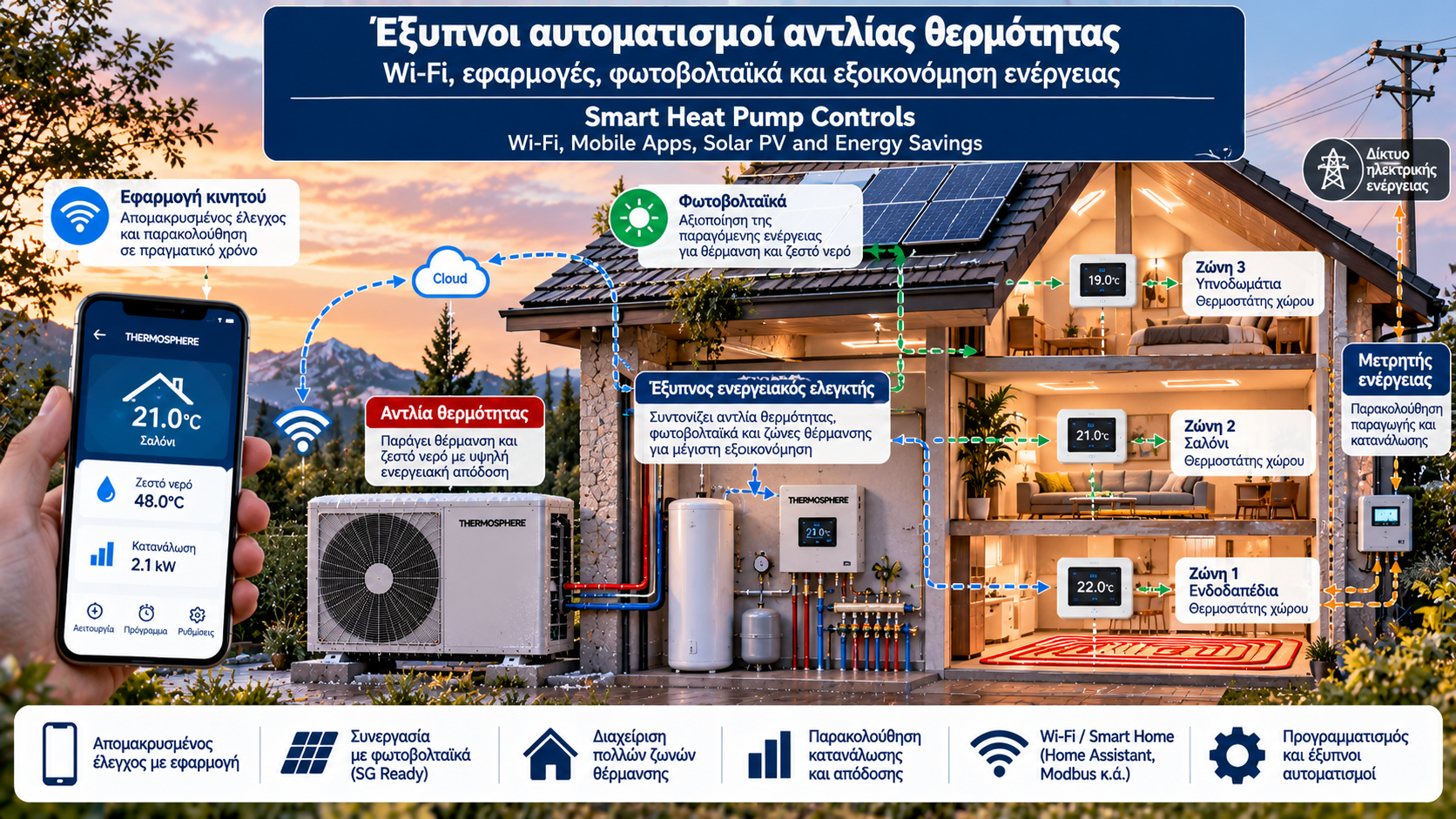
Smart Heat Pump Controls: Wi-Fi, Mobile Apps, Solar PV and Energy Savings
Modern heat pumps are no longer limited to producing hot water for building heating. Many models offer internet connectivity, remote monitoring, scheduling and integration with energy management systems.
Through a mobile application, users may be able to monitor and control their heat pump even when away from home.
Some systems can also use information from solar photovoltaic installations, energy meters or electricity tariffs.
However, Wi-Fi connectivity does not automatically make a heat pump more energy efficient.
Real benefits depend on how effectively the controls work with the building, heating system and available energy sources.
This guide explains smart heat pump functions, communication technologies and the requirements for safe and efficient operation.
1. What Is a Smart Heat Pump?
The term smart heat pump generally refers to equipment with advanced control, communication or energy management capabilities.
Depending on the model, these may include:
Wi-Fi or Ethernet connectivity.
Mobile applications.
Remote setting adjustments.
Operating schedules.
Temperature monitoring.
Fault notifications.
Energy consumption information.
Smart home integration.
Solar PV coordination.
Electricity price-based operation.
Not every heat pump supports all these functions.
Some features require additional hardware, subscriptions or configuration.
2. How Does a Heat Pump Connect to Wi-Fi?
Connectivity is usually provided through an integrated communication module or optional accessory.
The process varies by manufacturer but commonly involves:
Installing the official mobile application.
Creating a user account.
Activating the heat pump’s pairing mode.
Connecting to the home network.
Registering the equipment.
Testing remote communication.
Some devices support only specific Wi-Fi frequencies or network settings.
Always follow the manufacturer’s connection instructions.
3. What Can You Control From a Smartphone?
Depending on the equipment, mobile applications may allow users to:
Enable or disable heating operation.
Change temperature setpoints.
Configure schedules.
Control domestic hot water production.
View outdoor temperature.
Monitor heating-water flow temperature.
Receive fault notifications.
Review operating history.
Access energy information.
A parameter displayed in an application is not necessarily adjustable.
Some technical settings remain restricted to qualified installers.
4. Local Control vs Remote Control
Local control takes place through the equipment’s controller or local network.
Remote control allows communication over the internet from another location.
Many systems use manufacturer cloud services.
Remote access may therefore depend on:
Internet connectivity.
Server availability.
Application functionality.
Account status.
Loss of internet access does not necessarily stop heating.
In properly designed systems, the main local controller continues to operate independently of the mobile application.
5. Can a Heat Pump Operate Without Internet Access?
In most conventional installations, essential heating functions are controlled locally and do not require continuous internet access.
If Wi-Fi is unavailable, users may temporarily lose:
Remote access.
Mobile notifications.
Cloud-based operating history.
Certain energy optimization features.
Local protective functions and basic controls should continue according to the equipment’s design.
Exact behaviour must be verified in the manufacturer’s documentation.
6. What Is Energy Management?
Energy management coordinates electrical equipment with available energy, electricity consumption and building requirements.
An energy management system (EMS) may monitor:
Solar PV generation.
Building electricity consumption.
Grid imports.
Grid exports.
Battery status, if available.
Available electrical power.
Scheduled heating demand.
Using this information, it may send suitable control signals to a compatible heat pump.
7. How Do Heat Pumps Work With Solar PV?
Solar photovoltaic panels generate electricity mainly during daylight hours.
A heat pump can use part of that electricity for space heating or domestic hot water.
When solar generation exceeds other building loads, a compatible controller may shift some heating activity into the period of surplus generation.
Possible strategies include:
Scheduling domestic hot water heating during sunny periods.
Modest building preheating.
Using suitable thermal storage.
Adjusting operation based on available electrical power.
Comfort and safety limits must always be respected.
8. What Is Solar PV Surplus?
Solar surplus occurs when instantaneous PV generation exceeds the electricity being used elsewhere in the building.
For example:
PV generation: 4 kW.
Other building loads: 1.5 kW.
Instantaneous surplus: 2.5 kW.
Depending on the electrical installation, this surplus may be available for additional loads.
However, the heat pump does not necessarily need to consume 2.5 kW.
Its actual electrical demand depends on heating requirements, compressor modulation and control settings.
9. What Is SG Ready?
SG Ready is a defined control interface concept used by compatible heat pumps to respond to external energy management signals.
In its common configuration, two binary signals provide four logical operating states.
Depending on the equipment, these states may correspond to restricted, normal or increased use of available electricity.
SG Ready is not a general-purpose data communication protocol like Modbus.
The exact inputs, operating states and effects must be checked in the specific manufacturer’s documentation.
10. How Is SG Ready Used With Solar PV?
A compatible energy controller can monitor building electricity consumption and solar generation.
When appropriate conditions are met, it can send a control signal to the heat pump.
The heat pump may then follow an alternative operating strategy, subject to its settings and limitations.
For example, it may temporarily increase an allowed domestic hot water storage temperature target.
Operation still depends on thermal demand, safety limits and manufacturer control logic.
SG Ready does not mean the heat pump automatically absorbs every available watt of solar surplus.
11. Can a Heat Pump Store Energy?
A heat pump is not an electrical battery.
However, it can shift electricity consumption in time by using the building’s thermal inertia or suitable thermal storage.
Examples include:
Domestic hot water cylinders.
Controlled building preheating.
Purpose-designed thermal storage.
Thermal storage capacity is limited.
Excessively high temperatures may increase heat losses and reduce COP.
12. Should Water Temperature Be Increased Significantly When Solar Electricity Is Available?
Not necessarily.
Solar-generated electricity may have different economic value depending on the self-consumption arrangement, electricity contract and generation period.
However, producing heat at higher temperatures can reduce heat pump efficiency.
Therefore, excessive temperature increases are not always beneficial.
A suitable strategy balances:
Available surplus electricity.
Heat pump COP.
Thermal losses.
Storage capacity.
Comfort requirements.
Electricity value.
13. What Are Dynamic Electricity Tariffs?
Some electricity tariffs vary by time of day or market conditions.
A compatible smart controller may use price information to shift some heating activity into lower-cost periods.
For example, domestic hot water production may be scheduled during cheaper electricity hours.
However, the following must be considered:
The actual electricity contract.
Network and regulated charges.
Heating requirements.
Building thermal inertia.
COP at different operating conditions.
Backup heating requirements.
The cheapest hour is not always the most energy-efficient hour.
14. Example of a Smart Energy-Saving Strategy
Consider a home with:
An air-to-water heat pump.
Solar PV panels.
A domestic hot water cylinder.
A compatible energy management controller.
In the morning, solar production is limited.
Around midday, generation increases and surplus electricity becomes available.
The controller may schedule domestic hot water production during this period if the system has available thermal storage capacity.
In the evening, stored hot water may cover part of the household’s needs without immediate additional heating.
Actual savings depend on generation, demand, thermal losses and electricity pricing.
15. What Is Modbus?
Modbus is a communication protocol widely used in automation and energy management.
On compatible heat pumps, it may provide access to information such as:
Temperatures.
Operating status.
Fault codes.
Selected energy measurements.
Certain permitted settings.
Available data depends on the model, communication interface and manufacturer register map.
Not all parameters can necessarily be modified.
Write access requires particular care.
16. Can a Heat Pump Connect to Home Assistant?
Home Assistant is a smart home automation platform.
Some heat pumps can be integrated through:
Official integrations.
Local communication interfaces.
Modbus.
Cloud services.
Compatible third-party systems.
Availability and reliability depend on the manufacturer and connection method.
Third-party automation must not bypass factory safety protections.
Critical heating functions should remain under the approved local controller.
17. Can Artificial Intelligence Be Used?
Some advanced energy management systems use forecasting and optimization algorithms.
Depending on their design, they may consider:
Weather forecasts.
Historical electricity consumption.
Predicted solar generation.
Occupancy schedules.
Electricity prices.
Building thermal behaviour.
Artificial intelligence is not necessary for every smart automation system.
A well-designed rule-based controller may be sufficient for many homes.
18. What Happens If the Cloud Connection Fails?
If an application or cloud service becomes unavailable, remote access may temporarily stop.
Essential heating functions should continue according to the equipment’s design and local configuration.
Important considerations include:
Functional local controls.
Safety systems independent of cloud services.
Known behaviour during communication loss.
Suitable fallback settings.
Critical functions should not depend unnecessarily on internet connectivity.
19. How Can Heat Pump Cybersecurity Be Improved?
Internet-connected heat pumps should be protected like other smart devices.
Recommended practices include:
Strong, unique passwords.
Multi-factor authentication where supported.
Software updates.
Official applications.
Avoiding unnecessary internet-exposed ports.
Restricting third-party access.
Secure management of installer accounts.
Remote access should use approved, secure methods.
20. Are App-Based Energy Measurements Accurate?
Applications may display electrical consumption, useful heating output or estimated COP.
These values may be based on:
Physical meters.
Internal sensors.
Calculation models.
Controller estimates.
Accuracy therefore varies.
Reliable energy assessment may require a suitable electricity meter and heat meter.
Application readings should not automatically be treated as certified measurements.
21. Common Smart Automation Mistakes
Buying a Wi-Fi Thermostat Without Checking Compatibility
It may not communicate correctly with the heat pump.
Excessively Frequent Start/Stop Commands
These can create undesirable cycling.
Increasing Temperatures Without Considering COP
Additional thermal storage may come at a significant efficiency cost.
Incorrect Solar Surplus Detection
The controller may activate loads without sufficient available generation.
Bypassing Factory Safety Functions
This can compromise safety and reliability.
Excessive Cloud Dependence
Communication outages may disable important remote functions.
Failing to Measure Results
A smart-looking automation system does not necessarily reduce actual operating costs.
22. Pre-Purchase and Installation Checklist
Before choosing a smart control system, verify:
Does the heat pump include Wi-Fi, or is an accessory required?
Is there an official mobile application?
Which functions can be controlled remotely?
Is local control available?
Does the unit support SG Ready?
Is Modbus or another suitable interface available?
Can it coordinate with solar PV?
Is an additional electricity meter required?
Are subscriptions or cloud services necessary?
What happens if communication is lost?
Are factory protections preserved?
How will actual energy savings be measured?
23. Frequently Asked Questions
Can I Control My Heat Pump From a Smartphone?
Yes, if the model supports a compatible remote control function.
Does Heating Require Continuous Wi-Fi?
Usually not. Essential operation is typically controlled locally, but exact behaviour depends on the model.
Can Any Heat Pump Be Connected to Solar PV?
A heat pump can use electricity generated by solar panels, but active coordination requires compatible controls and proper system design.
What Does SG Ready Mean?
It is a control interface allowing compatible heat pumps to respond to defined external energy management signals.
Can I Connect a Heat Pump to Home Assistant?
Some models support suitable integrations or communication interfaces. Compatibility must be checked.
Does Smart Automation Always Save Electricity?
No. Savings depend on control settings, the building, electricity tariffs and heat pump operation.
Is It Better to Run the Heat Pump During Solar Generation?
It may be economically beneficial if heating demand or suitable thermal storage is available. Unnecessary temperature increases should be avoided.
Can I Change Every Technical Setting Through the App?
Not necessarily. Many installer parameters remain restricted for safety reasons.
Conclusion
Smart automation offers valuable options for monitoring, scheduling and managing heat pump energy use.
Wi-Fi connectivity and mobile applications improve convenience, while solar PV integration and compatible energy management systems may increase self-consumption and reduce operating costs.
However, actual efficiency depends on how the installation operates.
Compatibility, safety, correct hydraulic operation and reliable energy measurements remain essential.
A heat pump does not become more efficient simply because it connects to the internet. It becomes more effective when its controls make appropriate decisions without compromising comfort or safety.
Thermosphere.gr — Technical knowledge for heating and building systems.