
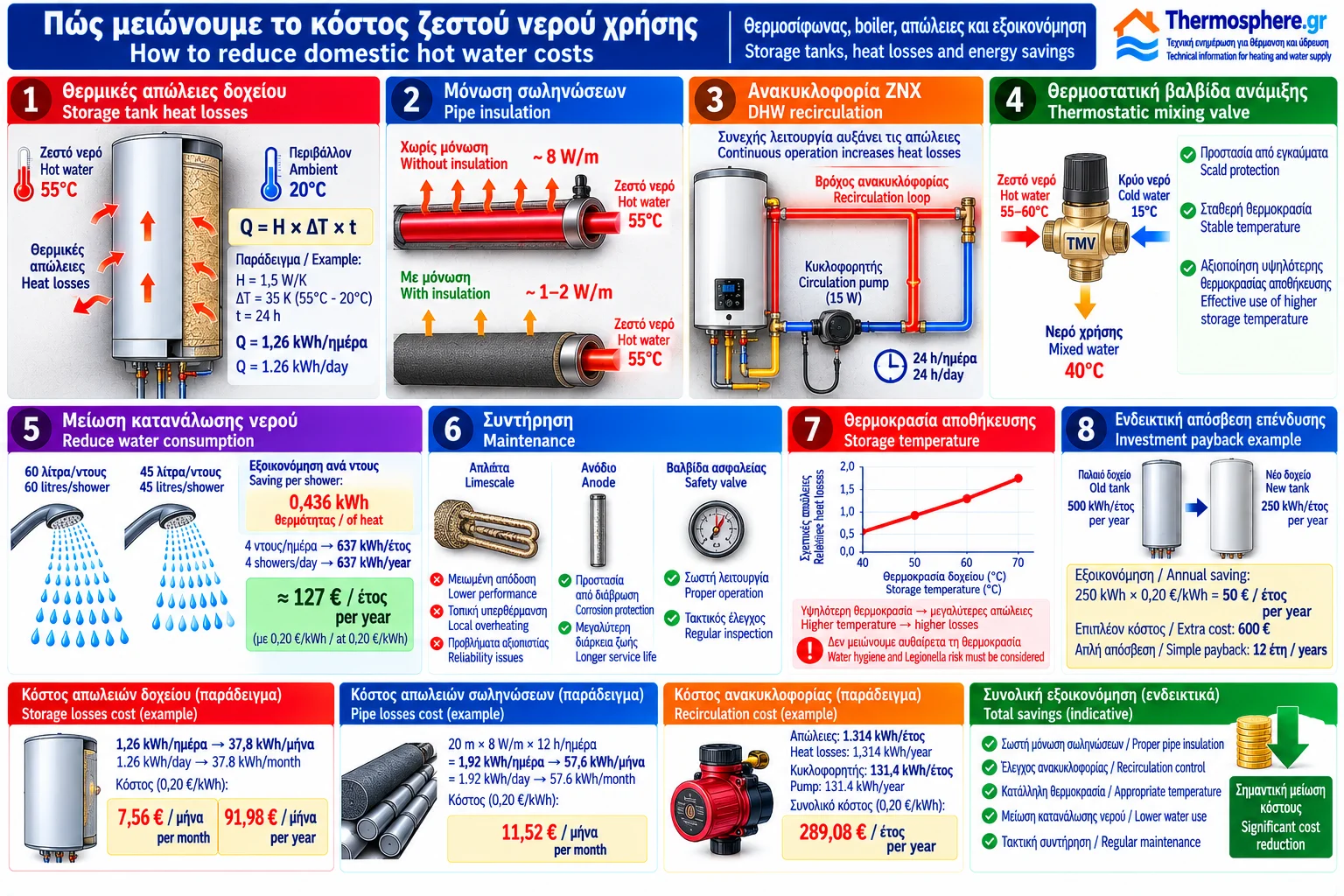
How to Reduce Domestic Hot Water Costs: Storage Tanks, Heat Losses and Energy Savings
Domestic hot water costs depend on more than electricity or fuel prices.
Even an efficient water heating system may consume unnecessary energy if it has high storage losses, poorly insulated pipes, uncontrolled recirculation or unsuitable operating settings.
Effective energy savings begin with understanding the entire domestic hot water installation.
This article examines where heat is lost, how losses can be calculated and which technical improvements can reduce operating costs.
1. What Determines the Real Cost of Domestic Hot Water?
Total DHW system costs include:
Energy required to heat the water.
Storage heat losses.
Distribution pipe heat losses.
Circulation pumps and auxiliary equipment.
Recirculation energy consumption.
Maintenance.
Equipment purchase and installation.
A simplified thermal energy balance is:
Qproduction = Quseful + Qlosses + ΔQstored
The final term represents the change in stored thermal energy during the period being analysed.
Over longer periods with similar initial and final storage conditions, this change may be relatively small.
Purchased energy also depends on heat source efficiency.
2. What Are Storage Tank Heat Losses?
A hot water storage tank maintains water at a temperature above the surrounding environment.
Heat therefore transfers from the tank to its surroundings.
Insulation reduces this transfer but does not eliminate it.
Storage losses depend on:
Tank surface area.
Insulation thickness and quality.
Storage temperature.
Ambient temperature.
Connections and thermal bridges.
Duration of hot water storage.
Manufacturers may provide standby loss or energy performance information under applicable test requirements.
3. Calculating Storage Heat Loss
A simplified relationship is:
Qloss = H × ΔT × t
Where:
Qloss = heat loss energy in Wh.
H = overall heat loss coefficient in W/K.
ΔT = tank-to-ambient temperature difference in K.
t = time in hours.
Assume:
H = 1.5 W/K
Average tank temperature = 55°C
Ambient temperature = 20°C
ΔT = 35 K
Time = 24 hours
Qloss = 1.5 × 35 × 24
Qloss = 1,260 Wh = 1.26 kWh/day
Over 30 days:
37.8 kWh of heat
The coefficient is hypothetical. Actual calculations require appropriate tank data and operating conditions.
4. What Do Storage Losses Cost?
If the tank is heated by an electric resistance element, electricity required to replace the losses is approximately equal to the heat lost.
At an illustrative electricity price of €0.20/kWh:
37.8 × 0.20 = €7.56 per month
Over 365 days:
1.26 × 365 = 459.9 kWh
Annual cost:
459.9 × 0.20 = €91.98
If the same losses are replaced by a heat pump with an effective average COP of 2.5:
459.9 / 2.5 ≈ 184 kWh of electricity
Annual cost:
184 × 0.20 ≈ €36.80
This assumes the stated COP applies to the energy required to replace these particular losses.
5. Does Tank Size Affect Heat Loss?
Yes, but there is no universal fixed loss rate per litre.
Larger tanks generally have more external surface area and may have higher total standby losses.
However, losses also depend on geometry, insulation and construction details.
A modern, well-insulated 200-litre tank may have lower losses than an older, poorly insulated smaller tank.
Actual product data should therefore be used.
6. Why Should Storage Tanks Not Be Excessively Large?
An oversized storage tank may increase:
Capital cost.
Space requirements.
Total storage losses.
Heating time.
Volume of stored water.
However, a tank that is too small may fail to cover peak demand.
Sizing should consider:
Number of users.
Hot water consumption profile.
Storage temperature.
Cold water temperature.
Reheating capacity.
Simultaneous demand.
Water hygiene requirements.
Tank capacity should not be selected solely on building floor area.
7. How Much Mixed Hot Water Can a Tank Provide?
The available volume at delivery temperature depends on mixing hot and cold water.
For ideal mixing:
Vmixed = Vhot × (Thot − Tcold) / (Tuse − Tcold)
Assume:
Stored hot water: 100 litres.
Storage temperature: 55°C.
Cold water temperature: 15°C.
Delivery temperature: 40°C.
Vmixed = 100 × (55 − 15) / (40 − 15)
Vmixed = 160 litres
This is a theoretical result.
Actual draw-off performance depends on tank stratification, internal mixing, connection positions and simultaneous reheating.
8. Distribution Pipe Heat Loss
Heat is lost not only from the storage tank but also through hot water pipes.
Losses depend on:
Pipe length.
Pipe diameter.
Pipe material.
Insulation thickness.
Water temperature.
Ambient temperature.
Duration for which the pipe remains hot.
Long distribution routes may increase both thermal losses and waiting time at taps.
9. Pipe Heat Loss Example
Assume:
Pipe length: 20 m.
Average linear heat loss: 8 W/m.
Time maintained hot: 12 hours/day.
Heat loss rate:
20 × 8 = 160 W
Daily heat loss:
160 × 12 / 1,000 = 1.92 kWh
Over 30 days:
1.92 × 30 = 57.6 kWh
With electric resistance heating at €0.20/kWh:
57.6 × 0.20 = €11.52 per month
The 8 W/m value is an illustrative assumption, not a universal pipe loss figure.
The example applies to a pipe maintained hot for the specified period, not one that cools between occasional short uses.
10. How Does Pipe Insulation Help?
Insulation reduces heat transfer to the surroundings.
Important selection factors include:
Insulation thermal conductivity.
Insulation thickness.
Pipe diameter.
Operating temperature.
Moisture and environmental conditions.
Mechanical protection.
Applicable technical requirements.
Connections, valves and insulation discontinuities deserve particular attention.
Continuous, properly installed insulation is generally more effective than isolated improvements.
11. What Is DHW Recirculation?
Some buildings use a domestic hot water recirculation loop.
A pump circulates hot water through the network to reduce waiting time at outlets.
Recirculation can provide:
Faster hot water availability.
Reduced water wasted while waiting.
Improved service to distant outlets.
However, continuous recirculation can substantially increase thermal losses.
12. Why Does Continuous Recirculation Increase Energy Use?
When water circulates continuously, much of the distribution network remains hot.
Pipes therefore lose heat for more hours.
The pump also consumes electricity.
The additional cost can be expressed as:
Recirculation cost = Heat loss replacement cost + Pump electricity cost
Actual consumption depends on insulation, loop length, temperatures and control strategy.
13. Annual Recirculation Cost Example
Assume:
Average loop heat loss: 150 W.
Continuous operation: 24 hours/day.
Pump electrical power: 15 W.
Annual thermal losses:
0.150 × 24 × 365 = 1,314 kWh of heat
Annual pump electricity:
0.015 × 24 × 365 = 131.4 kWh
If an electric resistance heater replaces the heat loss and electricity costs €0.20/kWh:
Heat loss replacement:
1,314 × 0.20 = €262.80
Pump electricity:
131.4 × 0.20 = €26.28
Illustrative annual total: €289.08
These are hypothetical values and should not be generalised to all recirculation systems.
14. Recirculation Scheduling and Controls
Possible control methods include:
Time scheduling.
Thermostatic control.
Temperature sensors.
Building automation.
Demand-based operation, where appropriate.
In some homes, recirculation may not be needed throughout the entire day.
However, operating restrictions must be assessed alongside water hygiene requirements, network temperatures and stagnation risks.
Larger or higher-risk buildings may require different temperature management strategies.
Energy savings must not compromise water hygiene.
15. Storage Temperature and Energy Cost
Higher storage temperature increases the temperature difference between the tank and its surroundings.
This generally increases standby heat loss.
For example, at an ambient temperature of 20°C:
Tank at 50°C: ΔT = 30 K.
Tank at 60°C: ΔT = 40 K.
With a constant heat loss coefficient, the second condition produces a higher instantaneous heat loss rate.
However, storage temperatures must not be reduced arbitrarily.
Legionella control and safe operation take priority.
16. Legionella and Water Hygiene
Legionella bacteria can multiply under favourable conditions in water systems.
Risk is influenced by:
Water temperature.
Stagnation.
Water residence time.
Biofilm.
Network condition.
In stored and distributed DHW systems, temperature and circulation must be managed according to applicable hygiene guidance and risk assessment.
No single temperature setting is universally suitable for every installation.
Thermostatic mixing valves can allow higher storage temperatures while providing controlled, lower temperatures at outlets.
Installation and maintenance should avoid problematic stagnant sections and unsuitable temperature conditions.
17. What Is a Thermostatic Mixing Valve?
A thermostatic mixing valve combines hot and cold water to deliver a controlled outlet temperature.
It can provide:
Scald protection.
More stable delivery temperature.
Effective use of hotter stored water.
Improved comfort.
A mixing valve does not eliminate tank standby losses.
It also does not replace appropriate water hygiene management.
Installation location and settings must follow manufacturer instructions and applicable requirements.
18. Reducing Water Consumption Without Sacrificing Comfort
Energy savings can also come from reducing the amount of hot water required.
Examples include:
Suitable lower-flow showerheads.
Repairing leaks.
Avoiding unnecessary water flow.
Appropriate delivery temperature control.
Improving system response time.
If shower consumption falls from 60 to 45 litres while delivery and cold water temperatures remain unchanged, the useful heating energy for that shower decreases proportionally.
19. Water Consumption Reduction Example
Assume:
Original shower volume: 60 litres.
New shower volume: 45 litres.
Delivery temperature: 40°C.
Cold water temperature: 15°C.
Volume reduction:
60 − 45 = 15 litres
Heat saved:
Q = 0.001163 × 15 × 25
Q ≈ 0.436 kWh per shower
For four showers per day:
0.436 × 4 ≈ 1.74 kWh/day
Annual useful heat savings:
1.7445 × 365 ≈ 637 kWh
With electric resistance heating at €0.20/kWh:
Illustrative savings ≈ €127 per year
Additional savings from lower water and wastewater consumption are not included.
20. Electric Water Heater Maintenance
Proper maintenance supports safety, reliability and service life.
Depending on the equipment, checks may include:
Heating element condition.
Scale deposits.
Corrosion protection.
Safety valve.
Electrical connections.
Thermostat.
Leaks.
Scale does not affect energy use in exactly the same way in every system.
An electric resistance element still converts nearly all its electrical input into heat, but scale can cause local overheating, impaired heat transfer and reliability problems.
Maintenance should follow manufacturer guidance and be performed by suitably qualified personnel.
21. Solar Water Heater Maintenance
Depending on the system, maintenance may include:
Collector inspection.
Leak checks.
Heat transfer fluid inspection, where applicable.
Closed-loop pressure checks.
Corrosion protection.
Safety valve checks.
Insulation inspection.
Backup electric heater inspection.
Reduced solar system performance may increase backup heater operation and energy costs.
22. Heat Pump Water Heater Maintenance
Relevant checks may include:
Air filters and airflow paths.
Heat exchanger condition.
Temperature sensors.
Controls.
Backup electric heater.
Condensate drainage.
Actual electricity consumption.
Refrigerant circuit work must be carried out by appropriately certified personnel where required.
23. When Is Replacing an Old Storage Tank Worthwhile?
Replacement may be justified when:
Existing standby losses are high.
Significant corrosion is present.
Insulation is inadequate.
Hot water capacity is insufficient.
Failures are frequent.
A different tank size is needed.
A wider system upgrade is planned.
However, replacing a functioning tank solely because it is older is not always economically justified.
Investment cost and expected savings must be compared.
24. Investment Payback Example
Assume:
Old tank annual standby losses: 500 kWh.
New tank annual standby losses: 250 kWh.
Reduction: 250 kWh of heat.
Heat source: electric resistance.
Electricity price: €0.20/kWh.
Annual savings:
250 × 0.20 = €50
If the additional replacement cost is €600:
Simple payback:
600 / 50 = 12 years
This demonstrates why replacing a tank solely for energy savings may not always be the best investment.
Maintenance differences, equipment failures and future energy prices are excluded.
25. Which Improvements Should Come First?
Priorities depend on the installation.
A practical assessment sequence is:
First: Check for excessive water use or visible leaks.
Next: Assess pipe insulation and tank standby losses.
Then: Review recirculation operation and appropriate control options.
After that: Evaluate maintenance and actual heating efficiency.
Finally: Assess whether equipment replacement or upgrading is financially justified.
Changes to temperature, recirculation or storage arrangements must remain compatible with water hygiene requirements.
26. Common Mistakes That Increase Costs
Poor Pipe Insulation
Increases losses, particularly in continuously hot networks.
Unassessed Continuous Recirculation
May cause substantial additional energy consumption.
Oversized Storage Tank
Can increase investment and standby losses.
Inappropriate Storage Temperature
Can affect both efficiency and hygiene.
Poor Maintenance
May reduce reliability and actual system performance.
Replacement Without Payback Analysis
May lead to investment with limited financial benefit.
27. Technical Standards and References
Relevant references include:
EU Regulation 812/2013: Energy labelling of water heaters.
EU Regulation 814/2013: Ecodesign requirements for water heaters and storage tanks.
EN 12897: Specifications for indirectly heated unvented storage water heaters.
EN 806: Specifications for drinking water installations inside buildings.
EN 1717: Protection against pollution of potable water through backflow.
ECDC — European Technical Guidelines for Legionella: Water system risk prevention and control.
Actual installations must comply with applicable national requirements, manufacturer instructions and risk assessment findings.
Conclusion
Reducing domestic hot water costs does not always require replacing the water heater or storage tank.
In many cases, the best approach is to identify actual energy losses within the installation.
Appropriate insulation, correct storage capacity, recirculation management, maintenance and reduced unnecessary water consumption can all lower energy demand.
At the same time, water hygiene, scald protection and safe operation must remain essential priorities.
Effective energy savings come from eliminating unnecessary losses, not from arbitrarily reducing the conditions needed for safe operation.
This article is intended for technical information. Numerical examples use hypothetical data and do not replace engineering design or water hygiene risk assessment.
Thermosphere.gr — Technical information for heating and water supply.