
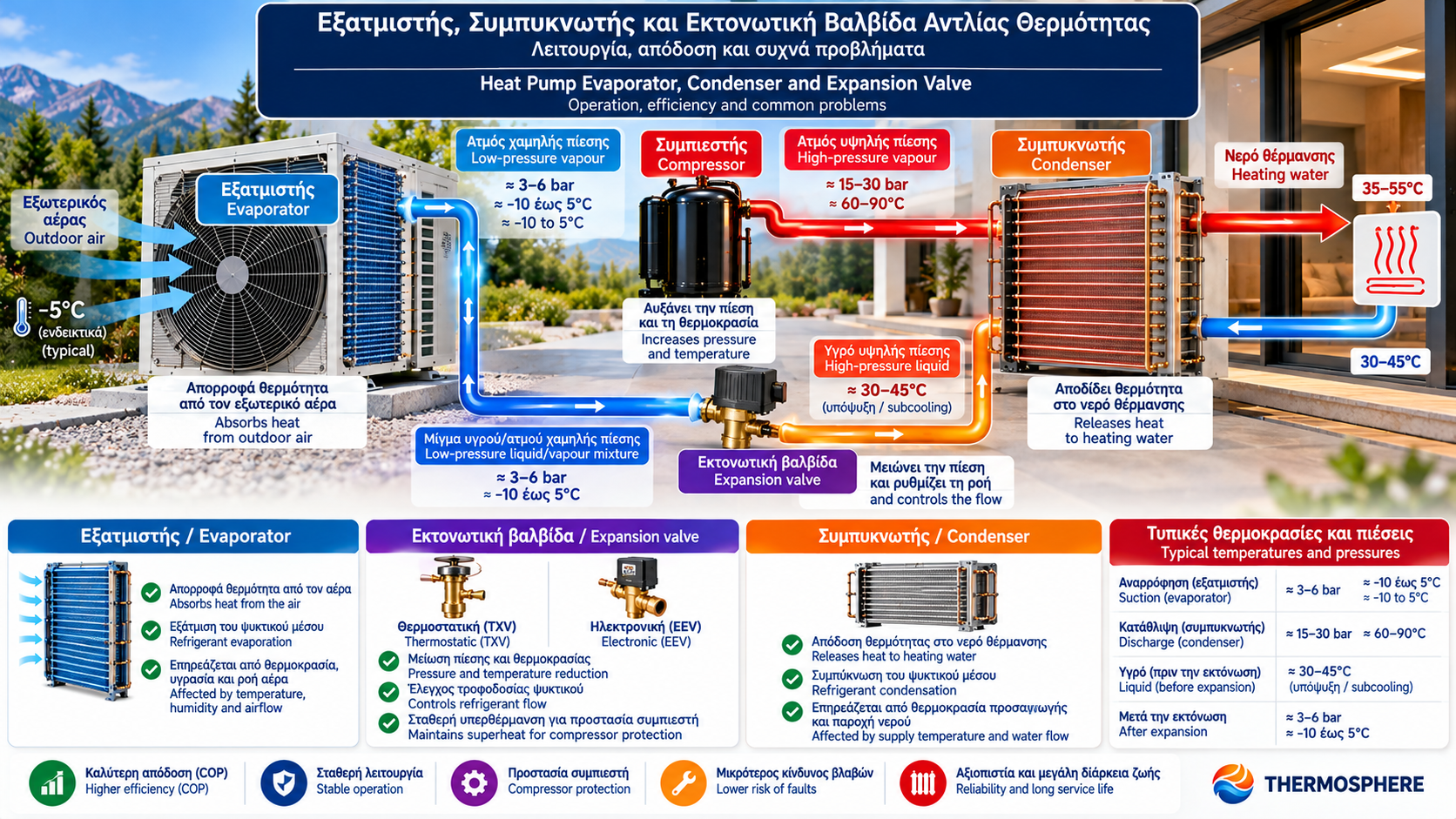
Heat Pump Evaporator, Condenser and Expansion Valve: Operation, Efficiency and Common Problems
A heat pump transfers thermal energy through a sealed refrigeration circuit. Alongside the compressor, three components play essential roles: the evaporator, condenser and expansion valve.
The evaporator allows the refrigerant to absorb heat, the condenser allows it to release heat, and the expansion valve regulates refrigerant flow into the low-pressure side of the system.
Their correct operation influences energy efficiency, operating stability and equipment reliability.
1. How Do the Three Components Work Together?
In an air-to-water heat pump operating in heating mode, the basic cycle includes:
Evaporator: Refrigerant absorbs heat from outdoor air and evaporates.
Compressor: Refrigerant vapour is compressed, increasing its pressure and temperature.
Condenser: Refrigerant releases heat to the heating water and condenses.
Expansion valve: Refrigerant pressure decreases before it returns to the evaporator.
The process repeats while the heat pump operates.
In reversible heat pumps, the functional roles of the heat exchangers may reverse during certain operating modes, including defrost.
2. What Is an Evaporator?
The evaporator is the heat exchanger in which refrigerant absorbs heat from a source.
In an air-to-water heat pump operating in heating mode, the outdoor heat exchanger normally serves as the evaporator.
A fan moves outdoor air across its surface. The refrigerant, at a lower temperature, absorbs heat from the air.
This heat input causes the refrigerant to evaporate.
Heat can still be extracted from cold outdoor air, provided a suitable temperature difference exists.
3. How Does the Evaporator Affect Efficiency?
Heat transfer performance depends on:
Heat exchanger surface area.
Airflow.
Coil cleanliness.
Outdoor temperature.
Humidity.
Evaporating temperature.
Fan operation.
If the evaporator cannot absorb sufficient heat, system performance may decrease.
Ice accumulation or contamination can restrict heat transfer and increase electricity consumption.
4. Why Does Ice Form on the Evaporator?
During cold, humid weather, the outdoor heat exchanger surface may fall below freezing temperature.
Moisture from the air can then freeze on the coil fins.
Frost formation is a normal phenomenon for many air-source heat pumps under certain conditions.
The unit periodically performs defrost cycles to remove accumulated frost.
A problem may exist when defrost is ineffective or excessive ice remains.
Possible causes include sensor problems, fan faults, drainage issues or refrigeration circuit malfunctions.
5. What Is a Condenser?
The condenser is the heat exchanger in which refrigerant releases heat and changes from vapour to liquid.
In an air-to-water heat pump operating in heating mode, the condenser transfers heat to the heating-water circuit.
Many units use plate heat exchangers, although other designs are also available.
The condenser should not be confused with a buffer tank or domestic hot water cylinder.
6. How Does the Condenser Affect COP?
Heating-water temperature influences the condensing temperature required by the refrigeration cycle.
Higher supply water temperatures generally require a larger temperature lift from the compressor.
This usually reduces COP.
For example, a heat pump may operate more efficiently at a 35°C supply temperature than at 55°C under otherwise comparable conditions.
Actual performance differences must be checked against the technical data of the specific unit.
7. Common Condenser Problems
Possible problems include:
Deposits or contamination on the water side.
Insufficient water flow.
Trapped air in the hydraulic circuit.
Excessive pressure losses.
Sensor malfunctions.
Internal heat exchanger leakage in less common cases.
Reduced heat transfer can cause higher condensing temperatures, protective shutdowns or inadequate heating.
Diagnosis should distinguish heat exchanger problems from circulation pump or wider installation faults.
8. What Is an Expansion Valve?
The expansion valve allows refrigerant to pass from the high-pressure side of the circuit to the low-pressure side.
During expansion, refrigerant pressure decreases and its thermodynamic state changes.
The valve also controls refrigerant feed to the evaporator.
Correct control is important for effective evaporator operation and compressor protection.
9. Thermostatic vs Electronic Expansion Valves
Thermostatic Expansion Valve — TXV
A thermostatic expansion valve regulates refrigerant flow using a mechanism that responds to superheat conditions.
It is used in various refrigeration applications.
Electronic Expansion Valve — EEV
An electronic expansion valve is controlled by the unit’s electronic system.
Its opening can be adjusted using sensor measurements and control algorithms.
In many modern variable-capacity heat pumps, an EEV supports precise refrigerant flow control over changing operating conditions.
An EEV does not automatically guarantee higher efficiency without appropriate system design and control.
10. What Is Refrigerant Superheat?
Superheat is the difference between the actual refrigerant vapour temperature and the saturation temperature corresponding to its pressure.
It is an important parameter for refrigeration circuit control and diagnosis.
Appropriate superheat helps ensure correct evaporator feeding and protects the compressor.
There is no single correct superheat value for every heat pump and operating condition.
11. What Is Subcooling?
Subcooling is the difference between the refrigerant saturation temperature on the high-pressure side and the actual liquid refrigerant temperature.
It can be used to evaluate the operation of certain refrigeration circuits.
Interpretation depends on the system architecture, refrigerant and manufacturer instructions.
Measurements must be performed by qualified technicians.
12. Symptoms of Possible Malfunctions
Symptom | Possible causes |
Reduced heating output | Heat exchanger contamination, low water flow or refrigeration circuit problems |
Frequent defrost cycles | Humid weather, restricted airflow, sensor issues or other faults |
High operating pressure | Poor condenser heat transfer, water flow problems or other causes |
Poor evaporator performance | Frost, dirt, fan problems or incorrect refrigerant feeding |
Unstable operation | Sensors, expansion valve, controls or changing operating conditions |
These symptoms do not provide a definitive diagnosis on their own.
13. Can a Blocked Expansion Valve Cause Problems?
A malfunctioning or restricted expansion device may reduce refrigerant flow.
This can result in inadequate evaporator feeding, reduced heating output or protective shutdowns.
Similar symptoms may also have other causes.
Replacing the valve without proper diagnosis is not recommended.
14. How Are Heat Exchangers Maintained?
Maintenance depends on the heat pump design and manufacturer instructions.
Outdoor Heat Exchanger
Check:
Coil fin cleanliness.
Unrestricted airflow.
Fan condition.
Defrost water drainage.
Visible physical damage.
Water-Side Heat Exchanger
Check:
Water quality.
Filters and dirt separators.
Water flow.
Pressure and temperature readings.
Signs of leakage.
Internal cleaning should use only manufacturer-approved methods.
15. When Is a Qualified Technician Required?
Professional attention is required when:
Refrigeration circuit fault codes recur.
The unit shuts down due to pressure or temperature limits.
Refrigerant leakage is suspected.
Abnormal frost accumulation persists.
Expansion valve malfunction is suspected.
The refrigerant circuit must be opened.
Refrigeration work requires suitable training, equipment and any legally required qualifications or certifications.
Additional precautions are essential for flammable refrigerants such as R290.
16. Frequently Asked Questions
Are the Evaporator and Condenser the Same Component?
Both are heat exchangers, but their functions differ according to the system’s operating mode.
Why Does the Outdoor Coil Freeze?
Its surface may fall below freezing during humid weather. Controlled defrost is a normal operating function.
What Does the Expansion Valve Do?
It reduces refrigerant pressure and controls refrigerant feed to the evaporator.
Is an Electronic Expansion Valve Better?
It enables precise electronic control, but overall efficiency depends on the complete equipment design and settings.
Can I Clean the Evaporator Myself?
Only where explicitly permitted by the manufacturer’s instructions, without interfering with electrical, mechanical or refrigerant components.
Can a Dirty Heat Exchanger Increase Electricity Consumption?
Yes. Restricted heat transfer can reduce efficiency and increase the energy required to meet the same heating demand.
Conclusion
The evaporator, condenser and expansion valve are essential parts of the heat pump refrigeration circuit.
The evaporator absorbs heat, the condenser releases it, and the expansion valve regulates pressure reduction and refrigerant feeding.
Correct operation of these three components contributes to energy efficiency, compressor protection and long-term heat pump reliability.
Technical References and Further Reading
ASHRAE Handbook — Refrigeration.
EN 378 — Refrigerating Systems and Heat Pumps: Safety and Environmental Requirements.
Official heat pump technical and service manuals.
Technical documentation from expansion valve and heat exchanger manufacturers.
Thermosphere.gr — Technical knowledge for heating and building systems.