
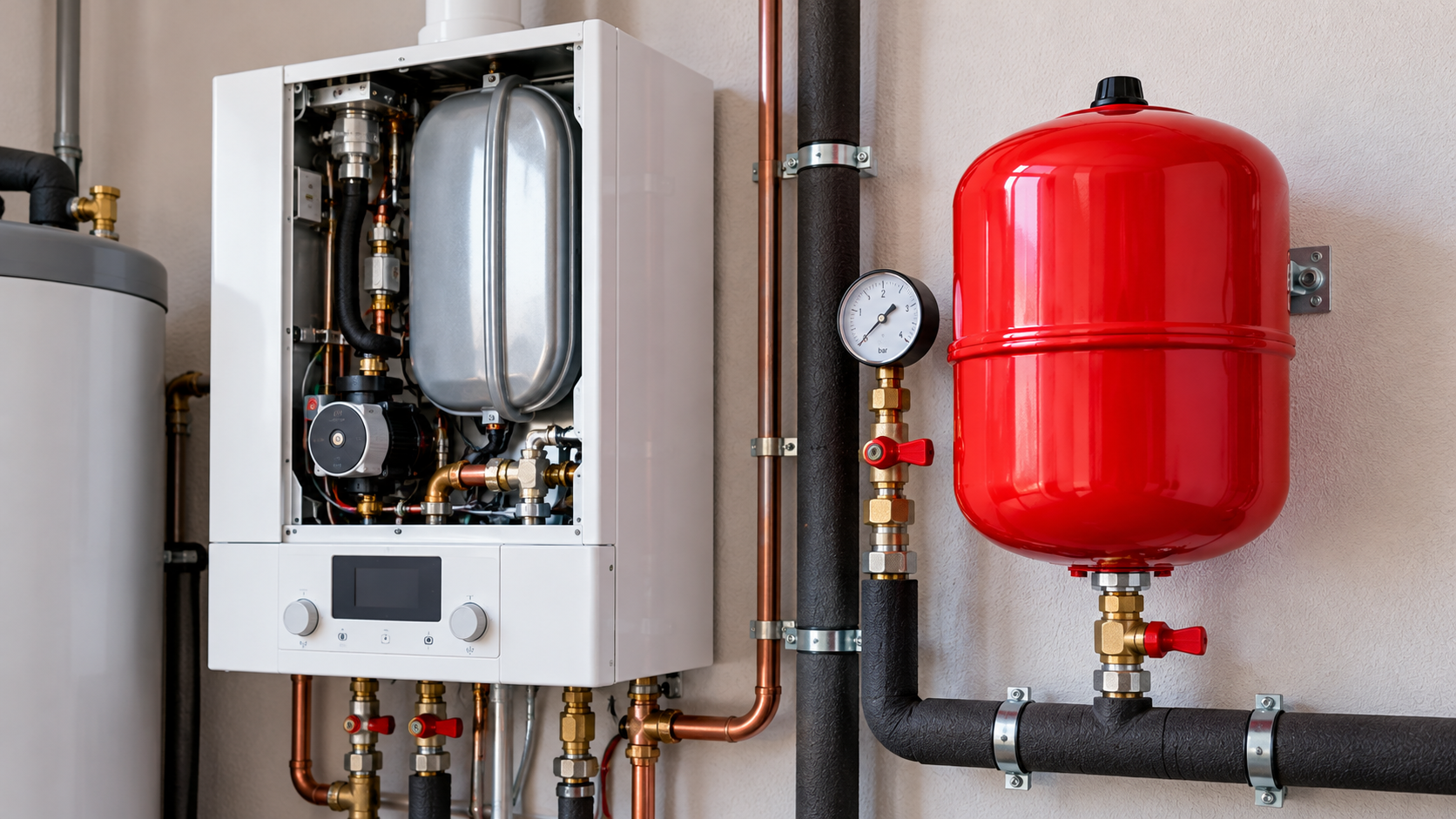
Internal vs External Boiler Expansion Vessel: What Is the Difference?
An expansion vessel is an essential component of a sealed central heating system. It accommodates changes in water volume caused by temperature variations and helps maintain pressure within acceptable operating limits.
Many wall-mounted gas boilers include a built-in expansion vessel.
However, an integrated vessel is not necessarily sufficient for every heating installation.
Systems with a large water volume, extensive pipework or additional heating circuits may require extra expansion capacity.
The decision between relying on the internal vessel and installing an external one should be based on the system’s actual hydraulic characteristics, rather than boiler output alone.
1. What Is an Internal Boiler Expansion Vessel?
An internal expansion vessel is installed inside the boiler casing and forms part of its hydraulic assembly.
It typically contains a flexible diaphragm separating the heating water from a pressurised gas chamber.
When the heating water expands, it enters the vessel and compresses the gas.
As the water cools and contracts, the gas helps return water to the circuit.
Advantages
Compact, integrated design.
No additional wall space required.
Fewer external connections.
Suitable for installations within the manufacturer’s design limits.
Limitations
The available capacity is fixed by the boiler manufacturer.
In some boiler designs, maintenance access or replacement may also be difficult.
2. What Is an External Expansion Vessel?
An external expansion vessel is installed outside the boiler and connected to the sealed heating circuit.
Its operating principle is essentially the same as that of an internal vessel.
The main advantage is that its capacity can be selected to match the requirements of the installation.
Advantages
Greater flexibility in vessel sizing.
Additional expansion acceptance capacity.
Potentially easier maintenance access.
Suitable for larger heating circuits when correctly specified.
Limitations
An external vessel requires sufficient installation space, appropriate support and a suitable hydraulic connection.
Installation must follow the manufacturer’s requirements and applicable safety standards.
3. Internal vs External Expansion Vessel: Key Differences
Feature | Internal vessel | External vessel |
Location | Inside boiler casing | Outside boiler |
Capacity | Manufacturer-defined | Selected for the system |
Additional space | Not normally required | Required |
Maintenance access | Depends on boiler design | Often more accessible |
System expansion | Limited flexibility | Greater flexibility |
Neither option is automatically better.
What matters is whether the available expansion capacity is sufficient for the actual heating system.
4. When Is the Built-In Expansion Vessel Sufficient?
An integrated vessel may be adequate when:
Total system water volume is within the manufacturer’s limits.
Pre-charge pressure is correctly adjusted.
The installation’s static height is compatible with the operating pressures.
The design temperature range is within the vessel’s capacity.
The heating circuit has not been significantly extended.
The technical documentation for the specific boiler model should always be checked.
5. When Is an External Expansion Vessel Required?
An additional external vessel may be needed when the existing expansion capacity is insufficient.
Large Heating System Water Volume
Extensive radiator systems, long pipe runs and additional hydraulic components can increase the total amount of water.
System Extensions
Adding radiators, heating zones or other components may increase expansion requirements beyond the original design.
Insufficient Acceptance Capacity
A sizing calculation may show that the built-in vessel cannot accommodate the expected thermal expansion within the permitted pressure range.
Problems with the Existing Vessel
A faulty integrated vessel may require repair or replacement.
Installing an external vessel should not be treated as a shortcut without identifying the fault and confirming that the resulting hydraulic arrangement is safe.
6. How Is Expansion Vessel Capacity Calculated?
The calculation begins with the total water volume of the sealed heating circuit.
Relevant factors include:
Water inside the boiler.
Radiators and heating emitters.
Distribution pipework.
Manifolds.
Additional water-containing components connected to the same sealed circuit.
Minimum and maximum fluid temperatures.
Static pressure, filling pressure and maximum allowable system pressure.
Example
Consider a heating installation containing 250 litres of water.
If the calculated thermal expansion for its operating temperature range is 2%, the expansion volume is:
250 × 0.02 = 5 litres
The fluid expands by approximately 5 litres.
However, this does not mean that a nominal 5-litre expansion vessel is sufficient.
Only part of a vessel’s nominal volume is available for accepting expanded water.
Its actual acceptance capacity depends on pre-charge pressure, filling pressure and maximum operating pressure.
The final nominal vessel size must therefore be determined through a complete calculation using appropriate manufacturer data.
This example is illustrative and is not a substitute for an installation-specific sizing assessment.
7. What Is the Correct Pre-Charge Pressure?
Pre-charge pressure is the gas pressure inside the vessel when the water side is depressurised.
There is no single correct pre-charge value for every boiler installation.
The appropriate setting depends on:
System static height.
Minimum required pressure at the highest point.
Cold filling pressure.
Boiler and vessel manufacturer specifications.
Pre-charge pressure must not be confused with the pressure displayed on the boiler gauge.
A reliable measurement requires the water side to be appropriately isolated and depressurised.
Inspection and adjustment should be carried out by a qualified heating professional.
8. Why Does Boiler Pressure Rise Too Much?
Some pressure increase during heating is normal.
Excessive increases may indicate:
Insufficient expansion vessel capacity.
Incorrect pre-charge pressure.
A damaged diaphragm.
An unsuitable hydraulic connection.
Unwanted water entering through the filling arrangement.
In some cases, the pressure relief valve may open and discharge water.
Repeated discharge is a sign that the system requires inspection.
9. Why Does Boiler Pressure Drop When Cold?
As the heating water cools, its volume decreases and system pressure may fall.
A small variation is expected.
A substantial pressure drop, particularly after an excessive rise during heating, may indicate an expansion vessel problem.
However, water leaks, pressure relief valve discharge and other causes must also be investigated.
Repeatedly topping up the system is not a permanent solution.
10. Can Internal and External Expansion Vessels Work Together?
Yes, provided the arrangement is correctly designed.
An additional external vessel can increase the total expansion acceptance capacity of the same sealed circuit.
However, the following must be considered:
Condition of the internal vessel.
Pre-charge pressure of each vessel.
Operating pressure range.
Hydraulic connection to the circuit.
Required total acceptance capacity.
Manufacturer instructions.
Adding a second vessel does not automatically resolve pressure problems.
11. Common Installation Mistakes
Selecting Capacity Based Only on Boiler kW
Boiler output alone does not determine water volume or expansion requirements.
Ignoring Pre-Charge Pressure
Even a correctly sized vessel may perform poorly if its pre-charge setting is unsuitable.
Incorrect Hydraulic Connection
The vessel must be connected at an appropriate point in accordance with the system design.
Accidentally Isolating the Vessel
An isolated vessel may leave the operating heating circuit without adequate expansion protection.
Replacing Components Without Diagnosis
Not every boiler pressure problem is caused by the expansion vessel.
12. Frequently Asked Questions
Do All Boilers Have an Internal Expansion Vessel?
No. Many wall-mounted boilers include one, but the arrangement depends on the boiler type and model.
Can I Add an External Vessel to a Boiler with an Internal One?
Yes, if the additional vessel is compatible with the boiler and the overall hydraulic system.
Is a Larger Expansion Vessel Always Better?
Not necessarily. Capacity should be determined by calculation. A larger vessel cannot correct an incorrect pre-charge setting or unrelated faults.
Does Pressure Approaching 3 Bar Mean the Vessel Is Faulty?
Not necessarily. Vessel condition, pre-charge pressure, available capacity and the filling arrangement must all be checked. The pressure relief valve setting depends on the specific system.
Can I Check the Pre-Charge Pressure Myself?
Correct testing requires depressurising the water side and following appropriate safety procedures. Inspection by a qualified technician is recommended.
Conclusion
Internal and external expansion vessels perform the same essential function: accommodating thermal expansion and helping control pressure in a sealed heating system.
A correctly sized integrated vessel may be entirely sufficient for a typical installation.
However, additional external expansion capacity may be necessary when system water volume or operating conditions exceed the built-in vessel’s capabilities.
The correct decision should be based on proper sizing calculations, pressure settings, manufacturer specifications and an assessment of the actual installation by a qualified professional.