
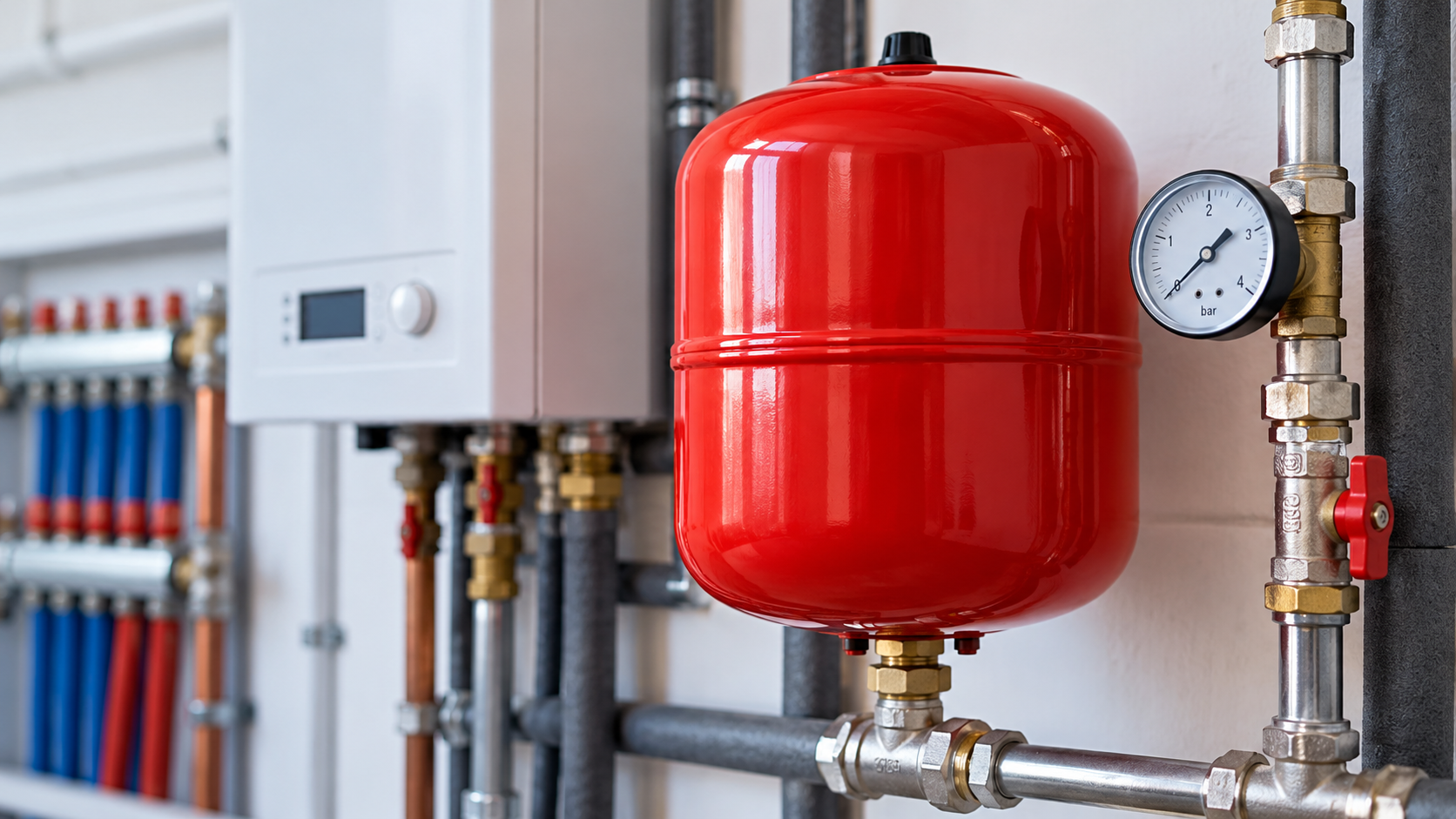
Why Is Choosing the Right Expansion Vessel Important?
An expansion vessel is an essential component of a sealed central heating system. Its purpose is to accommodate the increase in water volume as the temperature rises, helping prevent excessive pressure increases.
Choosing the correct expansion vessel is not simply a matter of matching it to the boiler’s heating output or the size of the property.
The required capacity depends on several factors, including the total system water volume, operating temperatures, static height, filling pressure and maximum allowable operating pressure.
An undersized or incorrectly pre-charged expansion vessel can cause significant pressure fluctuations, even when the other heating system components are functioning correctly.
1. What Happens When an Expansion Vessel Is Too Small?
As water heats up, it expands. In a sealed heating system, this additional volume must be accommodated by the expansion vessel.
If the vessel cannot absorb sufficient expansion, several problems may occur:
Excessive pressure increases during heating.
Discharge of water through the pressure relief valve.
Low system pressure after cooling.
Frequent topping up of the heating circuit.
Boiler shutdowns caused by insufficient system pressure.
However, these symptoms do not always mean that the expansion vessel is undersized.
Incorrect pre-charge pressure, a damaged diaphragm or a faulty filling arrangement may produce similar symptoms.
A proper diagnosis is therefore essential before replacing the vessel.
2. What Information Is Needed to Size an Expansion Vessel?
Five main parameters must be considered when selecting an expansion vessel.
Total System Water Volume
The total water volume includes all the water contained in the heating circuit:
Boiler or heat pump.
Radiators or underfloor heating circuits.
Distribution pipework.
Manifolds and associated hydraulic components.
Buffer tanks, where installed.
A heating system with a large buffer tank may require a substantially larger expansion vessel than another system with the same boiler output.
Operating Temperature
Water expands as its temperature increases.
For example, when water is heated from approximately 10°C to 80°C, its volume increases by around 2.9%.
Systems operating at lower temperatures generally experience less thermal expansion.
Static Height
Static height is the vertical distance between the expansion vessel connection point and the highest point of the heating circuit.
This determines part of the minimum pressure required to maintain adequate pressure throughout the system.
Filling Pressure and Pre-Charge Pressure
Filling pressure refers to the pressure of the water inside the heating circuit.
Pre-charge pressure refers to the gas pressure inside the expansion vessel, on the opposite side of its diaphragm.
These pressures are related but are not identical.
They must be selected according to the system’s static height, operating conditions and the manufacturer’s instructions.
Maximum Allowable Pressure
Every heating system has maximum pressure limits.
The expansion vessel must be sized so that system pressure remains within acceptable limits as the water heats up, allowing an appropriate safety margin below the pressure relief valve setting.
3. How Many Litres Should an Expansion Vessel Hold?
There is no single expansion vessel capacity suitable for every heating installation.
For example, two systems using 24 kW boilers may have completely different water volumes.
One may contain a small number of radiators and short pipe runs, while another may include extensive pipework, additional heating circuits and a buffer tank.
Although boiler output is useful information, it does not determine the required expansion vessel capacity on its own.
Correct sizing depends on the volume of water expansion and the amount of water the vessel can actually accept between its initial and maximum operating pressures.
4. Expansion Vessel Sizing: Worked Example
Consider a simplified sealed heating system with the following characteristics.
System data:
Total water volume: 200 litres.
Initial water temperature: 10°C.
Maximum water temperature: 80°C.
Approximate volumetric expansion: 2.9%.
Vessel pre-charge pressure: 1.0 bar gauge.
Maximum calculation pressure: 2.5 bar gauge.
Step 1: Calculate the Water Expansion Volume
The increase in water volume is calculated as:
200 × 0.029 = 5.8 litres
Therefore, the water expands by approximately 5.8 litres as the system heats up.
However, this does not mean that a vessel with a nominal capacity of 5.8 litres will be sufficient.
Step 2: Calculate the Vessel Acceptance Ratio
An expansion vessel cannot normally accept water equal to its entire nominal volume.
Part of the vessel contains compressed gas, which provides the cushioning effect required to control pressure.
For this simplified calculation, absolute pressures must be used.
A pre-charge pressure of 1.0 bar gauge corresponds to approximately 2.0 bar absolute.
A maximum operating pressure of 2.5 bar gauge corresponds to approximately 3.5 bar absolute.
Assuming the initial water pressure equals the vessel pre-charge pressure, the theoretical acceptance ratio is:
1 − (2.0 / 3.5) = 0.429
This represents approximately 42.9% of the vessel’s nominal capacity.
Step 3: Calculate the Theoretical Minimum Vessel Capacity
The required theoretical capacity is:
5.8 / 0.429 = approximately 13.5 litres
This is a simplified theoretical minimum under the stated assumptions.
It does not include additional water reserve, design allowances, manufacturing tolerances or other requirements that may apply to a real installation.
If the actual cold filling pressure is higher than the vessel’s pre-charge pressure, the available acceptance volume also changes.
A larger standard vessel size would therefore be considered, subject to a complete system calculation and the manufacturer’s sizing requirements.
Important: This example illustrates the calculation method. It is not a recommendation to install a particular vessel size in an actual heating system.
5. How Does Pre-Charge Pressure Affect Performance?
Pre-charge pressure is the gas pressure inside the expansion vessel before the water side is pressurised.
When the heating system warms up, expanding water enters the vessel and compresses the gas behind the diaphragm.
This helps limit the pressure increase within the heating circuit.
If the pre-charge pressure is incorrect, the vessel may not provide its intended acceptance capacity.
The factory pre-charge setting is not necessarily suitable for every installation.
For an accurate measurement, the water side of the vessel must be correctly isolated and depressurised.
Measuring the gas valve pressure while the vessel remains under water pressure does not necessarily reveal its original pre-charge setting.
Inspection and adjustment should be carried out by a suitably qualified heating technician.
6. Is a Larger Expansion Vessel Better?
A larger expansion vessel can provide additional expansion capacity and reduce pressure fluctuations.
However, selecting the largest available vessel is not automatically the best approach.
The following factors must also be considered:
Compatibility with the system fluid.
Maximum operating pressure.
Maximum operating temperature.
Correct pre-charge pressure.
Suitable hydraulic connection.
Available installation space.
Access for inspection and maintenance.
A larger expansion vessel will not correct faults elsewhere in the heating system.
For example, a filling valve that allows water to enter continuously can still cause system pressure to rise excessively.
7. Built-In or External Expansion Vessel?
Many wall-mounted boilers contain a built-in expansion vessel.
Its capacity is designed for a specified range of system conditions and water volumes.
However, the built-in vessel may not be sufficient for installations with larger water volumes.
In such cases, installing an additional external expansion vessel may be an option, provided it is compatible with the heating system and the manufacturer’s requirements.
The connection arrangement, pre-charge pressure and combined expansion capacity must be assessed by a qualified technician.
8. Common Expansion Vessel Sizing Mistakes
Selecting a Vessel Based Only on Boiler Output
Boiler power does not directly determine the total volume of water in the heating circuit.
Ignoring Buffer Tank Capacity
A buffer tank can substantially increase the total system water volume and the amount of thermal expansion.
Assuming the Factory Pre-Charge Is Correct
The factory setting may need adjustment to suit the installation’s static height and pressure requirements.
Confusing Expansion Volume with Vessel Capacity
The nominal vessel capacity must generally be greater than the calculated water expansion volume because only part of the vessel volume is available for water acceptance.
Ignoring Maximum Pressure Limits
The maximum operating pressure and pressure relief valve setting must be considered during sizing.
Replacing the Vessel Without Diagnosing the Problem
Pressure fluctuations can also result from incorrect pre-charge, diaphragm failure or other heating system faults.
9. Frequently Asked Questions
Is an 8-Litre Expansion Vessel Enough for a House?
It depends on the total water volume, operating temperatures and system pressures.
The correct capacity cannot be determined from floor area or boiler output alone.
Can I Install a Second Expansion Vessel?
In many heating systems, an additional vessel can be installed.
However, the hydraulic connection, pre-charge pressures and combined acceptance capacity must be suitable for the installation.
If Boiler Pressure Reaches 3 Bar, Is the Expansion Vessel Faulty?
Possibly, but not necessarily.
The vessel’s pre-charge pressure, diaphragm condition and capacity should be checked, along with other possible causes such as a faulty filling arrangement.
Do Heat Pumps Need Different Expansion Vessel Calculations?
The basic sizing principles are similar for sealed heating circuits.
However, heat pump installations may have different operating temperatures, water volumes and fluid compositions.
If glycol-based antifreeze is used, its thermal expansion characteristics must be included in the calculation.
How Often Should an Expansion Vessel Be Checked?
Inspection intervals should follow the manufacturer’s maintenance recommendations and the requirements of the installation.
Repeated pressure loss or excessive pressure increases during heating should be investigated by a qualified technician.
Conclusion
Choosing the correct expansion vessel is essential for the stable and safe operation of a sealed heating system.
Boiler output alone is not sufficient to determine the required vessel capacity.
The calculation must consider total system water volume, thermal expansion, static height, pre-charge pressure and maximum allowable operating pressure.
A properly sized and adjusted expansion vessel helps maintain stable system pressure and reduces the likelihood of unnecessary pressure relief valve discharge.
Final vessel selection and adjustment should always be confirmed by a qualified heating professional using the actual system specifications and the manufacturer’s technical documentation.