
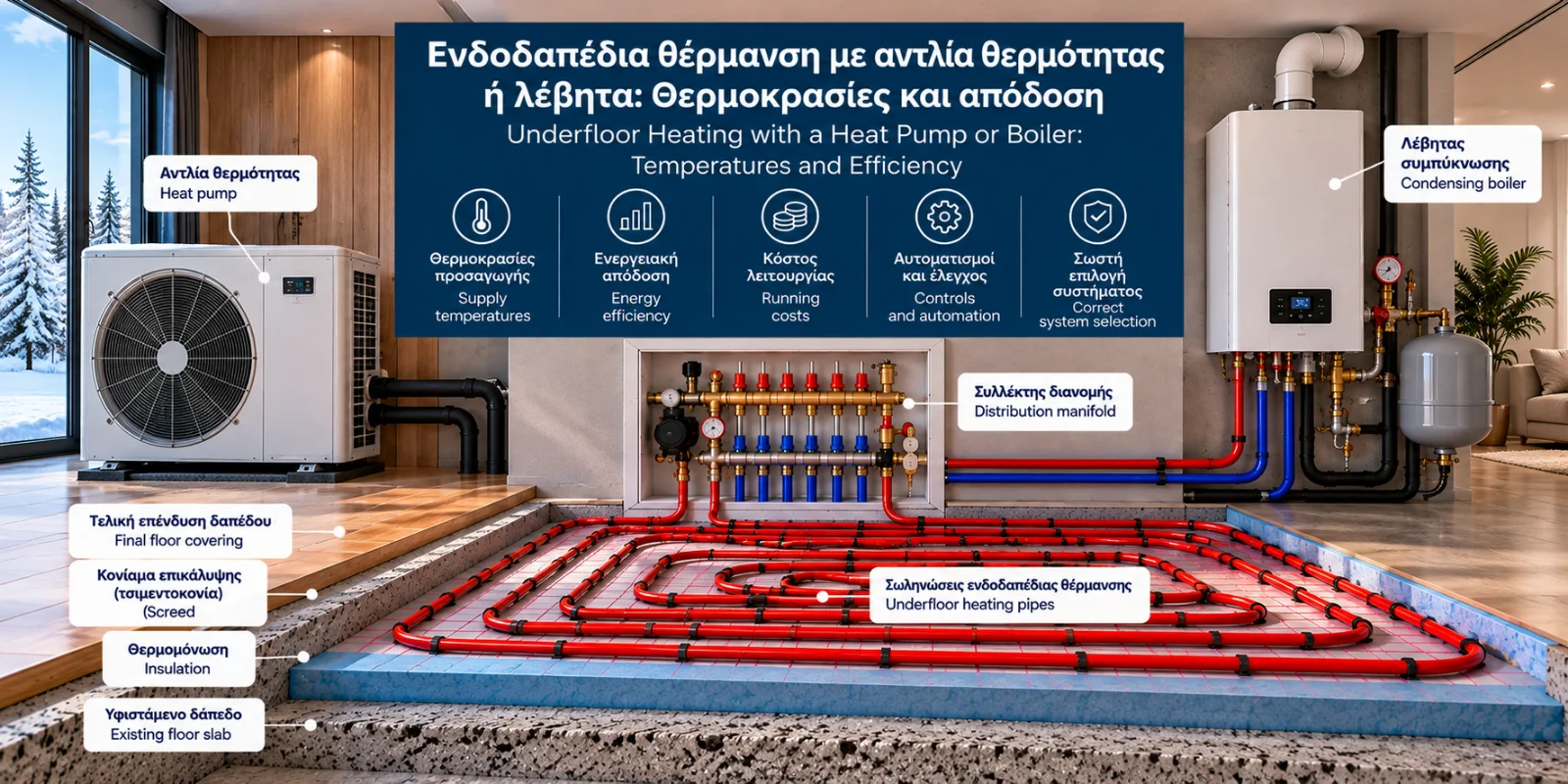
Underfloor Heating with a Heat Pump or Boiler: Temperatures and Efficiency
Hydronic underfloor heating is one of the most suitable solutions for low-temperature space heating. Unlike conventional radiators, it uses a large floor surface to distribute heat throughout a room.
This allows the system to operate with relatively low supply-water temperatures, making it particularly compatible with heat pumps and condensing boilers.
However, choosing the right heat source requires careful consideration of energy efficiency, installation costs, operating temperatures and building heating demand.
In this guide, we explain the differences between using a heat pump and a gas boiler with underfloor heating.
1. Why Does Underfloor Heating Operate at Low Temperatures?
Traditional radiators transfer heat through a relatively small surface area.
Underfloor heating uses a much larger surface, allowing it to provide the required heating output with a lower water temperature.
Many residential installations operate with supply-water temperatures of approximately 30–40°C.
However, the actual temperature depends on several factors:
Building heat losses.
Pipe spacing and installation layout.
Floor covering materials.
Thermal insulation.
Desired indoor temperature.
Available heated floor area.
The correct operating temperature must always be determined through system design calculations.
2. Underfloor Heating with a Heat Pump
A heat pump transfers thermal energy from the surrounding environment into the building's heating system.
Air-to-water heat pumps, for example, extract heat from outdoor air and transfer it to water circulating through the heating installation.
Although the heat pump uses electricity, it can deliver several units of useful heat for every unit of electrical energy consumed.
Understanding COP
The coefficient of performance (COP) describes the relationship between heat output and electrical energy consumption.
For example:
COP = 4
This means that, under specific operating conditions, the heat pump delivers 4 kWh of thermal energy while consuming 1 kWh of electricity.
However, COP is not constant.
It changes depending on outdoor temperature, supply-water temperature and operating conditions.
Why Is Underfloor Heating Ideal for Heat Pumps?
Heat pumps generally operate more efficiently when producing water at lower temperatures.
Because underfloor heating can distribute heat effectively at relatively low temperatures, it can help improve heat pump performance.
The result may be lower electricity consumption and reduced heating costs.
However, actual savings depend on correct sizing, building insulation and operating conditions.
3. Underfloor Heating with a Gas Boiler
Underfloor heating can also operate efficiently with a gas boiler.
Modern condensing boilers are particularly suitable because they can recover additional heat from combustion gases when the return-water temperature is sufficiently low.
This process improves boiler efficiency.
How Does a Condensing Boiler Work?
During combustion, water vapour is produced in the exhaust gases.
When the return-water temperature is sufficiently low, some of this vapour condenses inside the boiler's heat exchanger.
The condensation process releases additional heat that can be transferred to the heating water.
Underfloor heating can support this process because it commonly operates with relatively low return-water temperatures.
Is a Mixing Valve Necessary?
Not always.
If the boiler can safely deliver the required low supply-water temperature, a direct connection may be possible.
However, systems combining conventional radiators and underfloor heating may require separate temperature-controlled circuits.
A mixing valve, additional circulation pump or hydraulic separation may be necessary depending on the installation design.
4. Heat Pump vs Gas Boiler: Main Differences
Feature | Heat Pump | Condensing Gas Boiler |
|---|---|---|
Energy source | Electricity and environmental heat | Natural gas |
Low-temperature heating | Particularly suitable | Suitable |
Efficiency | Depends on COP and SCOP | Depends on seasonal boiler efficiency |
Initial investment | Often higher | Depends on existing infrastructure |
Running costs | Electricity price and SCOP | Gas price and efficiency |
Main installation needs | Suitable heat pump location and hydraulic connections | Gas supply and flue installation |
Neither technology is automatically the most economical solution for every building.
5. Comparing Heating Operating Costs
A practical comparison should consider the cost of producing one kilowatt-hour of useful heat.
Heat Pump Example
The approximate cost of useful heat is calculated as:
Electricity price ÷ SCOP
Assume:
Electricity price: €0.20/kWh.
Seasonal coefficient of performance (SCOP): 4.
Calculation:
€0.20 ÷ 4 = €0.05 per kWh of useful heat.
Gas Boiler Example
The approximate cost of useful heat is calculated as:
Gas price ÷ Boiler efficiency
Assume:
Natural gas price: €0.09/kWh.
Boiler efficiency: 95%, using a consistent energy basis.
Calculation:
€0.09 ÷ 0.95 = approximately €0.095 per kWh of useful heat.
These figures are hypothetical examples, not current energy prices.
They exclude fixed charges, maintenance, auxiliary electricity consumption and installation costs.
Actual operating costs depend on local tariffs and seasonal system performance.
6. What Is the Correct Supply-Water Temperature?
The supply-water temperature should be high enough to cover the heating demand without exceeding the limits of the floor system.
Excessively high temperatures can:
Reduce heat pump efficiency.
Increase energy consumption.
Cause uncomfortable floor temperatures.
Potentially damage unsuitable floor coverings.
The EN 1264 standard addresses the thermal performance and surface-temperature limits of embedded surface heating systems.
For ordinary occupied areas, a maximum floor surface temperature of approximately 29°C is commonly referenced under design conditions.
Different limits may apply to bathrooms, peripheral zones and specific floor materials.
The applicable standard and manufacturer instructions must always be followed.
7. Weather Compensation and Temperature Control
Weather compensation is a control strategy that adjusts the heating-water temperature according to outdoor conditions.
When the outdoor temperature increases, the controller reduces the required supply-water temperature.
When the weather becomes colder, the controller increases it according to the heating curve.
This approach can improve comfort and avoid unnecessarily high operating temperatures.
Weather compensation is particularly beneficial for heat pumps and low-temperature heating installations.
8. Continuous Operation and Thermal Inertia
Traditional underfloor heating systems embedded in screed have relatively high thermal mass.
The floor takes time to warm up and also retains heat after the heating system stops.
As a result, frequent large temperature changes may lead to delayed responses and indoor temperature fluctuations.
In many buildings, stable operation with appropriate weather compensation and modest temperature setbacks is preferable.
However, the optimal control strategy depends on the building's insulation, occupancy schedule and heating system characteristics.
9. Common Installation and Operating Mistakes
Excessively High Water Temperatures
High supply temperatures can reduce efficiency and increase the risk of overheating the floor.
Incorrect Heat Source Sizing
Oversized or undersized equipment may cause inefficient operation, frequent cycling or insufficient heating.
Poor Hydraulic Balancing
Incorrect flow rates can cause some rooms to heat faster than others.
Inappropriate Heating Controls
Poor coordination between thermostats, pumps and the heat source can reduce overall performance.
Neglecting Water Quality
Inadequate water quality can contribute to corrosion, deposits and reduced equipment reliability.
10. Frequently Asked Questions
Is a heat pump necessary for underfloor heating?
No. Underfloor heating can operate with a suitable gas boiler or another compatible heat source.
Can a gas boiler supply water at 35°C?
Some boilers can operate at low supply temperatures, but this depends on the model and manufacturer specifications.
Which option is cheaper to operate?
The answer depends on electricity and gas prices, seasonal efficiency, building heat losses and operating conditions.
Does every heat pump require a buffer tank?
No. The requirement depends on minimum system water volume, defrosting requirements, water flow and the manufacturer's recommendations.
Is underfloor heating suitable for older buildings?
It can be, but a heat-loss calculation is essential. Buildings with high heat losses may require insulation improvements or additional heat-emitting capacity.
Conclusion
Hydronic underfloor heating can work effectively with both heat pumps and condensing gas boilers.
Heat pumps benefit from low supply-water temperatures, while condensing boilers can achieve efficient operation when return-water temperatures allow condensation.
The best choice depends on the building's heating requirements, installation costs, energy prices and expected seasonal performance.
Correct system design, hydraulic balancing and temperature control are essential for reliable and economical operation.
Thermosphere.gr — Technical knowledge for heating and building systems.