
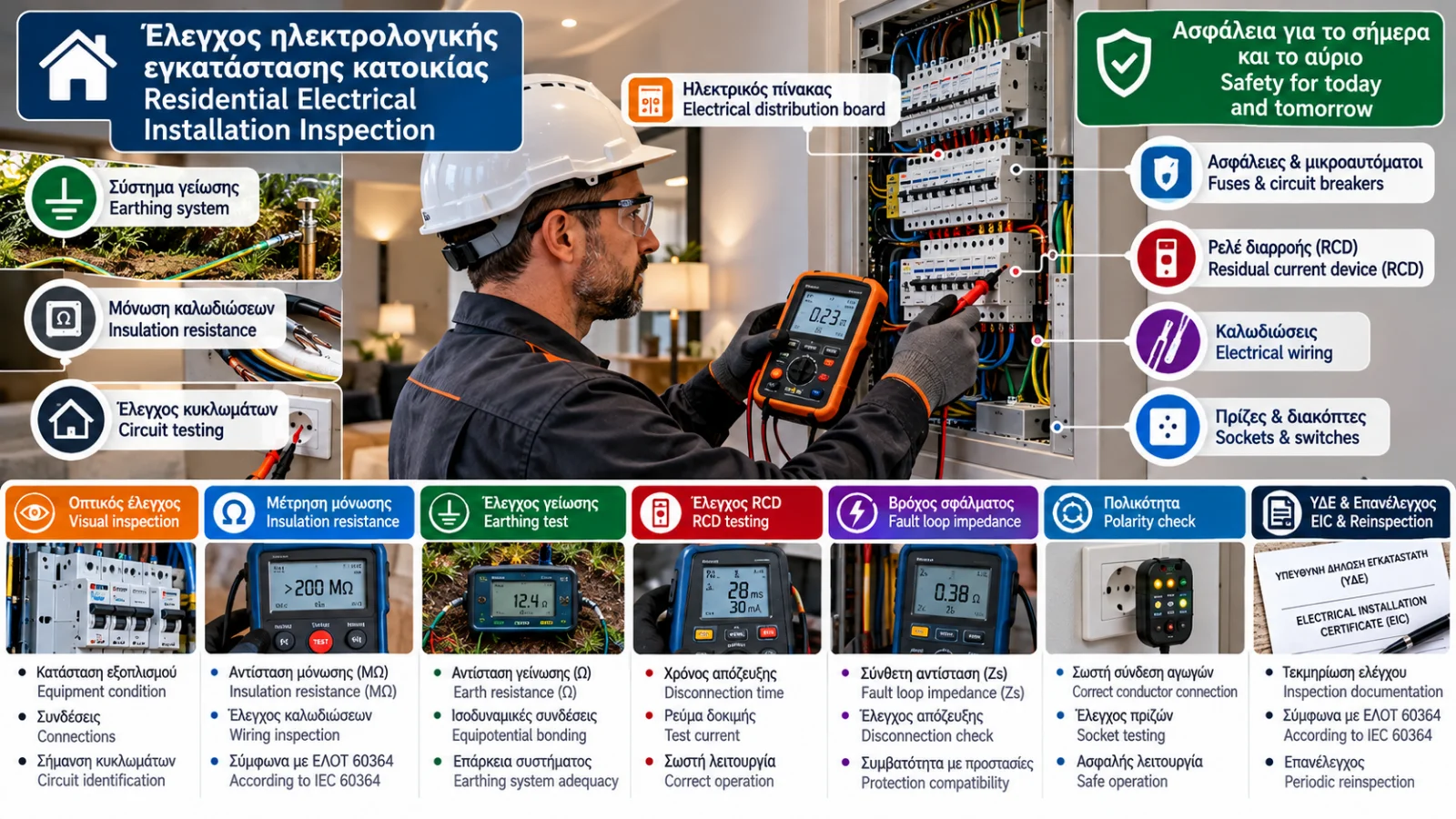
Home Electrical Installation Inspection: Complete Guide to Testing, Safety and Certification
A home's electrical installation is one of its most important technical systems. It supplies electricity to lighting, appliances, heating equipment, pumps and other devices used every day.
However, the fact that lights work and electrical outlets provide power does not necessarily mean that the installation is safe.
Problems such as inadequate earthing, deteriorated insulation, incorrect wiring and unsuitable protective devices may remain undetected for years.
A comprehensive electrical installation inspection helps assess the condition of the electrical system and verify the effectiveness of its protective measures.
This guide explains what a professional residential electrical inspection includes, which measurements are performed, how results are evaluated and what homeowners should know about electrical installation certification in Greece.
1. What Is an Electrical Installation Inspection?
An electrical installation inspection is an organized process involving visual examination, testing and measurements to determine whether an electrical installation complies with applicable safety requirements.
It is not limited to the main electrical distribution board.
Depending on the installation, an inspection may include:
The electrical supply and distribution system.
Main distribution boards.
Sub-distribution boards.
Electrical circuits and wiring.
Socket outlets and switches.
Protective conductors.
Earthing arrangements.
Protective devices.
Permanently connected electrical equipment.
Outdoor electrical circuits.
The inspection must be performed by a professional with the appropriate qualifications and legal authorization.
2. Why Is Electrical Inspection Important?
Electrical hazards may exist even when no obvious malfunction has occurred.
For example:
A socket outlet may operate without an effective protective earth connection.
A cable may have damaged insulation.
A residual current device may fail to operate correctly.
A circuit may be protected by an unsuitable circuit breaker.
A loose electrical connection may overheat.
A professional inspection helps identify these conditions before they develop into more serious problems.
3. Types of Electrical Installation Inspections
Initial Verification
Initial verification is performed before a new electrical installation is placed into service.
Its purpose is to establish whether the installation complies with the applicable requirements.
Periodic Inspection
Periodic inspection is carried out on existing electrical installations according to their use, classification and applicable regulatory requirements.
Its purpose is to assess the condition of the installation after a period of operation.
Additional or Exceptional Inspection
An additional inspection may be necessary following circumstances such as:
Significant electrical modifications.
Circuit extensions.
Electrical accidents.
Fire damage.
Serious electrical faults.
Evidence of unsafe operation.
The required inspection scope depends on the installation and applicable regulations.
4. How Does an Electrical Inspection Begin?
Before performing measurements, the electrician examines the available installation documentation.
This may include:
Previous electrical installation declarations.
Single-line diagrams.
Distribution board drawings.
Previous inspection reports.
Records of modifications.
Electrical supply characteristics.
Circuit identification records.
The electrician then performs a visual inspection.
Visual examination is essential because some defects cannot be identified through electrical measurements alone.
5. Electrical Distribution Board Inspection
The distribution board is the central point for electrical distribution and protection.
During an inspection, the electrician may examine:
The overall board arrangement.
Enclosure condition.
Circuit breaker suitability.
Residual current devices.
Circuit identification.
Conductors and connections.
Neutral and protective conductors.
Protective covers.
Protection against direct contact.
Compatibility between protective devices and circuits.
Why Are Circuit Breakers Checked?
A circuit breaker must be suitable for the electrical characteristics of the circuit it protects.
A higher-rated circuit breaker is not necessarily a better choice.
If the protective device is unsuitable, the wiring may not receive adequate protection during overloads or faults.
6. Earthing System Inspection
Protective earthing is a fundamental element of electrical safety.
Its effectiveness must be evaluated together with the installation's earthing system and protective devices.
What Is Checked?
Depending on the installation, the electrician may inspect:
Earthing arrangements.
Protective conductor connections.
Protective conductor continuity.
Required equipotential bonding.
Earth electrode resistance, where applicable.
Effectiveness of protection against electric shock.
What Is Earth Resistance?
Earth resistance describes a characteristic of the electrical connection between an earth electrode and the surrounding ground.
Its significance depends on the earthing arrangement and protective measures.
There is no single universal earth resistance value that independently proves every residential electrical installation is safe.
For example, in a TT system using RCD protection, verification involves the relationship between earthing resistance and the characteristics of the protective device.
Therefore, an earth resistance measurement must always be interpreted in the context of the entire installation.
7. Protective Conductor Continuity Testing
The protective conductor, commonly identified as PE, connects relevant conductive parts of an installation to the protective earthing system.
Continuity testing verifies that the required protective electrical connections are present and effective.
Testing may involve:
Socket outlets.
Metal equipment enclosures.
Protective conductors.
Equipotential bonding connections.
Distribution points.
Why Is a Simple Voltage Reading Insufficient?
The presence of voltage at a socket does not prove that its protective conductor is correctly connected.
Appropriate instruments and verification procedures are therefore required.
Continuity measurements must be performed using the necessary safe isolation procedures.
8. Insulation Resistance Testing
Electrical insulation limits unintended current flow between conductive parts.
Over time, insulation may deteriorate because of:
Temperature.
Moisture.
Mechanical stress.
Material aging.
Improper modifications.
Environmental conditions.
What Does the Test Measure?
Insulation resistance testing evaluates the insulation between the relevant conductors.
Results are commonly expressed in megohms (MΩ).
How Are Results Evaluated?
The required minimum insulation resistance and test voltage depend on the circuit's nominal voltage and applicable requirements.
IEC 60364-6 specifies test voltages and minimum insulation resistance values for different circuit categories.
The test must not be applied indiscriminately to connected electronic equipment, as the test voltage may damage sensitive devices.
The electrician selects the appropriate procedure and disconnects or protects equipment where necessary.
9. Residual Current Device (RCD) Testing
A residual current device is an important electrical protective device.
It detects an imbalance between the currents flowing through the live conductors of a protected circuit.
When the operating conditions are met, the RCD disconnects the electrical supply.
What Does Professional RCD Testing Include?
Testing may include:
Verification of RCD type.
Checking rated residual operating current.
Assessment of installation compatibility.
Functional testing.
Measurement of disconnection time.
Testing at appropriate residual currents.
What Does a 30 mA RCD Mean?
The 30 mA rating refers to the device's rated residual operating current.
It does not mean that every leakage current of exactly 30 mA will always produce the same disconnection time under all conditions.
RCD performance is assessed according to the device type, relevant product standard and applicable testing requirements.
Is the TEST Button Sufficient?
The TEST button provides a basic functional check according to the device's design.
It does not replace comprehensive testing using suitable instruments.
An RCD also does not replace protective earthing or overcurrent protection.
10. Earth Fault Loop Impedance Testing
Earth fault loop impedance testing is used to verify certain conditions for protection against electric shock.
Earth fault loop impedance is commonly represented by the symbol Zs.
What Is the Fault Loop?
When an electrical fault occurs, fault current follows a return path toward the electrical source.
The characteristics of this path influence the fault current and the operation of protective devices.
Why Is This Measurement Important?
In systems where protection relies on automatic disconnection of supply, the required disconnection conditions must be verified.
The assessment depends on:
Earthing system.
Fault loop impedance.
Protective device characteristics.
Required disconnection time.
There is no single acceptable fault loop impedance value for every electrical installation.
11. Polarity Testing
Polarity concerns the correct connection of live conductors within electrical circuits and accessories.
Testing verifies, where applicable, that:
Single-pole protective devices are installed in the appropriate conductors.
Switches interrupt the intended conductor.
Socket outlets and accessories are correctly connected.
Dangerous wiring errors are absent.
Correct polarity is an important part of electrical installation verification.
12. Voltage and Voltage Drop Assessment
Supply voltage is a fundamental electrical quantity.
However, the presence of nominal voltage at a particular point does not independently establish circuit safety.
What Is Voltage Drop?
When electrical current flows through conductors, a voltage drop occurs because of their impedance.
Voltage drop depends on:
Circuit length.
Conductor cross-sectional area.
Conductor material.
Load current.
Circuit characteristics.
Why Does It Matter?
Excessive voltage drop can affect the performance of electrical appliances and equipment.
Verification may involve appropriate measurements or calculations according to applicable requirements.
13. Three-Phase Electrical Installation Inspection
Homes with three-phase electrical supplies may require additional checks.
These may include:
Presence of all three phases.
Phase-to-phase voltages.
Phase-to-neutral voltages.
Load distribution.
Phase sequence.
Neutral conductor condition.
Protective device suitability.
Phase sequence is particularly important for certain electric motor applications.
Load distribution can also affect installation performance.
14. Socket Outlet and Circuit Inspection
Socket outlets are used daily and should be included in the appropriate inspection and verification process.
Depending on the installation, the electrician may examine:
Physical condition.
Correct wiring.
Protective conductor continuity.
Signs of deterioration.
Circuit protection.
Suitability for the installation environment.
Outlets in Wet and Outdoor Locations
Bathrooms, yards and other locations with special environmental conditions require additional consideration.
Equipment must be suitable for the location and comply with applicable requirements.
A protective cover alone does not establish that a socket outlet is correctly installed or adequately protected.
15. Which Instruments Are Used for Electrical Testing?
A comprehensive electrical inspection requires suitable testing equipment.
Instrument | Main Application |
|---|---|
Multimeter | Electrical quantity measurements |
Clamp meter | Current measurement |
Insulation resistance tester | Insulation testing |
Continuity tester | Protective conductor testing |
Earth resistance tester | Earthing measurements |
Fault loop impedance tester | Fault loop measurements |
RCD tester | Residual current device testing |
Multifunction installation tester | Multiple verification tests |
Instruments and measurement methods must be appropriate for the installation.
The IEC 61557 series provides relevant requirements for equipment used to test, measure or monitor protective measures in low-voltage electrical systems.
16. How Are Electrical Test Results Evaluated?
A measurement cannot always be classified as acceptable or unacceptable without additional information.
Measurement | Main Evaluation Criterion |
|---|---|
Insulation resistance | Compliance with applicable limits |
Protective conductor continuity | Effective continuity of protective connections |
Earth resistance | Compatibility with earthing and protective arrangements |
Fault loop impedance | Automatic disconnection conditions |
RCD testing | Correct operating characteristics |
Polarity | Correct electrical connections |
Voltage drop | Compliance with relevant design criteria |
Electrical inspection results must be evaluated as a whole.
A single successful measurement does not certify the safety of an entire installation.
17. What Is an Electrical Installation Certificate in Greece?
In Greece, the relevant electrical installation documentation includes the Υπεύθυνη Δήλωση Εγκαταστάτη (ΥΔΕ), commonly translated as the Electrician's Declaration or Electrical Installation Declaration.
The process is governed by the applicable Greek regulatory framework.
Depending on the installation and circumstances, the required documentation may include:
Electrical drawings.
Inspection and test reports.
Installation information.
Other prescribed supporting documents.
Is the Declaration Simply a Certificate?
The expression "electrician's certificate" is commonly used in everyday language.
However, the declaration should not be treated as a document without technical verification.
Its preparation is linked to the required inspection, testing and documentation procedures.
Who Can Issue It?
The declaration must be issued by a professional holding the required legal authorization under Greek legislation.
18. How Often Should an Electrical Installation Be Inspected?
Inspection intervals depend on the type and use of the installation and the applicable national regulations.
For ordinary residential installations in Greece, the maximum regular reinspection interval is generally ten years.
However, certain circumstances may require earlier inspection.
These may include:
Significant electrical modifications.
Changes in property use.
Electrical accidents.
Serious faults.
Other regulatory requirements.
Homeowners should consult the current legislation, previous installation documentation and an appropriately qualified electrician.
19. When Is an Earlier Inspection Necessary?
There are situations where waiting until the next scheduled inspection is not appropriate.
Examples include:
Repeated circuit breaker or RCD tripping.
Electric shocks or tingling sensations from appliances.
Overheating outlets.
Burning smells.
Unusual sparking.
Visible cable damage.
Installation of major electrical loads.
Renovation work.
Water entering electrical equipment.
Concerns about earthing.
If an immediate electrical hazard exists, stop using the affected equipment where this can be done safely and seek professional assistance.
20. What Happens If Problems Are Found?
The electrician evaluates the findings and identifies the necessary corrective actions.
Depending on the severity, these may include:
Replacing damaged accessories.
Correcting wiring errors.
Repairing protective conductor connections.
Upgrading protective devices.
Repairing electrical circuits.
Improving earthing arrangements.
Modifying distribution boards.
Performing additional tests.
After corrective work, the relevant verification tests must be repeated.
An installation should not be considered safe merely because an obvious symptom has disappeared.
21. Common Misconceptions About Electrical Inspections
"If the Outlets Work, the Installation Is Safe"
Normal operation does not prove compliance with electrical safety requirements.
"An RCD Means No Other Testing Is Necessary"
An RCD is only one part of the overall protection system.
"A Socket With Earth Contacts Must Be Properly Earthed"
Earth contacts do not prove that the protective connection is effective.
"A Larger Circuit Breaker Provides Better Protection"
Protective devices must match the characteristics of the circuit.
"A Simple Voltage Measurement Is Enough"
Comprehensive verification requires different tests and measurements.
"An Old Certificate Proves the Installation Is Still Safe"
Electrical installations can deteriorate or be modified over time.
22. Frequently Asked Questions
How Long Does a Home Electrical Inspection Take?
The duration depends on the size of the property, number of circuits, accessibility and installation condition.
Does the Electricity Need to Be Switched Off?
Some tests require safe isolation, while others are performed under different conditions. The electrician determines the appropriate procedure.
Can a Complete Inspection Be Performed With a Multimeter?
No. Comprehensive verification requires appropriate testing instruments and procedures.
Why Does My RCD Keep Tripping?
Possible causes include appliance faults, wiring defects or other electrical problems. Repeated tripping requires professional investigation.
Can an Old Electrical Installation Still Be Safe?
Age alone does not establish an installation's condition. Appropriate inspection and assessment against applicable requirements are necessary.
Is a New Electrical Declaration Required After Renovation?
That depends on the extent of the electrical work and the applicable legal requirements.
Is Inspecting the Distribution Board Enough?
No. Comprehensive inspection may require testing throughout the installation.
How Can I Check Whether My Home Is Properly Earthed?
Effective earthing must be verified using suitable testing procedures and professional assessment.
Can I Perform Electrical Tests Myself?
Professional electrical testing requires technical competence, suitable equipment and safe working procedures. It should not be attempted by unqualified or unauthorized individuals.
Conclusion
A residential electrical installation inspection is not simply an administrative formality.
It is a comprehensive technical assessment combining visual inspection, electrical testing, measurements and documentation.
Examination of the distribution board, earthing system, insulation, protective conductors and residual current devices helps verify the installation's protective measures.
Fault loop impedance, polarity and other electrical tests provide additional information needed to assess compliance with applicable technical requirements.
Electrical installation declarations and periodic inspections are important parts of maintaining appropriate technical documentation and supporting safe residential electrical operation.
Electrical safety is not demonstrated simply because an installation works. It must be properly inspected, tested and evaluated.
Thermosphere.gr — Technical knowledge for safer and more efficient installations.
Disclaimer: This article provides general educational and technical information. It does not replace professional electrical inspection, electrical engineering design or applicable legal requirements. Electrical testing and installation work must be performed by appropriately qualified and authorized professionals.
Technical References
ELOT 60364 — Requirements for Electrical Installations in Greece.
IEC 60364-6 — Low-Voltage Electrical Installations: Verification.
IEC 60364-4-41 — Protection Against Electric Shock.
IEC 60364-5-54 — Earthing Arrangements and Protective Conductors.
IEC 61557 — Electrical Safety in Low-Voltage Distribution Systems: Equipment for Testing, Measuring or Monitoring Protective Measures.
ELOT — Hellenic Organization for Standardization: https://www.elot.gr/
HEDNO — Hellenic Electricity Distribution Network Operator: https://www.deddie.gr/