
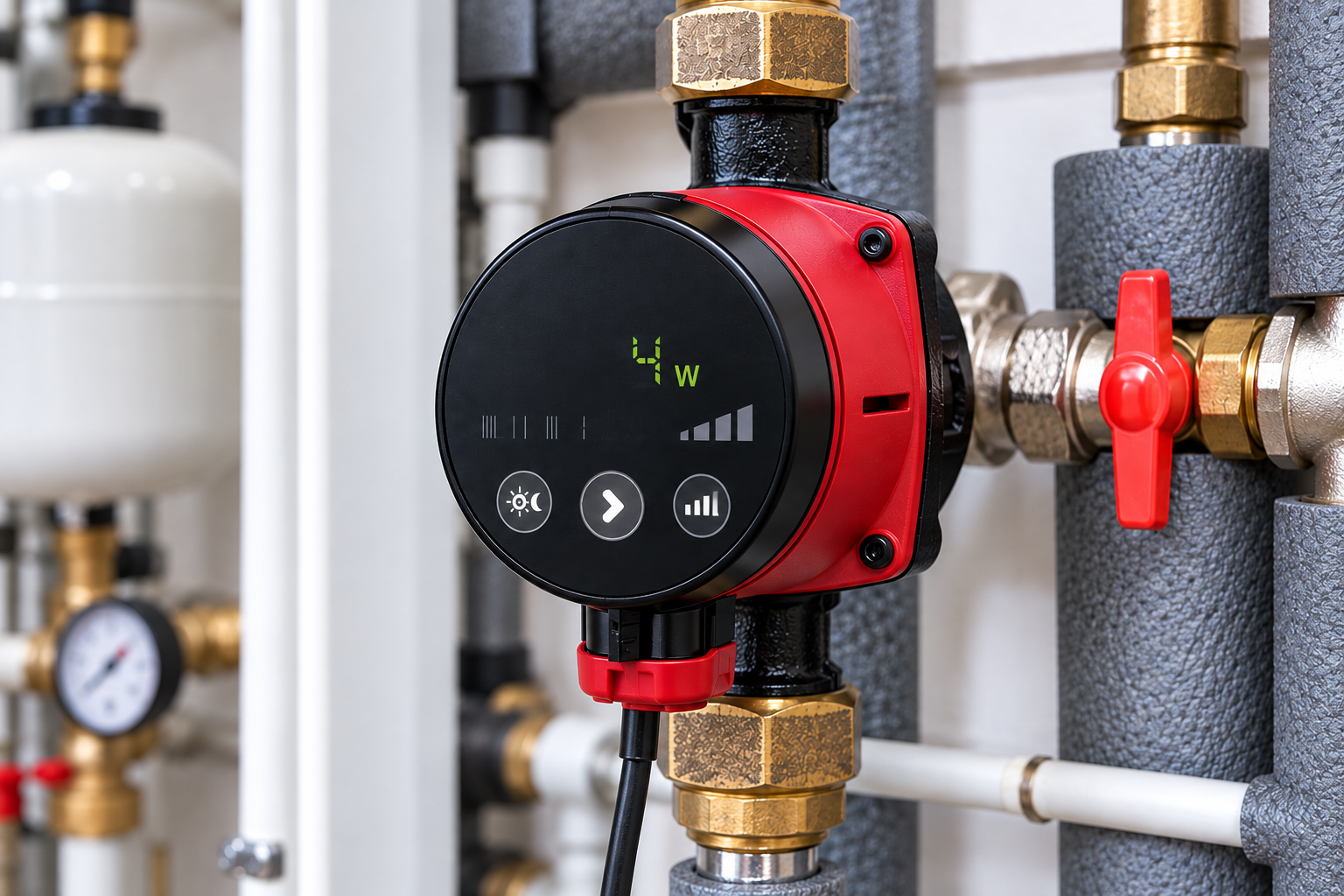
Heating Circulation Pump Installation: Correct Position, Orientation and Common Mistakes
Correct installation of a heating circulation pump is essential for reliable water circulation, efficient operation and equipment service life.
Even a correctly sized circulator may experience noise, inadequate flow or premature wear if installed incorrectly.
Flow direction, motor shaft orientation, positioning relative to the expansion vessel, and protection against trapped air and contaminants are all important considerations.
This guide explains the main installation principles and common mistakes to avoid.
1. What Does a Heating Circulation Pump Do?
A circulation pump moves water through the hydronic heating system.
It creates the differential pressure needed to overcome hydraulic resistance in pipes, valves and other components.
In a typical closed heating circuit, the pump does not need to overcome the building’s full static elevation as a water-lifting pump would. Required pump head is primarily associated with circulation pressure losses.
Correct installation must follow the hydraulic design and manufacturer instructions.
2. Where Should the Circulator Be Installed?
A heating circulator can be installed in different locations depending on the system design.
There is no universal rule requiring every circulator to be installed exclusively on the supply or return line.
Important factors include:
Expansion vessel connection location.
Water operating temperature.
Available pressure at the pump inlet.
Pipework arrangement.
Heat source requirements.
Manufacturer installation instructions.
In suitably designed closed systems, arranging the pump to circulate water away from the expansion vessel connection can help maintain favourable system pressures.
The final location should be determined by the hydraulic design.
3. Supply Line or Return Line?
Both positions can be appropriate depending on the installation.
Supply line: May be suitable when required pressure and temperature conditions are met and the system is designed accordingly.
Return line: May expose the pump to lower water temperatures, but this does not automatically make it the best hydraulic location.
Lower water temperature alone is not sufficient to determine the installation position.
Special attention is needed in systems with multiple pumps, hydraulic separators, buffer tanks and complex controls.
4. Why Is Motor Shaft Orientation Important?
For most wet-rotor circulation pumps, the motor shaft must remain horizontal.
Correct orientation supports lubrication and cooling of internal components by the circulating water.
Installing the motor shaft vertically when this is not permitted can cause operating problems and premature wear.
Two different concepts must be distinguished:
Motor shaft orientation.
Direction of the pipework.
Depending on the model, a circulator may be installed in horizontal or vertical pipework while keeping the motor shaft horizontal.
Permitted installation positions must always be confirmed in the manufacturer’s manual.
5. How Do You Check Flow Direction?
Most circulators have an arrow on the pump housing indicating water flow direction.
During installation, this arrow must align with the intended circulation direction in that section of the system.
Incorrect flow direction may cause:
Insufficient heating.
Unwanted circulation patterns.
Problems with control valves.
Improper hydraulic circuit operation.
Flow direction should be verified before commissioning.
6. How Does the Expansion Vessel Affect Pump Position?
In a closed hydronic system, the expansion vessel connection influences system pressure distribution while the circulator is running.
This location is often described as the Point of No Pressure Change.
Pump positioning relative to this point affects pressure levels in different parts of the system.
In many configurations, pumping away from the expansion vessel connection helps increase pressure throughout the circulating circuit.
This can reduce problems associated with air entry or insufficient pressure in sensitive locations.
The complete hydraulic arrangement must be evaluated rather than considering pump position in isolation.
7. Why Is Air Removal Important?
Trapped air can interfere with circulation pump operation and cause:
Gurgling.
Unstable water circulation.
Reduced performance.
Noise.
Cooling or lubrication problems in some wet-rotor circulators.
Before commissioning, the system must be correctly filled and vented according to installation instructions.
Some modern circulators include a dedicated venting function.
However, this feature does not necessarily remove air from every radiator or section of the heating network.
8. Is a Filter Needed Before the Pump?
Dirt, corrosion products and magnetite can cause problems in circulators and other heating system components.
For this reason, many installations include suitable strainers, dirt separators or magnetic separators.
The location and type of protective equipment should follow the system design and manufacturer guidance.
A poorly maintained strainer can create excessive pressure losses.
Therefore, filters should not be installed arbitrarily without considering hydraulic requirements.
9. What Should Be Considered When Connecting Pipework?
Correct pipe connections help protect the circulator against mechanical stress.
Avoid:
Excessive mechanical loads on the pump housing.
Unsupported pipework.
Misaligned connections.
Installations that prevent maintenance access.
Locations prone to air accumulation.
Some pump models or applications may require specific distances from elbows, valves or other fittings.
There is no universal straight-pipe length requirement that applies to every circulation pump.
Such requirements must be checked in the specific manufacturer’s manual.
10. Common Circulation Pump Installation Mistakes
Incorrect orientation: Motor shaft in a prohibited position → Check manufacturer instructions.
Wrong flow direction: Pump installed against intended circulation → Check housing arrow.
Trapped air: Inadequate venting → Fill and vent the system correctly.
Dirty system water: Insufficient contaminant protection → Check filters and separators.
Poor positioning: Unsuitable pressure conditions → Review hydraulic design.
Inadequate pipe support: Vibration transmission → Inspect supports and connections.
Incorrect settings: Unsuitable operating curve → Check flow and pump head requirements.
11. What Should Be Checked Before Startup?
Before commissioning a new circulation pump, the installer should verify:
Correct mechanical installation.
Permitted motor orientation.
Correct flow direction.
Suitable system filling pressure.
Proper air removal.
Correct valve positions.
Safe electrical connection.
Appropriate operating settings.
Absence of leaks.
Compatibility with heating equipment requirements.
Electrical connections must be performed by appropriately qualified professionals in accordance with applicable regulations and manufacturer instructions.
12. Can Homeowners Install a Circulation Pump Themselves?
Installing or replacing a circulator may involve:
Electrical disconnection and reconnection.
Work on hot-water pipework.
System isolation and depressurisation.
Sealing hydraulic connections.
Filling and venting.
Hydraulic control adjustments.
For safety and reliability, installation should be carried out by a suitably qualified professional.
Homeowners can observe operating indicators and report symptoms without intervening in electrical or hydraulic components.
13. Frequently Asked Questions
Should the Circulator Be Installed on the Supply or Return?
Either position may be suitable depending on the hydraulic design and manufacturer instructions.
Must the Motor Shaft Be Horizontal?
Most wet-rotor circulators require a horizontal motor shaft. Confirm this in the equipment manual.
Can a Circulator Be Installed in Vertical Pipework?
Yes, for many models, provided the permitted motor orientation and installation requirements are maintained.
What Happens if the Pump Is Installed Backwards?
If flow direction is opposite to the intended direction, circulation and system operation may be disrupted.
Is Venting Required After Installation?
Yes. Proper filling and air removal are essential commissioning procedures.
Does a Circulator Need a Filter?
Protection against contaminants is important, but filter type and placement depend on system design.
Conclusion
Correct circulation pump installation involves much more than connecting the pump to two pipes.
Motor shaft orientation, flow direction, positioning relative to the expansion vessel, air removal and hydraulic operating conditions all influence reliability and performance.
Installation should always follow the hydraulic system design and the official manufacturer instructions.
Technical References
Grundfos — Circulator installation and operating manuals: https://www.grundfos.com
Wilo — Circulator installation documentation: https://wilo.com
Caleffi — Technical publications on hydronic circuits, expansion vessels and air separation: https://www.caleffi.com
ASHRAE — Hydronic heating system engineering references: https://www.ashrae.org
For permitted mounting positions and model-specific installation requirements, always consult the official equipment manual.