
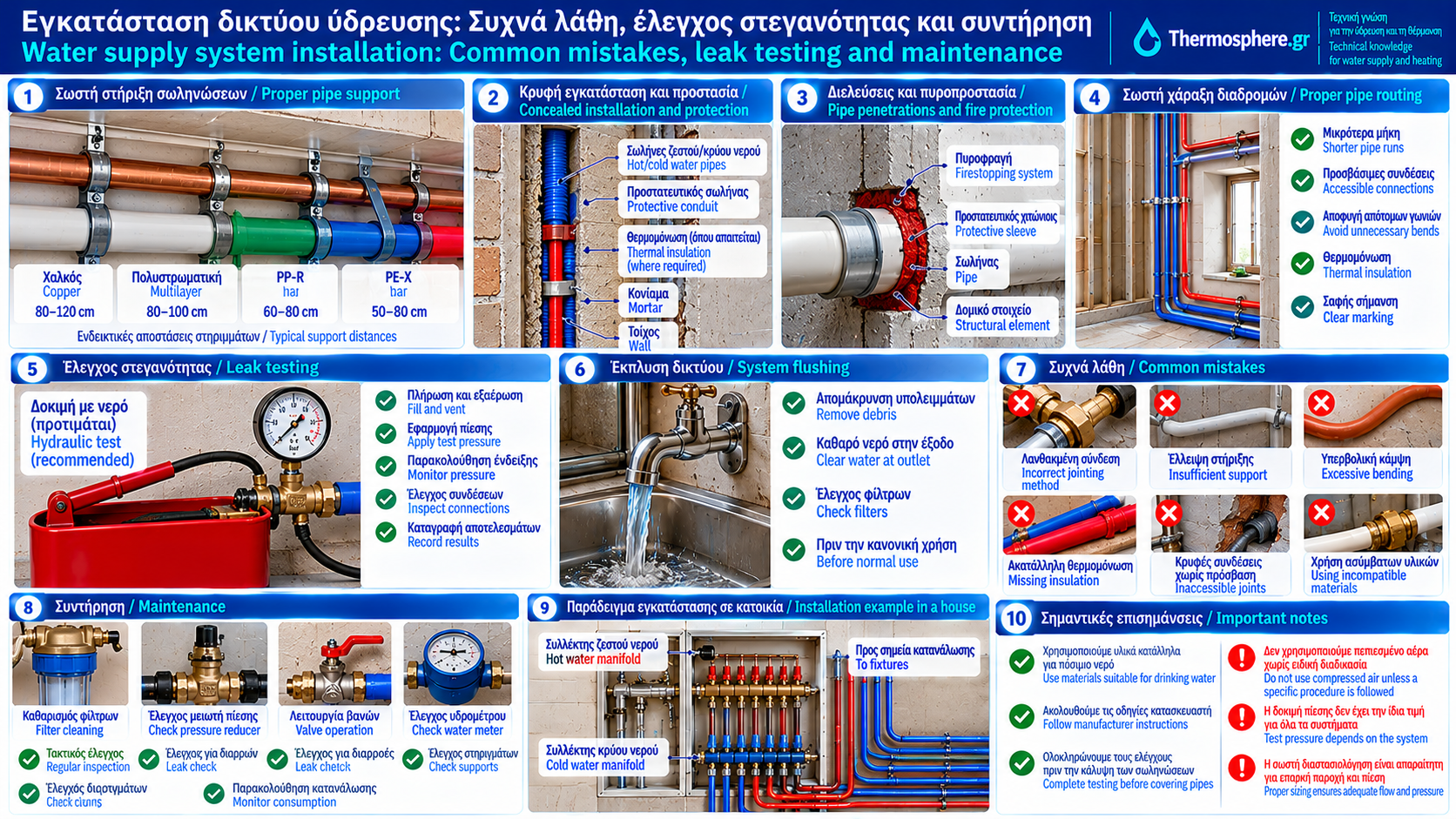
Water Supply System Installation: Common Mistakes, Leak Testing and Maintenance
Correct installation of a building water supply system is essential for safe and reliable operation.
Even high-quality pipes and fittings can fail if installation mistakes cause leaks, noise, pressure losses or excessive mechanical stress.
Important factors include compatible materials, correct pipe supports, protection of concealed connections and proper testing before the pipework is covered.
Installation does not end when the last fitting is connected. Leak testing, flushing, inspection and system handover are also necessary.
This Thermosphere.gr technical guide explains the key installation principles, common errors and maintenance practices that support long-term system reliability.
1. What Does Water Supply Installation Include?
A typical installation process involves:
Design and pipe sizing.
Selection of pipes and fittings.
Planning pipe routes.
Installing supports and protective components.
Making pipe connections.
Installing valves and control devices.
Leak testing.
Flushing and appropriate hygiene procedures.
Functional checks.
Documentation and handover.
Each stage contributes to the quality of the completed system.
2. Why Is Pipe Routing Important?
Pipe routes should be planned before installation begins.
The objective is to avoid unnecessary pipe lengths, inaccessible connections and locations subject to mechanical damage.
Important considerations include:
Fixture locations.
Available installation spaces.
Access to valves and manifolds.
Thermal insulation.
Wall and floor penetrations.
Protection against accidental drilling.
Fire protection requirements.
Pipes should not be routed through structural elements without appropriate design approval.
3. How Should Water Pipes Be Supported?
Pipe supports hold pipework in position and limit unwanted movement.
Support spacing depends on:
Pipe material.
Outside diameter.
Operating temperature.
Pipe orientation.
Weight of the pipe and water.
Manufacturer instructions.
Insufficient support may cause sagging, vibration and joint stress.
Overly rigid fixing may prevent necessary thermal movement.
Fixed and sliding supports should be arranged appropriately where required.
4. Why Must Thermal Expansion Be Considered?
Pipes change dimensions as temperature changes.
This is particularly important in domestic hot water installations.
Failure to accommodate expansion may result in:
Deformation.
Creaking noises.
Joint stress.
Support movement.
Damage at penetrations.
The required provisions depend on pipe material and system geometry.
Manufacturer installation instructions are essential.
5. What Matters in Concealed Pipework?
Pipes installed inside walls or floors require particular care.
Important considerations include:
Mechanical protection.
Compatibility with construction materials.
Thermal movement.
Insulation where necessary.
Joint accessibility.
Recording the actual pipe routes.
Not every type of joint is approved for inaccessible concealed installation.
Suitability must be verified for the specific piping system.
Required tests should be completed before pipework is permanently covered.
6. How Are Pipes Protected at Penetrations?
Pipes passing through walls or floors may require protective sleeves.
Sleeves can reduce mechanical contact with surrounding construction and allow specified movement.
Penetrations through fire-rated elements require an appropriate tested firestopping system in accordance with the fire protection design.
Simply filling the opening with an arbitrary material does not guarantee the required fire resistance.
7. Why Is Pipe Insulation Necessary?
Insulation on hot water pipes reduces heat loss.
Cold water pipes may require insulation to limit unwanted heating and, depending on conditions, surface condensation.
Insulation selection depends on:
Operating temperature.
Installation environment.
Humidity.
Pipe diameter.
Energy and hygiene requirements.
Hot and cold water pipe routes should minimise unwanted heat transfer between systems.
8. Common Pipe Jointing Mistakes
Many failures occur at joints and fittings.
Typical errors include:
Using incompatible components.
Incorrect insertion depth.
Wrong pressing tools or profiles.
Poor pipe-end preparation.
Incorrect heat fusion.
Overtightening threaded fittings.
Poor alignment.
Mechanical loading of joints.
Joining methods must follow the specific system specifications.
9. Why Are Isolation Valves Important?
Isolation valves allow individual parts of the network to be shut off.
Correct placement helps with:
Maintenance.
Fixture replacement.
Leak repairs.
Fault isolation.
Valves should remain accessible and clearly identified where necessary.
A valve permanently buried behind construction materials cannot serve its intended purpose effectively.
10. What Is Leak Testing?
Leak testing is intended to verify that a network does not exhibit unwanted leakage under specified test conditions.
It is an essential commissioning stage.
The test procedure depends on:
Pipe material.
Jointing system.
Manufacturer instructions.
Applicable technical standards.
Installation requirements.
There is no single universal test pressure or duration for every piping system.
11. How Is a Leak Test Performed?
The exact method must follow the applicable procedure.
In general, the process may include:
Verifying that all connections are complete.
Checking the suitability of components for the test.
Isolating equipment not rated for test pressure.
Filling and venting the system for hydraulic testing.
Applying the specified pressure with suitable equipment.
Monitoring the required readings.
Inspecting joints and exposed pipework.
Recording the results.
Temperature changes, plastic pipe elasticity and stabilisation requirements must be considered.
A pressure gauge reading change alone does not necessarily prove leakage without assessment of test conditions.
12. Can Compressed Air Be Used for Testing?
Compressed air stores significant energy and can cause serious injury if components fail.
It should not be used as an arbitrary substitute for hydraulic testing.
Where pneumatic testing is permitted, a specifically approved procedure, suitable equipment, exclusion measures and trained personnel are required.
Applicable standards and manufacturer instructions must be followed.
13. Why Must the System Be Flushed?
During installation, foreign materials may enter the pipework, including:
Dust.
Metal particles.
Cutting residues.
Debris.
Other contaminants.
Flushing helps remove these materials before normal use.
For drinking water installations, flushing and any additional cleaning or disinfection procedures must follow applicable requirements.
Incorrect chemicals or concentrations may damage the installation and compromise water quality.
14. What Is Water Hammer?
Water hammer is a rapid pressure change caused by a sudden change in flow velocity.
It may occur when a solenoid valve closes quickly.
Possible consequences include:
Loud banging noises.
Vibration.
Pipe stress.
Component damage.
Corrective measures may require assessment of velocity, pressure, pipe supports and appropriate protective devices.
Installing a component without identifying the cause may not solve the problem.
15. How Are Problems Diagnosed After Installation?
Diagnosis begins by identifying the symptom.
Low Pressure at One Tap
Possible causes include:
Blocked aerator.
Local valve restriction.
Faulty connection.
Low Pressure Throughout the Building
Possible causes include:
Supply problems.
Excessive network losses.
Pressure reducing valve malfunction.
Booster system problems.
Dampness on a Wall
Possible causes include a leaking pipe, condensation or another moisture source.
Investigation is required before invasive repairs.
16. Preventive Maintenance Checklist
Maintenance may include:
Inspecting exposed pipes.
Checking joints.
Testing isolation valves.
Servicing filters.
Inspecting pressure reducing valves.
Monitoring unusual water consumption.
Checking pipe supports.
Inspecting insulation.
Maintaining booster systems.
Checking backflow protection devices.
Inspection intervals depend on product specifications, usage and operating conditions.
17. How Can a Water Meter Help Detect Leaks?
A water meter may provide an initial indication of unexpected water consumption.
If all known water uses have stopped, continued registered flow may indicate a leak or another unrecognised demand.
Automatic appliances, tank filling and other consumers must be considered.
The meter reading alone cannot identify the location or cause of the loss.
18. Why Is Drinking Water Hygiene Important?
The installation must protect water from contamination and unfavourable stagnation conditions.
Important principles include:
Using suitable drinking water materials.
Providing appropriate backflow protection.
Avoiding unnecessary dead-end branches.
Limiting stagnation.
Managing water temperatures.
Maintaining storage tanks and equipment where present.
Risk management requirements, including Legionella-related considerations in relevant installations, depend on building use and applicable regulations.
19. What Should Be Included in System Handover?
An organised handover may include:
As-built drawings.
Material and component records.
Test reports.
Operating instructions.
Main and local isolation valve locations.
Maintenance instructions.
Equipment and warranty information.
Special operating requirements.
Documentation supports future repairs and reduces the risk of accidental damage to concealed pipes.
20. Frequently Asked Questions
Should Leak Testing Be Completed Before Walls Are Closed?
Yes. Required tests should be completed before critical pipe sections are covered, according to the system requirements.
What Pressure Should Be Used for Testing?
Test pressure depends on the applicable specifications, pipe material and manufacturer. No single value applies to every installation.
Why Do Pipes Bang When a Tap Closes?
Water hammer may be responsible. Pressure, flow velocity and pipe support conditions should be investigated.
Can Every Joint Be Concealed Inside a Wall?
Not necessarily. Suitability depends on the joint type and piping system specifications.
Do Cold Water Pipes Need Insulation?
Depending on the environment, insulation may be necessary to limit water heating and condensation.
How Often Is Maintenance Required?
There is no universal schedule. Intervals depend on components, usage, manufacturer instructions and applicable requirements.
Conclusion
Water supply reliability depends on both sound design and high-quality installation.
Correct supports, thermal expansion provisions, compatible fittings, leak testing and preventive maintenance help reduce failures.
A water supply system is properly completed only after it has been installed, tested, documented and safely handed over.
Technical References and Further Reading
EN 806-1: Specifications for installations inside buildings conveying water for human consumption — General.
EN 806-2: Design.
EN 806-4: Installation.
EN 806-5: Operation and maintenance.
EN 1717: Protection against pollution of potable water installations by backflow.
EN ISO 15874: Polypropylene piping systems.
EN ISO 15875: Crosslinked polyethylene piping systems.
EN ISO 21003: Multilayer piping systems.
CEN-CENELEC: https://www.cencenelec.eu/
Standards must be applied alongside national regulations, utility requirements and manufacturer instructions.
Safety note: Pressure testing, system modifications and cleaning or disinfection procedures must be performed by suitably trained personnel using approved procedures and equipment.
Thermosphere.gr — Technical knowledge for water supply and heating systems.