
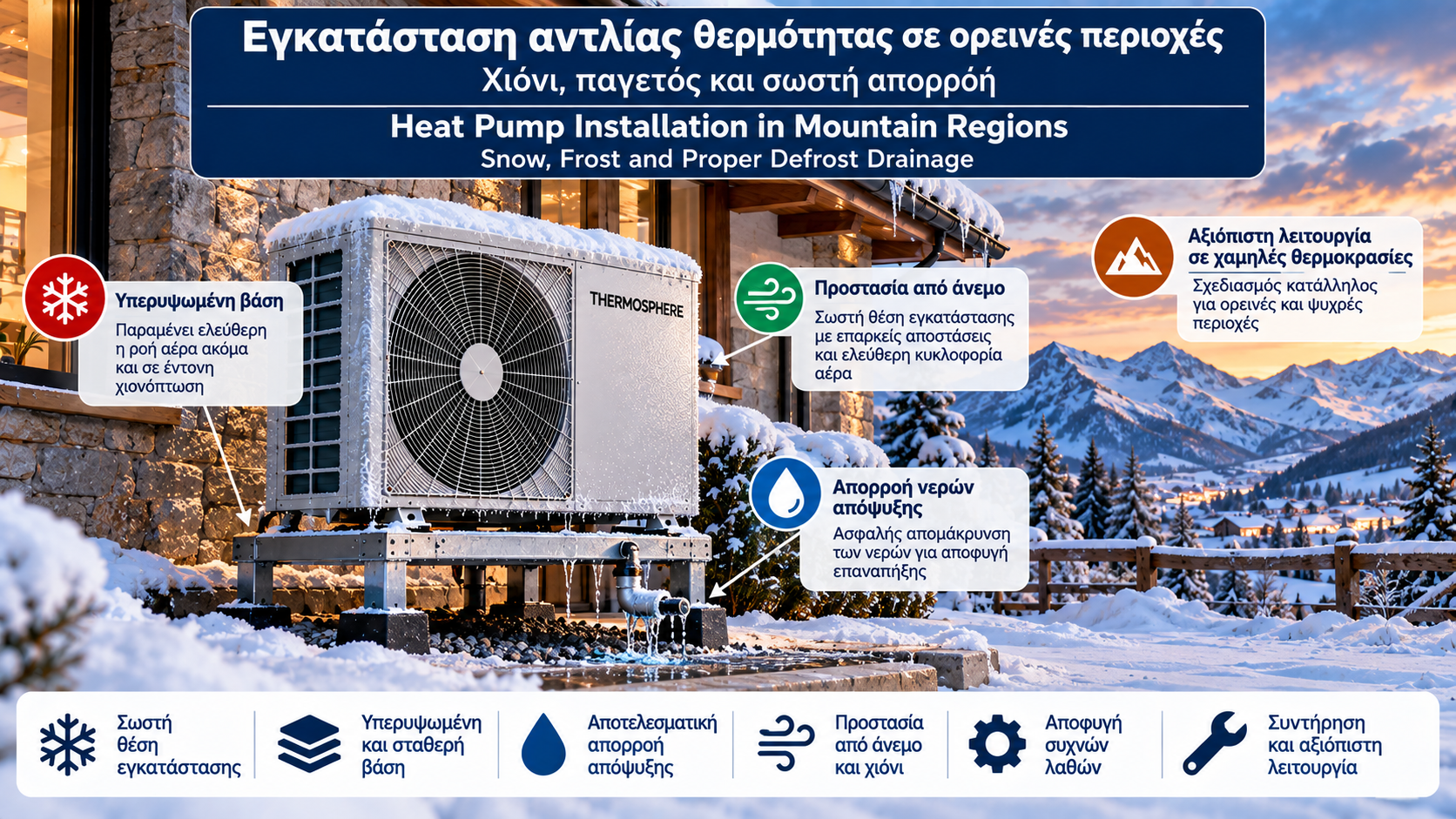
Installing Heat Pumps in Mountain Regions: Snow, Frost and Proper Defrost Drainage
Installing a heat pump in a mountain region or an area with heavy snowfall requires special attention.
Modern air-to-water heat pumps can operate at low outdoor temperatures, but their reliability depends on more than the technical capabilities of the equipment.
Installation location, mounting base, defrost water drainage, wind exposure and snow accumulation can significantly affect operation.
Even a correctly sized heat pump may experience problems if the outdoor unit is installed in an unsuitable location.
This guide explains the main considerations for designing, installing and maintaining heat pumps in snowy and freezing climates.
1. Why Do Mountain Regions Require Special Planning?
In mountainous areas, outdoor heat pump units may be exposed to several challenging conditions:
Extended periods of freezing temperatures.
Heavy snowfall.
Ice accumulation.
Strong winds.
High humidity.
Frequent defrost cycles.
Electrical power outages.
Difficult maintenance access.
These conditions can affect both energy efficiency and installation safety.
System design should therefore consider the actual local climate rather than relying only on the general geographic location.
2. How to Choose the Correct Outdoor Unit Location
The installation location is critical.
The outdoor unit must have sufficient clearance for air intake and discharge.
It should also be protected from predictable hazards, such as large quantities of snow falling from roofs.
Important considerations include:
Manufacturer-required wall clearances.
Airflow direction.
Potential snow accumulation.
Exposure to strong winds.
Defrost water drainage.
Maintenance accessibility.
Pedestrian safety.
Manufacturer installation instructions.
There is no single ideal location suitable for every building.
3. How High Should the Outdoor Unit Be Installed?
In regions with heavy snowfall, an elevated mounting base is often necessary.
The objective is to keep the following areas unobstructed:
Air intake.
Air discharge.
Underside of the unit.
Drainage outlets.
Maintenance clearances.
Mounting height should be determined according to expected snow accumulation and equipment specifications.
A base that is too low may allow the unit to become partially buried during heavy snowfall.
There is no universal mounting height for all climates.
The final choice must consider local snow conditions, site characteristics and structural requirements.
4. How Should the Mounting Base Be Designed?
The mounting base must safely support the outdoor unit and the loads expected at the installation site.
Important characteristics include:
Structural stability.
Appropriate anchoring.
Corrosion resistance.
Adequate elevation.
Suitable vibration control.
Effective drainage.
Resistance to local weather conditions.
Some installations use steel mounting frames, while others require appropriately designed concrete foundations.
The correct solution depends on the unit, ground conditions and manufacturer requirements.
Vibration isolators should be installed according to technical instructions without compromising stability.
5. What Happens When Snow Covers the Outdoor Unit?
A heat pump requires unrestricted airflow to extract heat from outdoor air.
If snow blocks the air grilles or obstructs the fan, operation may be affected.
Possible consequences include:
Reduced heating capacity.
Increased electricity consumption.
More frequent protective shutdowns.
Ineffective defrost operation.
Complete operating interruptions.
Homeowners can safely remove snow from the surrounding area.
However, metal tools should not be used near the fan or internal components.
6. Why Is Defrost Water Drainage So Important?
During winter operation, frost can form on the outdoor heat exchanger.
The heat pump automatically initiates defrost cycles to melt accumulated ice.
The resulting water must drain away effectively.
If water remains beneath the unit, it may freeze again.
Repeated melting and refreezing can create substantial ice accumulation.
Potential problems include:
Blocked drainage openings.
Ice formation around the mounting base.
Interference with components.
Slippery surfaces.
Restricted maintenance access.
Proper drainage should be considered during the initial installation design.
7. Designing Drainage for Freezing Conditions
The correct drainage arrangement depends on the site and manufacturer instructions.
Some installations allow water to drain freely onto a suitable surface.
Others require a dedicated drainage system.
Important factors include:
Expected defrost water volume.
Drainage slope.
Risk of refreezing.
Water traps.
Pedestrian safety.
Protection of foundations.
Manufacturer compatibility.
Water must not be directed toward locations where dangerous ice may form.
Long, exposed drainage pipes may also freeze unless specifically designed for cold conditions.
8. Is Heated Drainage Necessary?
In areas with severe freezing conditions, some manufacturers provide heated drain pans or drainage accessories.
These components can reduce ice accumulation in critical locations.
Their suitability depends on:
Outdoor unit design.
Local temperatures.
Installation position.
Drainage arrangement.
Manufacturer requirements.
Electric heating elements should not be added without technical approval.
Such systems require appropriate electrical protection and maintenance.
9. How Does Wind Affect Installation?
Wind can influence snow accumulation, rain exposure and other weather-related conditions.
Strong winds can create local snowdrifts.
For example, a building corner may accumulate much deeper snow than surrounding areas.
Installation planning should consider:
Prevailing wind direction.
Local turbulence.
Snow movement.
Pipe exposure.
Mounting requirements.
A location that appears sheltered is not necessarily suitable.
10. Should a Heat Pump Have a Protective Roof?
A properly designed canopy may help protect an outdoor unit from falling snow in certain situations.
However, an unsuitable cover can create additional problems.
Potential risks include:
Restricted air intake.
Recirculation of cold discharge air.
Difficult maintenance access.
Snow accumulation.
Additional structural loads.
Any canopy must be compatible with manufacturer instructions and required clearances.
Outdoor units should not be enclosed inside improvised boxes.
11. Why Must Air Recirculation Be Avoided?
During heating operation, an air-source heat pump extracts energy from outdoor air and discharges cooler air.
If this colder discharge air returns to the unit’s intake, the effective intake temperature may decrease.
This can reduce operating efficiency.
Air recirculation may result from:
Insufficient wall clearances.
Narrow enclosed spaces.
Poorly designed protective covers.
Obstructed air discharge.
Incorrect positioning of multiple units.
Manufacturer clearances must always be respected.
12. Installation Near Roofs and Gutters
Installing a heat pump beneath a roof requires particular care.
In snowy climates, large quantities of snow or ice may fall from above.
Water from gutters may also drip onto the unit and freeze.
Avoid locations where:
Snow falls from roofs.
Icicles form.
Gutters discharge water.
Falling objects are possible.
Safe maintenance access is restricted.
Appropriate structural protection may be required.
13. Can an Outdoor Unit Be Installed on a Balcony?
Balcony installation may be possible, but several factors must be evaluated.
These include:
Structural capacity.
Airflow clearances.
Defrost water drainage.
Vibration transmission.
Noise.
Maintenance access.
Local regulations.
Narrow or enclosed balconies may cause air recirculation.
In mountain regions, snow accumulation on the balcony floor must also be considered.
14. How Should Outdoor Pipes Be Protected?
Outdoor pipework must be designed for the expected climate.
Important measures include:
Appropriate thermal insulation.
Moisture protection.
UV-resistant materials.
Mechanical protection.
Avoiding unnecessary pipe lengths.
A suitable freeze protection strategy.
Monobloc heat pumps require particular attention because heating water circulates through outdoor components.
Pipe insulation alone cannot guarantee protection during prolonged power outages.
15. Monobloc or Split in Mountain Regions?
Both configurations can be suitable for cold climates when correctly selected and installed.
Monobloc
The refrigerant circuit is generally contained within the outdoor unit.
Special attention is required for freeze protection of outdoor hydraulic components.
Split
The outdoor and indoor units are generally connected through refrigerant lines.
The main water circuit can remain inside a protected building space.
However, refrigerant pipe installation requires appropriately qualified personnel.
The choice should consider all technical requirements rather than freezing risk alone.
16. How Does Altitude Affect Performance?
At higher elevations, air density is lower than at sea level under comparable conditions.
This can influence heat transfer at the outdoor heat exchanger.
The actual effect depends on equipment design, operating conditions and altitude.
Some manufacturers specify altitude limits or additional installation requirements.
Mountain installations should therefore consider both local design temperatures and any altitude-related restrictions.
17. What Should Be Considered When Sizing the Heat Pump?
A heat pump installed in a mountain region must meet the building’s heating requirements at design conditions.
The selection process includes:
Building heat loss calculations.
Local outdoor design temperature.
Available heating capacity at low temperatures.
COP at relevant operating points.
Required heating-water temperature.
Backup heating requirements.
Hydraulic system design.
A unit rated for operation down to −20°C does not necessarily maintain its nominal heating capacity at that temperature.
18. How Do Frequent Defrost Cycles Affect Heating?
During cold and humid conditions, frost may accumulate on the outdoor heat exchanger.
The heat pump performs defrost cycles to remove it.
During defrost, useful heat delivery to the building may temporarily decrease.
Regions with frequent fog and high humidity may experience more defrost cycles.
System design should therefore consider real winter operating behaviour rather than nominal heating capacity alone.
19. What Happens During a Power Outage?
Power outages can create additional risks in mountainous regions with severe freezing conditions.
When electricity is interrupted, active freeze protection functions may stop.
Installations with outdoor water circuits require suitable protection.
Depending on the design, solutions may include:
Compatible frost protection valves.
Suitable antifreeze solutions.
Backup electrical power.
Other approved protection methods.
The appropriate strategy should be selected by the system designer and installer.
20. Maintenance in Snowy Regions
Before winter, a professional inspection is recommended according to the manufacturer’s maintenance schedule.
The inspection may include:
Outdoor heat exchanger condition.
Air intake and discharge clearances.
Drainage system.
Mounting base and supports.
Pipe insulation.
Freeze protection arrangements.
Sensors.
Fault history.
Electrical protection devices.
During winter, homeowners can perform basic visual checks from a safe position.
21. Common Installation Mistakes
Mounting the Unit Too Low
Snow and ice may obstruct the outdoor unit.
Inadequate Drainage
Defrost water may refreeze beneath the equipment.
Installing in a Narrow Recess
Airflow can become restricted.
Installing Beneath a Gutter
Water may drip onto the unit and freeze.
Poor Pipe Protection
Exposed pipes may experience excessive heat loss or freezing.
No Power Outage Protection Plan
Active frost protection may stop when electricity is unavailable.
Poor Maintenance Access
Snow can make inspection and servicing difficult.
22. Pre-Installation Checklist
Before selecting the final installation location, consider:
How much snow may accumulate at the site?
Could snow fall from the roof?
Is the mounting base high enough?
Are manufacturer airflow clearances maintained?
Where will defrost water drain?
Could the drainage system freeze?
Is maintenance access safe?
Is freeze protection adequate?
Have power outages been considered?
Can the heat pump meet heating demand at design temperature?
These questions help identify problems before installation.
23. Frequently Asked Questions
Can a Heat Pump Operate During Snowfall?
Yes, provided the equipment is suitable for the conditions and airflow remains unobstructed.
Should the Outdoor Unit Be Raised Above Ground Level?
An elevated base is often required in snowy climates. Its height depends on local conditions and manufacturer requirements.
Is Ice Formation Normal?
Temporary frost on the outdoor heat exchanger can be normal. The unit must be able to defrost effectively.
Is Special Drainage Required?
It depends on the equipment and site. Drainage requires particular attention in freezing climates.
Can I Cover the Outdoor Unit to Protect It from Snow?
Improvised covers that restrict airflow should not be used. Any protective structure must comply with manufacturer instructions.
Is Monobloc or Split Better for Mountain Regions?
There is no universal answer. The correct choice depends on system configuration, freeze protection, building requirements and equipment specifications.
How Much Does Snow Increase Electricity Consumption?
Snowfall alone does not produce a predictable increase. Performance depends on outdoor temperature, humidity, defrost operation and unobstructed airflow.
Conclusion
Successful heat pump installation in mountain regions requires more than selecting equipment capable of operating at low temperatures.
Correct placement, an adequate mounting base, protection from falling roof snow, unrestricted airflow and effective defrost drainage are essential.
Suitable freeze protection and power outage planning must also be included.
Design decisions should be based on actual site conditions, manufacturer instructions and building requirements.
A properly selected heat pump delivers reliable performance when supported by correct installation, safe drainage and appropriate protection against winter conditions.
Thermosphere.gr — Technical knowledge for heating and building systems.