
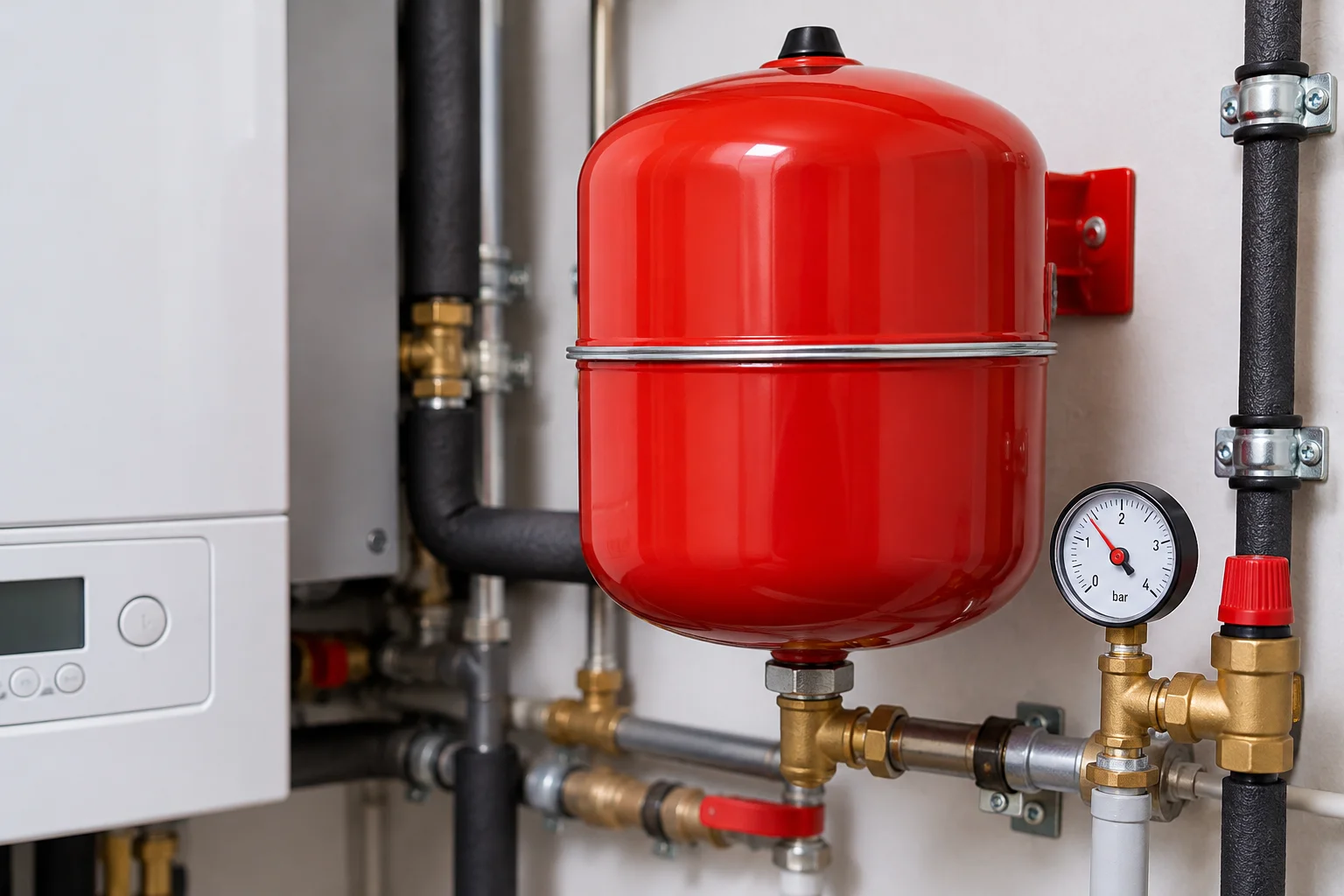
An expansion vessel is an essential component of every sealed heating system. It absorbs the increase in water volume as the water heats up and helps limit pressure fluctuations.
When the expansion vessel is not functioning correctly, system pressure may rise excessively, the safety relief valve may discharge water, and frequent topping up may become necessary.
This guide explains how a heating expansion vessel works, the most common faults, the correct pre-charge pressure, and the proper inspection procedure.
How Does a Heating Expansion Vessel Work?
In most sealed heating systems, an elastic diaphragm separates the expansion vessel into two chambers:
The water chamber, connected to the heating circuit.
The gas chamber, which contains gas at a specified pre-charge pressure.
As the water heats up, its volume increases. Some of this expanded water enters the vessel, compressing the gas.
When the system cools down, the compressed gas expands and pushes the water back into the heating circuit.
This process helps control pressure fluctuations during heating operation.
What Pressure Should an Expansion Vessel Have?
There is no single pre-charge pressure suitable for every heating installation.
The correct pressure depends on:
The static height of the heating system.
The installation position of the expansion vessel.
The minimum required system pressure.
The cold filling pressure.
The specifications of the boiler or heat pump.
The manufacturer's instructions.
As a hydrostatic approximation, every 10 metres of water column corresponds to approximately 1 bar.
Important: Expansion vessel pre-charge pressure and heating system filling pressure are different values. They should not be confused.
What Are the Symptoms of a Faulty Expansion Vessel?
1. Pressure Rises Excessively When the Boiler Heats Up
A small pressure increase during heating is normal.
However, if the pressure rises rapidly and approaches the opening pressure of the safety relief valve, the expansion vessel should be inspected.
Possible causes include loss of pre-charge pressure, diaphragm failure, insufficient vessel capacity, or a blocked connection to the heating circuit.
2. The Safety Relief Valve Discharges Water
The safety relief valve protects the heating installation against excessive pressure.
Many domestic heating systems use a 3-bar safety relief valve, but the specified opening pressure depends on the equipment.
If the valve repeatedly discharges water during heating, both the overall installation and the expansion vessel need to be checked.
Never block or cap the discharge outlet of a safety relief valve.
3. Pressure Drops When the Heating System Cools Down
A typical sequence is:
System pressure is normal when the water is cold.
Pressure rises excessively during heating.
The safety relief valve discharges water.
After cooling, the system pressure becomes unusually low.
Repeatedly topping up the system does not solve the underlying problem and may introduce additional oxygen and dissolved minerals into the heating circuit.
4. The Expansion Vessel Has Lost Its Pre-Charge
Gradual gas loss can reduce the vessel's effective expansion capacity.
This does not necessarily mean that the diaphragm has failed. In some cases, the pre-charge can be restored after an appropriate technical inspection.
5. The Diaphragm Has Failed
If the diaphragm ruptures, water may enter the gas chamber.
Water emerging from the gas charging valve is a strong indication of diaphragm failure.
Depending on the vessel design, the entire vessel may need replacing, or the diaphragm may be replaced if the model is designed for that procedure.
Why Does an Expansion Vessel Fill With Water?
The presence of water on the system side of an expansion vessel is normal.
A problem occurs when the vessel can no longer absorb enough of the water's thermal expansion.
Possible causes include:
Loss of gas pre-charge.
Diaphragm failure.
Incorrect pressure settings.
Insufficient vessel capacity.
A closed isolation valve or blocked connection.
Therefore, finding water inside an expansion vessel does not, by itself, prove that the vessel is faulty.
How Is Expansion Vessel Pre-Charge Pressure Checked?
Pre-charge pressure can only be measured reliably when the water side of the vessel has been properly depressurised.
A qualified technician follows a procedure that includes:
Safely switching off the heating equipment and allowing it to cool where necessary.
Correctly isolating the expansion vessel or the relevant section of the heating circuit.
Fully depressurising the water side of the vessel.
Measuring gas pressure using a suitable pressure gauge.
Checking for possible diaphragm failure.
Comparing the measured pre-charge with the installation requirements.
Restoring normal operation and checking system pressure behaviour.
Simply adding air while the water side remains pressurised is not a correct adjustment method.
Inspection and adjustment should be carried out by a suitably qualified technician.
Can an Expansion Vessel Be Too Small?
Yes. Even a mechanically sound expansion vessel may have insufficient capacity for the installation.
Correct sizing depends on:
The total water volume of the heating system.
The operating temperature range.
The pre-charge and filling pressures.
The maximum permissible pressure.
The static height of the system.
The use of antifreeze, where applicable.
Selecting an expansion vessel based only on the boiler's output in kW is not sufficient.
When Does an Expansion Vessel Need Replacing?
Replacement should be considered when:
A non-replaceable diaphragm has failed.
Significant corrosion or mechanical damage is present.
The vessel cannot maintain the required pre-charge pressure.
Its capacity is insufficient for the heating installation.
The decision should be based on a technical assessment rather than the age of the vessel alone.
Could Something Other Than the Expansion Vessel Be Responsible?
Yes. If system pressure increases even when the heating system is not operating, other possible causes should be investigated.
These include:
A faulty filling valve or automatic filling device.
Leakage between circuits operating at different pressures through a heat exchanger.
A defective pressure gauge.
Similarly, if pressure continuously decreases, possible leaks from pipes, radiators, fittings and valves must be ruled out.
Frequently Asked Questions
How Many Bar Should an Expansion Vessel Have?
The correct pre-charge depends on the static height, filling pressure and technical requirements of the installation. There is no universal pressure setting.
Why Does Pressure Rise When the Heating Comes On?
Water expands as its temperature increases. If the expansion vessel does not have sufficient effective capacity, system pressure may rise excessively.
How Can I Tell Whether the Diaphragm Has Ruptured?
Water emerging from the gas charging valve is a strong indication of diaphragm failure. However, the condition should be confirmed through an appropriate technical inspection.
Can I Recharge the Expansion Vessel Myself?
This is not recommended without suitable technical training. Safe isolation, depressurisation of the water chamber and correct determination of the pre-charge pressure are required.
How Often Should an Expansion Vessel Be Checked?
Follow the manufacturer's instructions and the maintenance schedule for the heating installation. Additional inspection is necessary if unusual pressure fluctuations occur.
Conclusion
The expansion vessel protects a sealed heating system against excessive pressure fluctuations.
A rapid pressure increase during heating, discharge from the safety relief valve, and a significant pressure drop after cooling are warning signs that require investigation.
Correct diagnosis relies on measurements, inspection of the installation and compliance with the manufacturer's instructions—not arbitrary air charging or unnecessary component replacement.
Technical References
EN 12828 — Heating systems in buildings: Design for water-based heating systems.
Installation and maintenance instructions issued by the expansion vessel manufacturer.
Technical specifications of the boiler or heat pump.
Safety note: This article is for informational purposes. Isolation, depressurisation and adjustment of heating equipment should be carried out by a suitably qualified technician.