
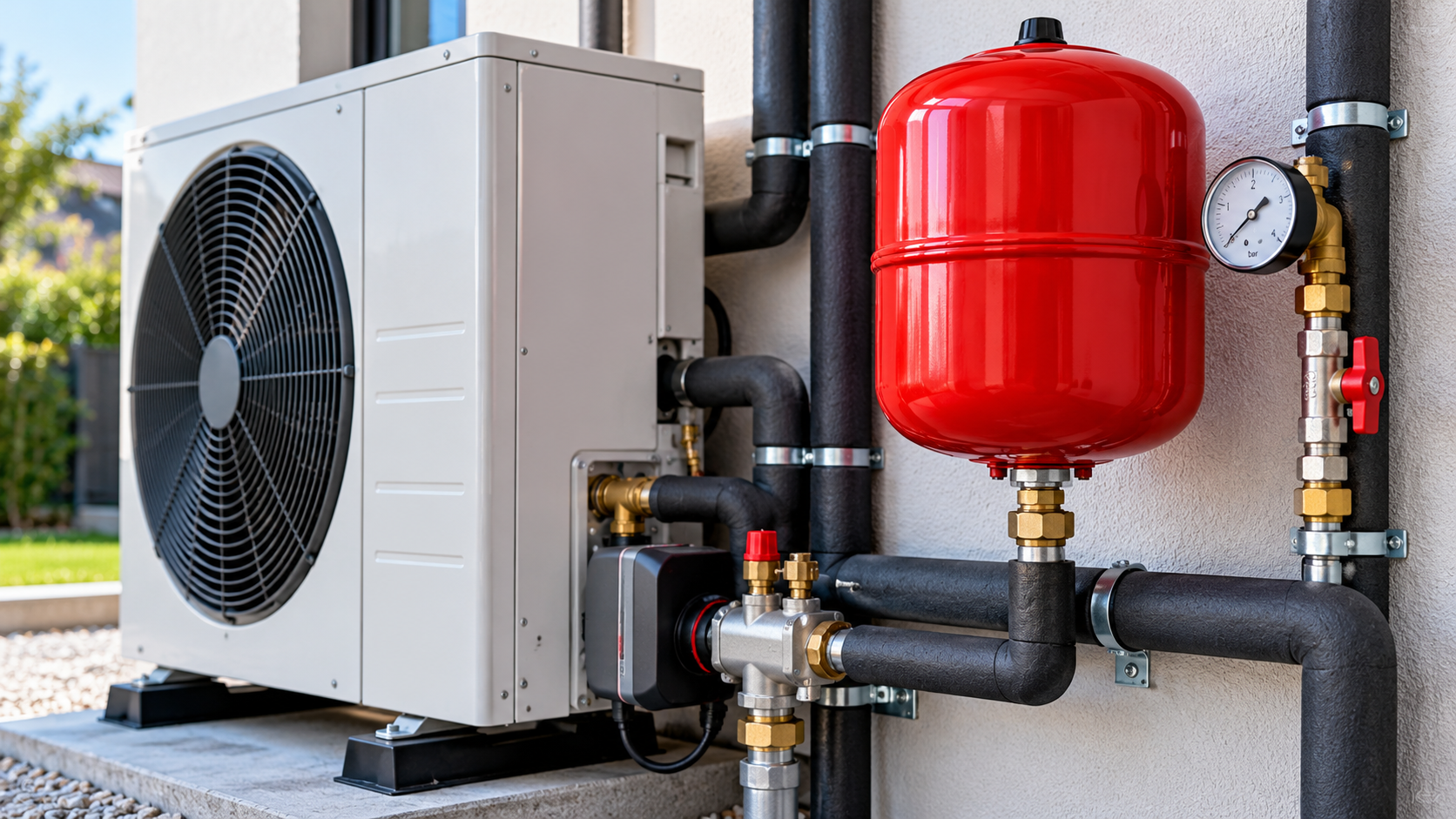
Heat Pump Expansion Vessel: Why Is It Essential?
An expansion vessel is an essential component of a sealed hydronic heat pump system. Its primary function is to accommodate changes in fluid volume as temperature varies, helping maintain system pressure within acceptable limits.
Correct expansion vessel sizing is particularly important in heat pump installations. Many heat pumps operate at lower water temperatures than conventional boilers, while their systems may include underfloor heating, fan coil units, extensive pipework or buffer tanks.
The required vessel capacity does not depend solely on the heat pump’s rated output in kilowatts.
Instead, it depends mainly on the total fluid volume, operating temperature range, static height and system pressures.
An incorrectly sized or adjusted expansion vessel may cause excessive pressure fluctuations, repeated pressure relief valve discharge or low-pressure faults.
1. How Does an Expansion Vessel Work?
A diaphragm expansion vessel contains two chambers separated by a flexible membrane.
One chamber is connected to the heating system water, while the other contains pressurised gas.
As the water temperature increases, the fluid expands and enters the vessel, compressing the gas.
This limits the increase in system pressure.
When the water cools, its volume decreases, allowing the compressed gas to push some water back into the heating circuit.
This process helps stabilise pressure but does not replace the pressure relief valve or other essential safety devices.
2. Do All Heat Pumps Have a Built-In Expansion Vessel?
No. The presence and capacity of an integrated expansion vessel depend on the heat pump manufacturer and model.
Some heat pumps include an internal vessel, while others require an external one.
Even when an integrated vessel is provided, it may not be sufficient for every installation.
For example, adding a large buffer tank increases the total system water volume and may require additional expansion capacity.
Before installation, check:
The heat pump manufacturer’s technical manual.
The capacity of any integrated expansion vessel.
The factory pre-charge pressure.
The maximum permitted system water volume specified by the manufacturer.
The actual operating conditions of the installation.
An external vessel should only be selected after evaluating these parameters.
3. How Is Expansion Vessel Capacity Calculated?
Sizing begins by determining the total fluid volume of the sealed circuit.
This includes:
Heat pump hydraulic components.
Radiators or fan coil units.
Underfloor heating circuits.
Distribution pipework.
Manifolds.
Buffer tanks connected to the same sealed circuit.
Water expands as its temperature rises.
The amount of expansion depends on the temperature difference between the initial and maximum operating conditions.
Low-temperature heating systems may experience less thermal expansion than conventional high-temperature radiator systems.
However, the maximum design temperature must be based on the actual system specifications.
Example: Expansion Volume Calculation
Consider a simplified heat pump installation with the following characteristics:
Total water volume: 300 litres.
Initial temperature: 10°C.
Maximum temperature: 55°C.
Approximate water expansion: 1.4%.
The expansion volume is calculated as follows:
300 × 0.014 = 4.2 litres
The water volume increases by approximately 4.2 litres.
However, this does not mean that a 4.2-litre nominal expansion vessel is sufficient.
An expansion vessel can only accept a portion of its nominal capacity as water.
Its actual acceptance volume depends on the pre-charge pressure, cold filling pressure and maximum permitted operating pressure.
The final vessel size must therefore be calculated using the manufacturer’s sizing method, with appropriate design allowances.
Important: This is an educational example, not a complete expansion vessel sizing calculation for a real installation.
4. What Is the Correct Pre-Charge Pressure?
Pre-charge pressure is the gas pressure inside the expansion vessel when the water side is depressurised.
There is no universal pre-charge pressure suitable for every heat pump installation.
The correct value depends on:
The static height of the heating system.
The minimum pressure required at the highest point.
The cold filling pressure.
The manufacturer’s technical specifications.
The factory pre-charge pressure may need adjustment to suit the installation.
To measure the actual pre-charge pressure, the water side of the vessel must be correctly isolated and depressurised.
Measuring the gas valve while the vessel remains under water pressure does not necessarily reveal the true pre-charge setting.
Inspection and adjustment should be performed by a suitably qualified heating technician.
5. Where Should the Expansion Vessel Be Installed?
The correct installation location depends on the hydraulic arrangement and the heat pump manufacturer’s instructions.
In many heating systems, the expansion vessel is connected to the return pipework, where operating temperatures are generally lower.
Its connection point relative to the circulation pump is also important because it influences pressure distribution during operation.
The vessel must maintain an appropriate hydraulic connection to the sealed circuit it protects.
It should not be possible to isolate the expansion vessel accidentally while leaving the heating circuit operating without adequate expansion protection.
Where a service isolation arrangement is permitted, it must include the necessary safeguards and comply with the applicable installation requirements.
The vessel should also be accessible for inspection, maintenance and replacement.
6. How Does a Buffer Tank Affect Expansion Vessel Sizing?
Buffer tanks are commonly used in heat pump installations to increase available water volume or support the hydraulic operation of the system.
If the buffer tank is part of the same sealed circuit, its water volume must be included in the expansion calculation.
For example:
Original circuit water volume: 120 litres.
Additional buffer tank capacity: 200 litres.
Approximate combined volume: 320 litres.
The total fluid volume has increased substantially.
As a result, the required expansion vessel capacity may also increase.
Where hydraulically independent sealed circuits are used, each circuit must be evaluated separately.
The correct arrangement depends on the system design.
7. What Changes When Glycol Is Used?
Some heat pump installations use water-glycol mixtures to provide frost protection.
Glycol changes the physical properties of the heat transfer fluid, including its thermal expansion characteristics.
Consequently, expansion vessel calculations should not automatically use the expansion values of pure water.
The following information is required:
Glycol type.
Glycol concentration.
Minimum and maximum operating temperatures.
Thermal expansion data for the specific mixture.
Compatibility of the expansion vessel and diaphragm with the fluid.
Manufacturer data should be used for accurate calculations.
8. Why Does Heat Pump System Pressure Rise?
A moderate pressure increase during heating is normal.
However, excessive pressure increases may indicate a problem.
Possible causes include:
Insufficient expansion vessel capacity: The vessel cannot accommodate the required fluid expansion.
Incorrect pre-charge pressure: The available acceptance capacity is reduced.
Damaged diaphragm: The vessel can no longer operate as designed.
Faulty filling arrangement: Additional water may enter the circuit unintentionally.
Incorrect hydraulic connection: The vessel may not communicate properly with the circuit it is intended to protect.
The underlying cause should be identified before replacing or adding an expansion vessel.
9. Why Does Pressure Drop When the System Cools?
As water cools, its volume decreases and system pressure may fall.
A small pressure change is expected.
However, a significant pressure drop, particularly following an excessive pressure increase during heating, may indicate an expansion vessel problem.
Other possible causes include:
Water leaks.
Water discharge through the pressure relief valve.
Faulty connections.
Insufficient initial filling pressure.
Repeatedly topping up the heating system should not be considered a permanent solution.
The cause of pressure loss should be investigated.
10. Common Expansion Vessel Installation Mistakes
Choosing a Vessel Based Only on Heat Pump Output
Heat pump capacity in kilowatts does not directly determine the total system water volume or expansion requirements.
Ignoring Buffer Tank Capacity
A large buffer tank can significantly increase the total expansion volume.
Using an Incorrect Pre-Charge Pressure
The factory setting may not match the installation’s static height and filling pressure.
Choosing an Unsuitable Connection Point
The expansion vessel location must be compatible with the hydraulic design and manufacturer requirements.
Ignoring Glycol Properties
Water-glycol mixtures may expand differently from pure water.
Providing Insufficient Maintenance Access
Poor accessibility makes inspection, servicing and replacement more difficult.
11. Frequently Asked Questions
Does Every Heat Pump Need an Expansion Vessel?
A sealed hydronic heating circuit requires suitable provision for thermal expansion.
Depending on the equipment and system design, this may be provided by an integrated or external expansion vessel.
Is the Built-In Expansion Vessel Always Sufficient?
No. Its capacity must be checked against the total system water volume and operating conditions.
Can I Install a Second Expansion Vessel?
In many systems, an additional expansion vessel can be installed, provided the hydraulic arrangement, pre-charge pressures and combined acceptance capacity are appropriate.
Should Pre-Charge Pressure Always Be 1 Bar?
No. The correct value depends on static height, filling pressure and the manufacturer’s requirements.
Does a Buffer Tank Need a Separate Expansion Vessel?
Not necessarily.
If the buffer tank is connected to the same sealed circuit, it may be protected by the existing expansion vessel arrangement, provided the total expansion capacity is sufficient.
Hydraulically independent circuits require separate assessment.
Can a Boiler Expansion Vessel Be Used with a Heat Pump?
An expansion vessel designed for sealed heating circuits may also be suitable for a heat pump installation.
However, its pressure rating, temperature rating, capacity and compatibility with the system fluid must meet the installation requirements.
Conclusion
Correct expansion vessel sizing is essential for the safe and reliable operation of a sealed heat pump heating system.
The required vessel capacity depends primarily on total fluid volume, operating temperature range and system pressures—not simply on the heat pump’s rated output.
Special attention is required when buffer tanks, multiple hydraulic circuits or antifreeze mixtures are present.
Final vessel selection, installation location and pre-charge adjustment should be confirmed by a qualified heating professional using the actual system specifications and the manufacturer’s technical documentation.