
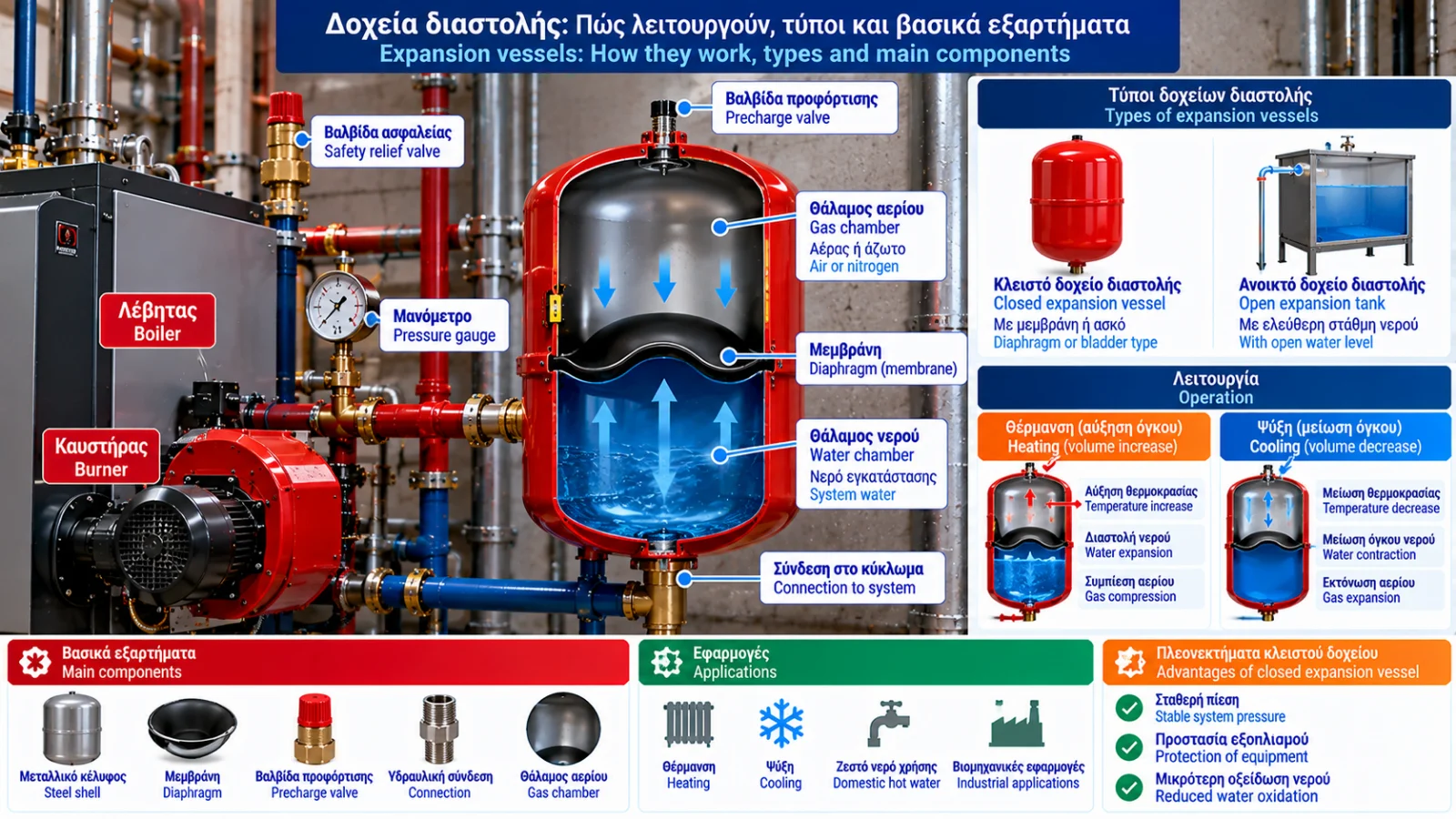
Expansion Vessels: How They Work, Types and Main Components
An expansion vessel is an essential component of a water-based heating or cooling installation. Its primary purpose is to accommodate changes in water volume caused by temperature variations, thereby limiting the resulting pressure changes within the system.
Without a suitable expansion vessel, heating water in a closed hydraulic circuit can cause a significant pressure increase, potentially opening the safety relief valve and placing additional stress on system components.
Correct selection, installation and maintenance are essential for safe and reliable operation.
1. What Is an Expansion Vessel?
An expansion vessel is a device that provides capacity to accommodate thermal expansion of water.
In a closed heating system, water increases in volume as its temperature rises.
Because water is relatively incompressible compared with gas, even a small volume increase can cause a substantial pressure rise if no expansion capacity is available.
Modern closed expansion vessels provide this capacity through a compressible gas volume.
2. Why Does Water Expand?
Water density changes with temperature.
As water is heated from typical filling temperatures to normal heating system operating temperatures, its volume generally increases.
For example, a system containing 1,000 litres of water heated from approximately 20°C to 80°C may experience a volume increase of around 27 litres.
The exact increase depends on the temperature range and fluid properties.
This additional volume must be accommodated in a controlled manner.
3. How Does a Closed Expansion Vessel Work?
A modern closed expansion vessel normally contains two regions:
A water side connected to the hydraulic system.
A gas side containing compressed air or nitrogen.
The two regions are separated by a flexible diaphragm or bladder, depending on the design.
When water temperature increases:
Water expands.
Additional water enters the vessel.
The diaphragm moves or deforms.
The available gas volume decreases.
The gas compresses and its pressure rises.
As the water cools, the compressed gas expands and pushes water back into the system.
This action limits system pressure fluctuations.
4. Main Components
The main components of a typical closed expansion vessel include:
Steel shell
The external pressure-containing body, designed for the specified operating pressure.
Diaphragm or bladder
A flexible barrier separating water and gas. Its shape and attachment depend on the vessel design.
Gas chamber
Contains the compressible gas that accommodates changes in water volume.
Precharge valve
Allows checking and, where permitted, adjusting gas precharge pressure.
Hydraulic connection
Connects the vessel to the heating or cooling circuit.
Some vessels have replaceable membranes, while others use permanently installed diaphragms.
5. Open Expansion Tanks
Open expansion tanks communicate with the atmosphere and are used in appropriately designed open hydraulic systems.
They are generally located at a high point in the installation.
Water level changes inside the tank as the system expands and contracts.
Advantages include:
Simple operating principle.
No pressurized gas chamber.
Suitability for certain open-system configurations.
Disadvantages include:
Exposure of system water to the atmosphere.
Potential oxygen ingress and corrosion.
Freeze protection requirements.
Possible water losses.
Installation location constraints.
Open expansion tanks are not direct replacements for closed vessels in every installation.
6. Closed Diaphragm Expansion Vessels
Closed diaphragm expansion vessels are widely used in modern hydronic systems.
Their main advantages include:
Reduced contact between system water and atmospheric air.
Flexible installation within suitable plant room locations.
Controlled pressure variation.
Compatibility with many closed heating and cooling systems.
Selection must consider pressure, temperature, water volume and manufacturer specifications.
7. Diaphragm Versus Bladder Vessels
Two common construction approaches are available.
Diaphragm Vessel
A flexible diaphragm separates the gas and water regions.
In some designs, the diaphragm is permanently attached to the vessel body.
Bladder Vessel
Water or gas is contained within a flexible bladder, depending on the construction.
Some models allow bladder replacement.
Neither design is universally superior. Suitability depends on the application and the characteristics of the specific vessel.
8. What Is Precharge Pressure?
Precharge pressure is the gas pressure inside the vessel before pressurized system water enters it.
It is commonly represented by p₀.
Precharge affects how much water the vessel can accept and how pressure changes during operation.
Precharge pressure must not be confused with system filling pressure.
The correct value depends on static height, vessel location, equipment requirements and the design method.
Actual precharge should be measured with the vessel's water side isolated and depressurized, following manufacturer instructions.
9. Static Height and Pressure
System static height affects the minimum pressure required at the vessel connection.
For water, a useful approximation is:
10 metres of elevation difference ≈ 1 bar
For example, if the highest point in the circuit is 12 metres above the vessel, the hydrostatic pressure difference is approximately 1.2 bar.
This does not automatically determine the correct precharge or filling pressure.
Required pressure margins and equipment specifications must also be considered.
10. How Does Pressure Change During Heating?
In a properly designed system, pressure rises gradually as the water heats up.
The expansion vessel accommodates the additional volume and limits the pressure increase.
If the vessel is undersized, isolated or has lost its correct precharge, pressure may rise excessively.
In some cases, the safety relief valve may operate.
Pressure behavior should be evaluated together with temperature, system volume and initial operating conditions.
11. Expansion Vessel Versus Safety Relief Valve
The expansion vessel and safety relief valve perform different functions.
Expansion vessel: Accommodates normal thermal expansion.
Safety relief valve: Protects the system against excessive pressure according to its specified operating characteristics.
A safety relief valve should not act as the normal method of accommodating thermal expansion.
Repeated relief valve operation during heating requires technical investigation.
12. Where Should an Expansion Vessel Be Installed?
Installation location depends on the hydraulic system design.
In many closed systems, the vessel is connected near the system pressure reference point, often close to the suction side of the main circulation pump.
The precise location must account for:
Pump arrangement.
Operating temperatures.
Static pressure.
Maintenance access.
Manufacturer instructions.
Safety requirements.
Accidental isolation of the expansion vessel during normal operation must also be prevented.
13. Expansion Vessels in Cooling Systems
Expansion vessels are also used in closed chilled-water systems.
Volume change depends on the actual operating temperature range.
When water–glycol mixtures are used, the properties of the specific mixture must be considered.
The thermal expansion characteristics may differ significantly from those of pure water.
Sizing should therefore not automatically use water-only data.
14. Domestic Hot Water Expansion Vessels
Expansion vessels installed in closed domestic hot water systems must be suitable for contact with potable water where required.
Construction materials and applicable approvals differ from vessels intended exclusively for closed heating circuits.
Not every heating expansion vessel is suitable for potable water service.
15. How to Select the Correct Vessel
Expansion vessel selection depends on:
Total system water volume.
Minimum and maximum operating temperatures.
Fluid thermal expansion.
System static height.
Precharge pressure.
Filling pressure.
Maximum allowable operating pressure.
Safety relief valve setting.
Connection location and arrangement.
Material and diaphragm compatibility.
Nominal vessel volume is not equal to the volume of expansion water it can accept.
Actual acceptance capacity depends on operating pressures and gas compression.
16. Why Boiler Capacity Alone Is Not Enough
A common mistake is choosing an expansion vessel based only on boiler output in kW.
Boiler capacity does not directly determine system water volume.
Two installations with identical boiler capacities may have very different water volumes because of:
Different numbers of radiators.
Different pipe lengths.
Underfloor heating circuits.
Buffer tanks.
Heat exchangers.
Different operating temperatures.
Correct selection requires an estimate or measurement of total system water content.
17. Thermal Expansion Example
Consider a closed heating circuit with:
Total water volume: 800 litres.
Initial temperature: 20°C.
Maximum temperature: 80°C.
For this temperature range, water volume increases by approximately 2.7%.
The additional volume is:
ΔV ≈ 800 × 0.027 = 21.6 litres
The system must therefore accommodate approximately 21.6 litres of thermal expansion.
This does not mean that a nominal 21.6-litre expansion vessel is sufficient.
Required vessel capacity also depends on precharge, filling pressure and maximum operating pressure.
A complete sizing method will be covered in the next article.
18. Common Operating Problems
Typical problems include:
Loss of precharge
Gas pressure decreases, affecting expansion acceptance capacity.
Diaphragm failure
The diaphragm may deteriorate or rupture, compromising separation between water and gas.
Insufficient vessel capacity
The vessel cannot accommodate the required expansion volume within the permitted pressure range.
Isolation from the system
A closed valve or blocked connection may prevent proper operation.
Incorrect precharge
Improper adjustment can reduce available acceptance capacity.
19. Maintenance and Periodic Inspection
Maintenance should follow manufacturer instructions and applicable installation requirements.
Typical inspections include:
External vessel condition.
Signs of leakage or corrosion.
Connection integrity.
Precharge pressure, with the water side correctly isolated and depressurized.
Pressure behavior during heating and cooling.
Signs of diaphragm failure.
Working on pressurized equipment requires appropriate safety precautions.
20. Standards and Technical References
Depending on the application, relevant references include:
EN 12828: Heating systems in buildings — Design for water-based heating systems.
EN 13831: Closed expansion vessels with built-in diaphragm for installation in water systems.
Directive 2014/68/EU (PED): Pressure equipment requirements, where applicable.
Manufacturer documentation: Pressure and temperature limits, precharge, installation and maintenance.
The applicable editions and scope of each reference must be verified.
Conclusion
An expansion vessel is a critical component for pressure control in heating and cooling systems.
Its operating principle is based on accommodating water thermal expansion through a compressible gas separated from the water by a diaphragm or bladder.
Correct selection depends not only on boiler output or nominal vessel size, but also on fluid volume, operating temperatures and actual pressure conditions.
Proper sizing, suitable precharge and periodic maintenance contribute to safe and reliable system operation.