
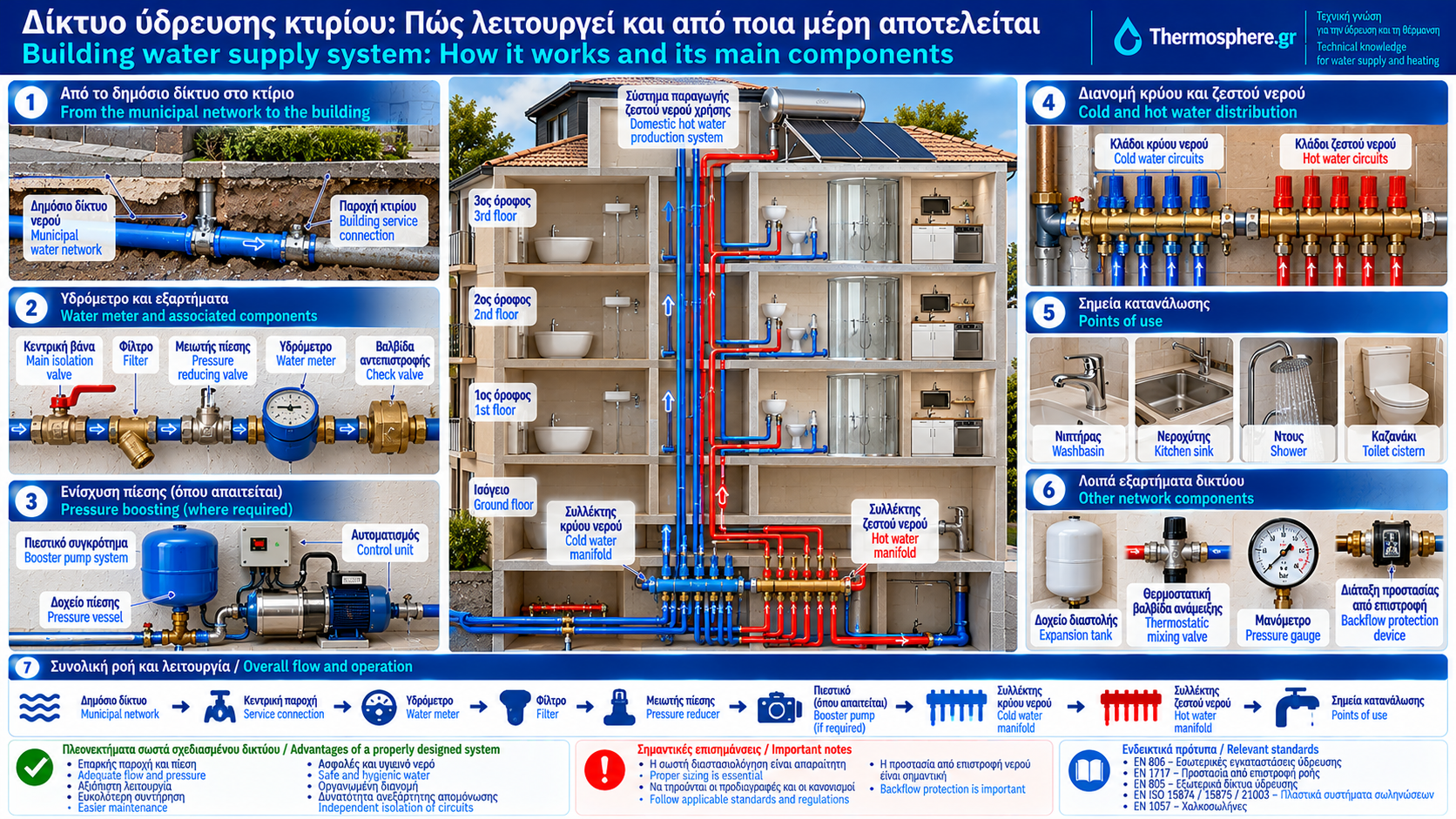
Building Water Supply Systems: How They Work and Their Main Components
A building water supply system is one of the essential installations in residential, commercial and multi-storey buildings.
Its purpose is to transport and distribute water to fixtures and appliances while maintaining adequate flow and pressure.
Although the operation may appear simple, a water supply system includes pipes, valves, fittings, protective devices and, in some installations, pressure boosting equipment.
Correct design and installation are essential for reliability, safety and drinking water hygiene.
This Thermosphere.gr technical guide explains how building water supply systems work and describes their main components.
1. What Is a Building Water Supply System?
A building water supply system consists of pipes, fittings and equipment that deliver water from the supply connection to the points of use.
Typical fixtures include:
Washbasins.
Kitchen sinks.
Showers and bathtubs.
Toilet cisterns.
Washing machines.
Water heaters.
Outdoor taps.
The system must provide sufficient water without excessive pressure losses or hygiene problems.
2. How Does Water Enter a Building?
In a typical building supplied by a municipal network, the general flow path is:
Municipal network → Building service connection → Water meter → Main distribution → Branch pipes → Fixtures
Depending on the installation, additional components may include:
Isolation valves.
Filters.
Pressure reducing valves.
Backflow protection devices.
Booster pump systems.
Water storage tanks.
The exact arrangement depends on the design, utility requirements and applicable regulations.
3. What Is the Main Water Service Connection?
The main service connection links the building to its water source.
Correct sizing is important because it affects available flow and pressure losses.
An undersized connection may cause problems when several fixtures operate simultaneously.
The pipe size should be determined from the building’s calculated demand rather than simply counting taps.
4. What Does a Water Meter Do?
A water meter measures the volume of water passing through the supply.
Consumption is commonly expressed in cubic metres.
1 m³ = 1,000 litres.
Water meters are used for consumption measurement and billing according to the water utility’s terms.
They can also help identify unexpected consumption and possible leaks.
Meter location and associated fittings must comply with the installation and utility requirements.
5. Main Water Isolation Valve
The main isolation valve allows the water supply to be shut off to a building or section of pipework.
It is used for:
Maintenance.
Repairs.
Component replacement.
Leak isolation.
Emergencies.
Its location should be accessible and known to the building occupants.
Knowing how to isolate the water supply can significantly reduce damage during a leak.
6. Which Materials Are Used for Water Supply Pipes?
Common piping materials include:
Copper
Used for cold and hot water systems where water quality and operating conditions are suitable.
Polypropylene (PP-R)
A plastic piping system typically joined using appropriate heat-fusion techniques in accordance with manufacturer instructions.
Crosslinked Polyethylene (PE-X)
Used in water distribution systems with compatible fittings and approved connection methods.
Multilayer Pipes
Combine different material layers and are widely used in modern installations.
Polyethylene (PE)
Commonly used in suitable external and underground water supply applications.
Material selection depends on pressure, temperature, water quality, installation conditions and fitting compatibility.
7. How Is Water Distributed Inside a Building?
Two common arrangements are branched distribution and manifold distribution.
Branched Distribution
A main pipe supplies successive branches through suitable fittings, such as tees.
Manifold Distribution
Water is delivered to a manifold, from which separate lines supply individual fixtures or groups of fixtures.
Manifolds may include individual isolation valves.
Each arrangement has different material, space and maintenance requirements.
Selection should be based on the system design.
8. What Is a Plumbing Manifold?
A manifold is a distribution component with one inlet and multiple outlets.
It supplies separate pipe circuits.
Potential advantages of a properly designed manifold system include:
Organised distribution.
Individual circuit isolation.
Easier circuit identification.
Fewer concealed branching connections in some arrangements.
However, manifold distribution does not eliminate the need for correct hydraulic sizing.
9. How Does Water Pressure Work?
Pressure is a fundamental operating parameter.
It is commonly expressed in bar.
Pressure available at a fixture depends on:
Supply pressure.
Elevation.
Pipe friction losses.
Local losses through fittings.
Flow rate.
As water flows through the network, pressure losses occur.
This is one reason why correct pipe sizing is essential.
10. Why Is Pressure Lower on Upper Floors?
Raising water requires hydraulic head.
For water under ordinary conditions, an elevation difference of approximately 10 metres corresponds to about 1 bar of hydrostatic pressure.
For example, a height difference of 15 metres corresponds to approximately 1.5 bar.
This is a simplified hydrostatic approximation.
Actual operating pressure must also account for friction losses and supply conditions.
High-rise buildings may therefore require dedicated pressure management.
11. What Is a Pressure Reducing Valve?
A pressure reducing valve regulates downstream pressure within its operating limits.
It may be necessary when the supply pressure is higher than desired for the building installation.
The correct setting depends on the system requirements and component specifications.
Installation and maintenance should follow the manufacturer’s instructions.
12. When Is a Booster Pump System Needed?
A booster pump system is used when available pressure or flow is insufficient to serve the building.
It may include:
One or more pumps.
Automatic controls.
Pressure sensors.
Pressure vessels where specified.
Protective devices.
A booster system should not be installed without appropriate design assessment.
Connections to public networks require particular care because direct suction restrictions and drinking water protection requirements may apply.
13. How Is Domestic Hot Water Distributed?
Domestic hot water can be produced by systems such as:
Electric storage water heaters.
Solar water heaters.
Boilers with domestic hot water production.
Heat pumps for domestic hot water.
Other suitable water heating equipment.
Hot water is distributed from the production system to fixtures through dedicated pipework.
The installation may include:
Hot water pipes.
Thermal insulation.
Thermostatic mixing valves.
Safety valves.
Recirculation systems where necessary.
Correct design must consider water hygiene, scalding risk and energy losses.
14. What Is Domestic Hot Water Recirculation?
In some larger buildings, hot water is circulated through a dedicated return pipe.
This can reduce the waiting time for hot water at distant fixtures.
The system may include:
A circulation pump.
Return pipework.
Balancing valves.
Thermal insulation.
Controls.
Recirculation must be designed and balanced appropriately to avoid unnecessary energy losses and unfavourable hygiene conditions.
15. Why Are Backflow Protection Devices Important?
A check valve permits flow in one direction and restricts reverse flow.
However, a basic check valve is not always sufficient to protect drinking water from contamination.
Backflow protection must be selected according to the risk category and applicable requirements, including EN 1717.
16. Why Is Correct Pipe Diameter Important?
Pipe diameter affects:
Water velocity.
Pressure losses.
Flow capacity.
Operating noise.
Overall hydraulic performance.
Undersized pipes can cause high velocities and excessive pressure losses.
Oversizing is not always beneficial because it increases the volume of water held within the system and may worsen stagnation and hot water waiting times.
Sizing should be based on calculations rather than guesswork.
17. Common Water Supply System Problems
Typical issues include:
Low water pressure.
Pressure fluctuations.
Leaks.
Water hammer.
Pipe noise.
Blocked filters.
Deposits.
Joint failures.
Insufficient flow during simultaneous use.
Long hot water waiting times.
Proper diagnosis is essential.
For example, low pressure at one tap does not automatically mean a booster pump is required.
A local blockage or defective fitting may be responsible.
18. How Is a New Water Supply System Tested?
Before commissioning, the system should be inspected and tested according to applicable requirements and manufacturer instructions.
Checks may include:
Visual inspection.
Verification of pipe supports.
Material compatibility checks.
Leak testing.
System flushing.
Appropriate hygiene procedures.
Valve and equipment operation checks.
Documentation of results.
Test pressure and duration depend on the relevant specifications and should not be selected arbitrarily.
19. How Is a Water Supply System Maintained?
Maintenance may include:
Inspection of exposed pipes.
Checking fittings and joints.
Testing isolation valves.
Maintaining filters.
Inspecting pressure reducing valves.
Monitoring unusual water consumption.
Maintaining booster systems.
Checking protective devices.
Managing cold and hot water hygiene.
Inspection frequency depends on the installation, operating conditions and maintenance requirements.
20. Frequently Asked Questions
Where Does a Home Water Supply System Begin?
In a building connected to a public water network, the internal installation is supplied through the building service connection. Responsibility boundaries are defined by the utility and applicable regulations.
What Is the Difference Between Manifold and Branched Distribution?
Manifold systems use separate lines from a central distribution point, while branched systems use successive pipe branches.
What Water Pressure Should a Building Have?
There is no single pressure suitable for every installation. Requirements depend on fixtures, network losses, building height and applicable specifications.
Why Does Pressure Drop When Two Taps Are Open?
Possible causes include limited available flow, high network pressure losses or local restrictions.
Does Every Apartment Building Need a Booster Pump?
No. The need depends on available supply pressure and the requirements of the highest fixtures.
Can Different Pipe Materials Be Combined?
Yes, provided suitable transition fittings are used and the relevant system specifications are followed.
Conclusion
A building water supply system is an integrated hydraulic network designed to provide sufficient flow, suitable pressure, watertightness and water hygiene.
Correct pipe selection, distribution layout, protective devices and hydraulic sizing determine long-term reliability.
A properly designed water supply system does more than deliver water to taps: it supports safe, consistent and efficient operation for years.
Technical References and Further Reading
EN 806 series: Specifications for installations inside buildings conveying water for human consumption.
EN 1717: Protection against pollution of potable water in water installations and general requirements of devices to prevent pollution by backflow.
EN 805: Water supply — Requirements for systems and components outside buildings.
EN ISO 15874: Plastics piping systems for hot and cold water installations — Polypropylene.
EN ISO 15875: Plastics piping systems for hot and cold water installations — Crosslinked polyethylene.
EN ISO 21003: Multilayer piping systems for hot and cold water installations inside buildings.
EN 1057: Copper and copper alloys — Seamless, round copper tubes for water and gas in sanitary and heating applications.
CEN-CENELEC: https://www.cencenelec.eu/
Application of standards must be considered alongside national requirements, utility regulations and manufacturer instructions.
Safety note: Water supply systems should be installed, modified and tested by suitably trained personnel. Particular attention must be paid to preventing drinking water contamination and backflow.
Thermosphere.gr — Technical knowledge for water supply and heating systems.