
Renovating plumbing installations is perhaps the most critical stage in a property renovation. While tiles and sanitary ware are the "showcase," the piping hidden behind walls and under floors is the heart of the home. A wrong choice of material or poor workmanship during installation can lead to costly damages, dampness, and the destruction of your new investment.
In Greek homes, especially those built before 1990, we often encounter galvanized iron pipes that have reached the end of their lifespan, exhibiting corrosion and mineral buildup. Today, material technology offers solutions that guarantee a lifespan of over 50 years, provided the correct choice is made based on the network's requirements.
Main piping materials in the Greek market
Each material has its own technical characteristics, advantages, and disadvantages. Let's look at the most common ones:
1. Copper (Cu)
Copper remains the "king" of plumbing networks for many technicians. It is a fully recyclable material with antimicrobial properties and excellent resistance to high temperatures and pressures.
- Advantages: Long service life, not affected by solar radiation (if exposed), small outer diameter.
- Disadvantages: High material cost, requires an experienced technician for soldering, susceptible to very "hard" or acidic water (corrosion).
2. Multilayer Pipe (PEX-Al-PEX)
This is a combination of plastic (polyethylene) and aluminum. It is perhaps the most popular choice for modern renovations in Greece.
- Advantages: Combines the flexibility of plastic with the stability of metal. It has shape "memory," does not rust, and has very low friction.
- Disadvantages: Connection components (mechanical compression or press-fit) are relatively expensive.
3. Polypropylene Pipes (PP-R)
The green or white pipes joined by heat fusion (fusing). They are widely used due to their low cost.
- Advantages: Very economical material, complete airtightness due to heat fusion (pipe and fitting become a single mass).
- Disadvantages: High thermal expansion, requires caution regarding heating time during fusion so that the internal cross-section does not "close up."
"Manifold" System vs. "Classic" Network
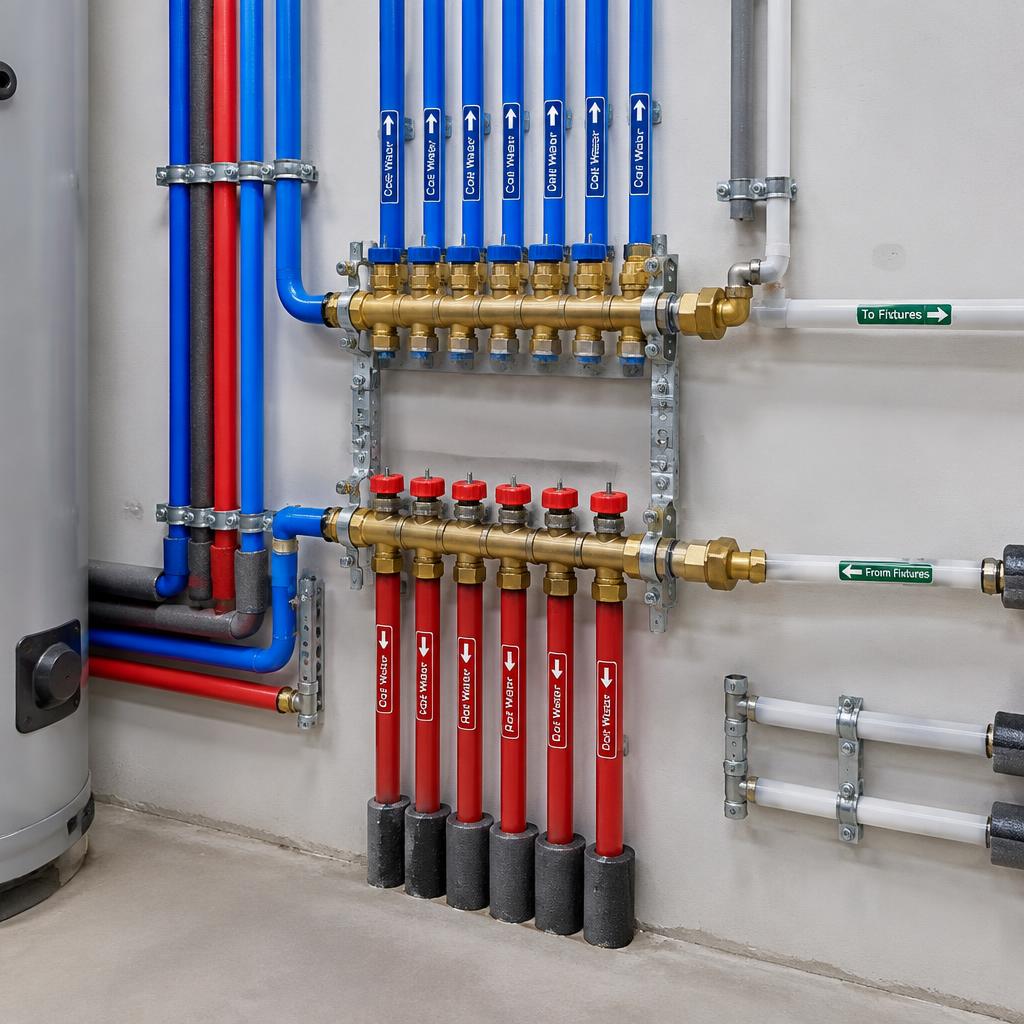
During renovation, the pipe layout is just as important as the material. In Greece, the installation using a manifold is now preferred.
In this system, every supply point (faucet, toilet flush, shower) is connected directly to a central manifold with an independent pipe (pipe-in-pipe or protective conduit). This means:
- There are no connections or joints inside walls or under floors.
- If a fault occurs in one line, you can isolate only that one from the manifold without leaving the entire house without water.
- Easier replacement of the inner pipe without digging, if the protective conduit has been used correctly.
What to watch for in renovation: Technical tips
As a technician, I place particular emphasis on the following points that are often skipped due to haste or cost:
Pipe Insulation
It is essential that all domestic hot water pipes are insulated with suitable foam material (armaflex). This reduces thermal losses and prevents water vapor condensation. It also protects the pipes from contractions and expansions that could crack the plaster.
Network Pressure and Reducers
In many areas of Greece, the pressure of the EYDAP or local municipal water network exceeds 6-7 bar, especially at night. This stresses valves, toilet flushes, and connections. Installing a high-quality pressure reducer on the main supply is the best safety measure for your installation.
Leak Testing (Pressure Test)
Before closing up wall repairs and laying tiles, the installation must be "pressure tested." We fill the network with water and increase the pressure (usually to 10-15 bar) using a manual or electric pump for at least 24 hours. If the pressure gauge needle does not drop, the installation is leak-proof.
Cost and Budget
Prices vary depending on the region and the size of the house. Indicatively, for a typical bathroom and kitchen (complete plumbing renovation):
- Labor: €600 - €1,200 depending on complexity.
- Materials (Multilayer/PEX): €300 - €500.
- Materials (Copper): €500 - €800.
Frequently Asked Questions (FAQ)
1. Can I connect new PEX pipes to old iron ones?
Yes, there are special connection fittings (male/female), but it is recommended to completely replace old piping up to the meter, as old iron pipes will continue to produce rust that will clog your new faucets.
2. What is the best material for hot water from a solar water heater?
Copper and high-spec multilayer pipe are the best solutions. Be careful with simple PEX plastic pipes without an oxygen barrier, as the high temperatures from the solar heater (over 80°C in summer) can degrade them.
3. Why is there noise in the walls when I turn off the tap?
This is called "water hammer." It happens when the pressure is high or the pipes have not been secured properly with brackets. The solution is to install a pressure reducer or a special anti-water hammer device.
Conclusion
The choice of material for water supply networks should not be made solely on the criterion of the lowest price. For an average Greek home, the multilayer pipe with a manifold system is the golden mean between cost, installation ease, and reliability. Always ask your plumber for a written warranty and a pressure test before completing the work.