
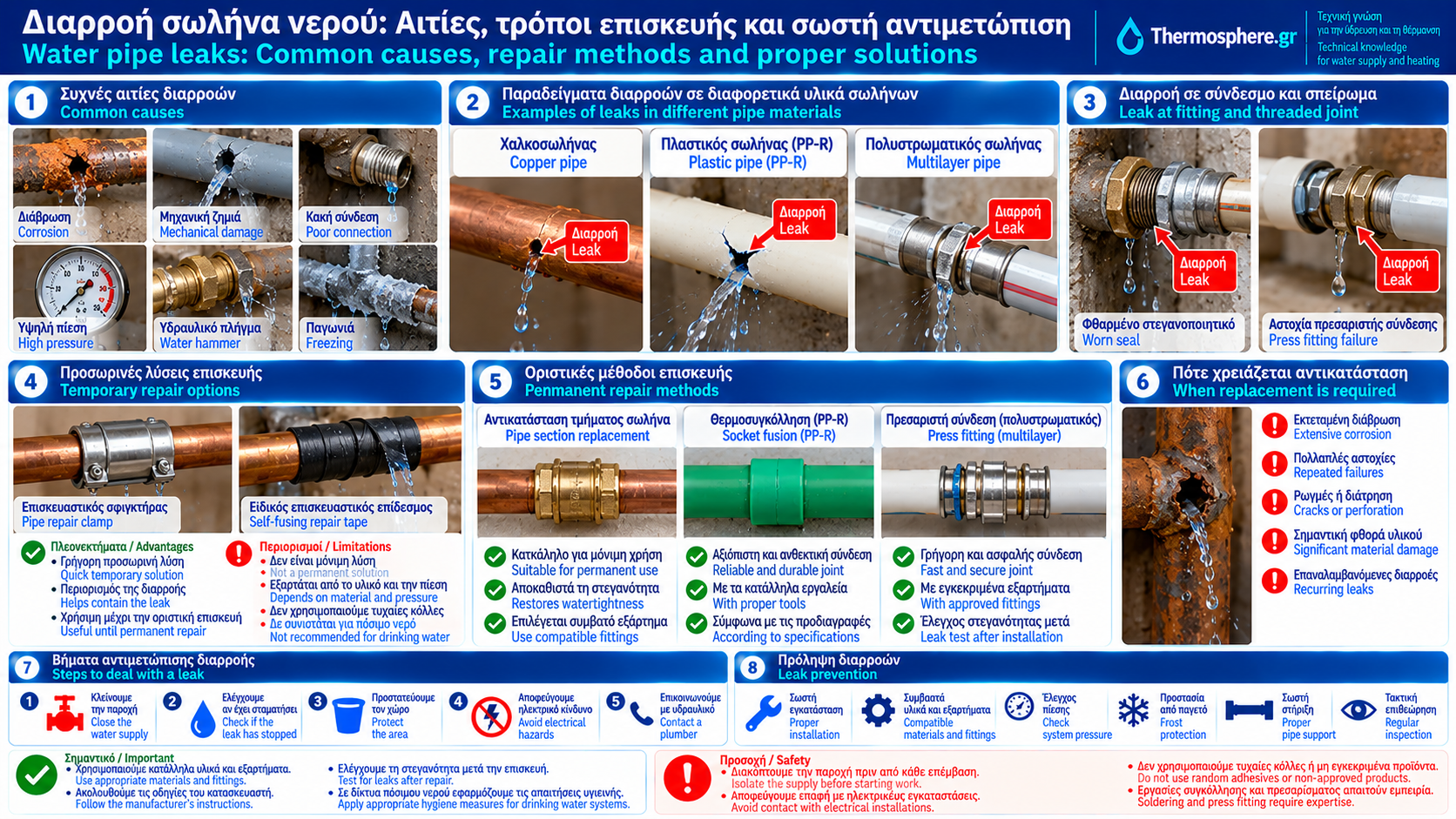
Water Pipe Leaks: Common Causes, Repair Methods and Proper Solutions
A leaking water pipe is one of the most common problems in plumbing installations. It can occur in older metal pipes, plastic piping, multilayer systems or the connections between components.
Some leaks appear as small droplets, while others cause substantial water discharge and require immediate isolation of the supply.
Proper repair involves more than temporarily stopping the water. The cause must be identified, the pipe condition assessed and a repair method selected that is compatible with the material and operating conditions.
This Thermosphere.gr guide explains common pipe leak causes, initial safety measures, temporary solutions and permanent repair approaches.
1. How Does a Water Pipe Leak Develop?
A leak occurs when water escapes through a point where watertightness has been lost.
Possible locations include:
The pipe wall.
Threaded joints.
Couplings.
Elbows and tees.
Soldered connections.
Press fittings.
Material transition fittings.
Mechanically stressed areas.
A pressurised pipe may continue leaking even when every tap is closed.
The discharge rate depends on pressure, defect size and hydraulic conditions.
2. Common Causes of Water Pipe Leaks
Corrosion
Some metal pipes can gradually lose wall thickness due to corrosion.
As deterioration progresses, small holes may develop.
Poor Connections
Incorrect assembly, unsuitable fittings or inadequate sealing can lead to leaks.
Excessive Pressure
High pressure increases mechanical loading on pipes and joints.
However, it is not the only possible cause of failure.
Water Hammer
Rapid changes in water velocity can produce transient pressure surges.
Repeated loading may stress the system.
Thermal Expansion
Temperature changes cause materials to expand and contract.
If the installation does not accommodate movement, mechanical stress may develop.
Mechanical Damage
Drilling, renovation work and inadequate pipe support can cause damage.
Freezing
Water freezing inside pipes can generate excessive pressure and cause rupture, particularly in unprotected sections.
3. What to Do Immediately When a Water Pipe Bursts
The priorities are safety and limiting water discharge.
Close the appropriate isolation valve if it is safe and accessible.
Check whether the water flow has stopped.
Move vulnerable belongings away from the affected area.
Avoid wet electrical appliances, wiring and outlets.
Contact a plumber for assessment and repair.
If the valve does not operate, isolation may be required further upstream.
Do not interfere with shared or public infrastructure without appropriate authorisation.
Important: Never approach an electrical panel through standing water. Electrical isolation must be performed safely by a qualified professional.
4. How to Identify the Exact Leak Location
For exposed pipework, inspection can begin by observing the path of the water.
Water may travel along the pipe before dripping, so the visible drip point may not be the source.
A technician checks:
The pipe wall.
Joints and fittings.
Supports.
Corrosion.
Cracks and deformation.
Concealed leaks may require acoustic detection, thermal imaging or other appropriate diagnostic methods.
Accurate diagnosis should precede repair selection.
5. Temporary Leak Repair Options
Some products may provide temporary containment under suitable conditions.
Examples include:
Specialised pipe repair clamps.
Approved temporary sealing components.
Suitable repair wraps where permitted by the manufacturer.
Selection depends on:
Pipe material.
Diameter.
Operating pressure.
Temperature.
Defect type.
Whether the system carries drinking water.
Do not use random adhesives, tapes or chemicals on drinking water pipes.
A temporary repair should not automatically be considered suitable for permanent service.
6. When Should a Pipe Section Be Replaced?
Replacement is often appropriate when:
The pipe wall has been perforated.
Significant corrosion is present.
A crack has developed.
The pipe is deformed.
The material has deteriorated.
Repeated leaks occur in the same area.
The repair must restore both mechanical integrity and watertightness.
Covering the visible symptom is not sufficient.
7. Copper Pipe Repairs
Copper pipes are used in many water supply and heating installations.
Leaks may result from:
Localised corrosion.
Joint failure.
Mechanical damage.
Inadequate support.
Repair may involve removing the defective section and installing a replacement using suitable fittings.
Depending on the system, approved joining methods may include appropriate capillary joints or press fittings.
The method must be compatible with the pipe and its intended use.
Flame-based joining requires fire safety precautions and should not be attempted by untrained individuals.
8. Plastic Pipe Repairs
Plumbing systems may contain different plastic pipe materials, including PP-R, PE-X and PE.
Not all plastic pipes are repaired using the same method.
PP-R: Suitable socket-fusion methods and fittings belonging to the specified system may be used.
PE-X: Compatible mechanical fittings or manufacturer-approved joining systems are required.
PE: The joining method depends on the application, pipe type and approved system techniques.
Unsuitable fittings can cause further leaks.
It is also important to verify whether the specific joint is permitted within concealed construction.
9. Multilayer Pipe Repairs
Multilayer pipes are widely used in modern plumbing systems.
Failures may occur in the pipe itself or at a fitting.
Repairs generally require:
Identifying the piping system.
Confirming the correct dimensions.
Selecting compatible fittings.
Using the specified tools.
Testing the repaired section.
For press fittings, the pressing profile and tools must be approved for the particular system.
Two fittings that look similar are not necessarily compatible.
10. Leaks at Threaded Joints and Couplings
Not every leak means the pipe itself is broken.
Connections may leak because of:
Worn seals.
Unsuitable sealing materials.
Incorrect assembly.
Deformation.
Corrosion.
Incompatible components.
Repair may require disassembly and replacement of the defective component.
Overtightening can damage threads or crack fittings.
11. What Is a Pipe Repair Coupling?
A repair coupling is a component designed to restore specific types of pipe defects.
Different designs include:
Mechanical couplings.
Repair clamps.
Couplings used when replacing a short pipe section.
Suitability depends on technical specifications.
Important checks include:
Outside pipe diameter.
Pipe material.
Pressure rating.
Operating temperature.
Drinking water suitability where required.
Approval for exposed or concealed installation.
Not every repair coupling is suitable for every pipe.
12. Why Can a Pipe Leak Again After Repair?
Recurring leakage may result from:
Repairing only the visible defect.
Widespread corrosion elsewhere.
Incorrect fittings.
Improper assembly.
Excessive pressure.
Thermal or mechanical stress.
Inadequate leak testing.
When several failures occur within a short period, the overall condition of the installation should be assessed.
Replacing a larger section may be more reliable than repeatedly repairing individual defects.
13. How Is a Repair Checked?
After repair, the plumbing system must be checked for correct operation.
Verification may include:
Visual inspection.
Controlled restoration of the water supply.
Joint inspection.
Appropriate leak testing.
Monitoring for renewed moisture.
Checking associated components.
Testing methods and pressures must follow the piping system requirements and applicable instructions.
Following work on drinking water pipework, appropriate flushing or other hygiene measures may be necessary, depending on the extent of the intervention.
14. When Is Extensive Pipe Replacement Worth Considering?
Partial or extensive replacement may be appropriate when:
Leaks recur.
Corrosion is widespread.
Pipe materials are unsuitable or seriously deteriorated.
Multiple defects are present.
Repeated repairs become costly.
The decision should be based on technical assessment rather than age alone.
An older installation does not necessarily require complete replacement if it remains in good condition.
15. How to Prevent Pipe Leaks
Preventive measures include:
Choosing appropriate materials.
Ensuring compatibility between pipes and fittings.
Following manufacturer instructions.
Providing proper pipe support.
Protecting pipes from mechanical stress.
Preventing freezing.
Checking system pressure.
Managing water hammer where necessary.
Regularly inspecting accessible joints.
Correct installation practices are essential for long-term reliability.
16. Frequently Asked Questions
Can a Perforated Pipe Be Repaired Without Replacement?
Specialised repair components exist for certain applications. Suitability depends on pipe material, defect type and operating conditions. Replacing the damaged section is often preferable.
Can Ordinary Electrical Tape Stop a Pipe Leak?
No. Ordinary electrical tape is not a certified sealing solution for pressurised water pipes.
Why Is a Pipe Coupling Leaking?
Possible causes include damaged seals, incorrect assembly, corrosion or deformation.
Can High Water Pressure Cause Leaks?
Yes. Excessive pressure can stress pipes and fittings, especially where weak points already exist.
Must All Pipes Be Replaced After One Leak?
Not necessarily. The decision depends on the cause and the overall condition of the installation.
Can a Pipe Inside a Wall Be Repaired?
Yes, although localised access is often necessary. The repair method must suit the pipe material and be permitted for the installation location.
Conclusion
Water pipe leaks require accurate diagnosis and an appropriate repair method.
Temporary solutions can help contain certain failures but do not always replace permanent repairs.
Replacing damaged pipe sections, using compatible fittings and verifying watertightness are fundamental to reliable restoration.
The best repair is not simply the one that stops the water today, but the one that restores safe and dependable operation over time.
Technical References and Further Reading
EN 806: Specifications for installations inside buildings conveying water for human consumption.
EN 1717: Protection against pollution of potable water in water installations and general requirements of devices to prevent pollution by backflow.
EN ISO 15875: Plastics piping systems for hot and cold water installations — Crosslinked polyethylene (PE-X).
EN ISO 15874: Plastics piping systems for hot and cold water installations — Polypropylene (PP).
EN ISO 21003: Multilayer piping systems for hot and cold water installations inside buildings.
EN 1057: Copper and copper alloys — Seamless, round copper tubes for water and gas in sanitary and heating applications.
CEN-CENELEC: https://www.cencenelec.eu/
Material and fitting specifications must be considered alongside manufacturer instructions and applicable installation requirements.
Safety note: Before repair work, the system must be appropriately isolated and depressurised. Joining, pressing and pressure testing procedures should be performed by suitably trained personnel.
Thermosphere.gr — Technical knowledge for water supply and heating systems.