
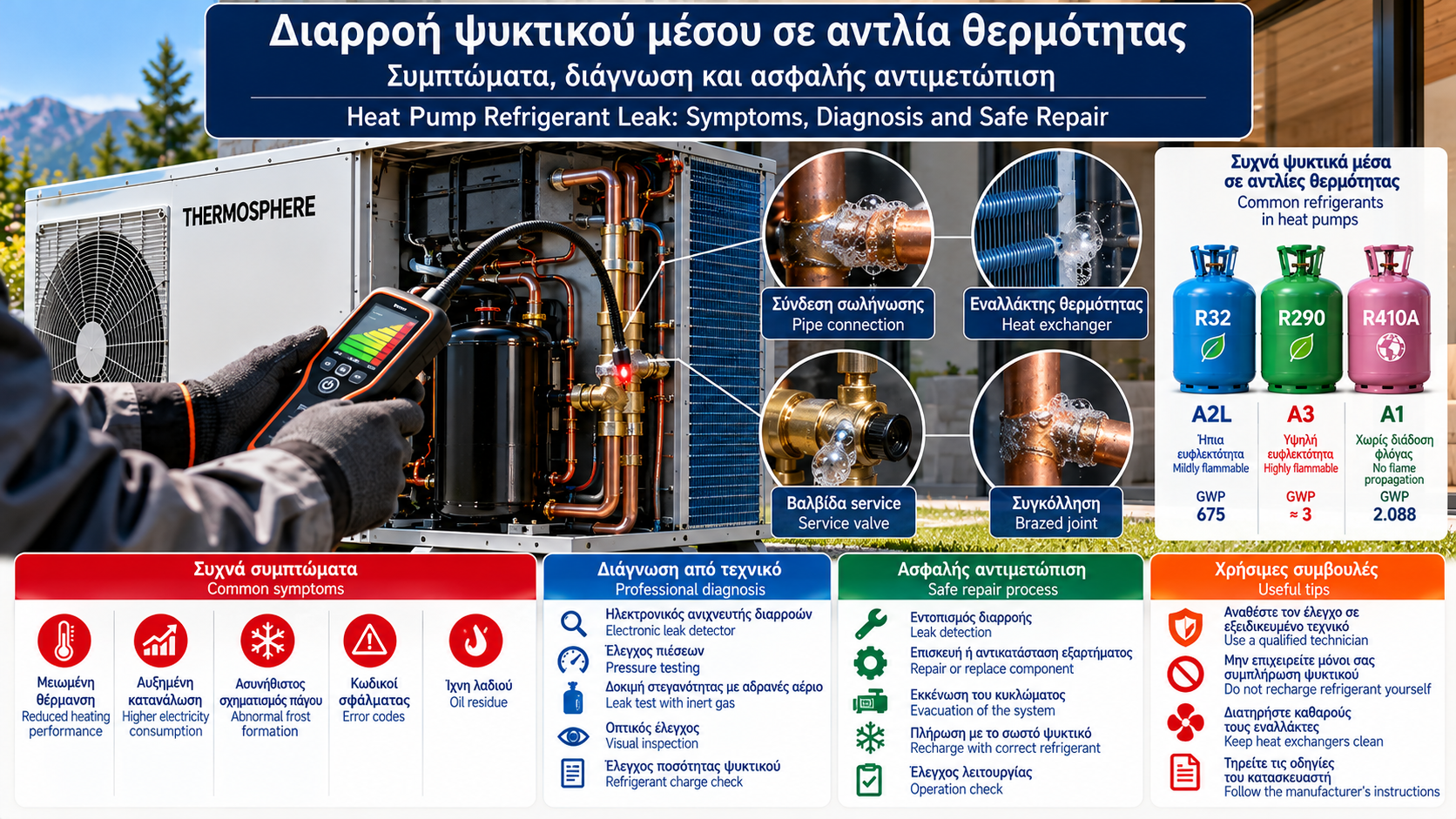
Heat Pump Refrigerant Leak: Symptoms, Diagnosis and Safe Repair
A refrigerant leak is one possible cause of reduced performance or malfunction in a heat pump.
Refrigerant circulates inside a sealed circuit and enables heat transfer from the environment to the building’s heating-water system.
In a correctly functioning installation, refrigerant is not consumed during operation. Repeated refrigerant top-ups are therefore not considered normal maintenance.
Poor heating performance, frost or an error code does not prove that a refrigerant leak exists. Proper technical diagnosis is required to identify the actual cause.
1. What Is a Refrigerant Leak?
A refrigerant leak occurs when refrigerant escapes from the sealed refrigeration circuit into the surrounding environment.
Possible causes include:
Failed connections.
Pipe corrosion or deterioration.
Mechanical stress.
Vibration.
Component failure.
Manufacturing defects.
Incorrect installation or previous repair work.
Leaks vary in severity. Some develop slowly and are difficult to locate, while others result in rapid refrigerant loss.
2. Common Symptoms of a Refrigerant Leak
Reduced Heating Performance
The heat pump may struggle to achieve the required heating-water temperature.
However, insufficient water flow, low outdoor temperatures and other faults can produce similar symptoms.
Increased Electricity Consumption
In some cases, reduced refrigeration circuit performance leads to longer operating periods.
Higher electricity consumption is not a specific indicator of refrigerant leakage.
Repeated Error Codes
The unit may display faults associated with pressure, temperature or compressor operation.
Error codes differ between manufacturers.
Unusual Frost Formation
Abnormal frost patterns on certain circuit components may be associated with refrigerant feeding problems.
These must be distinguished from normal frost formation on the outdoor heat exchanger, which is addressed by defrost operation.
Oil Residue
Oily traces around refrigeration connections can indicate a possible leak because compressor lubricant circulates with the refrigerant.
However, they do not provide definitive proof.
3. Where Can Refrigerant Leaks Occur?
Possible locations include:
Refrigerant pipe connections.
Brazed joints.
Heat exchangers.
Service valves.
Pipes exposed to vibration.
Components affected by corrosion or mechanical damage.
Split heat pumps generally have refrigerant connections between indoor and outdoor units.
In monobloc heat pumps, the refrigeration circuit is normally contained within the factory-built unit.
This does not mean monobloc units are immune to refrigerant leaks.
4. Does Refrigerant Naturally Disappear Over Time?
No. Refrigerant is not a consumable that requires routine replenishment.
Repeated charging requirements suggest that a possible leak or another problem needs investigation.
Simply adding refrigerant without identifying the underlying cause is not a complete repair.
5. How Is Professional Leak Detection Performed?
A qualified technician follows the equipment manufacturer’s procedures and selects methods suitable for the specific refrigerant.
Diagnosis may include:
Reviewing fault history.
Evaluating operating temperatures and pressures.
Visually inspecting accessible connections.
Using a suitable electronic leak detector.
Applying an approved leak-detection solution.
Performing pressure-tightness testing with an appropriate inert gas where specified.
Checking refrigerant charge according to the manufacturer’s procedures.
Improvised methods and unsuitable equipment should not be used.
Additional precautions are essential when working with flammable refrigerants.
6. Can a Leak Be Diagnosed from Pressure Alone?
Not reliably.
Refrigeration circuit pressures depend on refrigerant type, temperatures, load and operating conditions.
A single pressure reading cannot confirm the correct refrigerant charge or locate a leak.
A comprehensive assessment is necessary.
7. What Should an Owner Do if a Leak Is Suspected?
If a refrigerant leak is suspected:
Record the symptoms and displayed fault codes.
Do not open the refrigeration circuit.
Do not attempt to recharge refrigerant yourself.
Do not bypass safety devices.
Contact a suitably qualified technician.
If a significant leak of a flammable refrigerant such as R290 is suspected, avoid flames, smoking, sparks and operating electrical switches near the suspected leak. Move away from the hazardous area and seek qualified assistance.
The safety instructions for the specific equipment always take priority.
8. Is an R32 Leak Dangerous?
R32 belongs to safety class A2L and is mildly flammable.
Leaks must be managed using appropriate safety procedures.
The level of risk depends on the refrigerant quantity, room configuration, ventilation and potential ignition sources.
9. Is an R290 Leak Dangerous?
R290 is propane and belongs to safety class A3, indicating high flammability.
A leak can create a flammable mixture with air.
Because propane is heavier than air, it may accumulate in low-lying areas under certain conditions.
R290 installations must therefore follow manufacturer-defined safety requirements and protective zones.
10. What About R410A?
R410A is classified as A1, meaning no flame propagation under the specified classification test conditions.
This does not make a leak harmless.
High refrigerant concentrations can displace oxygen in poorly ventilated spaces.
R410A also has a high GWP, making its release environmentally harmful.
11. How Is a Refrigerant Leak Repaired?
Repair depends on the location and severity of the fault.
A professional repair process may involve:
Confirming and locating the leak.
Safely recovering refrigerant where required.
Repairing or replacing the defective component.
Performing a leak-tightness test.
Evacuating the circuit using the appropriate procedure.
Charging the approved refrigerant in the specified quantity.
Checking operation and documenting the work.
The precise procedure depends on equipment design, refrigerant type and applicable requirements.
12. Why Is Simply Adding Refrigerant Not Enough?
A top-up may temporarily restore some performance without correcting the reason for refrigerant loss.
This can lead to:
Recurring faults.
Additional costs.
Environmental emissions.
Unpredictable operation.
Potential compressor stress.
Proper repair requires identifying and correcting the leak.
13. Can a Refrigerant Leak Damage the Compressor?
Yes, in some circumstances.
Insufficient refrigerant charge can affect heat transfer, operating temperatures and lubrication conditions.
Continued operation outside permitted limits can place additional stress on the compressor.
However, not every small leak causes immediate mechanical damage.
The system must be evaluated by a qualified technician.
14. How Can Refrigerant Leaks Be Prevented?
Preventive measures include:
Correct installation according to manufacturer instructions.
Appropriate pipe support.
Limiting unwanted vibration.
Protection against mechanical damage.
Inspection for corrosion.
Scheduled maintenance where required.
Prompt investigation of unusual operating symptoms.
No maintenance programme can eliminate every possible future failure.
15. When Are Mandatory Leak Checks Required?
Within the European Union, Regulation (EU) 2024/573 establishes leak-checking obligations for specified categories of equipment and fluorinated greenhouse gases.
Requirements depend on factors including:
Gas type.
Refrigerant charge.
CO₂-equivalent or other applicable thresholds.
Equipment category.
Relevant exemptions.
Not every heat pump is subject to the same inspection schedule.
R290 is not a fluorinated greenhouse gas, but relevant installation and maintenance safety requirements still apply.
16. Frequently Asked Questions
How Can I Tell if My Heat Pump Is Low on Refrigerant?
Reduced performance or an error code may occur, but no single symptom confirms low refrigerant charge.
How Often Should Refrigerant Be Added?
A leak-tight refrigeration circuit does not require routine refrigerant top-ups.
Can I Continue Operating the Heat Pump?
It depends on the problem. If a leak is suspected, particularly involving a flammable refrigerant, follow the equipment safety instructions and obtain professional advice.
Does Refrigerant Have a Smell?
Smell should not be relied upon to detect a leak. Refrigerants do not necessarily have a reliably recognisable odour.
Is Leak Repair Expensive?
Costs depend on the leak location, accessibility, replacement parts and required work.
Can I Use a Different Refrigerant?
No, unless the equipment manufacturer explicitly approves the alternative refrigerant and the required procedure.
Conclusion
A refrigerant leak can affect heat pump performance, reliability and safety.
Symptoms alone are not sufficient for a definitive diagnosis, and simply adding refrigerant does not correct the underlying fault.
The appropriate solution is professional leak detection, suitable repair and confirmation that the installation operates safely.
Technical References and Further Reading
Regulation (EU) 2024/573 on fluorinated greenhouse gases.
EN 378 — Refrigerating Systems and Heat Pumps: Safety and Environmental Requirements.
ISO 817 — Refrigerants: Designation and Safety Classification.
ASHRAE Standard 34 — Designation and Safety Classification of Refrigerants.
Official heat pump installation and service manuals.
Thermosphere.gr — Technical knowledge for heating and building systems.