
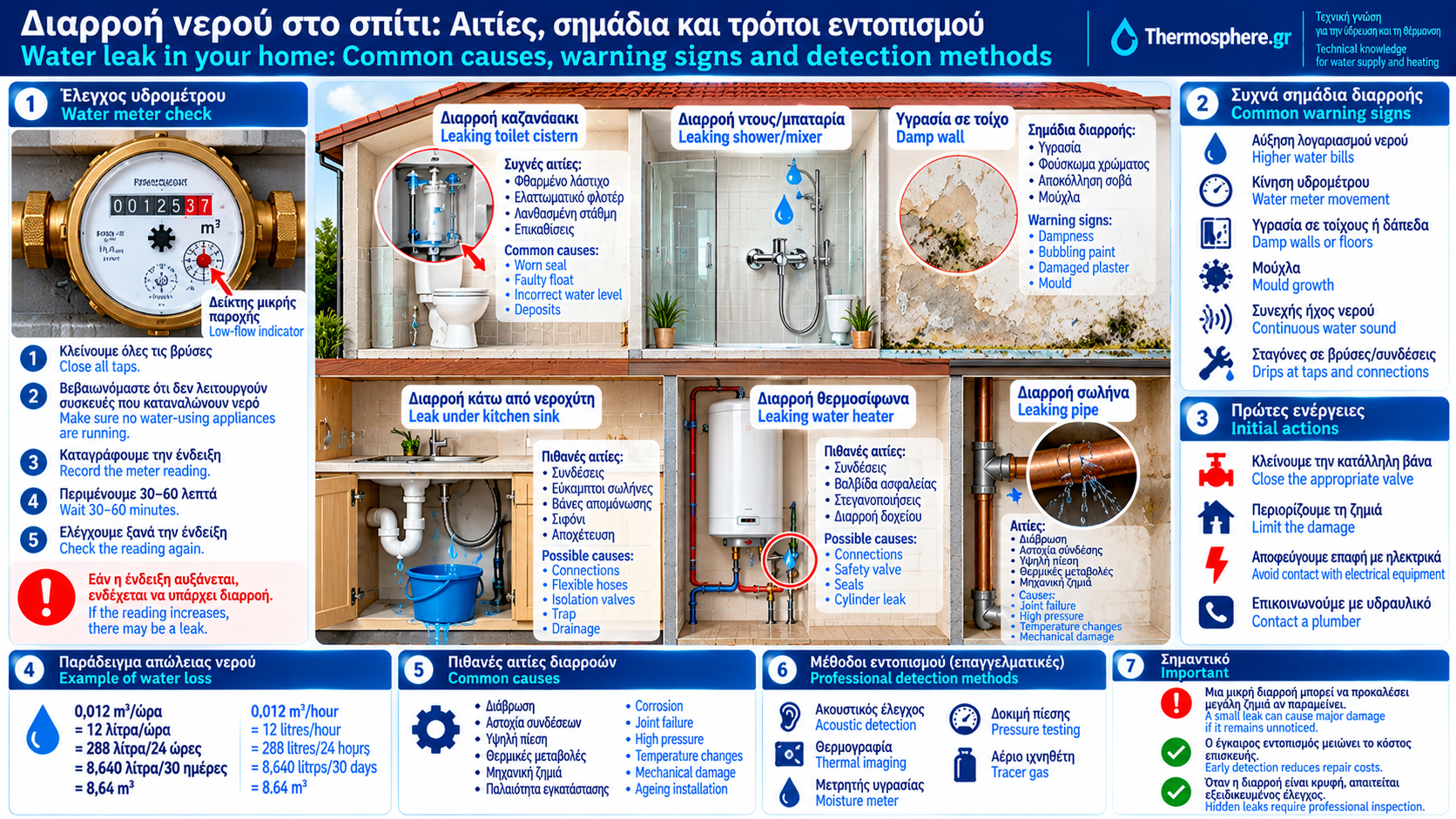
Water Leak in Your Home: Common Causes, Warning Signs and Detection Methods
A household water leak can begin at a simple fitting, a worn connection or a pipe concealed inside a wall.
Some leaks become obvious immediately. Others remain unnoticed for weeks or months, causing increased water consumption, dampness and damage to building materials.
Early detection is important for limiting damage and avoiding unnecessary repair work.
This Thermosphere.gr guide explains common leak causes, warning signs and initial checks that can be carried out safely.
1. What Is a Water Leak?
A water leak is the unwanted escape of water from a plumbing network, component or appliance.
Possible sources include:
Water supply pipes.
Taps and mixers.
Valves and connections.
Toilet cisterns.
Water heaters.
Flexible supply hoses.
Drainage pipes.
Not all leaks behave the same way.
A pressurised supply pipe may leak continuously, even when no taps are open.
A drainage leak may appear only when a sink, shower or appliance is being used.
Understanding this difference helps narrow down the source.
2. Common Warning Signs
Typical warning signs include:
An unexplained increase in water bills.
Water meter movement without known consumption.
Damp walls or floors.
Bubbling or peeling paint.
Damaged plaster.
Mould growth.
Water droplets beneath sinks.
Continuous water-flow sounds.
Moisture near water heaters or plumbing appliances.
However, dampness does not always mean a pipe is leaking.
Condensation, rainwater penetration and failed waterproofing can produce similar symptoms.
3. How to Check Your Water Meter for Leaks
A water meter is a useful starting point for investigating unwanted water consumption.
Step 1: Stop Water Use
Close all taps and make sure washing machines and other appliances are not operating.
Check that toilet cisterns and storage tanks are not filling.
Step 2: Record the Reading
Write down or photograph the meter reading.
Step 3: Check the Low-Flow Indicator
If the meter has a low-flow indicator, observe whether it moves when no water should be in use.
Step 4: Wait Without Using Water
Allow a suitable period, such as 30–60 minutes, during which no water is consumed.
Step 5: Compare Readings
If the reading increases, investigate the cause.
This test can identify unwanted consumption within the network measured by the meter.
It does not identify the exact leak location.
It also cannot rule out drainage leaks or rainwater penetration.
4. Calculating Water Loss
Suppose the meter records an increase of 0.012 m³ in one hour without known consumption.
Since:
1 m³ = 1,000 litres
the volume is:
0.012 × 1,000 = 12 litres per hour.
If the loss continues at the same rate:
Over 24 hours: 288 litres.
Over 30 days: 8,640 litres.
In cubic metres: 8.64 m³.
This is a hypothetical example of constant leakage.
Actual leakage rates may change with pressure and operating conditions.
5. Leaking Toilet Cisterns
A toilet cistern can leak into the bowl without leaving water on the floor.
Common causes include:
Worn flush valve seals.
Faulty float mechanisms.
Incorrect water level.
Deposits affecting sealing surfaces.
A continuous thin stream into the bowl is a typical warning sign.
The cistern may also refill periodically without being flushed.
Inspection and repair depend on the mechanism design.
6. Leaking Taps and Mixers
Tap leaks may appear:
At the spout.
Around the base.
At supply connections.
At flexible hoses.
Inside the mixer cartridge.
Causes include worn cartridges, damaged seals, corrosion and mechanical stress.
If water appears beneath the basin, isolation valves should also be inspected.
Overtightening connections is not always an appropriate repair and can damage threads or seals.
7. Leaks Beneath Kitchen Sinks
Two types of pipework are usually present beneath a sink.
Supply pipes: Carry water under pressure.
Drainage pipes: Remove used water.
If moisture appears without sink use, inspect the supply-side connections first.
If leakage occurs only when water drains from the sink, the trap or waste pipe may be responsible.
Observing when moisture appears is a valuable diagnostic clue.
8. Hidden Leaks Inside Walls
Hidden leaks may cause:
Localised dampness.
Discolouration.
Bubbling paint.
Plaster deterioration.
Mould.
Dampness on the opposite side of a wall.
However, the visible damp area may not correspond to the actual leak location.
Water can migrate through joints, cavities and porous materials.
Opening walls without adequate investigation may therefore cause unnecessary damage.
9. Leaks Beneath Tiles and Floors
Concealed floor pipework can leak due to:
Material deterioration.
Joint failure.
Corrosion.
Mechanical stress.
Poor initial installation.
Possible warning signs include persistent dampness, deteriorating joints and damage to surrounding materials.
Visual inspection alone cannot reliably locate every leak.
Professional testing may be required.
10. Leaks Near Water Heaters
Water near a heater can originate from:
Supply connections.
Safety relief valves.
Damaged seals.
The storage vessel.
Adjacent pipework.
A safety relief valve may discharge water when pressure rises during heating.
Continuous or unusual discharge requires investigation.
If water is present near electrical components, avoid touching the equipment and arrange safe electrical isolation by a qualified professional.
11. Main Causes of Pipe Leaks
Corrosion
Some metal pipe systems may gradually lose material.
Joint Failure
Connections can leak due to poor assembly, deterioration or mechanical stress.
Excessive Pressure
High pressure can increase mechanical loading and worsen weak points.
Temperature Changes
Thermal expansion and contraction can stress pipes and joints.
Mechanical Damage
Drilling or other building work can damage concealed pipework.
Ageing Installations
The probability of component deterioration may increase over time, depending on materials and operating conditions.
12. Professional Hidden Leak Detection Methods
Professional methods include:
Acoustic detection: Uses sounds produced by water escaping from pressurised pipes.
Thermal imaging: May reveal temperature anomalies associated with leaks, particularly in some hot water systems.
Moisture meters: Help assess moisture distribution within materials.
Pressure testing: Checks the tightness of appropriately isolated pipe sections.
Tracer gas: Uses suitable detection gas and specialised instruments in appropriate applications.
No single method works in every situation.
For example, thermal cameras do not see directly through walls and cannot always pinpoint a leak.
13. What to Do When an Active Leak Is Found
Initial actions depend on the severity of the situation.
Close the appropriate water isolation valve if safe.
Move belongings away from the affected area.
Avoid contact with wet electrical appliances or wiring.
Record the leak location and circumstances.
Contact a plumber for diagnosis and repair.
If there is a risk of electric shock, do not walk through water to reach an electrical panel.
Electrical isolation must be performed safely by a qualified person.
14. Can a Small Leak Cause Major Damage?
Yes.
Leak severity depends on both flow rate and duration.
A small continuous leak may lead to:
Persistent moisture in building materials.
Plaster deterioration.
Damage to wooden components.
Mould growth under suitable conditions.
Increased water consumption.
Damage to neighbouring areas.
Small but persistent warning signs should not be ignored.
15. How to Prevent Water Leaks
Preventive measures include:
Regular visual checks of connections.
Inspection of flexible hoses.
Toilet cistern maintenance.
Monitoring unusual water consumption.
Pressure checks where appropriate.
Suitable pipes and fittings.
Proper pipe support.
Early treatment of corrosion and deterioration.
Leak sensors and automatic shut-off devices can also be useful in some installations.
They may reduce the consequences of leaks but do not replace proper plumbing design and installation.
16. Frequently Asked Questions
How Can I Tell If There Is a Hidden Water Leak?
Possible signs include dampness, higher consumption and water meter movement without known use. Testing is required for confirmation.
My Water Meter Moves When No Taps Are Open. What Does It Mean?
There may be a leak or another source of unwanted consumption. Automatic filling systems and appliances should be ruled out first.
Can There Be a Leak Without Visible Dampness?
Yes. Water may escape into concealed spaces or surrounding soil.
Does a Damp Wall Always Mean a Broken Pipe?
No. Condensation, rainwater and waterproofing failures can produce similar symptoms.
Can a Thermal Camera Find a Leak?
Thermal imaging can assist in some situations, but it does not independently confirm the exact location or cause.
When Should I Call a Plumber?
Professional help is appropriate when the source is unclear, water loss continues, building materials become damp or pressurised pipework requires repair.
Conclusion
Household water leaks may originate from a simple fitting or a more serious failure within the plumbing system.
Water meter checks, observation of damp areas and distinguishing supply leaks from drainage problems are useful initial steps.
For concealed leaks, accurate diagnosis can reduce unnecessary destructive work.
Early investigation and proper repair are more important than temporarily concealing the symptoms.
Technical References and Further Reading
EN 806: Specifications for installations inside buildings conveying water for human consumption.
EN 805: Water supply — Requirements for systems and components outside buildings.
ISO 24512: Activities relating to drinking water and wastewater services — Guidelines for the management of drinking water utilities and for the assessment of drinking water services.
U.S. EPA WaterSense: https://www.epa.gov/watersense — household leak and water efficiency guidance.
CEN-CENELEC: https://www.cencenelec.eu/ — European technical standardisation.
Standards apply according to installation type and relevant requirements.
Safety note: In the event of an active leak near electrical equipment, avoid contact with water and electrical installations. Pressurised plumbing should be isolated appropriately before repair work.
Thermosphere.gr — Technical knowledge for water supply and heating systems.