
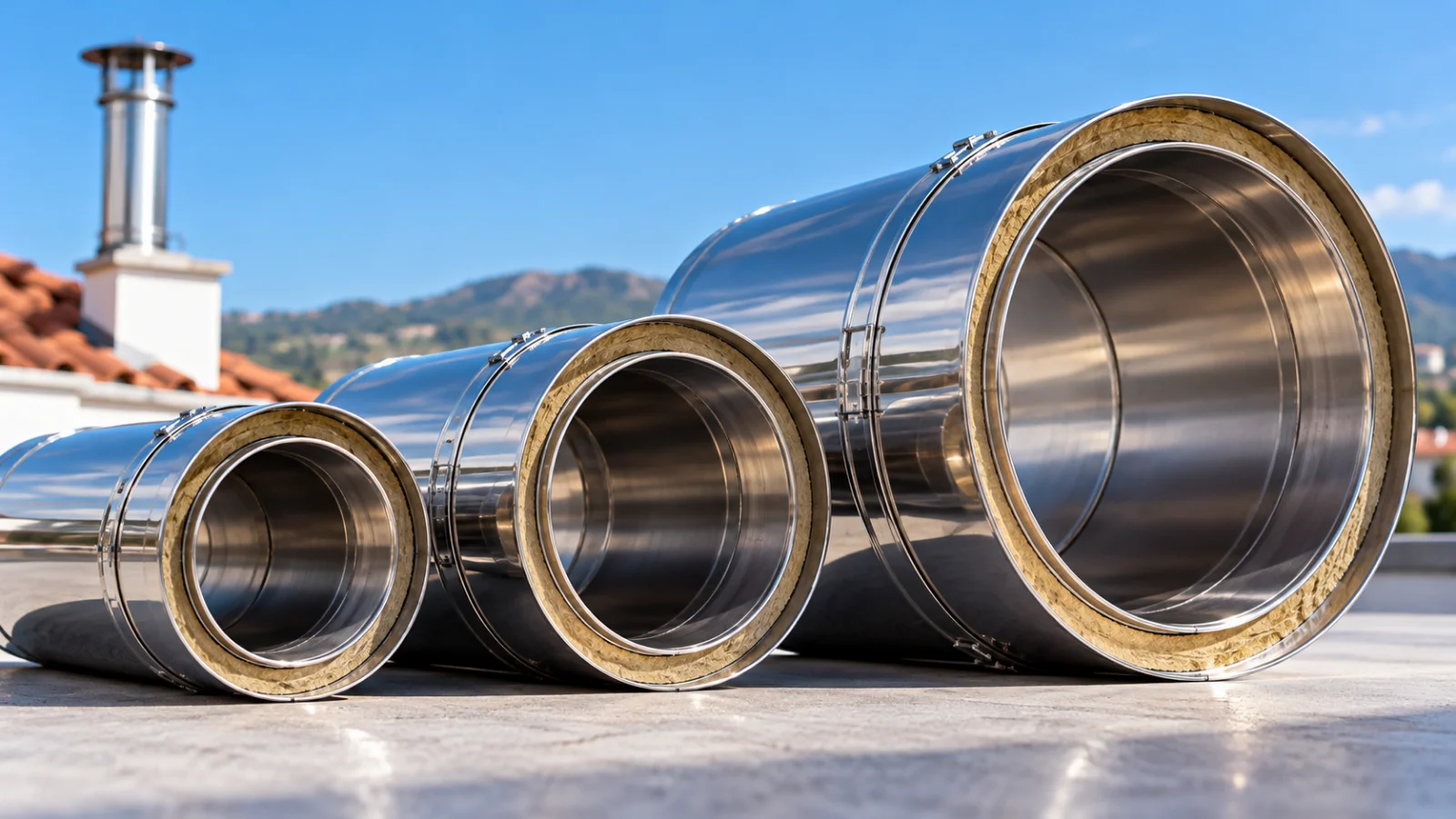
Chimney Diameter: How to Calculate and Choose the Correct Size
Chimney diameter is one of the most important parameters in the design of a flue gas evacuation system.
A chimney with an unsuitable internal cross-section may experience poor draft, excessive pressure losses, significant flue gas cooling or unstable appliance operation.
The correct diameter cannot be determined solely from the rated output of a boiler, stove or fireplace. Proper sizing requires an assessment of the complete installation, including appliance characteristics and operating conditions.
Why Is Chimney Diameter Important?
The internal diameter determines the available cross-sectional area through which combustion gases flow.
For a circular flue, the cross-sectional area is calculated using:
A = π × D² / 4
Where:
A: Internal cross-sectional area, in m².
D: Internal diameter, in m.
This relationship shows that the cross-sectional area increases with the square of the diameter.
For example, increasing the diameter by 20% increases the cross-sectional area by 44%.
Even relatively small changes in diameter can therefore have a significant effect on flue gas flow conditions.
How Does Diameter Affect Flue Gas Velocity?
For a given volumetric flow rate, the average flow velocity is related to the cross-sectional area by:
v = Q / A
Where:
v: Average flow velocity, in m/s.
Q: Volumetric flue gas flow rate, in m³/s.
A: Internal cross-sectional area, in m².
If the volumetric flow rate remains constant, a smaller diameter results in a higher average velocity.
Conversely, a larger diameter results in a lower average velocity.
However, velocity alone does not determine whether a chimney is correctly sized.
Pressure losses and the thermal behaviour of the flue system must also be considered.
What Happens When Chimney Diameter Is Too Small?
An excessively small chimney diameter can significantly increase flow resistance.
Pressure losses occur because of friction between the flue gases and the chimney walls, as well as local resistance caused by bends, fittings and changes in direction.
In a natural-draft installation, excessive pressure losses may exceed the available chimney draft pressure.
Possible consequences include:
Inadequate flue gas evacuation.
Unstable appliance operation.
Difficulty during start-up.
Smoke entering the occupied space.
Increased sensitivity to changing operating conditions.
Increasing chimney height does not always compensate for an undersized flue.
What Happens When Chimney Diameter Is Too Large?
Choosing a larger chimney diameter does not automatically provide safer or more efficient operation.
In some installations, an excessively large cross-section may contribute to:
Lower flue gas velocity.
Increased flue gas cooling.
Reduced available natural draft pressure.
Greater risk of condensate formation.
Unstable operation at low appliance output.
These effects depend on flue gas temperature, mass flow rate, chimney height and thermal insulation.
A larger diameter does not necessarily cause problems in every installation. Suitability must be confirmed through appropriate technical assessment.
How Is Chimney Diameter Related to Natural Draft?
Natural chimney draft results from the density difference between warm flue gases and the surrounding outdoor air.
The available draft pressure must be sufficient to overcome flow resistance and satisfy the appliance's operating requirements.
Chimney diameter affects:
Flue gas velocity.
Frictional pressure losses.
Local pressure losses.
Flue gas cooling and thermal behaviour.
Correct chimney sizing therefore requires a balance between available pressure, system resistance and temperature conditions.
Is the Appliance Outlet Diameter Sufficient to Determine Chimney Size?
Not in every case.
The flue outlet diameter of a boiler, stove or fireplace is an important design parameter.
However, it does not necessarily determine the diameter of the entire chimney.
The final selection also depends on:
Flue gas mass flow rate.
Flue gas temperature at the appliance outlet.
Required operating pressure.
Chimney height and total flue length.
Number and geometry of bends.
Thermal insulation.
Outdoor design conditions.
Manufacturer restrictions concerning permitted diameters, reductions and flue configurations must always be followed.
How Is Chimney Diameter Calculated According to EN 13384-1?
The European standard EN 13384-1 specifies thermal and fluid dynamic calculation methods for chimneys serving one combustion appliance.
The calculation considers:
Flue gas mass flow rate.
Flue gas temperature.
Appliance pressure requirements.
Chimney diameter and height.
Frictional and local pressure losses.
Thermal losses through the chimney system.
Ambient and operating conditions.
The calculation allows different diameters and chimney configurations to be assessed.
Its purpose is to verify that the installation satisfies the required pressure and temperature conditions.
Selecting chimney diameter solely from general reference tables, without checking actual installation data, may produce incorrect results.
Example: Comparison of Chimney Cross-Sectional Areas
The following table shows the geometric cross-sectional area of several example internal chimney diameters.
Internal diameter | Cross-sectional area |
|---|---|
100 mm | 78.5 cm² |
120 mm | 113.1 cm² |
130 mm | 132.7 cm² |
150 mm | 176.7 cm² |
180 mm | 254.5 cm² |
200 mm | 314.2 cm² |
The values are calculated using the geometric formula for circular ducts.
This table is not a chimney sizing chart based on appliance output. It only illustrates the differences in cross-sectional area.
What About Condensing Boilers?
Modern condensing boilers frequently use fan-assisted flue systems operating under positive pressure.
In these installations, the correct flue diameter is determined by the manufacturer's approved system configurations.
The maximum permitted flue route may depend on:
Flue diameter.
Total installation length.
Number of bends.
Type of flue system.
Specific boiler model.
Rules developed for traditional natural-draft chimneys must not automatically be applied to fan-assisted systems.
How Does Thermal Insulation Affect Chimney Sizing?
Thermal insulation reduces flue gas cooling as combustion products travel through the chimney.
In natural-draft installations, maintaining flue gas temperature can help preserve available draft pressure.
Insulation may also influence the conditions under which condensation occurs.
However, an insulated chimney does not automatically compensate for an unsuitable internal diameter.
Diameter and thermal insulation must be evaluated together.
Common Chimney Sizing Mistakes
Choosing a Larger Diameter for Extra Safety
An oversized flue may create unfavourable thermal conditions in certain installations.
Choosing a Smaller Diameter for Easier Installation
An undersized flue may produce excessive pressure losses.
Ignoring Chimney Height
The same diameter may behave differently in chimneys of different heights.
Overlooking Bends and Fittings
Changes in direction introduce additional resistance that must be included in the assessment.
Using Generic Sizing Tables Without Verification
Indicative tables do not replace manufacturer requirements or proper engineering calculations.
Conclusion
The correct chimney diameter is neither the largest nor the smallest available size.
It is the diameter that allows the complete flue system to operate within the required pressure and temperature limits, taking account of the connected appliance.
Diameter, height, thermal insulation and chimney routing are interdependent design parameters.
For suitable natural-draft installations, calculation methods such as those described in EN 13384-1 support technically justified chimney sizing.
Final sizing should be performed by a suitably qualified professional in accordance with the manufacturer's instructions and applicable requirements.
Technical References
EN 13384-1 — Chimneys: Thermal and fluid dynamic calculation methods — Part 1: Chimneys serving one combustion appliance.
EN 15287-1 — Chimneys: Design, installation and commissioning — Part 1.
EN 1443 — Chimneys: General requirements.
EN 1856-1 — Chimneys: Requirements for metal chimneys — Part 1: System chimney products.
The applicable editions of these standards, national regulations and manufacturer-specific requirements should be verified for each installation.