The electrical installation is the heart of every modern building. When a fault occurs, ranging from a simple fuse trip to a total blackout, the diagnosis must be methodical, safe, and accurate. As technicians, we do not simply look for "why the lights went out," but we identify the root cause to prevent situations such as electrocution or fire.
The Importance of Proper Preparation and Safety
Before touching any tool, there is one golden rule: safety precedes diagnosis. The use of Personal Protective Equipment (PPE), such as insulated shoes and VDE-certified (1000V) tools, is non-negotiable.
- Visual inspection: Many faults are visible to the naked eye. Look for traces of smoke, the smell of burnt plastic, or discoloration on sockets and fuses.
- Understanding the history: Ask the owner what happened at the time of the fault. Was a specific appliance running? Was there heavy rainfall or a voltage fluctuation?
Step 1: Checking the Electrical Switchboard
The switchboard is where every diagnosis begins. Here, we can categorize the problem into three basic types: overload, short circuit, or earth leakage.
Recognizing the Signs
If a Miniature Circuit Breaker (MCB) has tripped, the problem usually concerns that specific line (e.g., kitchen, room sockets). If the Residual Current Device (RCD) has tripped, there is a current leakage to earth, which indicates an insulation or moisture problem.
- Overload: Occurs when too many appliances operate simultaneously on a 10A or 16A line.
- Short circuit: Direct contact between phase and neutral. The fuse trips instantaneously, often with a characteristic sound.
Step 2: Isolating Lines and Appliances
To pinpoint the exact location, follow the method of gradual isolation. Switch off all fuses and the RCD. Then:
- Unplug all devices from the outlets of the problematic line.
- Switch on the RCD and the main fuse.
- Switch on the individual fuses one by one.
If the RCD trips as soon as you switch on a specific fuse, then the fault lies within that circuit. If the fuses remain on, but the RCD trips as soon as you plug in a specific device, then the device is faulty.
Step 3: Using Measurement Instruments (Multimeter and Megger)
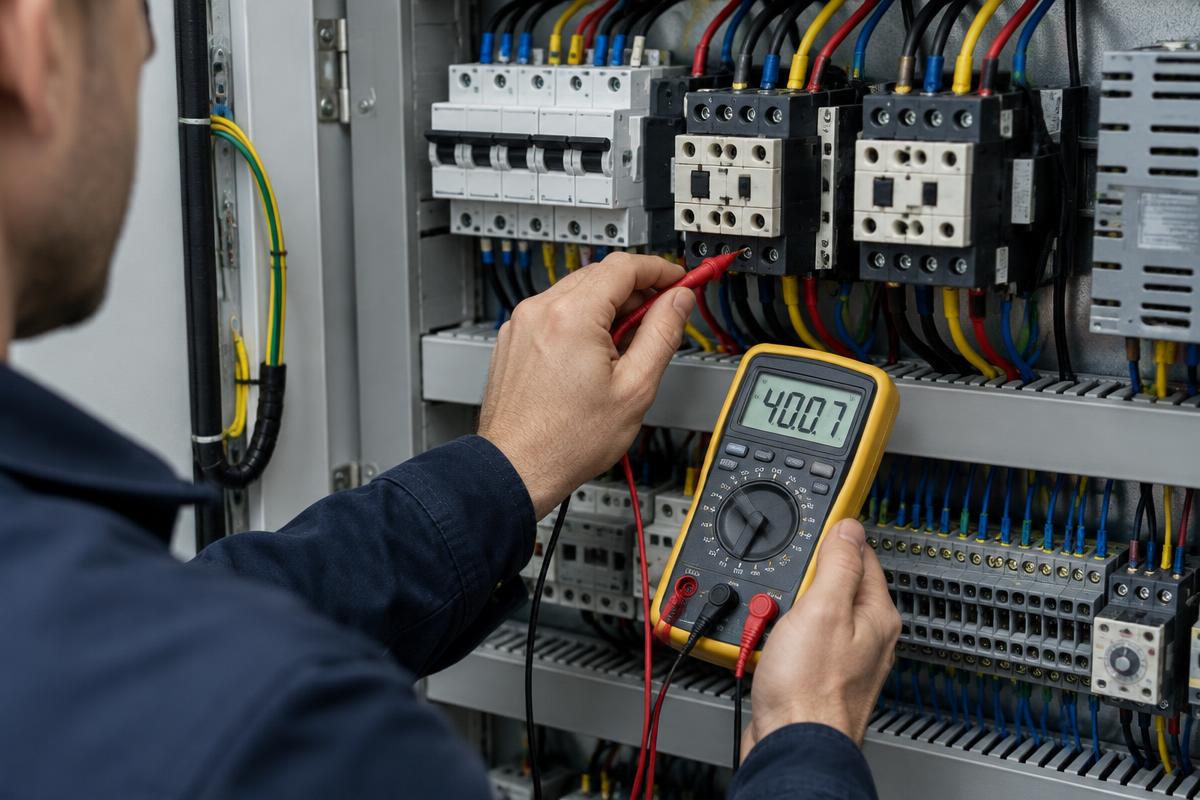
When visual inspection and isolation are not enough, we move on to precision measurements. The multimeter is useful for checking voltage (V) and continuity, but for diagnosing difficult faults, the Megger (insulation tester) is essential.
Measuring Insulation Resistance
With the power supply off, we measure the resistance between phase-earth and neutral-earth. According to the HD 384 standard, a value below 1 MΩ (Megohm) indicates a serious insulation problem. In practice, in a new installation, we expect values above 100 MΩ.
Common causes of low insulation in Greece:
- Moisture in outdoor light fixtures or junction boxes.
- Degraded cables inside conduits due to age.
- Rodents that have damaged cable insulation.
Step 4: Checking Continuity and Loose Connections
One of the most insidious faults is a "cold solder" or a loose connection in a terminal block. Loose connections cause arcing, which generates high temperatures, melts plastics, and can cause a fire without the fuse tripping immediately.
Check with a screwdriver if the screws on the switchboard fuses and sockets are tight. Use the "buzz" (continuity) function of the multimeter to ensure that the conductor has not been broken internally at some point along its path.
Frequently Asked Questions (FAQ)
Why does the RCD trip without having any appliance turned on?
This often happens due to the accumulation of small leakage currents from multiple electronic devices (e.g., PC power supplies) or due to moisture in outdoor sockets and lights that remain energized even if turned off at the switch.
Can I replace a 10A fuse with a 16A one if it trips often?
No! The fuse protects the cable. If the line has 1.5mm² cable and you install a 16A fuse, the cable will overheat and may catch fire before the fuse has a chance to "trip."
How do I know if the fuse is burnt out or if the utility provider (DEDDIE) is at fault?
Check if the neighbors have power. If they do, check the main fuse on the switchboard and then the fuse at the provider's meter. If there is voltage at the input of the main switch but not at the output, the fault is internal.
Conclusion
Diagnosing electrical faults requires patience and strategic thinking. Starting from the simple (visual inspection, devices) and moving to the complex (insulation measurements, switchboard checks), you can identify the problem with accuracy. In any case, if you are not sure about handling voltage, calling a licensed electrician is not just an option, but a safety requirement for your life and your property.