
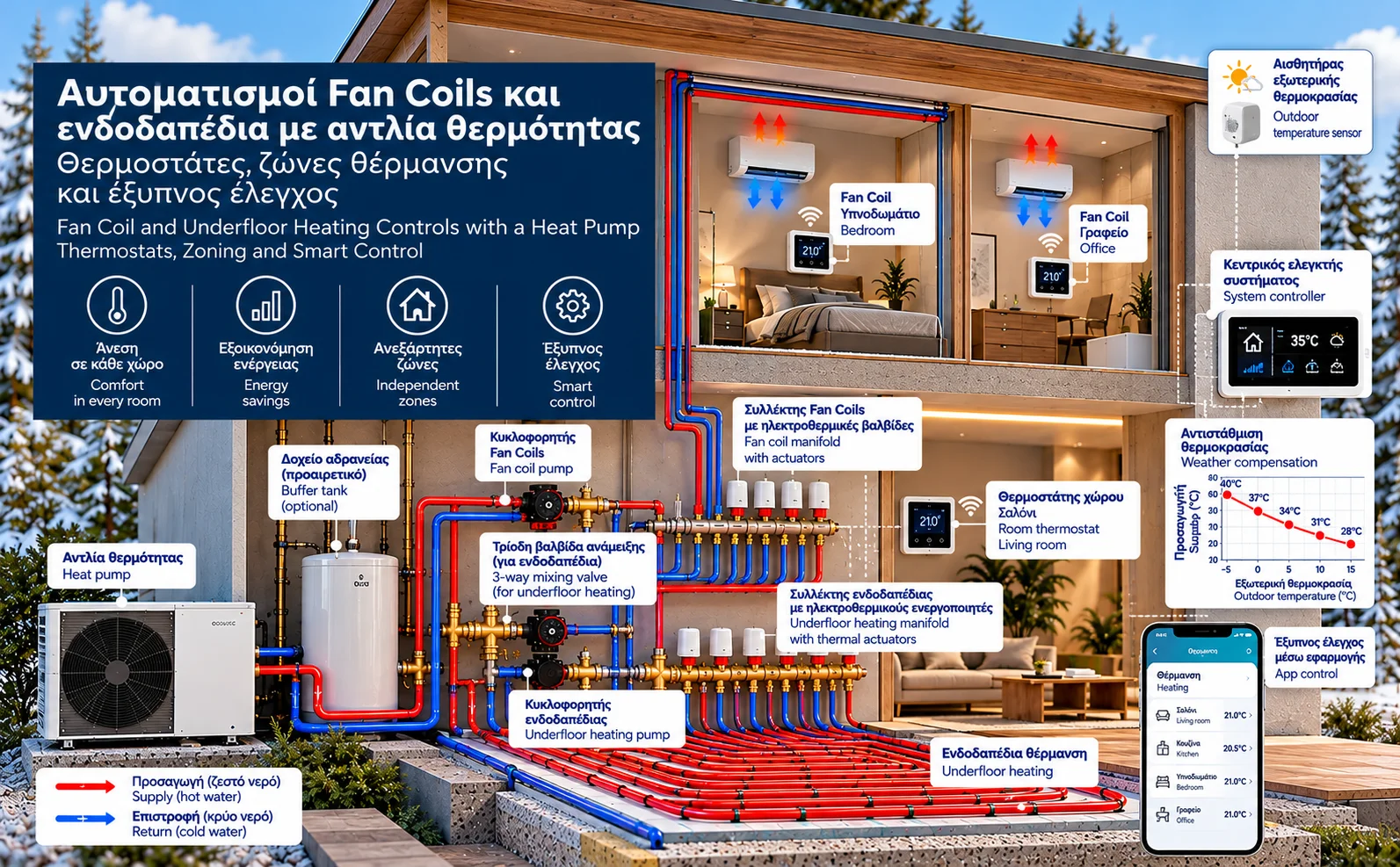
Fan Coil and Underfloor Heating Controls with a Heat Pump: Thermostats and Zoning
Combining fan coil units and hydronic underfloor heating with a single heat pump offers flexibility in residential and commercial buildings.
However, successful operation requires proper coordination between thermostats, valves, circulation pumps and the heat pump itself.
Underfloor heating generally has higher thermal inertia, while fan coil units respond more quickly to changes in room temperature.
This difference makes control system design particularly important.
This guide explains heating zones, thermostats, thermal actuators, weather compensation and the coordination needed for efficient operation.
1. What Are Heating Zones?
A heating zone is a room or group of rooms controlled independently from other areas.
For example, a two-story home may include:
Zone 1: Living room with underfloor heating.
Zone 2: Kitchen with underfloor heating.
Zone 3: Bedroom with a fan coil unit.
Zone 4: Second bedroom with a fan coil unit.
Each zone may have its own thermostat and suitable water-flow control device.
However, independent zone operation must remain compatible with the heat pump's minimum operating requirements.
2. How Does a Room Thermostat Work?
A thermostat measures room temperature and compares it with the desired setpoint.
When heating is required, it sends a signal to the appropriate controller or actuator.
For underfloor heating, this signal may open a valve on the distribution manifold.
For fan coils, it may activate the fan and control a water valve.
The exact functions depend on the thermostat, fan coil model and control design.
3. Thermal Actuators for Underfloor Heating
Thermal actuators are commonly installed on manifold valves.
When they receive the appropriate electrical signal, they gradually change the valve position.
This allows or restricts water flow through the corresponding circuit.
Actuators may be normally closed or normally open, depending on the model.
They must be compatible with the supply voltage, manifold valves and control system.
4. How Are Fan Coil Units Controlled?
A fan coil unit may include:
Room thermostat.
Fan speed selection.
Motorized water valve.
Temperature sensors.
Integrated or external controller.
When heating is required, the controller allows warm water to flow and operates the fan according to its control logic.
Some units prevent fan operation until the heat exchanger reaches a suitable temperature, avoiding uncomfortable cold airflow.
5. Why Do Underfloor Heating and Fan Coils Need Different Control Strategies?
Underfloor heating, especially when embedded in screed, stores a considerable amount of thermal energy.
Even after warm-water circulation stops, the floor continues releasing heat.
Fan coil units usually have lower thermal inertia and can adjust heating output more quickly.
Therefore:
Underfloor heating often benefits from gradual and stable control.
Fan coils can respond more quickly to changing demand.
Thermostat operation should not cause excessive heat pump cycling.
6. What Is Weather Compensation?
Weather compensation adjusts supply-water temperature according to outdoor conditions.
During mild weather, the heat pump can often operate with cooler water.
As outdoor temperatures decrease, the required supply temperature may increase.
The appropriate weather compensation curve depends on:
Building heat losses.
Heating terminal requirements.
Desired room temperatures.
Heat pump capabilities.
Building thermal characteristics.
Correctly configured weather compensation can improve seasonal efficiency.
7. How Do Thermostats Work with Weather Compensation?
Weather compensation determines the appropriate water temperature, while room thermostats control heating demand in individual areas.
Both functions must work together.
For example, with correctly adjusted weather compensation, underfloor heating may maintain stable indoor temperatures without frequent interruptions.
Thermostats can limit heating when additional heat gains occur, such as direct sunlight.
The exact strategy depends on the controller's capabilities and system requirements.
8. What Happens When All Zones Close?
This is one of the most important control design considerations.
If all fan coil and underfloor heating valves close simultaneously, water circulation may become severely restricted.
However, the heat pump may require a minimum water flow for safe operation.
Depending on the equipment, the system may require:
A suitable hydraulic arrangement.
Buffer tank.
Controlled minimum-flow path.
Coordinated pump and valve operation.
Control logic that prevents unsuitable operating conditions.
The selected solution must follow manufacturer instructions and engineering design.
9. Central System Controller
In a more complex installation, a central controller may coordinate:
Heating demand.
Heat pump operation.
Circulation pumps.
Mixing valves.
Zone actuators.
Supply-water temperatures.
Weather compensation.
The controller must be compatible with the available inputs, outputs and communication interfaces of the connected equipment.
Devices from different manufacturers do not necessarily communicate without additional hardware or integration.
10. Smart Thermostats and Remote Control
Some heating systems offer remote monitoring through mobile applications.
Depending on their capabilities, users may be able to:
Monitor room temperatures.
Change temperature setpoints.
Configure operating schedules.
Receive fault notifications.
Control different heating zones.
However, remote control alone does not guarantee better energy efficiency.
Potential savings depend on correct settings, actual usage and equipment compatibility.
11. Example: Two-Story House
Consider a home with underfloor heating on the ground floor and fan coils upstairs.
Two thermostats control different groups of underfloor heating circuits downstairs.
Each upstairs fan coil has its own thermostat.
A central controller receives heating demand information.
The heat pump adjusts operation according to demand and the selected weather compensation strategy.
The hydraulic arrangement maintains the required circulation conditions even when some zones close.
This example illustrates a possible control architecture rather than a construction-ready electrical design.
12. Common Control Mistakes
Incompatible Thermostats and Actuators
Different supply voltages or control logic can cause malfunction.
Too Many Independent Zones
A large number of small zones may create minimum-flow problems and excessive cycling.
Incorrect Weather Compensation
An excessively high curve can increase consumption, while an excessively low curve may fail to meet the heating demand.
Frequent Large Setpoint Changes
For underfloor heating, sudden temperature changes may result in slow response or overheating.
Poor Circulation Pump Coordination
Pumps and valves must operate according to the overall hydraulic control strategy.
13. Frequently Asked Questions
Does every room need its own thermostat?
Not necessarily. The number of zones depends on room usage, heating requirements and system design.
Can one thermostat control multiple underfloor heating circuits?
Yes. One thermostat can control multiple actuators through a suitable wiring centre or control interface.
Is a central controller always necessary?
No. Its necessity depends on system complexity and equipment capabilities.
Are smart thermostats better?
They can offer convenience and additional control features, but they do not replace correct hydraulic and thermal design.
Conclusion
Controls are an essential part of any installation combining fan coils and underfloor heating with a heat pump.
Proper coordination between thermostats, actuators, circulation pumps and the central controller helps maintain thermal comfort and reliable operation.
Weather compensation, prevention of excessive cycling and maintaining minimum required water flow are particularly important.
System design must follow equipment specifications and building requirements.
Thermosphere.gr — Technical knowledge for heating and building systems.