
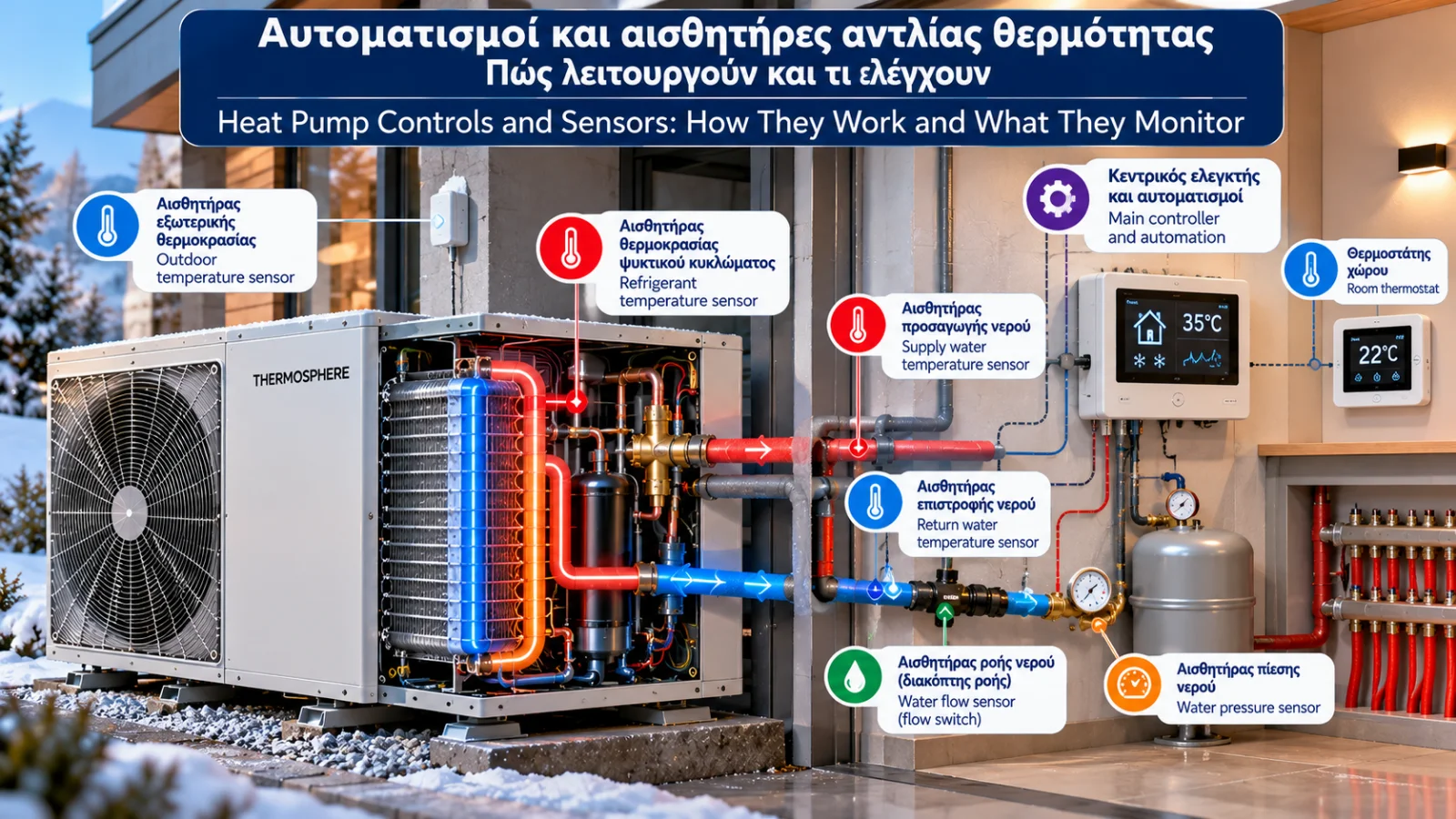
Heat Pump Controls and Sensors: How They Work and What They Monitor
Modern heat pumps rely on much more than compressors and heat exchangers. Electronic controllers, sensors and automated safety systems continuously monitor operating conditions and adjust system performance.
These components allow a heat pump to respond to changing heating demands, regulate water temperature and protect critical equipment.
1. What Are Heat Pump Controls?
Heat pump controls are the electronic systems responsible for coordinating operation.
The main controller receives information from sensors, compares measured values with target settings and sends commands to individual components.
Depending on the model, it may control:
Compressor operation and capacity.
Outdoor fan speed.
Circulation pump operation.
Heating water supply temperature.
Defrost activation.
Auxiliary electric heaters.
Frost protection and safety shutdowns.
The exact control strategy varies between manufacturers and models.
2. Temperature Sensors
Temperature sensors are essential components in heat pump operation.
Many systems use NTC thermistors, whose electrical resistance changes with temperature.
Outdoor Air Temperature Sensor
Measures ambient outdoor temperature.
Its readings may be used for weather compensation, defrost management and other operating functions.
Supply Water Temperature Sensor
Measures the temperature of water leaving the heat pump toward the heating system.
The controller uses this information to regulate heat production.
Return Water Temperature Sensor
Measures the temperature of water returning from the heating circuit.
The difference between supply and return temperatures provides useful information about hydronic system operation.
Refrigerant Circuit Temperature Sensors
These sensors monitor critical locations, such as the compressor and heat exchangers.
They support refrigerant circuit control and equipment protection.
3. What Is Weather Compensation?
Weather compensation automatically adjusts the target heating water temperature according to outdoor conditions.
As outdoor temperature decreases, a building generally requires more heat.
The controller may therefore increase the target supply water temperature.
When outdoor conditions become milder, it may reduce that temperature.
Illustrative heating curve:
Outdoor Temperature | Target Supply Temperature |
|---|---|
+15°C | 28°C |
+10°C | 31°C |
+5°C | 34°C |
0°C | 37°C |
-5°C | 40°C |
These figures are examples only and are not universal recommended settings.
The appropriate heating curve depends on building heat losses, heat emitters and manufacturer guidance.
Proper weather compensation can improve efficiency by avoiding unnecessarily high water temperatures.
4. Pressure Sensors
Pressure sensors monitor important operating conditions.
Refrigerant Pressure
Many heat pumps use pressure sensors or switches to monitor and protect the refrigerant circuit.
Abnormal pressure readings may be associated with heat transfer problems, flow restrictions or other operating faults.
Hydronic Water Pressure
Some models also monitor water pressure.
If pressure falls outside the permitted range, the controller may display a warning or prevent operation.
Not all heat pumps use identical sensor configurations.
5. Water Flow Sensors and Flow Switches
Adequate water circulation is essential for reliable heat transfer.
A flow sensor or flow switch may verify that sufficient water is circulating through the system.
Insufficient flow may cause:
Poor heat transfer.
Excessive supply-return temperature difference.
Safety protection activation.
Compressor shutdown.
Possible causes include blocked filters, trapped air, closed valves or circulation pump faults.
6. How Does a Room Thermostat Work?
A room thermostat measures indoor temperature and communicates heating demand to the controller.
Depending on the installation, it may use a simple on/off contact or a digital communication interface.
More advanced systems combine room temperature feedback with weather compensation.
Excessively frequent starts and stops may reduce operating efficiency and affect component service life.
7. What Is Inverter Control?
Many modern heat pumps use variable-speed compressors.
Inverter electronics adjust compressor speed to match heating demand.
When the building requires more heat, compressor speed may increase.
When demand decreases, compressor speed may be reduced.
Within the system's operating range, this helps reduce unnecessary cycling.
8. Frost Protection Controls
Heat pumps incorporate protective functions for low-temperature conditions.
Depending on the design, frost protection may activate:
Water circulation.
Compressor operation.
Auxiliary electric heating.
Warnings or protective operating modes.
Important: Active frost protection may not function during a power failure. Appropriate hydronic freeze protection must follow manufacturer requirements and local conditions.
9. How Do Sensors Control Defrost?
During winter heating, frost may accumulate on the outdoor heat exchanger.
The controller uses sensor readings and operating parameters to determine when defrost is required.
Defrost may involve temporary refrigerant cycle reversal, changes in fan operation and a controlled return to heating.
The exact algorithm varies by manufacturer.
10. Common Sensor and Control Faults
Incorrect Temperature Readings
Faulty sensors may provide inaccurate data, causing inappropriate operating decisions.
Pressure Sensor Faults
Incorrect pressure readings may trigger alarms or protective shutdowns.
Water Flow Sensor Faults
A flow-related fault may prevent compressor operation.
Communication Errors
The controller may lose communication with peripheral devices or user interfaces.
Incorrect Settings
An unsuitable heating curve or incompatible zone control settings may reduce comfort and efficiency.
A fault code alone does not always identify the root cause. Diagnosis should follow the technical documentation for the specific model.
11. What Can a Homeowner Check?
Without opening electrical or refrigerant components, a homeowner may check:
Displayed fault codes.
Target temperature settings.
Operating schedules.
Visible airflow obstructions around the outdoor unit.
Water pressure readings, where available, against the manufacturer's instructions.
Electrical measurements, sensor testing and refrigerant circuit work should be carried out by appropriately qualified professionals.
12. Frequently Asked Questions
Can a faulty sensor stop a heat pump?
Yes. If a critical sensor fails, the controller may stop operation to protect the equipment.
Does weather compensation reduce energy consumption?
It can improve efficiency when properly configured by avoiding unnecessarily high supply water temperatures.
Do all heat pumps have a water flow sensor?
Not necessarily. Water circulation monitoring depends on the system design.
Is a room thermostat necessary with weather compensation?
This depends on the control strategy and installation requirements. Some systems combine weather compensation with indoor temperature feedback.
Conclusion
Sensors and automated controls are essential to the operation of modern heat pumps.
They regulate heating output, support energy efficiency and activate protective functions when operating conditions become unsafe.
Correct configuration, regular maintenance and timely diagnosis help ensure reliable system performance.
Thermosphere.gr — Technical knowledge for heating and building systems.