
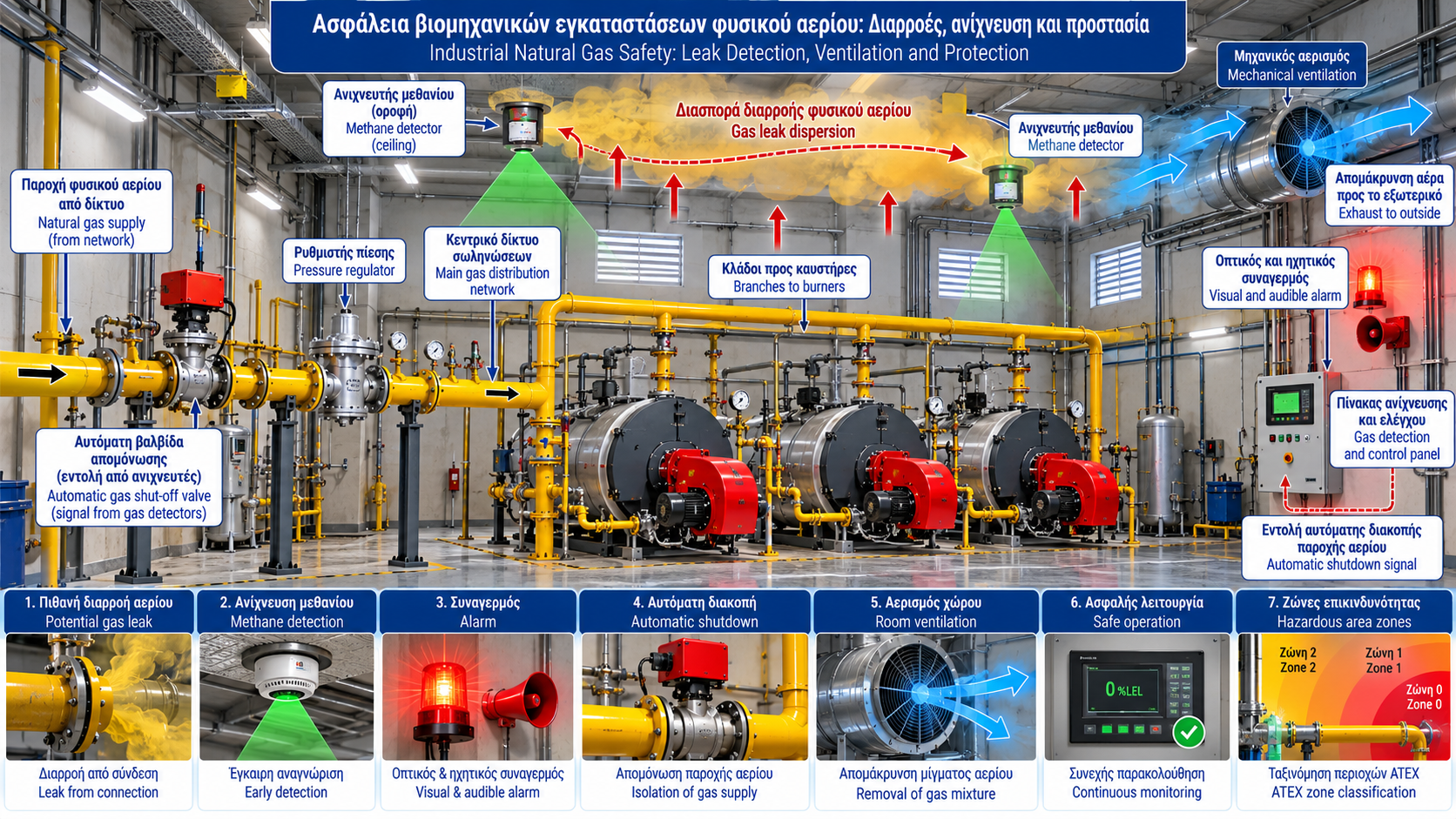
Industrial Natural Gas Safety: Leak Detection, Ventilation and Protection
Industrial natural gas safety depends on preventing leaks, detecting hazardous conditions early and reliably isolating fuel supply when necessary.
Facilities containing steam boilers, industrial burners and thermal processing equipment have multiple piping connections, valves and components that require safety assessment.
Effective protection requires more than installing a single gas detector. It involves appropriate engineering, ventilation, safety controls, maintenance and emergency procedures.
1. Main Natural Gas Hazards
Natural gas consists primarily of methane, a flammable gas.
An uncontrolled leak can form a flammable mixture with air when the concentration is within its flammable range and a suitable ignition source is present.
Methane has a lower explosive limit (LEL) of approximately 5% by volume in air, depending on conditions and gas composition.
Other hazards include oxygen displacement in confined spaces and equipment failures under unacceptable pressure conditions.
2. Potential Gas Leak Locations
Possible leakage points include flanged joints, threaded connections, valve seals, instrument fittings, pressure regulation components and damaged piping.
Leak likelihood depends on design quality, installation practices, operating conditions and maintenance.
3. How Gas Detectors Work
A gas detector monitors the concentration of combustible gas in its surrounding environment.
Common sensing technologies include catalytic bead and infrared (IR) detection.
The detector sends information to a controller or other suitable system, which initiates specified alarms and protective actions.
Technology selection depends on gas composition, environmental conditions, reliability requirements and the risk assessment.
4. Understanding %LEL
The %LEL value represents gas concentration as a percentage of its lower explosive limit.
Assuming methane has an LEL of 5% by volume:
10% LEL corresponds to approximately 0.5% methane in air.
20% LEL corresponds to approximately 1% methane in air.
100% LEL corresponds to approximately 5% methane in air.
These are illustrative conversions.
Actual alarm setpoints must be established through the applicable risk assessment, standards and manufacturer requirements.
5. Gas Detector Placement
Methane is lighter than air under typical ambient conditions and generally tends to rise.
However, actual leak dispersion is influenced by ventilation patterns, room geometry, obstructions, leak momentum, temperature and the location of possible release points.
Detector placement must therefore be based on credible leak scenarios rather than a universal ceiling-mounting rule.
6. Natural and Mechanical Ventilation
Appropriate ventilation helps reduce the accumulation of flammable gas.
Natural ventilation relies on openings and pressure differences.
Mechanical ventilation uses fans and designed airflow paths.
The required arrangement depends on the room, possible leak scenarios and applicable technical requirements.
Ventilation does not replace leak prevention or required isolation systems.
7. Automatic Emergency Gas Isolation
Properly designed installations may use gas detection signals to initiate automatic fuel isolation.
This function requires suitable shut-off valves and control equipment.
Valve location must support the intended safety scenario.
Gas isolation must be coordinated with burner operation and other safety interlocks.
8. Alarms and Monitoring
Gas detection systems may provide visual alarms, audible alarms, control-panel signals, event logging and emergency shutdown commands.
Protective responses must be defined in the engineering design.
Sensor failure, power loss and communication faults must also be addressed appropriately.
A system’s reliability depends on its response to both hazardous gas concentrations and its own failures.
9. Hazardous Area Classification and ATEX
Where explosive atmospheres may occur, hazardous area classification must follow the applicable framework.
Zone classification depends on release sources, expected frequency and duration of explosive atmospheres, and ventilation conditions.
Electrical and non-electrical equipment must be suitable for the classified area.
An entire boiler room should not automatically be assigned a particular ATEX zone without a technical assessment.
10. Emergency Response to a Suspected Gas Leak
Personnel must follow the facility’s approved emergency response plan.
General principles include:
Alerting responsible personnel.
Evacuating the hazardous area.
Avoiding actions that could create ignition sources.
Isolating the gas supply only when it can be done safely and according to the emergency plan.
Contacting emergency services when required.
Allowing re-entry and restart only after appropriate inspection and authorization.
Leaks must never be searched for using an open flame.
Unauthorized work on pressurized gas equipment is unsafe.
11. Gas Detector Maintenance
Gas detectors require periodic inspection and testing according to manufacturer instructions.
Maintenance may include physical inspection, wiring checks, response testing with suitable test gas, calibration where required, alarm verification and confirmation of shutdown functions.
Records of test results should be maintained.
A sensor response test does not necessarily replace verification of the entire safety chain.
12. Prevention Through Effective Management
Leak prevention also depends on operational management.
Important measures include regular piping inspection, corrosion monitoring, valve maintenance, isolation procedures, change management, personnel training and up-to-date technical documentation.
System modifications should be assessed before implementation.
13. Relevant Standards
Important technical references include:
EN 60079-29-1: Performance requirements for flammable gas detectors.
EN 60079-29-2: Selection, installation, use and maintenance guidance for flammable gas and oxygen detection equipment.
EN 60079-10-1: Classification of areas containing explosive gas atmospheres.
Directive 1999/92/EC: Minimum requirements for protecting workers from explosive atmospheres.
Directive 2014/34/EU: Equipment and protective systems intended for potentially explosive atmospheres.
Applicability must be verified against the specific installation and current national regulations.
Conclusion
Industrial natural gas safety requires a coordinated combination of leak prevention, gas detection, ventilation, fuel isolation and emergency preparedness.
Gas detectors are important protective devices, but they do not replace sound engineering, inspection or maintenance.
Effective protection depends on a comprehensive risk assessment and reliable integration of all relevant safety functions.