
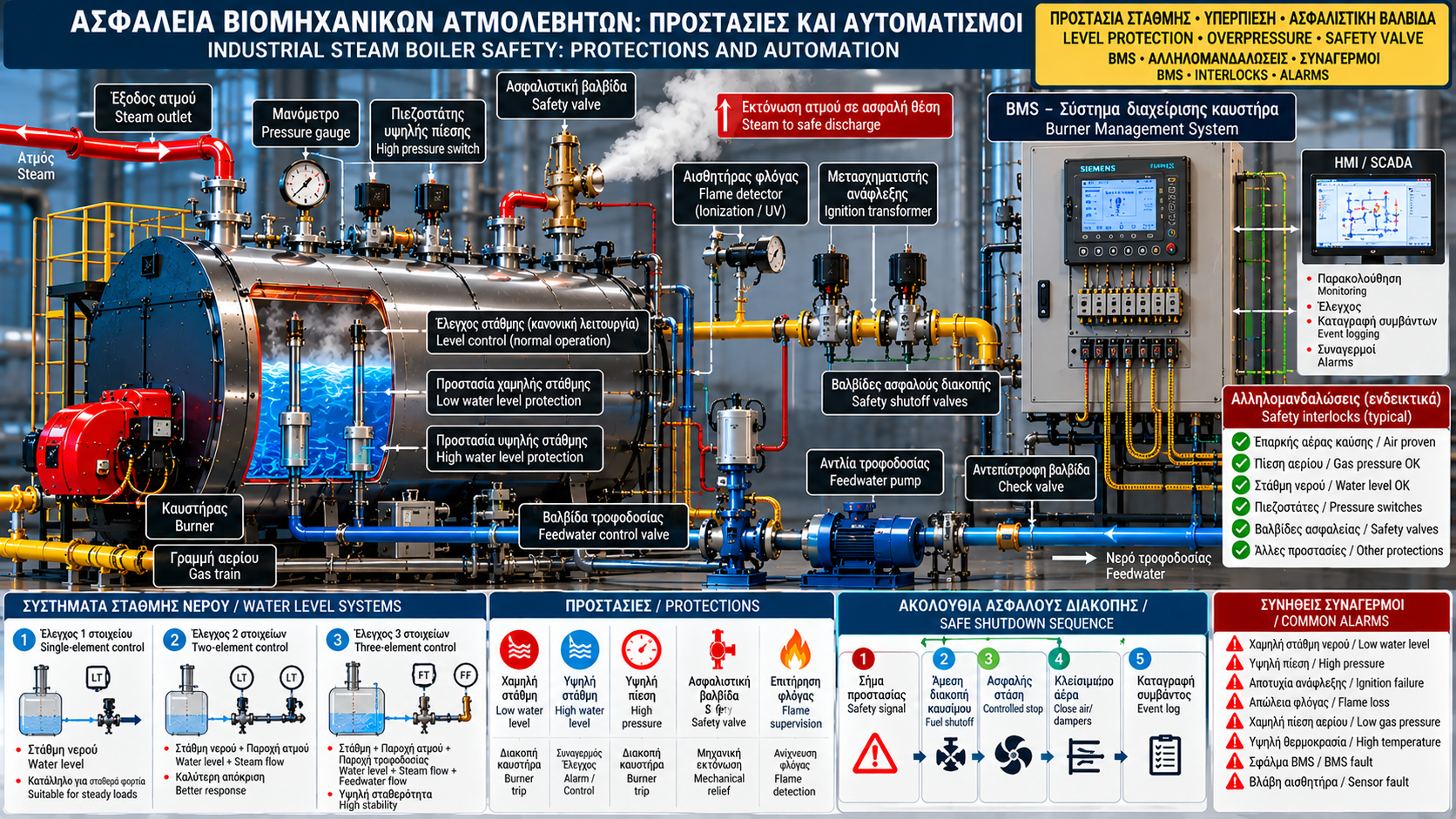
# Industrial Steam Boiler Safety: Protection Systems, Safety Valves and Automation
## Introduction
Industrial steam boilers operate with thermal energy, water and pressurized steam. High temperatures, stored energy and combustion equipment make safety a fundamental operating requirement.
A safe installation does not rely on one device. It requires appropriate pressure-equipment design, reliable protective functions, automation, inspections, maintenance and trained personnel.
Requirements depend on boiler type, pressure, capacity, fuel and the applicable regulatory framework.
## 1. Main Operating Hazards
Important hazards include overpressure, insufficient water level, overheating of metal surfaces, pressure-equipment failure and combustion problems.
Hot surfaces, steam leaks, electrical energy and incorrect interventions create additional risks.
Risk assessment must cover normal operation, startup, shutdown, maintenance and foreseeable failures.
## 2. Multiple Layers of Protection
Steam boiler safety relies on a combination of measures.
Normal process control maintains operating parameters within desired limits.
Protective devices respond to unacceptable conditions.
Safety valves provide suitable mechanical overpressure protection.
Inspections and operating procedures complement these engineering measures.
## 3. Normal Control Versus Safety Protection
Pressure and level controllers support normal boiler operation.
Safety protection serves a different purpose: bringing the system to its specified safe state when a defined hazard occurs.
An ordinary sensor connected to a PLC does not automatically constitute a certified safety function.
Required independence, reliability and architecture depend on engineering assessment and applicable requirements.
## 4. Low-Water-Level Protection
Insufficient water level may expose heated surfaces without adequate cooling.
This can cause severe overheating and equipment damage.
Low-water protection monitors the required condition and initiates the specified safe shutdown when its limit is violated.
Protective devices must not be bypassed or replaced by normal feedwater control.
## 5. Water-Level Detection Technologies
Depending on design, conductivity probes, floats, differential-pressure transmitters and other suitable technologies may be used.
Selection depends on pressure, temperature, water quality and the intended function.
Normal-control sensors and safety devices are not necessarily interchangeable.
Installation, testing and maintenance must follow manufacturer instructions.
## 6. Redundant and Independent Level Protection
Many applications require more than one suitable low-water protective device.
The architecture must meet applicable requirements and the risk assessment.
Two sensors relying on the same unprotected circuit do not necessarily provide true independence.
Common-cause failures must also be considered.
## 7. High Water Level
Excessive water level can impair steam quality and increase the risk of water carryover into the distribution system.
Depending on design, alarms or suitable protective actions may be provided.
Assessment must also account for shrink and swell.
A high-level indication should not be interpreted without considering actual operating conditions.
## 8. Steam-Pressure Control
The normal pressure controller adjusts burner heat input according to demand.
In modulating systems, this may involve firing-rate modulation.
Normal control aims to maintain stable steam generation.
It does not replace independent high-pressure protection.
## 9. Overpressure Protection
Overpressure may result from control failure, inadequate burner response or other malfunctions.
Suitable high-pressure protective devices initiate the specified safe shutdown.
Limits must agree with the design and applicable requirements.
Arbitrarily increasing trip limits to avoid shutdowns is dangerous.
## 10. Safety Valves
Safety valves are mechanical devices for protection against overpressure.
They open under defined conditions to discharge the required fluid.
Selection requires suitable set pressure, relieving capacity, materials and compliance with applicable requirements.
Discharge must be routed to a safe location.
Safety valves are not intended for routine pressure regulation.
## 11. Pressure Limiters Versus Safety Valves
A high-pressure switch or limiter acts through a control or protection system to stop heat generation.
A safety valve mechanically relieves pressure when its operating conditions are reached.
These functions are different and complementary.
Having one does not automatically eliminate the need for the other.
## 12. Burner Management System — BMS
A Burner Management System manages critical sequences for safe burner operation.
Depending on application, it includes permissive checks, pre-purge, ignition, flame supervision and safe fuel shutdown.
The BMS must be suitable for the specific installation and meet relevant requirements.
It must not be confused with general monitoring software or an ordinary process PLC.
## 13. Furnace Pre-Purge
Pre-purge is intended to appropriately clear potential combustible mixtures before the specified ignition sequence.
Requirements depend on design and applicable standards.
A fan-running signal alone does not prove adequate airflow.
Required timings and proving conditions must not be changed arbitrarily.
## 14. Flame Supervision
Flame supervision detects acceptable flame presence during defined operating stages.
Ionization, ultraviolet or another approved detection technology may be used.
If acceptable flame is not proven under the specified conditions, the system must perform the required safe response.
Bypassing flame detection is unacceptable.
## 15. Fuel Safety Shutoff Valves
Suitable safety shutoff valves isolate fuel supply when required.
The arrangement may include additional monitoring and valve-proving equipment depending on fuel and design.
Selection, installation and testing must meet applicable requirements.
Valves must not be bypassed to maintain operation.
## 16. Safety Interlocks
Interlocks permit or prevent operations according to defined conditions.
Examples may include combustion-air proving, suitable fuel pressure and available boiler protections.
Some interlocks are operational, while others perform critical safety functions.
This distinction must be documented in the engineering design and risk assessment.
## 17. Emergency Stop and Safe Shutdown
Emergency stop is one possible risk-reduction function where required by risk assessment.
Safe burner shutdown may involve a specified sequence of actions depending on equipment design.
Pressing STOP on an HMI does not provide electrical isolation.
Maintenance requires suitable hazardous-energy isolation procedures.
## 18. Alarm, Trip and Lockout
An alarm indicates a warning or deviation.
A trip is a shutdown action initiated by a defined condition.
Lockout is a latched shutdown state requiring a specified reset procedure.
Exact definitions depend on the system.
Recording the initiating cause is essential for correct diagnosis.
## 19. Why Reset Is Not a Repair
Resetting a fault does not eliminate the condition that triggered the protection.
Repeated restart attempts without investigation can increase risk.
Low-water events, overpressure and ignition failures require particular care.
Restart is permitted only after specified conditions have been satisfied.
## 20. PLC, HMI and SCADA
A PLC may perform normal boiler process automation.
An HMI provides controls and indications, while SCADA may support monitoring and event recording.
Critical safety functions require appropriate architecture and equipment.
Loss of communication with an HMI must not defeat required boiler protection.
## 21. Safety Function Testing
Safety devices require periodic testing under approved procedures.
Tests may cover level instruments, pressure limiters, flame supervision, interlocks and suitable valves.
Methods and intervals depend on applicable requirements, manufacturer instructions and maintenance plans.
Testing must be performed by authorized personnel without uncontrolled creation of hazardous conditions.
## 22. Pressure Equipment Inspection
The boiler pressure vessel, connections, piping and accessories are subject to appropriate inspection requirements.
Wear, corrosion, deposits and other deterioration mechanisms must be assessed.
Inspections may include external and internal examinations and other required tests.
The program is determined by applicable regulations and operating conditions.
## 23. Operator Training and Procedures
Safety also depends on human performance.
Operators must understand normal indications, alarms, startup and shutdown procedures and required fault responses.
Instructions should be available and reflect the actual installation.
Changes to protection settings and circuits require appropriate approval and documentation.
## 24. Conclusion
Industrial steam boiler safety relies on multiple complementary protective layers.
Level control, pressure limiters, safety valves, the BMS and interlocks perform distinct but interconnected functions.
Appropriate design, approved testing, maintenance and operator training are essential to reliable operation.