
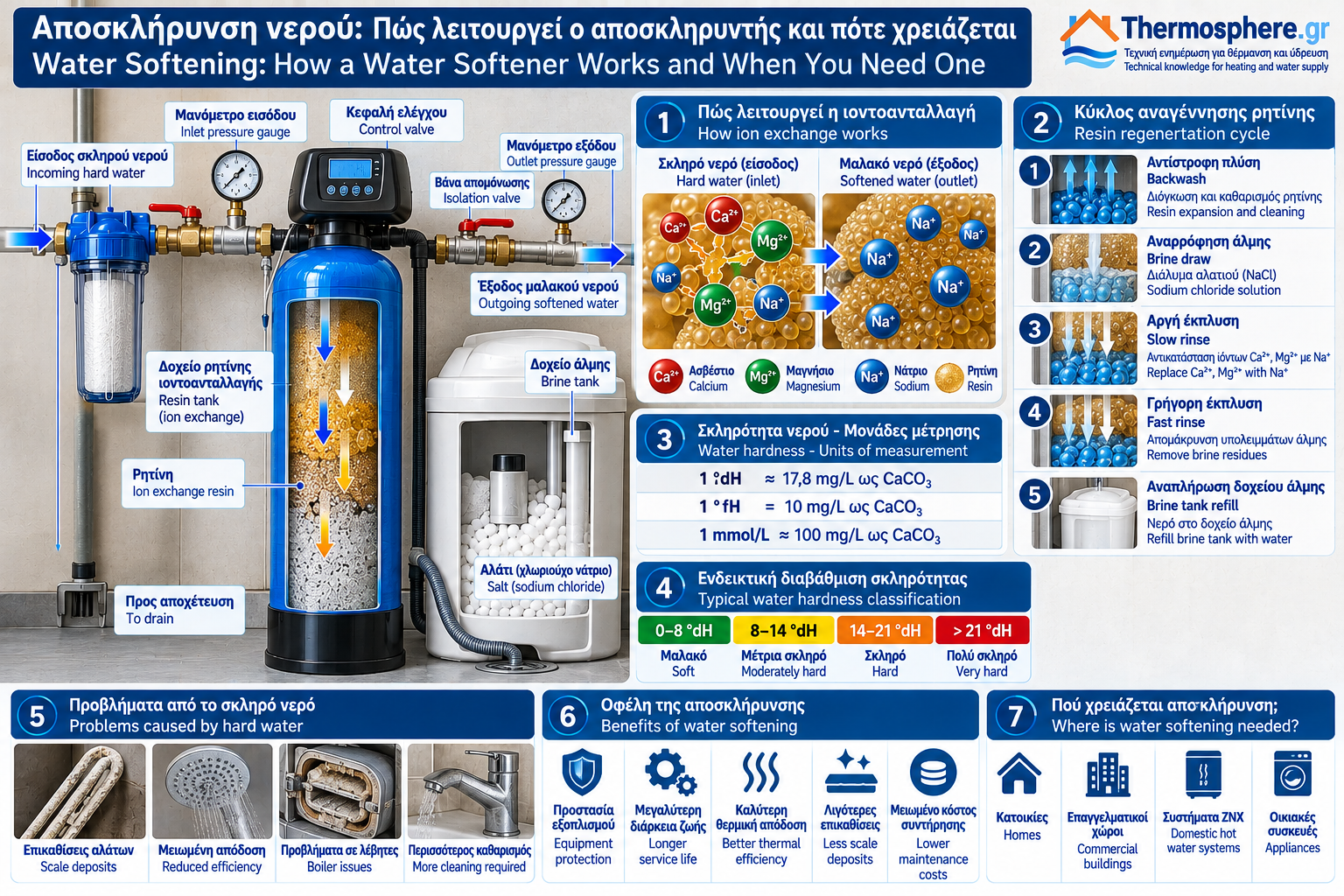
Water Softening Explained: How Water Softeners Work and When You Need One
Water hardness is one of the key characteristics affecting plumbing installations, domestic hot water systems and many household and commercial appliances.
Hard water contains elevated concentrations of dissolved calcium and magnesium ions. Under suitable conditions, particularly during heating, these ions can contribute to mineral scale formation on heat-transfer surfaces, pipework and fittings.
Water softening is a treatment process designed to reduce hardness and limit the formation of such deposits.
However, a water softener is not necessary in every building. The decision should be based on measured water hardness, equipment requirements and actual operating conditions.
1. What Is Water Hardness?
Water hardness is primarily caused by dissolved calcium (Ca²⁺) and magnesium (Mg²⁺) ions.
These ions commonly originate from minerals dissolved as water passes through geological formations.
Total hardness may be expressed in:
mg/L as CaCO₃.
German degrees (°dH).
French degrees (°fH).
mmol/L.
These units are not numerically equivalent.
For reference:
1 °dH ≈ 17.8 mg/L as CaCO₃
1 °fH = 10 mg/L as CaCO₃
The classification of water as soft or hard varies between reference systems.
2. What Problems Can Hard Water Cause?
High water hardness does not automatically mean that the water is unsafe to drink.
However, it may create operational problems.
Scale Formation
During heating, changes in water chemistry can promote calcium carbonate precipitation.
Deposits commonly occur on:
Heat exchangers.
Electric water heater elements.
Boilers and domestic hot water equipment.
Faucets and shower fittings.
Valves and plumbing components.
Reduced Heat-Transfer Performance
Scale deposits introduce additional thermal resistance.
Their effect depends on deposit thickness, composition and equipment operating conditions.
Increased Cleaning Requirements
Hard water may leave visible mineral deposits on bathroom fittings and appliances.
It may also affect the performance of certain detergents.
3. What Is a Water Softener?
A water softener is a treatment unit designed to reduce the concentration of hardness-forming ions.
The most common technology is ion exchange.
A typical ion-exchange water softener includes:
A pressure vessel containing resin.
Cation-exchange resin.
A control head or multiport valve.
A brine tank.
A regeneration system.
A drain connection.
Depending on the application, pretreatment filters, blending arrangements and monitoring instruments may also be included.
4. How Does Ion Exchange Work?
In conventional sodium-cycle water softeners, the resin contains active sites initially associated with sodium ions.
As hard water passes through the resin, calcium and magnesium ions are retained and corresponding sodium ions are released into the water.
This process reduces water hardness.
It is not ordinary mechanical filtration. It is a chemical ion-exchange process.
Does Softening Remove All Dissolved Salts?
No.
A conventional sodium-cycle softener does not remove all dissolved salts.
It mainly exchanges calcium and magnesium ions for sodium ions.
Water softening is therefore different from desalination or reverse osmosis.
5. What Is Resin Regeneration?
During operation, the resin gradually accumulates calcium and magnesium ions.
When its available exchange capacity decreases, regeneration is required.
In sodium-cycle softeners, regeneration typically uses a sodium chloride solution known as brine.
A typical cycle may include:
Backwashing, where specified.
Brine draw.
Slow rinsing.
Fast rinsing.
Refilling the brine tank with water.
The exact sequence depends on the control valve and system design.
During regeneration, hardness ions are displaced from the resin and discharged with the rinse water.
6. How Is Water Softener Capacity Calculated?
Sizing depends primarily on:
Incoming water hardness.
Daily water consumption.
Maximum instantaneous flow.
Desired residual hardness.
Usable resin capacity.
Salt consumption per regeneration.
Available regeneration frequency and timing.
Example Calculation
Consider a household with:
Incoming hardness: 300 mg/L as CaCO₃.
Daily water consumption: 600 L.
A target of nearly complete softening.
The daily hardness load is:
300 mg/L × 600 L = 180,000 mg as CaCO₃
Equivalent to:
180 g as CaCO₃ per day.
For a theoretical five-day regeneration interval:
180 × 5 = 900 g as CaCO₃.
This calculation does not directly determine the required resin volume.
Final sizing depends on the usable capacity of the selected resin system, regeneration settings and appropriate operating margins.
7. Timer-Controlled and Metered Water Softeners
Timer-Controlled Systems
Regeneration takes place according to a programmed schedule.
This approach is simple but may cause regeneration even when water consumption is low.
Metered Systems
Regeneration is scheduled based on measured water consumption and calculated remaining treatment capacity.
Properly configured metered systems can reduce unnecessary regeneration cycles.
Duplex Systems
Where uninterrupted softened water supply is required, two-vessel systems may be used.
Depending on the arrangement, one vessel may remain in service while the other regenerates.
8. Where Should a Water Softener Be Installed?
Installation location depends on the treatment objective and plumbing configuration.
A softener is commonly installed on the supply feeding equipment or plumbing zones that require reduced hardness.
The installation must provide:
Adequate flow and pressure.
Suitable pretreatment where necessary.
Access for salt replenishment.
An appropriate drain connection.
Protection from freezing.
Safe electrical supply where required.
Sufficient maintenance access.
The regeneration drain must comply with manufacturer instructions and local plumbing requirements, including appropriate backflow protection.
9. Should the Entire House Receive Softened Water?
Not necessarily.
In some applications, softening may be limited to particular equipment, such as:
Domestic hot water production systems.
Washing machines and commercial appliances.
Equipment with specified water hardness limits.
Whole-building softening should be assessed according to water use, appliance requirements and the suitability of the treated water for each outlet.
10. Is Softened Water Safe to Drink?
Softening is not a disinfection process or a complete water purification method.
If incoming water is unsafe to drink, a conventional water softener does not automatically make it safe.
Sodium-cycle water softeners also increase the sodium concentration in treated water.
The increase depends on the hardness removed.
For example, removing 100 mg/L of hardness expressed as CaCO₃ by sodium exchange theoretically adds approximately 46 mg/L of sodium.
Where treated water is intended for drinking, its final quality must be evaluated against applicable requirements and user needs.
Individuals on sodium-restricted diets should seek personalised medical advice.
11. Water Softener Maintenance
Maintenance commonly includes:
Checking salt levels and salt quality.
Inspecting the brine tank.
Checking the control valve and regeneration cycles.
Measuring hardness before and after the unit.
Inspecting for leaks.
Checking pretreatment filters.
Performing periodic cleaning and inspection according to manufacturer instructions.
Resin does not have one universal replacement interval.
Its service life depends on water quality, chlorine exposure, iron contamination, operating conditions and maintenance.
12. Common Water Softener Problems
Water Remains Hard
Possible causes include:
Exhausted resin capacity.
Inadequate regeneration.
Insufficient salt.
Incorrect settings.
Valve faults or untreated-water bypass.
Excessive Salt Consumption
This may result from incorrect regeneration settings or unsuitable system sizing.
Unusual Water Level in the Brine Tank
The brine draw process, valves and associated pipework should be inspected.
Reduced Water Flow
Possible causes include undersizing, blockage, pretreatment filter problems or control valve faults.
13. Water Softeners vs Scale Treatment vs Reverse Osmosis
These technologies are not equivalent.
Technology | Main Function |
Ion-exchange water softener | Reduces calcium and magnesium |
Sediment filter | Retains suspended particles |
Scale inhibitor dosing system | Limits certain scale formation mechanisms without necessarily removing hardness |
Reverse osmosis | Reduces many dissolved components, including hardness ions |
Devices marketed as magnetic or electronic water softeners should not be considered equivalent to ion exchange without reliable evidence supporting their specific performance claims.
14. When Is a Water Softener Worth Installing?
Installation may be beneficial when:
Measured water hardness is high.
Scale deposits repeatedly develop.
Equipment requires lower hardness.
Scale-related maintenance costs are significant.
Proper regeneration and maintenance can be provided.
Selection should consider not only the purchase price but also salt consumption, regeneration water use, energy consumption where applicable and ongoing maintenance.
Conclusion
Water softening is an effective treatment technology for reducing hardness and limiting problems associated with mineral scale deposits.
Ion-exchange softeners primarily replace calcium and magnesium ions with sodium ions and require periodic resin regeneration.
Correct system selection depends on incoming hardness, water consumption, required flow rate and the technical requirements of the installation.
A properly sized and maintained water softener can reduce scale formation and help protect plumbing equipment.
This article provides general technical information. Drinking water treatment equipment must be selected and installed with appropriate water quality assessment and compliance with applicable requirements.
Thermosphere.gr — Technical knowledge for heating, water supply and modern plumbing systems.