
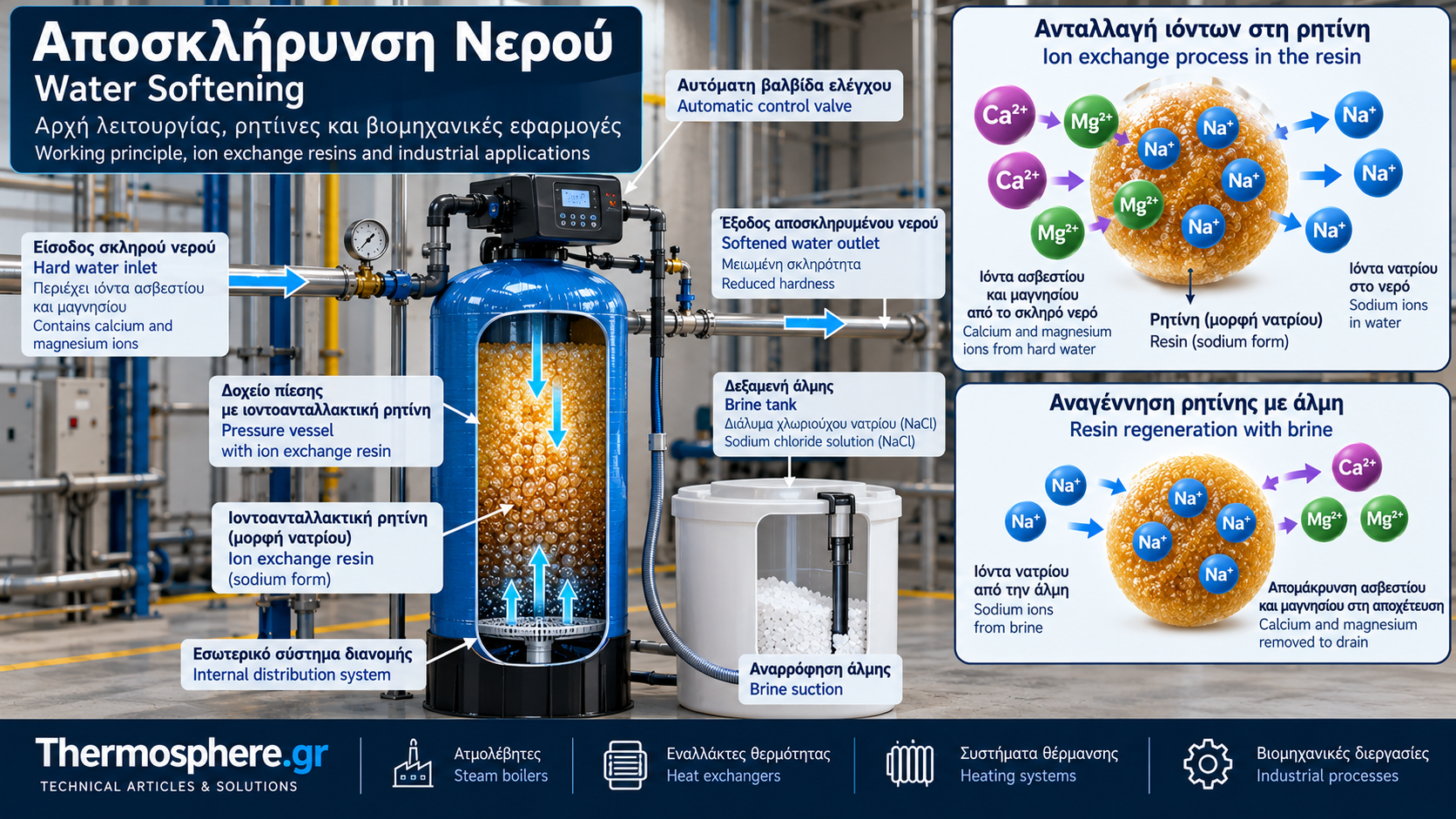
# Water Softening: Working Principle, Ion Exchange Resins and Industrial Applications
## Introduction
Water softening is an essential water treatment process in many industrial facilities, particularly in steam generation, heating and thermal processing systems.
Hard water contains dissolved calcium (Ca²⁺) and magnesium (Mg²⁺) ions that can contribute to mineral scale formation on heated surfaces and inside piping.
Scale deposits reduce heat transfer efficiency, increase energy consumption and may contribute to overheating of metal surfaces.
Water softening reduces hardness-forming ions, most commonly through ion exchange technology.
## 1. What Is Water Hardness?
Water hardness is primarily caused by dissolved calcium and magnesium ions.
Common measurement units include:
- mg/L as CaCO₃.
- German degrees (°dH).
- French degrees (°fH).
- mmol/L.
Useful conversions:
1 °dH ≈ 17.85 mg/L as CaCO₃.
1 °fH = 10 mg/L as CaCO₃.
Accurate unit identification is essential because incorrect conversions can lead to equipment sizing errors.
## 2. Why Does Scale Form?
When water is heated or its chemical equilibrium changes, certain dissolved compounds may precipitate.
Calcium carbonate (CaCO₃) is a common example.
Scale can form on:
- Heat transfer surfaces.
- Steam boilers.
- Heat exchangers.
- Hot water systems.
- Valves and pipelines.
Scale formation depends on temperature, pH, alkalinity, ion concentrations and operating conditions.
## 3. How Does a Water Softener Work?
Most conventional water softeners use a strong acid cation exchange resin in sodium form.
As hard water passes through the resin bed, calcium and magnesium ions are retained by the resin.
At the same time, the resin releases an equivalent amount of sodium ions.
Simplified ion exchange reactions:
2 R–Na + Ca²⁺ → R₂–Ca + 2 Na⁺
2 R–Na + Mg²⁺ → R₂–Mg + 2 Na⁺
R represents an active ion exchange site.
The treated water has reduced hardness but is not demineralized.
## 4. What Does Water Softening Remove?
Conventional sodium-cycle softening primarily removes calcium and magnesium hardness.
It does not provide comprehensive removal of all dissolved salts.
In particular:
- It does not substantially reduce total dissolved solids (TDS).
- It does not reliably remove silica, chloride or sulfate.
- It is not a disinfection process.
- It does not necessarily remove organic contaminants.
- It does not replace reverse osmosis or demineralization where high-purity water is required.
Electrical conductivity generally does not decrease significantly during conventional softening.
## 5. Main Water Softener Components
A typical water softening system includes:
1. Pressure vessel containing resin.
2. Ion exchange resin.
3. Internal water distribution and collection system.
4. Automatic or manual control valve.
5. Brine tank.
6. Brine injection or suction system.
7. Isolation valves and piping.
8. Monitoring and control instruments.
Industrial systems may also include flowmeters, online hardness analyzers and automatic duty-standby controls.
## 6. Ion Exchange Resins
Water softening resins are generally synthetic polymers containing functional groups that exchange cations.
Strong acid cation resins are widely used in water softening.
Important characteristics include:
- Ion exchange capacity.
- Operating capacity.
- Mechanical strength.
- Water chemistry compatibility.
- Maximum operating temperature.
- Resistance to fouling and oxidizing agents.
Actual operating capacity depends on feedwater quality, flow rate, regeneration salt dose and system design.
## 7. What Happens When the Resin Becomes Exhausted?
During operation, resin exchange sites gradually become occupied by calcium and magnesium ions.
As available capacity decreases, hardness may appear in the treated water.
This is known as hardness breakthrough.
To restore ion exchange capacity, the resin is regenerated using sodium chloride (NaCl) brine.
Regeneration removes much of the accumulated hardness and returns the resin primarily to sodium form.
## 8. Basic Regeneration Stages
A regeneration cycle may include:
- Backwashing.
- Brine introduction.
- Slow rinsing.
- Fast rinsing.
- Brine tank refill.
The exact sequence depends on valve configuration and equipment design.
Regeneration produces wastewater containing elevated salt concentrations and hardness ions, requiring appropriate disposal or treatment.
## 9. Simplex and Duplex Water Softeners
Water softeners are commonly configured as Simplex or Duplex systems.
Simplex:
A single resin vessel serves the installation.
Softened water production is normally interrupted during regeneration unless suitable storage or an alternative supply arrangement is available.
Duplex:
Two resin vessels can operate alternately, allowing one unit to regenerate while the other supplies softened water.
Continuous production capability depends on equipment sizing and control configuration.
## 10. Industrial Applications
Water softening is used in:
- Boiler feedwater pretreatment.
- Heating systems.
- Heat exchangers.
- Industrial hot water networks.
- Washing and cleaning processes.
- Pretreatment for selected reverse osmosis systems.
- Various industrial manufacturing processes.
Suitability depends on the required water quality for each application.
## 11. Water Softening for Steam Boilers
Water softening reduces the risk of hardness scale formation on boiler heat transfer surfaces.
However, softened water still contains other dissolved salts and may require additional treatment.
Depending on boiler requirements, further processes may include:
- Reverse osmosis.
- Deaeration.
- pH control.
- Chemical water treatment.
- Conductivity monitoring and blowdown control.
Softening does not replace a complete boiler feedwater treatment program.
## 12. Basic Operating Checks
Reliable operation requires monitoring:
- Inlet water hardness.
- Outlet water hardness.
- Water flow rate.
- Pressure drop.
- Salt consumption.
- Regeneration frequency.
- Brine level and condition.
- Valve and control system performance.
Outlet hardness testing is particularly important because it confirms actual treated water quality.
## 13. Common Operating Problems
Potential problems include:
- Hardness breakthrough.
- Incomplete regeneration.
- Insufficient salt.
- Salt bridging in the brine tank.
- Blocked brine suction system.
- Resin fouling or degradation.
- Control valve malfunction.
- Excessive service flow.
- Untreated water bypass.
Troubleshooting should rely on measured water quality and verification of actual equipment operation.
## Conclusion
Ion exchange water softening is an effective method for reducing hardness and protecting industrial equipment against mineral scale.
Successful operation depends on proper resin selection, correct sizing, effective regeneration and regular water quality monitoring.
For steam generation and other demanding industrial applications, water softening should form part of an integrated water treatment strategy.
Thermosphere.gr – Technical Knowledge for Professionals.