
# Water Deaerators: Working Principle, Types and Industrial Applications
## Introduction
Water deaerators are important components in industrial steam generation and water treatment systems.
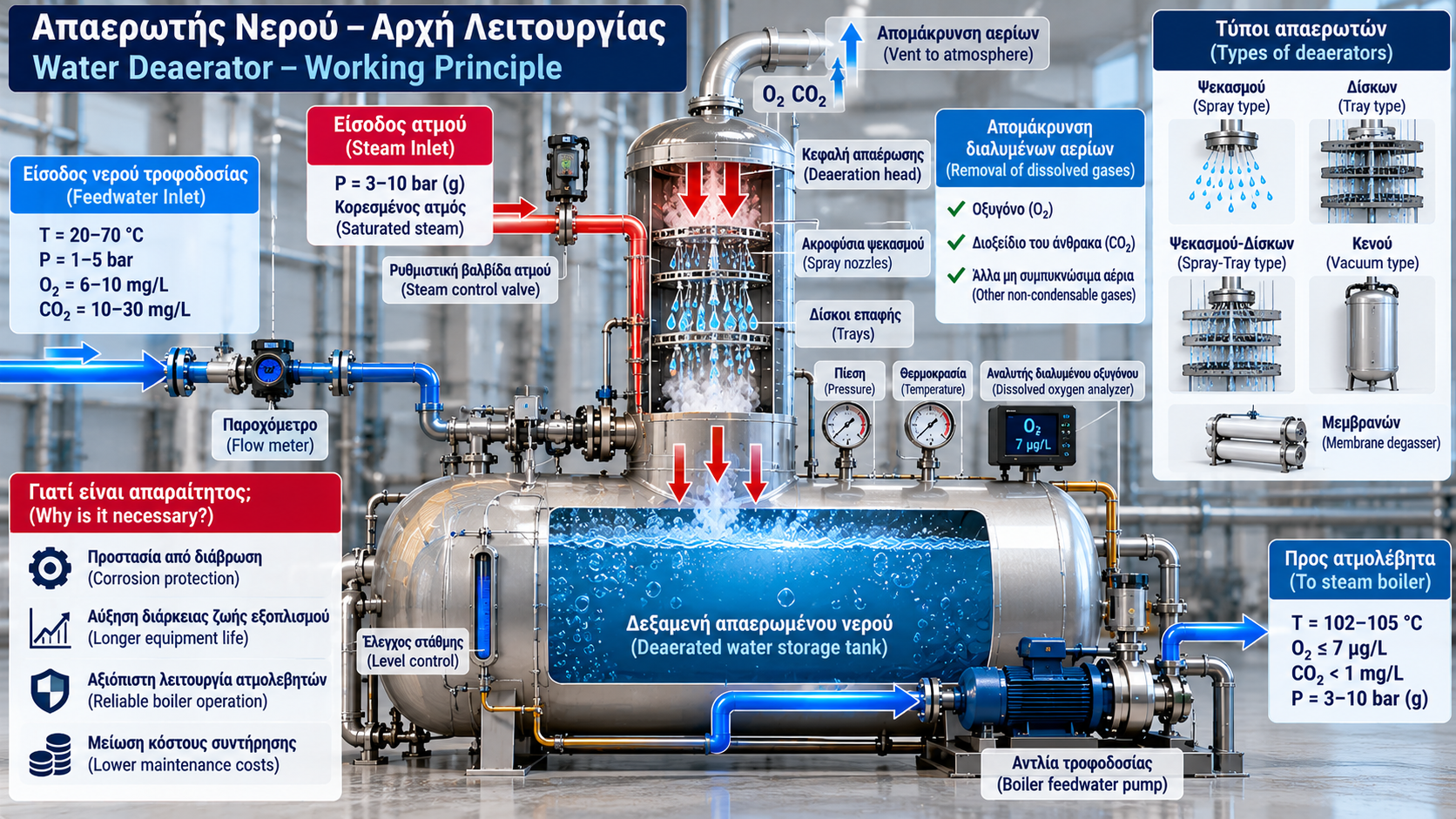
Their primary purpose is to remove dissolved gases, particularly oxygen (O₂) and carbon dioxide (CO₂), which can contribute to corrosion in piping, tanks, pumps and heat transfer equipment.
Effective deaeration supports boiler feedwater quality, reduces corrosion risks and improves long-term equipment reliability.
## 1. What Is a Water Deaerator?
A deaerator is a device designed to reduce the concentration of dissolved gases in water.
Thermal deaerators achieve this by heating water and bringing it into direct contact with steam.
Other technologies include vacuum deaeration and membrane-based degassing.
The appropriate technology depends on water quality requirements, flow rate, available energy sources and operating conditions.
## 2. Why Must Dissolved Gases Be Removed?
### Dissolved Oxygen
Dissolved oxygen contributes to electrochemical corrosion of metallic surfaces.
In boiler feedwater systems, oxygen is particularly associated with localized pitting corrosion.
Pitting can cause substantial localized metal loss even when the overall corrosion rate appears relatively low.
### Carbon Dioxide
Carbon dioxide dissolves in water and participates in chemical equilibria involving carbonic acid and bicarbonate ions.
Under certain conditions, it can lower pH and contribute to corrosion.
In steam systems, additional CO₂ may form from the thermal decomposition of bicarbonate compounds and subsequently enter condensate networks.
Thermal deaeration primarily removes free dissolved gases and does not necessarily eliminate every source of CO₂ generation within the steam system.
## 3. Thermal Deaerator Working Principle
Thermal deaeration uses the reduced solubility of gases as water approaches the saturation temperature corresponding to the operating pressure.
Feedwater enters the deaerator and comes into direct contact with steam.
This process:
- Raises the water temperature.
- Promotes transfer of dissolved gases from water into the gas phase.
- Allows gases to leave through a suitable venting arrangement.
- Provides heated water for boiler feedwater storage.
Performance depends on temperature, pressure, contact time, water distribution and effective venting.
## 4. Temperature and Pressure
Temperature is a critical operating parameter in thermal deaeration.
As water approaches its saturation temperature at the operating pressure, dissolved gas removal becomes more effective.
For example, at approximately 1.2 bar absolute pressure, the saturation temperature of pure water is about 105°C.
Absolute pressure must not be confused with gauge pressure.
Actual operating temperatures depend on the deaerator pressure and system configuration.
There is no single universal operating temperature for every deaerator.
## 5. Main Types of Water Deaerators
### Spray-Type Deaerators
Spray-type deaerators distribute incoming water through specially designed nozzles.
Spraying increases the contact area between water and steam, improving heat transfer and gas removal.
### Tray-Type Deaerators
Tray-type deaerators distribute water over a series of trays or contact surfaces.
The arrangement increases water-steam contact time and promotes effective gas removal.
### Spray-Tray Deaerators
Some industrial systems combine initial spray heating with additional tray contact.
Actual performance depends on mechanical design and operating conditions.
### Vacuum Deaerators
Vacuum deaerators use reduced pressure to promote dissolved gas removal.
They can be suitable for applications where high-temperature thermal deaeration is undesirable.
### Membrane Degassers
Membrane degassing systems use specialized gas-liquid separation membranes and a suitable driving force, such as vacuum or sweep gas.
These systems are used where controlled dissolved gas removal is required.
## 6. Main Components of a Thermal Deaerator
A typical industrial thermal deaerator may include:
- Deaeration head.
- Spray nozzles or contact trays.
- Feedwater inlet.
- Steam inlet.
- Venting system.
- Deaerated water storage tank.
- Pressure and temperature instruments.
- Water level control system.
- Safety valves and protective devices, where required.
The exact arrangement depends on equipment type, design pressure and manufacturer specifications.
## 7. The Importance of Venting
Effective gas removal requires a suitable outlet for non-condensable gases.
The vent carries these gases away together with some water vapor.
Insufficient venting can reduce deaeration efficiency.
Excessive venting can increase steam and energy losses.
Vent settings must follow equipment design and manufacturer recommendations.
## 8. Dissolved Oxygen Performance
Deaerator performance is commonly evaluated by measuring dissolved oxygen concentration at the outlet.
Some high-performance thermal deaerators are designed to achieve residual oxygen concentrations of approximately 7 μg/L (7 ppb) or lower under specified operating conditions.
This value is not a universal requirement for every installation.
Actual oxygen limits depend on boiler manufacturer requirements, chemical treatment programs and applicable feedwater quality specifications.
## 9. Chemical Oxygen Control
Thermal deaeration may be combined with chemical treatment to control residual dissolved oxygen.
Chemical selection depends on:
- Boiler type and operating pressure.
- Feedwater quality.
- Required oxygen concentration.
- Process restrictions.
- Chemical supplier recommendations.
Chemical oxygen scavenging does not automatically replace the need for effective mechanical or thermal deaeration.
## 10. Industrial Applications
### Steam Boilers
Thermal deaerators are widely used to prepare feedwater for industrial steam boilers.
### Power Generation
Oxygen removal is an important part of corrosion control in water-steam cycles.
### Chemical Processing
Deaeration is used where dissolved gas control is necessary for equipment protection or process stability.
### Industrial Water Treatment
Vacuum and membrane degassing technologies can be applied to specialized water treatment processes.
## 11. Common Operating Problems
Potential operating problems include:
- Insufficient water temperature.
- Incorrect operating pressure.
- Inadequate steam supply.
- Blocked spray nozzles.
- Poor water distribution.
- Insufficient venting.
- Unstable water level.
- Air ingress into parts of the system.
- Faulty sensors or control valves.
Troubleshooting should be based on measured operating data and manufacturer instructions.
## 12. Maintenance and Safety
Preventive maintenance activities include:
- Monitoring pressure and temperature.
- Inspecting the venting arrangement.
- Checking steam control valves.
- Verifying water level controls.
- Inspecting nozzles or trays.
- Monitoring dissolved oxygen.
- Checking boiler feedwater pumps.
- Inspecting safety devices.
Thermal deaerators may operate as pressurized equipment at elevated temperatures.
Maintenance requires appropriate isolation, depressurization, cooling and approved safety procedures.
## Conclusion
Water deaerators are essential corrosion-control components in many industrial water and steam systems.
Effective removal of dissolved oxygen and other gases helps reduce corrosion risk and supports reliable equipment operation.
Selecting the appropriate deaerator technology, maintaining correct temperature and pressure, and implementing preventive maintenance are fundamental to achieving consistent performance.
Thermosphere.gr – Technical Knowledge for Professionals.