
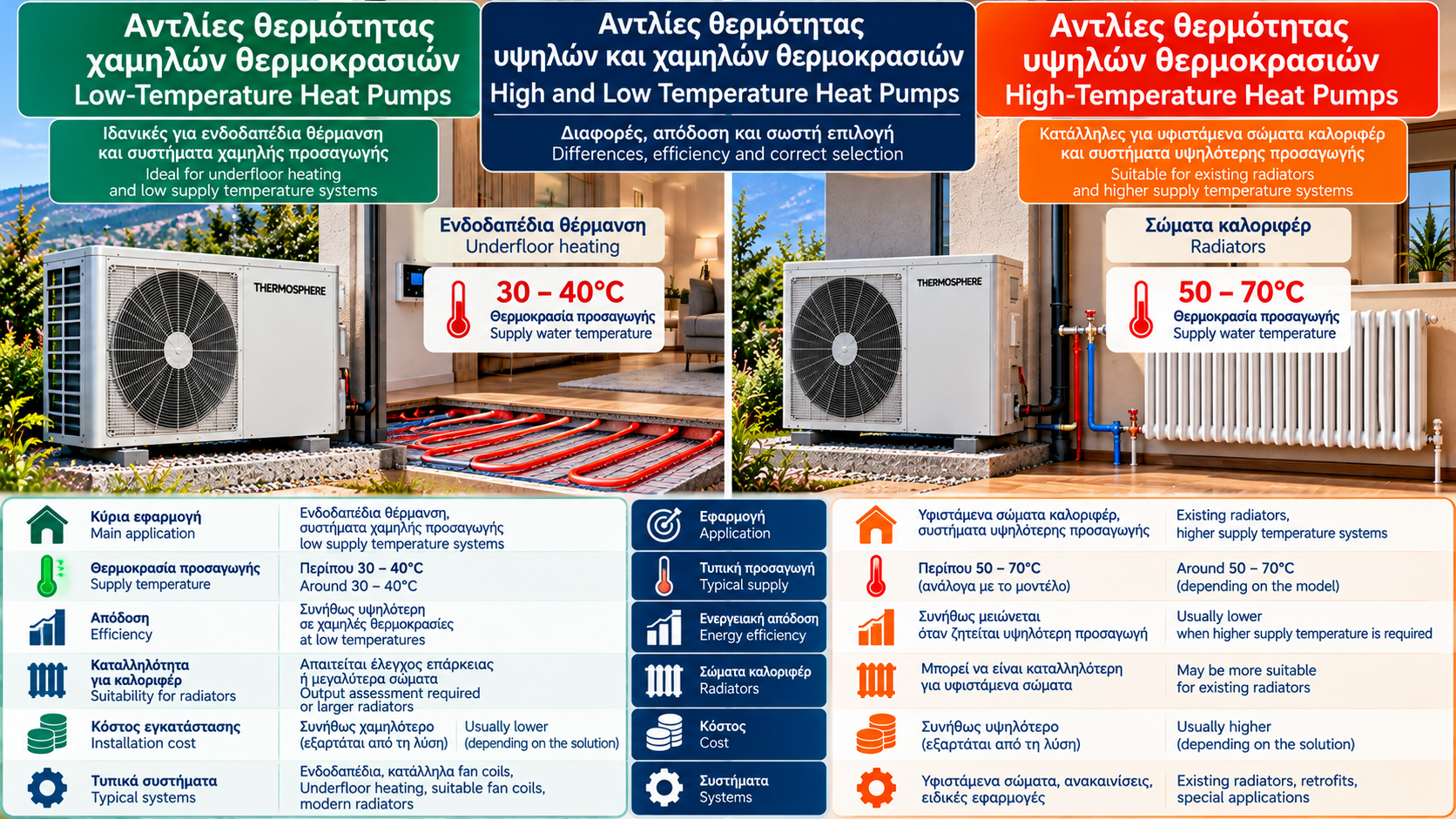
High-Temperature vs Low-Temperature Heat Pumps: Differences, Efficiency and Selection
Choosing a heat pump involves more than selecting the rated capacity or manufacturer. One of the most important factors is the water temperature required by the heating system.
A home with underfloor heating may operate effectively with relatively low supply water temperatures. An older building with small radiators may require higher temperatures to meet its heating demand.
This difference leads to the distinction between low-temperature and high-temperature heat pumps.
However, these terms are not a universal classification with identical limits across all manufacturers. The capabilities of each product must be confirmed using its technical documentation.
1. What Is a Low-Temperature Heat Pump?
Low-temperature heat pumps are primarily intended for heating systems that can deliver the required room heating with relatively low water temperatures.
Typical applications include:
Underfloor heating.
Radiators sized for lower water temperatures.
Fan coil units designed for the relevant operating conditions.
Buildings with relatively low heat losses.
Many underfloor heating applications operate with supply temperatures of approximately 30–40°C, depending on system design and conditions.
These values are illustrative, not universal requirements.
2. What Is a High-Temperature Heat Pump?
High-temperature heat pumps are designed to deliver higher heating-water temperatures than many conventional low-temperature systems.
Depending on the model and outdoor conditions, some can achieve supply temperatures around 65–75°C or higher.
A stated maximum supply temperature does not necessarily mean that the unit can deliver its rated heating capacity under all outdoor conditions.
These systems may be considered for:
Existing radiator installations.
Buildings where replacing radiators is difficult.
Heating systems requiring higher water temperatures.
Certain specialist hot water applications.
3. Main Differences
Feature | Low-Temperature | High-Temperature |
Main application | Low supply-temperature systems | Systems requiring hotter water |
Underfloor heating | Highly suitable | Possible, but high-temperature capability may be unnecessary |
Existing radiators | Output assessment required | May be suitable |
Energy consumption | Depends on operating conditions | Generally increases at higher supply temperatures |
Maximum supply temperature | Model-dependent | Designed for higher values |
Cost | Depends on the complete solution | Depends on the complete solution |
4. Why Does Supply Temperature Affect Energy Consumption?
A heat pump transfers heat from a lower-temperature source to a higher-temperature heating circuit.
As the required temperature lift increases, the refrigeration cycle generally needs more work.
Consequently, at the same outdoor temperature, a heat pump typically operates with a lower COP when a higher supply water temperature is required.
COP is the ratio between useful heating output and electrical input at a particular operating point.
For example:
COP 4 means 4 kWh of heat output for every 1 kWh of electricity.
COP 3 means 3 kWh of heat output for every 1 kWh of electricity.
These are calculation examples, not performance figures for a particular product.
5. Example of Electricity Consumption
Assume a building requires 12,000 kWh of useful heat over a heating period.
In a hypothetical scenario with seasonal efficiency of 4:
12,000 ÷ 4 = 3,000 kWh of electricity
In another hypothetical scenario with seasonal efficiency of 3:
12,000 ÷ 3 = 4,000 kWh of electricity
The difference is 1,000 kWh.
This demonstrates the importance of seasonal efficiency, but it does not predict the actual consumption of a specific home.
A realistic assessment requires heat-loss calculations, climate data, operating temperatures and equipment performance information.
6. Which Is Better for Radiators?
The answer depends on the actual heat output of the radiators at the proposed operating temperatures.
A radiator produces less heat when its average water temperature decreases relative to the room temperature.
Therefore, a radiator that adequately heated a room with high-temperature water may not provide sufficient output at substantially lower temperatures.
Before choosing a high-temperature heat pump, consider whether:
Existing radiators can meet demand at lower temperatures.
Selected radiators could be replaced with larger models.
Building heat losses can be reduced.
Weather compensation can be implemented.
Not every older house automatically requires a high-temperature heat pump.
7. Which Is Better for Underfloor Heating?
Underfloor heating is particularly suitable for low-temperature operation because of its large heat-emitting surface.
A properly sized low-temperature heat pump is therefore often a sensible choice.
Even when a heat pump capable of producing higher water temperatures is installed, the underfloor circuit must operate within its design and material limits.
The ability to generate hotter water does not mean that such temperatures should be supplied to underfloor heating.
8. What About Domestic Hot Water?
Domestic hot water production is a separate operating requirement.
A heat pump operating efficiently at low temperatures for space heating may use a higher temperature to heat a domestic hot water cylinder.
Depending on the model, an electric immersion heater may assist with specific functions.
Temperature selection must consider:
Manufacturer instructions.
Cylinder capacity.
Hygiene requirements.
Scald prevention.
Energy consumption.
Maximum water temperature capability should not be confused with the temperature continuously required for space heating.
9. Are High-Temperature Heat Pumps Less Efficient?
Operating at a higher supply temperature generally reduces the efficiency of the same system under comparable conditions.
However, this does not mean every high-temperature model is less efficient than every low-temperature model.
Compressor technology, refrigerant selection, heat exchangers and controls can vary significantly.
Compare specific models at the operating temperatures required by the building.
10. How Does Outdoor Temperature Affect Performance?
As outdoor temperatures fall, the available heating capacity and efficiency of an air-to-water heat pump may change.
The extent depends on the model.
Performance should therefore be checked at temperatures close to the local winter design conditions, rather than only at mild outdoor temperatures.
This is especially important when high supply water temperatures are also required.
11. What Is Weather Compensation?
Weather compensation adjusts heating-water supply temperature according to outdoor conditions and system settings.
During milder weather, the system may operate with cooler water.
This avoids unnecessarily maintaining the highest supply temperature.
A correctly configured weather compensation curve can help improve seasonal performance.
12. Which Is More Cost-Effective?
An economic comparison should include:
Equipment price.
Installation costs.
Possible radiator replacement.
Building insulation improvements.
Expected electricity consumption.
Maintenance costs.
Expected service life.
A high-temperature heat pump may reduce the need for radiator replacement in some buildings.
A low-temperature system may offer lower running costs where the building and heat emitters allow low supply temperatures.
Neither solution is universally the most economical.
13. Five Common Mistakes
1. Choosing a high-temperature heat pump without assessing the radiators.
A more expensive or unsuitable solution may be selected unnecessarily.
2. Comparing only maximum supply temperatures.
Maximum temperature alone does not establish available capacity or efficiency.
3. Ignoring winter design conditions.
The unit must be assessed at the outdoor temperatures relevant to the location.
4. Operating continuously at unnecessarily high supply temperatures.
This can increase energy consumption without improving comfort.
5. Selecting equipment without calculating heat losses.
Correct sizing is essential for reliable operation.
14. Frequently Asked Questions
Can I Install a Low-Temperature Heat Pump in an Older House?
Yes, provided an assessment confirms that the heat pump and heat emitters can meet the building’s heating demand at the selected temperatures.
Can High-Temperature Heat Pumps Reach 70°C?
Some models can reach approximately 70°C or higher under specified conditions. Always check the manufacturer’s performance data.
Which Uses Less Electricity?
Consumption depends on the specific unit, operating conditions and supply temperature. Lower required supply temperatures generally favour efficiency.
Must I Replace Every Radiator?
Not necessarily. Each radiator should be assessed against the heat demand of its room.
Can a High-Temperature Heat Pump Work With Underfloor Heating?
Yes, provided the system is designed and controlled to maintain suitable water temperatures.
Does Hotter Water Always Mean Better Heating?
No. The objective is to meet the building’s heat demand at the lowest practical supply temperature.
Conclusion
High-temperature and low-temperature heat pumps address different heating system requirements.
Low-temperature solutions are particularly suitable where the required heating output can be delivered with cooler water.
High-temperature solutions can serve installations requiring hotter water, including certain retrofits of existing radiator systems.
The correct choice should be based on heat-loss calculations, radiator performance and verified heat pump efficiency at the intended operating conditions.
Thermosphere.gr — Technical knowledge for heating and building systems.