
Water Pumps: Types, How They Work and How to Choose the Right Pump
Water pumps are essential components of water supply systems in homes, apartment buildings, commercial properties and agricultural installations.
They are used to move water between locations, increase available pressure or supply water from tanks, wells and boreholes.
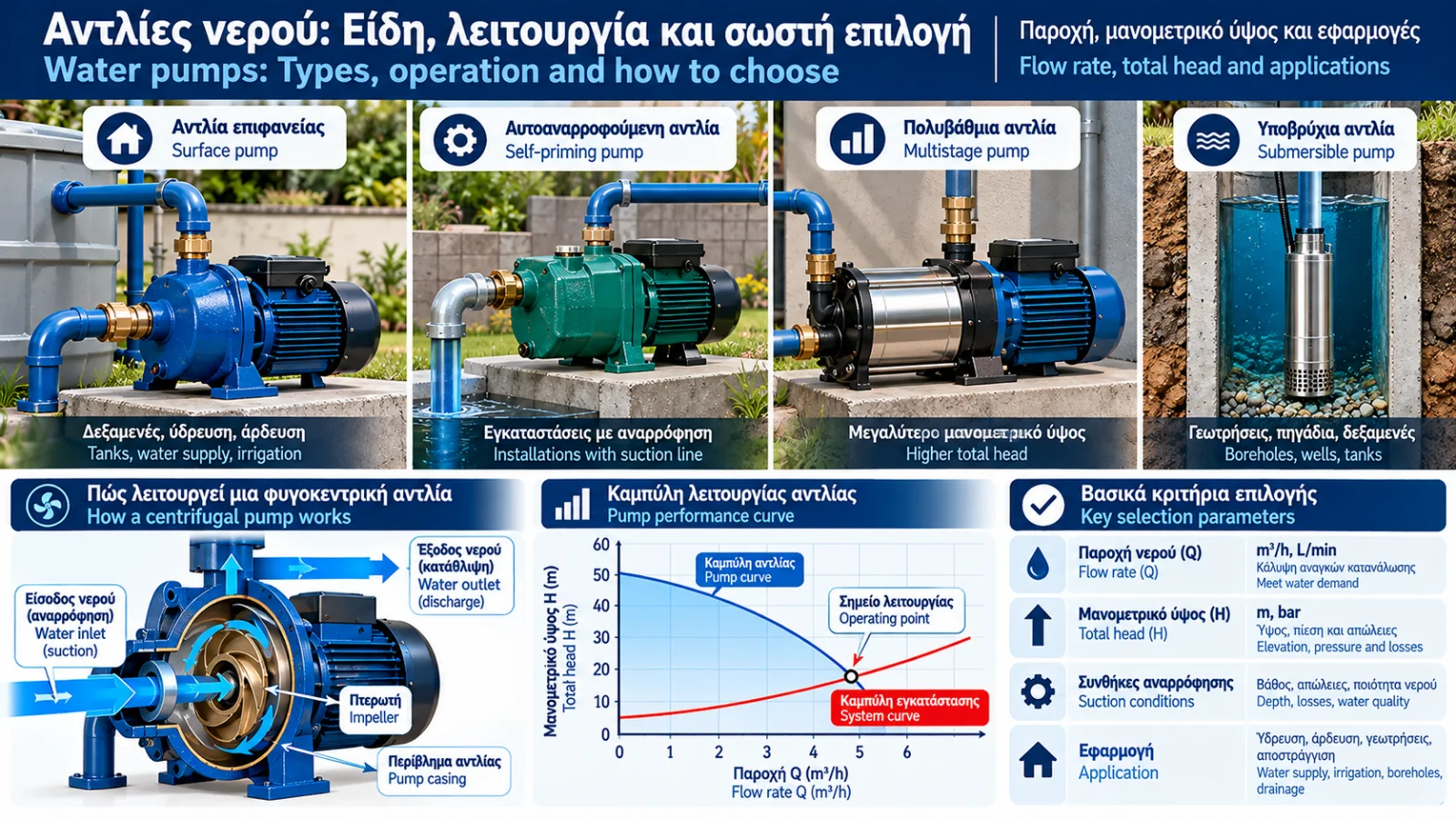
Although many pump designs are available, proper selection depends primarily on two factors: required flow rate and total dynamic head.
A pump with a powerful electric motor is not necessarily suitable for a particular installation. Its performance curve, the hydraulic system and suction conditions are equally important.
This Thermosphere.gr guide explains the main types of water pumps, their operating principles and the factors to consider before choosing a pump.
1. What Is a Water Pump?
A water pump is a mechanical device that transfers energy to a liquid, allowing it to flow through pipes or move to a higher elevation.
Most domestic water supply applications use electrically driven pumps.
An electric motor drives the pump's hydraulic mechanism, which transfers energy to the water.
Depending on its design, a pump may be used for:
Supplying a home from a storage tank.
Boosting water pressure where permitted.
Transferring water between tanks.
Pumping from wells and boreholes.
Irrigation.
Drainage and dewatering.
Industrial and commercial applications.
Not every pump is suitable for every application.
For example, a drainage pump may not be suitable for potable water or for supplying a pressurised domestic distribution network.
2. How Does a Centrifugal Pump Work?
The centrifugal pump is one of the most common water pump designs.
Its main components include:
Impeller.
Pump casing.
Shaft.
Electric motor.
Shaft sealing system.
Suction and discharge connections.
During operation, the rotating impeller transfers energy to the water.
Water enters the impeller through the suction side, gains velocity and moves towards the discharge.
Inside the hydraulic casing, part of its kinetic energy is converted into static pressure.
The pump provides the energy difference required to move water through the system.
Important: A centrifugal pump does not simply produce a fixed pressure. Its actual flow rate depends on the interaction between the pump and the hydraulic resistance of the installation.
3. Main Types of Water Pumps
Water pumps can be classified by their hydraulic principle, installation arrangement and intended application.
Surface Pumps
Surface pumps are installed outside the water source.
They draw water through a suction pipe and deliver it to the distribution system.
They are commonly used with storage tanks and irrigation installations.
Their suction capability is limited by atmospheric pressure, hydraulic losses and operating conditions.
Self-Priming Pumps
Self-priming pumps are designed to remove a certain amount of air from the suction line and establish flow after being prepared according to the manufacturer's instructions.
This does not mean they can operate continuously without water.
Their self-priming capability and limitations depend on the specific model.
Submersible Pumps
Submersible pumps operate while immersed in water.
Depending on their design, they are used in tanks, wells, boreholes and drainage applications.
Their submerged installation avoids some of the suction limitations associated with surface pumps.
Multistage Pumps
Multistage pumps contain multiple impeller stages.
Energy is added to the water in successive stages, allowing higher total head under appropriate conditions.
They are commonly used where greater pressure is required.
Drainage Pumps
Drainage pumps remove water from pits, basements and other areas.
Their suitability depends on allowable solid particle size, water quality and required head.
They should not automatically be considered suitable for drinking-water applications.
4. Comparison of Common Pump Types
Pump type | Typical application | Main characteristic |
|---|---|---|
Surface centrifugal | Tanks, water supply, irrigation | Relatively simple hydraulic arrangement |
Self-priming | Installations with suction lines | Can re-establish suction under specified conditions |
Borehole submersible | Wells and boreholes | Operates below the water surface |
Multistage | Higher-head applications | Multiple hydraulic stages |
Drainage | Pits and flooded areas | Designed for water removal |
These categories can overlap. A submersible borehole pump, for example, may also be a multistage centrifugal pump.
5. What Is Pump Flow Rate?
Flow rate is the volume of water transferred per unit of time.
It is commonly represented by Q.
Typical units include:
m³/h: cubic metres per hour.
L/min: litres per minute.
L/h: litres per hour.
For example:
1 m³/h = 1,000 L/h ≈ 16.7 L/min
A flow rate of 3 m³/h therefore corresponds to approximately 50 L/min.
However, the maximum flow rate shown in a pump catalogue does not mean that the same flow can be delivered at every pressure or elevation.
Actual flow changes with the required head.
6. What Is Total Dynamic Head?
Head represents the energy added by a pump per unit weight of liquid.
It is commonly represented by H and expressed in metres of liquid column.
For water, a useful approximation is:
10 metres of water column ≈ 0.98 bar
This relationship describes the pressure equivalent of a water column, not a fixed pressure produced by every pump.
The total head required by an installation may include:
Elevation difference.
Required pressure at the point of use.
Friction losses in pipes.
Local losses through valves and fittings.
Available inlet pressure, where applicable.
Correct pump selection must consider total system requirements, not simply building height.
7. Pressure Versus Head
Pressure is commonly expressed in bar.
Head is expressed in metres.
For water of approximately constant density, the two quantities are related.
However, pump head describes the difference in total hydraulic energy between the pump inlet and outlet.
It is not always identical to the pressure indicated by a discharge gauge.
Gauge readings depend on the measurement location, elevation and suction-side pressure.
8. Why Doesn't a Pump Always Deliver Its Maximum Flow?
Every centrifugal pump has a characteristic performance curve.
This curve shows how the available head varies with flow rate.
For typical centrifugal pumps, head decreases as flow increases.
The hydraulic installation also has a system curve representing the head required at different flow rates.
The actual operating point is determined by the intersection of the pump curve and the system curve.
This explains why a pump advertised with a maximum flow of 5 m³/h may deliver substantially less flow in a system with high friction losses or pressure requirements.
9. What Is the Best Efficiency Point?
The Best Efficiency Point (BEP) is the operating point where a pump achieves its maximum hydraulic efficiency under specified conditions.
Operating within an appropriate efficiency region can contribute to:
Reduced electricity consumption.
Lower undesirable hydraulic loads.
Improved reliability.
Reduced component stress.
A pump does not necessarily need to operate exactly at BEP at all times.
The appropriate operating region depends on manufacturer recommendations and system requirements.
10. Understanding Suction Lift
Surface pumps may need to draw water from a level below the pump.
Suction lift is limited by available atmospheric pressure and hydraulic losses.
At sea level, the theoretical atmospheric limit for lifting water is approximately 10 metres, but practical allowable suction lift is lower.
It depends on:
Altitude.
Water temperature.
Suction pipe length and diameter.
Losses through filters and fittings.
Pump NPSH requirements.
A quoted suction lift of 8 metres should not be treated as a universal operating guarantee.
For deeper water sources or difficult suction conditions, a different arrangement, such as a submersible pump, may be necessary.
11. What Is Pump Cavitation?
Cavitation occurs when local pressure inside the pump falls sufficiently for vapour bubbles to form.
As the bubbles move into higher-pressure regions, they can collapse and cause mechanical damage.
Possible symptoms include:
Unusual noise.
Vibration.
Reduced performance.
Progressive impeller damage.
Avoiding cavitation requires adequate Net Positive Suction Head Available (NPSHa) relative to the pump's requirements and an appropriate safety margin.
NPSH is a different quantity from total dynamic head.
12. How to Choose a Pump for a House
Selection should begin with actual system requirements.
Important factors include:
Required peak flow rate.
Required pressure at fixtures.
Elevation difference.
Pipe friction losses.
Water source and quality.
Suction conditions.
Control system.
Electrical supply.
Suitability of materials for potable water, where required.
The final choice should be verified using the performance curve of the specific pump model.
13. Example: Selecting a Pump for a Home
Consider a hypothetical domestic water supply installation fed from a storage tank.
Assume:
Required flow: 2.5 m³/h.
Elevation difference: 8 m.
Required residual pressure at the most demanding fixture: 2 bar.
Estimated pipe losses: 7 m.
For water, 2 bar corresponds to approximately 20.4 metres of water column.
Therefore:
Required total head ≈ 8 + 20.4 + 7 = 35.4 m
The selection target is a pump capable of delivering approximately 2.5 m³/h at 35–36 m head, with an appropriate design margin.
The example assumes negligible velocity at the free water surfaces and no additional inlet pressure at the supply tank.
A pump should not be selected merely because its catalogue states a maximum head of 36 metres.
It must provide the required head at the required flow rate.
14. Water Pump Versus Pressure Booster System
A pump is the machine that transfers energy to water.
A pressure booster system may include:
One or more pumps.
Pressure switch or pressure sensor.
Pressure vessel.
Electrical control panel.
Electronic controller or variable-frequency drive.
Protective devices.
A booster system automatically controls pressure and water delivery.
Its operation and settings will be covered in the next article of this series.
15. What Are Inverter-Controlled Pumps?
The term inverter pump is often used for pumping systems with variable-speed electronic control.
A variable-frequency drive changes motor speed according to demand.
In suitably designed systems, this may provide:
Better flow matching.
More stable pressure control.
Reduced frequent starts.
Electricity savings under certain operating profiles.
An inverter does not automatically make every pumping system more efficient.
Actual savings depend on demand, pump characteristics and system design.
16. Potable Water Safety Considerations
Equipment used in drinking-water systems must be suitable for contact with water intended for human consumption and comply with applicable requirements.
Important considerations include:
Material suitability.
Storage tank hygiene.
Contamination prevention.
Backflow protection.
Correct maintenance.
Separation of incompatible water networks.
Directly connecting a booster pump to the public water main must not be assumed to be permitted.
Local water utility rules and relevant backflow protection requirements must be followed.
17. Common Water Pump Selection Mistakes
Choosing a Pump Only by Motor Power
Motor wattage or horsepower does not establish the actual flow and head available at the operating point.
Selecting Only by Maximum Flow
Maximum flow is usually specified at conditions different from the intended operating point.
Ignoring Pipe Losses
Long pipes, small diameters and fittings can significantly increase required head.
Overestimating Suction Capability
A surface pump cannot lift water from unlimited depth.
Using the Wrong Drainage Pump
Not every drainage pump is suitable for pressurised water distribution or potable water.
Ignoring Dry-Running Protection
Operating without sufficient water can seriously damage pumps not designed for such conditions.
18. When Is Professional Assessment Needed?
Professional pump selection and installation are particularly important when dealing with:
Difficult suction conditions.
Significant elevation differences.
Insufficient pressure in multi-storey buildings.
Boreholes and wells.
Potable water systems.
Multiple pumps.
Variable-speed pressure control.
Cavitation or water hammer risks.
Electrical connections and protective devices must comply with manufacturer instructions and applicable requirements.
19. Frequently Asked Questions
Which Water Pump Is Best for a House?
It depends on required flow, pressure, elevation, water source and hydraulic losses.
What Does 3 m³/h Mean?
It means 3,000 litres per hour at the specified operating point or under the conditions associated with that rating.
What Does 40 Metres of Head Mean?
It describes hydraulic energy per unit weight. It does not mean the pump delivers its maximum flow at 40 metres of head.
Can a Surface Pump Lift Water from 15 Metres Below It?
Not using conventional suction lift from a water surface 15 metres below the pump. A different arrangement, often a submersible pump, is normally required.
Is a Higher-Wattage Pump Better?
Not necessarily. Suitability depends on the operating point and efficiency.
What Is a Self-Priming Pump?
It is a pump designed to remove air from its suction line under specified conditions after being prepared according to the manufacturer's instructions.
What Is the Difference Between a Pump and a Booster Set?
A pump transfers energy to water, while a booster set combines pumping equipment with automatic pressure controls.
Conclusion
Selecting a water pump correctly requires more than comparing motor power or maximum catalogue flow rates.
The essential parameters are required flow, total dynamic head, pump performance curve and installation conditions.
Suction limitations, cavitation prevention, water quality and safe operation are also important.
A correctly selected pump must meet the system's requirements at its actual operating point while providing suitable efficiency and reliability.
Technical References and Further Reading
Hydraulic Institute: Pump selection principles, performance curves and operating guidance — https://www.pumps.org/
Europump: European pump industry technical resources — https://www.europump.net/
Grundfos: Pump training and technical guides — https://www.grundfos.com/
KSB: Pump technical reference material — https://www.ksb.com/
EN 806: Specifications for installations inside buildings conveying water for human consumption.
EN 1717: Protection against pollution of potable water installations through backflow.
General technical references do not replace the performance curve, manual and specifications of the actual pump.
Safety note: Water pump installation and electrical connections should be carried out by appropriately qualified personnel. Particular attention is required for electrical protection, dry-running prevention and potable water hygiene.
Thermosphere.gr — Technical knowledge for water supply and building systems.