
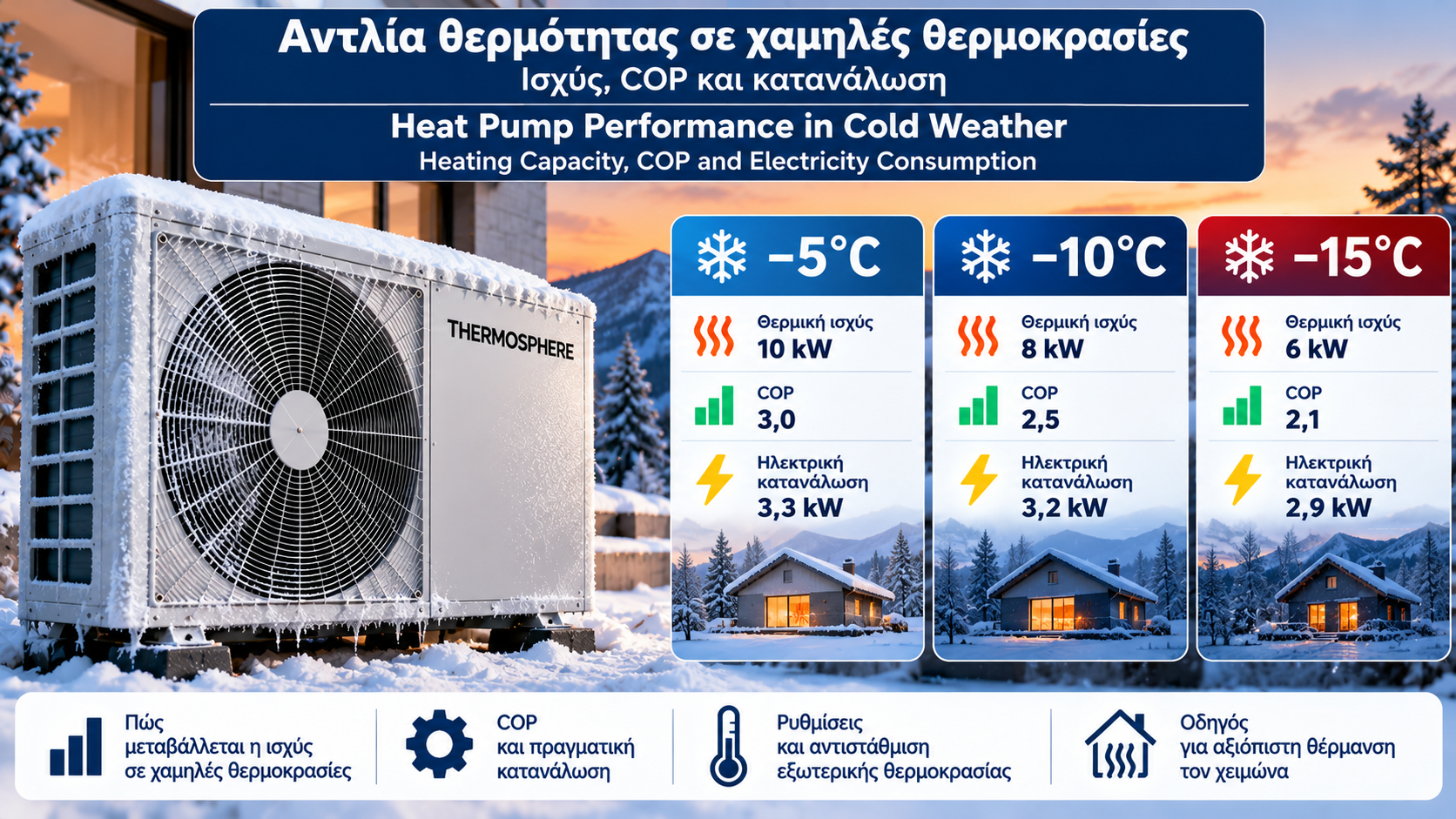
Heat Pumps at −5°C, −10°C and −15°C: Heating Capacity, COP and Electricity Consumption
Can a heat pump efficiently heat a home when outdoor temperatures drop to −5°C, −10°C or even −15°C?
Yes, provided that the equipment is correctly selected and the installation meets the building’s actual heating requirements.
Modern air-to-water heat pumps can operate at very low outdoor temperatures. However, their heating capacity, electricity consumption and coefficient of performance (COP) do not remain constant.
As outdoor temperatures decrease, transferring heat from the air to the heating-water circuit generally becomes more demanding. At the same time, the building’s heat losses increase.
This guide explains how heat pump performance changes during freezing weather, how to calculate electricity consumption and which operating settings can improve winter efficiency.
1. How Does a Heat Pump Work in Freezing Weather?
Even when outdoor temperatures fall below 0°C, air still contains thermal energy.
A heat pump extracts this energy through its refrigerant circuit.
The process involves four main stages:
The outdoor heat exchanger absorbs heat from the air.
The refrigerant carries this energy toward the compressor.
The compressor increases refrigerant pressure and temperature.
The indoor heat exchanger transfers heat to the heating-water circuit.
As outdoor temperatures decrease, the temperature lift required by the refrigeration cycle may increase.
This affects compressor power consumption and overall efficiency.
2. What Is COP and Why Does It Decrease in Winter?
The coefficient of performance (COP) expresses the relationship between useful heating output and electrical power input.
COP = Heating output / Electrical input
For example, if a heat pump produces 9 kW of heat while consuming 3 kW of electrical power:
COP = 9 / 3 = 3.
Under these conditions, each kilowatt-hour of electricity produces 3 kWh of useful heat.
COP depends on several factors:
Outdoor temperature.
Heating-water flow temperature.
Compressor operating conditions.
Defrost frequency.
Part-load operation.
Auxiliary electricity consumption.
A heat pump does not operate at one fixed COP throughout the heating season.
3. How Does COP Change at −5°C, −10°C and −15°C?
Consider a hypothetical heat pump operating with a leaving water temperature of 35°C.
Outdoor temperature | Illustrative COP |
+7°C | 4.5 |
0°C | 3.6 |
−5°C | 3.0 |
−10°C | 2.5 |
−15°C | 2.1 |
Important: These values are hypothetical and are intended only to illustrate a possible trend. They are not certified performance figures for a particular model.
Actual results depend on compressor technology, refrigerant, heating-water temperature and operating conditions.
The general principle is that COP tends to decrease as the temperature difference between the outdoor air and heating-water circuit increases.
4. How Much Electricity Does a Heat Pump Use at −10°C?
Electricity consumption depends on the amount of useful heat required and the actual COP.
The basic equation is:
Electrical energy (kWh) = Useful heating energy (kWh) / COP
Assume a home requires 10 kW of heating output for one hour.
At COP 4:
10 / 4 = 2.5 kWh.
At COP 3:
10 / 3 = 3.33 kWh.
At COP 2:
10 / 2 = 5 kWh.
Therefore, electricity consumption increases when COP decreases, assuming the same amount of heat must be delivered.
In practice, colder outdoor temperatures also increase the building’s heating demand.
Winter electricity consumption can therefore increase for two reasons:
The heat pump operates at a lower COP.
The building requires more heat.
5. Example of Daily Electricity Consumption
Consider three hypothetical scenarios with a constant average heating demand over 24 hours.
Outdoor temperature | Average heating demand | Average COP | Electricity per 24 hours |
0°C | 5 kW | 3.6 | 33.3 kWh |
−5°C | 6 kW | 3.0 | 48.0 kWh |
−10°C | 7 kW | 2.5 | 67.2 kWh |
For the final scenario:
7 × 24 / 2.5 = 67.2 kWh.
These examples demonstrate the combined effect of increased heating demand and reduced efficiency.
They are not predictions of actual household electricity bills.
Real consumption depends on building heat losses, weather duration, operating settings and equipment performance.
6. What Happens to Heating Capacity at Very Low Temperatures?
Heat pump heating capacity is not necessarily constant across different outdoor temperatures.
Many models experience reduced maximum heating output as outdoor temperatures fall.
However, this behaviour is not identical for every heat pump.
Some systems use inverter compressors, vapour injection or other technologies to maintain or increase heating output at particular operating points.
Therefore, a heat pump marketed as a 12 kW unit will not necessarily deliver 12 kW at −15°C.
Equally, it is incorrect to assume that all heat pumps lose capacity according to one fixed percentage.
The manufacturer’s heating capacity tables must be checked at the relevant design conditions.
7. Understanding A7/W35 and A−7/W55
Manufacturers publish performance information at defined test conditions.
For example:
A7/W35
A7: Outdoor air temperature of 7°C.
W35: Leaving water temperature of 35°C.
A−7/W55
A−7: Outdoor air temperature of −7°C.
W55: Leaving water temperature of 55°C.
These are very different operating conditions.
The second requires the heat pump to operate with colder outdoor air and hotter heating water.
Equipment selection should therefore use performance data that closely match the building’s actual design requirements.
8. Why Does Flow Temperature Affect Electricity Consumption?
Flow temperature is the temperature of the water delivered to radiators, underfloor heating or fan coil units.
Higher required water temperatures generally increase the work performed by the refrigeration cycle.
A heating system capable of meeting demand with 35°C water will typically allow more efficient heat pump operation than a system requiring 55°C water under otherwise identical conditions.
This is why the correct sizing of heat emitters is important.
Selecting an efficient heat pump is not enough; the distribution system must also be compatible with suitable operating temperatures.
9. Underfloor Heating or Radiators in Cold Weather?
Underfloor heating often operates at relatively low water temperatures because of its large heat transfer surface.
This can help maintain higher heat pump efficiency.
Radiators can also work effectively with heat pumps when appropriately sized.
Older buildings with smaller radiators may require higher water temperatures.
A proper assessment should consider:
Room-by-room heat losses.
Existing radiator output.
Required flow temperature.
Return-water temperature.
Hydraulic balancing.
Replacing every radiator is not always necessary, but their suitability must be assessed.
10. What Is Weather Compensation?
Weather compensation is a control function that adjusts heating-water temperature according to outdoor conditions.
During mild weather, the system can use lower water temperatures.
As outdoor temperatures fall, the controller increases flow temperature to match the building’s heating demand.
A hypothetical heating curve might look like this:
Outdoor temperature | Flow temperature |
+12°C | 30°C |
+5°C | 35°C |
0°C | 40°C |
−5°C | 45°C |
−10°C | 50°C |
These figures are illustrative rather than recommended settings for every installation.
The appropriate heating curve depends on insulation, heat emitters and building behaviour.
11. How Should Weather Compensation Be Adjusted?
A properly configured heating curve should maintain indoor comfort without unnecessarily high water temperatures.
If the curve is too high:
Flow temperatures increase.
COP may decrease.
Electricity consumption may rise.
If the curve is too low:
Rooms may fail to reach the desired temperature.
Heating recovery may become excessively slow.
Adjustments should be gradual and based on indoor temperature and operating data.
Large, unplanned changes to installer-level settings should be avoided.
12. Why Might a Heat Pump Run Continuously at −10°C?
Continuous operation does not necessarily indicate a fault.
A correctly sized inverter heat pump may run for long periods while adjusting its output to match heating demand.
As outdoor temperatures fall, the building requires more heat, so operating hours may increase.
Continuous operation can be normal when:
Indoor temperature is maintained.
The unit operates within manufacturer specifications.
No persistent faults occur.
Energy consumption is consistent with heating demand.
However, if the heat pump runs continuously while indoor temperatures remain too low, further investigation is needed.
13. Why Is My Heat Pump Not Heating Enough in Freezing Weather?
Insufficient heating can have several causes.
Insufficient Available Heating Capacity
The heat pump may not meet the building’s design heating load.
Incorrect Weather Compensation
The heating-water temperature may be too low for the installed radiators.
Restricted Water Flow
Blocked filters, closed valves or circulation pump problems may limit heat transfer.
Frequent Defrost Cycles
During humid, freezing weather, repeated defrost cycles can reduce net heat delivery.
High Building Heat Losses
The building may require more heating power than originally estimated.
Diagnosis should be based on measurements rather than arbitrary control adjustments.
14. How Does Defrost Affect Actual Efficiency?
During cold, humid weather, frost may form on the outdoor heat exchanger.
The heat pump initiates defrost cycles to remove this frost.
During defrost, normal heat delivery to the building may temporarily decrease.
The frequency and duration of defrost cycles affect actual operating efficiency.
For this reason, electricity consumption should not be evaluated using only a single instantaneous COP value.
The total useful heat delivered and electricity consumed over time are more meaningful.
15. What Is an Electric Backup Heater?
Some heat pumps include an internal or external electric resistance heater for supplementary heating.
It may operate:
When heat pump output is insufficient.
During particular operating procedures.
For some domestic hot water strategies.
As a backup heat source.
An electric resistance heater converts approximately 1 kWh of electricity into 1 kWh of heat.
Frequent operation can therefore increase electricity consumption considerably.
However, disabling it without a technical assessment may compromise comfort, safety or reliable system operation.
16. What Is the Bivalent Point?
The bivalent point is the outdoor temperature at which available heat pump output equals the building’s heating demand.
Below this point, supplementary heating may be required.
For example, at −10°C:
Building heating demand: 11 kW.
Available heat pump output: 9 kW.
The shortfall is:
11 − 9 = 2 kW.
In a properly designed bivalent system, the remaining 2 kW can be supplied by an appropriate supplementary heating source.
The bivalent point must be determined during system design rather than selected arbitrarily.
17. COP vs SCOP: What Is the Difference?
COP describes efficiency at a specific operating point.
SCOP is a seasonal coefficient calculated using a standardised methodology for defined climatic and operating conditions.
For example:
COP 3.0 means three units of useful heat per unit of electricity at a particular operating point.
SCOP 4.0 represents a standardised seasonal ratio of useful heat to electrical energy under the applicable assessment conditions.
Actual seasonal performance may differ from the manufacturer’s declared SCOP.
Climate, heating-water temperature, controls and auxiliary electricity consumption all influence real-world performance.
18. How to Choose a Heat Pump for a Cold or Mountainous Region
The selection process should begin with a building heat loss calculation.
The next steps include assessing:
The local outdoor design temperature.
Required heating-water flow temperature.
Available heat pump output at design conditions.
COP at the relevant operating points.
Minimum and maximum operating limits.
Need for supplementary heating.
Defrost and hydraulic installation requirements.
A brochure stating that a heat pump operates down to −20°C or −25°C is not sufficient evidence of suitability.
The minimum operating temperature does not guarantee that rated heating capacity or efficiency will be maintained.
19. Practical Tips for Efficient Winter Operation
To improve winter performance:
Keep the outdoor unit clear of obstructions.
Ensure defrost water can drain correctly.
Use a suitable weather compensation curve.
Avoid unnecessarily high flow temperatures.
Monitor electric backup heater operation.
Maintain water filters and hydraulic components.
Avoid repeated large thermostat adjustments without a clear reason.
Record recurring faults and unusual operating behaviour.
Advanced settings should follow manufacturer documentation and professional installer guidance.
20. Frequently Asked Questions
Can a Heat Pump Work at −15°C?
Yes. Some heat pumps are designed to operate at −15°C and below. However, their available heating output and required water temperature must be checked.
How Much Electricity Does a Heat Pump Use at −10°C?
There is no universal figure. Consumption depends on building heating demand, COP, operating hours and supplementary heating.
Is Continuous Operation Normal?
Yes. Continuous operation may be normal during high heating demand, provided the desired indoor temperature is maintained.
Why Do Electricity Bills Increase During Freezing Weather?
Because building heat losses increase and heat pump COP generally decreases as outdoor temperatures fall.
Should I Manually Increase the Flow Temperature?
Not necessarily. Properly configured weather compensation automatically adjusts flow temperature to outdoor conditions.
Is an Electric Backup Heater Always Required?
No. The requirement depends on system design, available heat pump output and the backup heating strategy.
Should I Turn My Heat Pump Off at Night?
There is no universal answer. Systems with high thermal inertia may require considerable recovery time after large nighttime temperature setbacks. The best strategy depends on the building and heating system.
Conclusion
Heat pumps can provide effective heating even in regions with very low outdoor temperatures.
Operation at −5°C, −10°C or −15°C should not be judged solely by whether the unit can start.
What matters is the available heating capacity, COP, required heating-water temperature and ability to meet the building’s heat losses.
Correct design, suitable sizing and optimised weather compensation are essential for efficient operation.
The best heat pump for a cold climate is not necessarily the model with the highest nominal capacity, but the one that reliably meets the building’s actual heating demand under design conditions.
Thermosphere.gr — Technical knowledge for heating and building systems.