
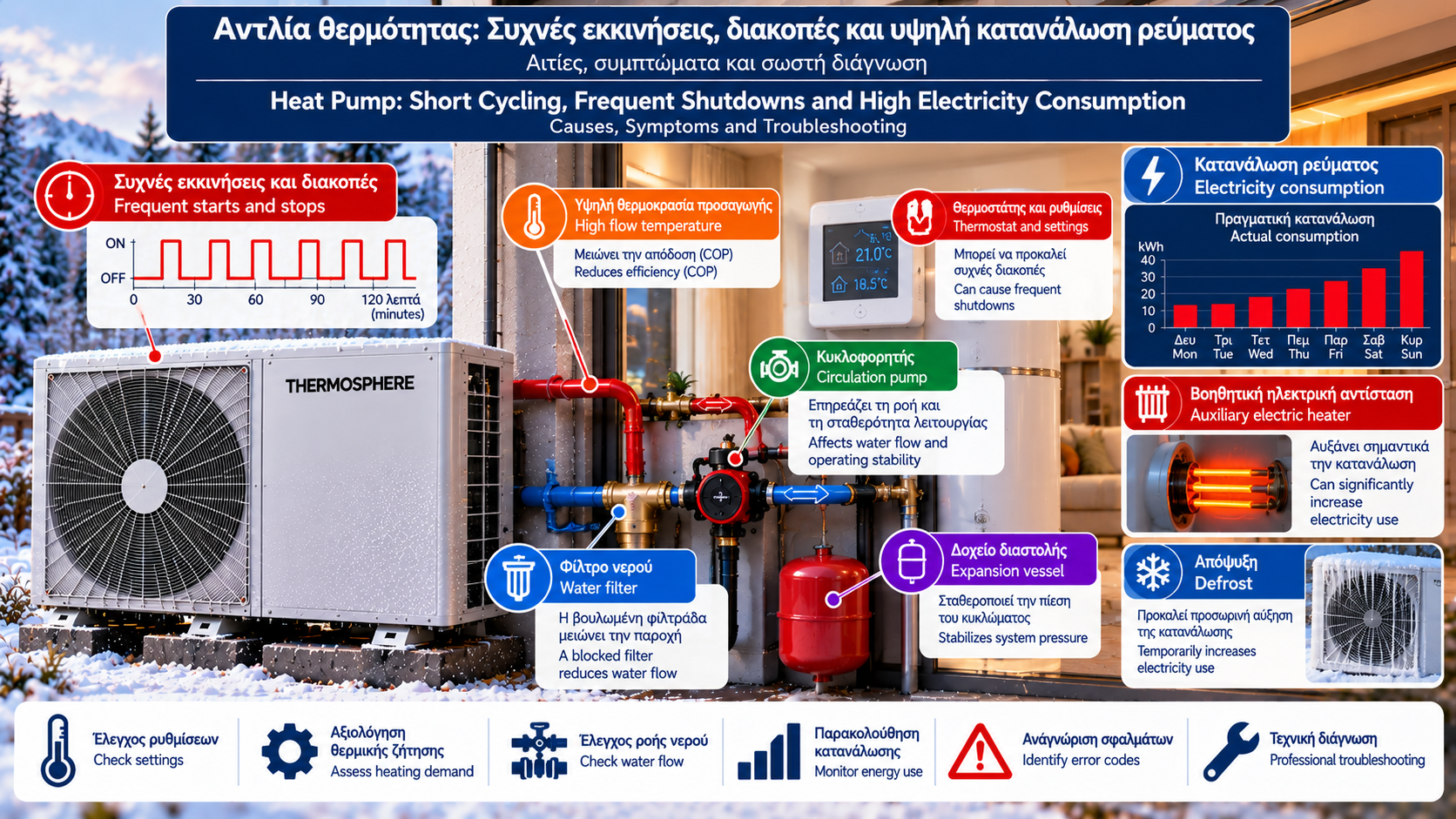
Heat Pump Short Cycling, Frequent Shutdowns and High Electricity Consumption
A heat pump that repeatedly starts and stops or consumes unusually large amounts of electricity does not necessarily have a mechanical fault.
Its behaviour may be related to equipment sizing, controller settings, thermostats, heating-water temperature, hydraulic design or the building’s actual heating demand.
In other cases, frequent shutdowns may result from protective functions or technical faults requiring professional diagnosis.
The first step is to understand when intermittent operation is normal and when it may indicate a problem.
1. What Is Heat Pump Short Cycling?
Short cycling occurs when the compressor repeatedly starts and stops after relatively short operating periods.
For example, a heat pump may start, run for a few minutes, stop and restart shortly afterwards.
However, there is no universal number of minutes or starts that defines problematic cycling for every heat pump.
Assessment depends on:
Compressor type.
Minimum heating output.
Building heating demand.
Available system water volume.
Control strategy.
Manufacturer requirements.
Frequent cycling can reduce seasonal efficiency and, under some conditions, increase component wear.
2. Is It Normal for a Heat Pump to Stop?
Yes.
A heat pump may stop when:
The target temperature has been reached.
There is no heating demand.
Outdoor conditions allow heating shutdown.
Domestic hot water production has finished.
The system enters a normal standby state.
A normal operating stop differs from a protective shutdown caused by a fault.
If an error code appears, the specific cause must be investigated.
3. Why Can an Oversized Heat Pump Cycle Frequently?
Every heat pump operates within a defined heating capacity range.
Even inverter heat pumps cannot reduce their output indefinitely.
For example, suppose a heat pump has a minimum heating output of 4 kW under particular conditions, while the building currently requires only 2 kW.
The heat pump produces more heat than the building needs.
Water temperature may rise quickly, causing the controller to stop the compressor.
When temperature falls, the compressor starts again.
This can create frequent cycling, especially during mild weather.
Minimum heating capacity should be checked in the manufacturer’s performance data rather than inferred from nominal capacity alone.
4. What Happens When System Water Volume Is Too Low?
Available water volume affects the thermal inertia of a heating installation.
When volume is insufficient, water temperature can change rapidly.
This may lead to short operating cycles.
Required water volume depends on the manufacturer, installation design and zoning strategy.
In some systems, a buffer tank or another hydraulic arrangement may be needed.
However, adding a buffer tank is not a universal solution.
Poorly designed connections can increase heat losses, cause unwanted temperature mixing or raise energy consumption.
5. Can the Thermostat Cause Frequent Shutdowns?
Thermostat control affects compressor operating duration.
A basic on/off thermostat may stop heating demand when the target room temperature is reached.
If the system responds too quickly to small temperature changes, frequent switching may occur.
Possible contributing factors include:
Poor thermostat location.
Inappropriate control differential.
Rapid changes in indoor temperature.
Unsuitable control strategy.
Multiple heating zones opening and closing.
The appropriate solution depends on the controller and the overall system design.
6. Does Weather Compensation Affect Cycling?
Yes.
Weather compensation adjusts target water flow temperature according to outdoor conditions.
An excessively high heating curve may produce hotter water than the building needs.
Possible consequences include:
Faster achievement of room temperature.
More frequent thermostat shutdowns.
Increased heat losses.
Reduced COP.
Conversely, an excessively low heating curve may cause insufficient heating.
Settings should balance comfort and efficiency.
7. Can Thermostatic Radiator Valves Cause Problems?
Yes, particularly when several valves close and substantially reduce available water flow.
This can affect:
Circulation.
Heat absorbed by the distribution system.
Flow temperature stability.
Compressor operating duration.
Multi-zone systems must maintain the manufacturer’s minimum water flow and suitable system volume.
Safety protections must never be bypassed to keep the heat pump operating.
8. Why Does a Heat Pump Run Continuously?
Continuous operation is not necessarily a fault.
A correctly sized inverter heat pump may run for extended periods at low output.
This is often desirable when heating demand is relatively stable.
A problem may exist if:
The building cannot reach the desired temperature.
Electricity consumption is disproportionately high.
The heat pump operates continuously at high output.
Auxiliary electric heating is frequently activated.
Available heating performance appears insufficient.
Operating duration must be assessed alongside heating output, electricity consumption and building conditions.
9. Why Does Electricity Consumption Increase in Winter?
As outdoor temperature falls, building heat losses generally increase.
At the same time, the efficiency of many air-to-water heat pumps decreases as the temperature difference between outdoor air and heating water increases.
Therefore, higher electricity consumption during colder weather does not automatically indicate a fault.
Important factors include:
Weather conditions.
Indoor temperature.
Heating-water flow temperature.
Actual heating demand.
Domestic hot water use.
Auxiliary heater operation.
10. What Is COP?
COP is the ratio of useful heating energy delivered to electrical energy consumed under specific operating conditions.
For example, if a heat pump delivers 9 kWh of heat while consuming 3 kWh of electricity:
COP = 9 / 3 = 3
This means that 3 units of heat are delivered for every unit of electricity consumed under those conditions.
COP is not constant throughout the year.
It varies with outdoor temperature, water temperature and operating conditions.
11. What Is SCOP?
SCOP describes seasonal heat pump efficiency under a defined calculation methodology.
It is useful for comparing products under standardized conditions.
However, the actual seasonal efficiency of an installation may differ because of:
Climate.
Water flow temperatures.
Controller settings.
Building heat losses.
Hydraulic design.
Auxiliary electricity consumption.
A rated SCOP does not guarantee a specific electricity bill.
12. Higher Flow Temperature Usually Means Higher Consumption
In general, producing hotter heating water creates more demanding operating conditions for the refrigeration cycle.
This usually reduces energy efficiency.
For example, an installation capable of meeting heating demand with 35°C flow water may operate more efficiently than the same installation at 50°C, under comparable conditions.
However, flow temperature must remain sufficient to heat the building.
Reducing it too far can leave rooms cold.
13. When Does the Auxiliary Electric Heater Operate?
Some heat pumps include an internal or external electric backup heater.
Depending on system design and settings, it may operate when:
Compressor heating capacity is insufficient.
Specific low-temperature conditions occur.
Domestic hot water production requires support.
Special protection or hygiene functions are performed.
A designated backup operating mode is activated.
Electric resistance heating delivers approximately one unit of heat per unit of electrical energy.
Therefore, prolonged use can significantly increase electricity consumption.
However, backup heating should not be disabled arbitrarily because it may serve important safety or heating-capacity functions.
14. Does Defrost Increase Electricity Consumption?
Defrost is a normal function of air-to-water heat pumps when ice forms on the outdoor heat exchanger.
The process uses energy and may temporarily reduce the heat available for space heating.
Defrost frequency depends on weather conditions, humidity and equipment operation.
Normal defrosting is not a fault.
However, unusually frequent or incomplete defrost cycles require investigation.
15. How Does Building Insulation Affect Consumption?
A heat pump cannot overcome substantial building heat losses without using additional energy.
Heating demand increases when a building has:
Inadequate insulation.
Poor-performing windows.
Significant air leakage.
Thermal bridges.
Excessively high indoor temperature settings.
These factors may explain high consumption even when the compressor is operating correctly.
16. Can Low Water Flow Affect Energy Consumption?
Yes.
Inadequate circulation can cause unstable operation, large temperature differences and protective shutdowns.
Depending on the system, this may reduce overall performance.
Possible causes include:
Blocked filters.
Closed valves.
Trapped air.
Circulation pump problems.
Unsuitable hydraulic design.
Actual water flow should be verified against manufacturer requirements.
17. How Should Electricity Consumption Be Measured?
The most reliable approach is to measure the electrical energy actually consumed by the installation.
A suitable electricity meter can be installed by a qualified electrician.
It is important to know whether the measurement includes:
Compressor.
Fans.
Circulation pumps.
Electric heaters.
Auxiliary equipment.
Reliable measurement of delivered heating energy is also required to calculate actual operating efficiency.
Electricity consumption alone is not sufficient to determine real COP.
18. Practical Example: Why Does the Heat Pump Start Every Few Minutes?
Consider a home with low heating demand during mild weather.
The heat pump’s minimum heating output is greater than the building’s current requirement.
At the same time, the available system water volume is small.
Water quickly reaches the target temperature, the compressor stops and then restarts shortly afterwards.
A proper assessment should include:
Minimum heating capacity.
Actual heating demand.
Available system water volume.
Thermostats and heating zones.
Weather compensation.
Hydraulic operation.
The correct solution is not necessarily compressor replacement or buffer tank installation.
19. Practical Example: Electricity Consumption Suddenly Increased
Suppose daily electricity consumption rises from 18 kWh to 35 kWh.
This does not, by itself, prove that the heat pump is faulty.
Investigate whether:
Outdoor temperature has fallen.
The desired indoor temperature has increased.
Weather compensation settings have changed.
Domestic hot water demand has increased.
Auxiliary electric heating has operated.
Defrost operation has changed.
Total operating duration has increased.
Meaningful comparisons require similar conditions and a sufficient monitoring period.
20. Common Symptoms and Possible Causes
Symptom | Possible causes |
Frequent short operating cycles | Oversizing, low water volume, control strategy |
Continuous operation | Stable demand or insufficient available capacity |
High electricity consumption | Cold weather, high flow temperature, electric heaters, heat losses |
Frequent error-related shutdowns | Protective function, hydraulic or technical fault |
High domestic hot water consumption | High setpoints, increased demand, backup heating |
Poor efficiency in mild weather | Minimum output, cycling, unsuitable settings |
Increased consumption during freezing weather | Higher demand, lower COP, defrost |
Indoor temperature fluctuations | Thermostat, zoning, weather compensation, thermal inertia |
21. What Can Homeowners Check Safely?
Homeowners can:
Record how often the heat pump starts and stops.
Review normal heating settings.
Check whether the home maintains its desired temperature.
Record outdoor temperature.
Review electricity consumption readings, if available.
Check whether backup heating is shown as active on the controller.
Record any error codes.
Compare operation across days with similar weather conditions.
Compressor protection settings and electrical connections must not be modified without appropriate technical expertise.
22. When Is Professional Assistance Required?
A qualified technician should assess the system when:
Compressor cycling is excessively frequent.
Error codes recur.
Electricity consumption rises without an obvious explanation.
Auxiliary electric heating operates unusually often.
The heat pump cannot reach the target temperature.
Water circulation problems occur.
Unusual noises are present.
Electrical or refrigeration faults are suspected.
The complete installation should be evaluated rather than focusing only on the compressor.
23. Frequently Asked Questions
Is It Normal for a Heat Pump to Run All Day?
Yes. An inverter heat pump may operate continuously at low output when heating demand is stable.
Why Does My Heat Pump Start and Stop Every Few Minutes?
Possible causes include low heating demand, excessive minimum output, low water volume or control settings.
How Many Compressor Starts per Hour Are Normal?
There is no universal number for every model. Manufacturer specifications should be followed.
Why Does My Heat Pump Use More Electricity in Cold Weather?
Because building heating demand increases and COP often decreases.
What Does COP 3 Mean?
It means that 3 units of useful heating energy are delivered per unit of electrical energy under the specified conditions.
Could the Electric Backup Heater Be Responsible?
Yes. Prolonged backup heater operation can significantly increase electricity consumption.
Should I Turn Off My Heat Pump Every Night?
Not necessarily. The best operating strategy depends on building characteristics, thermal inertia and the control system.
Does a Buffer Tank Always Reduce Cycling?
No. It can help in some installations, but results depend on correct sizing and hydraulic integration.
How Can I Tell Whether My Electricity Consumption Is Normal?
Compare reliable measurements with weather conditions, heating demand and delivered thermal energy.
Can Incorrect Settings Increase My Electricity Bill?
Yes. Excessive flow temperature, unsuitable control and unnecessary auxiliary heating can increase consumption.
Conclusion
Frequent compressor starts, shutdowns and high electricity consumption do not always indicate mechanical failure.
They are often related to minimum compressor output, building heating demand, water volume, weather compensation and control strategy.
Higher electricity consumption may also result from low outdoor temperatures, high heating-water temperatures or auxiliary electric heating.
Accurate diagnosis requires operating records, energy measurements and an assessment of the complete heating installation.
Appropriate settings and professional checks can reduce unnecessary cycling and improve overall energy efficiency.
Thermosphere.gr — Technical knowledge for heating and building systems.