
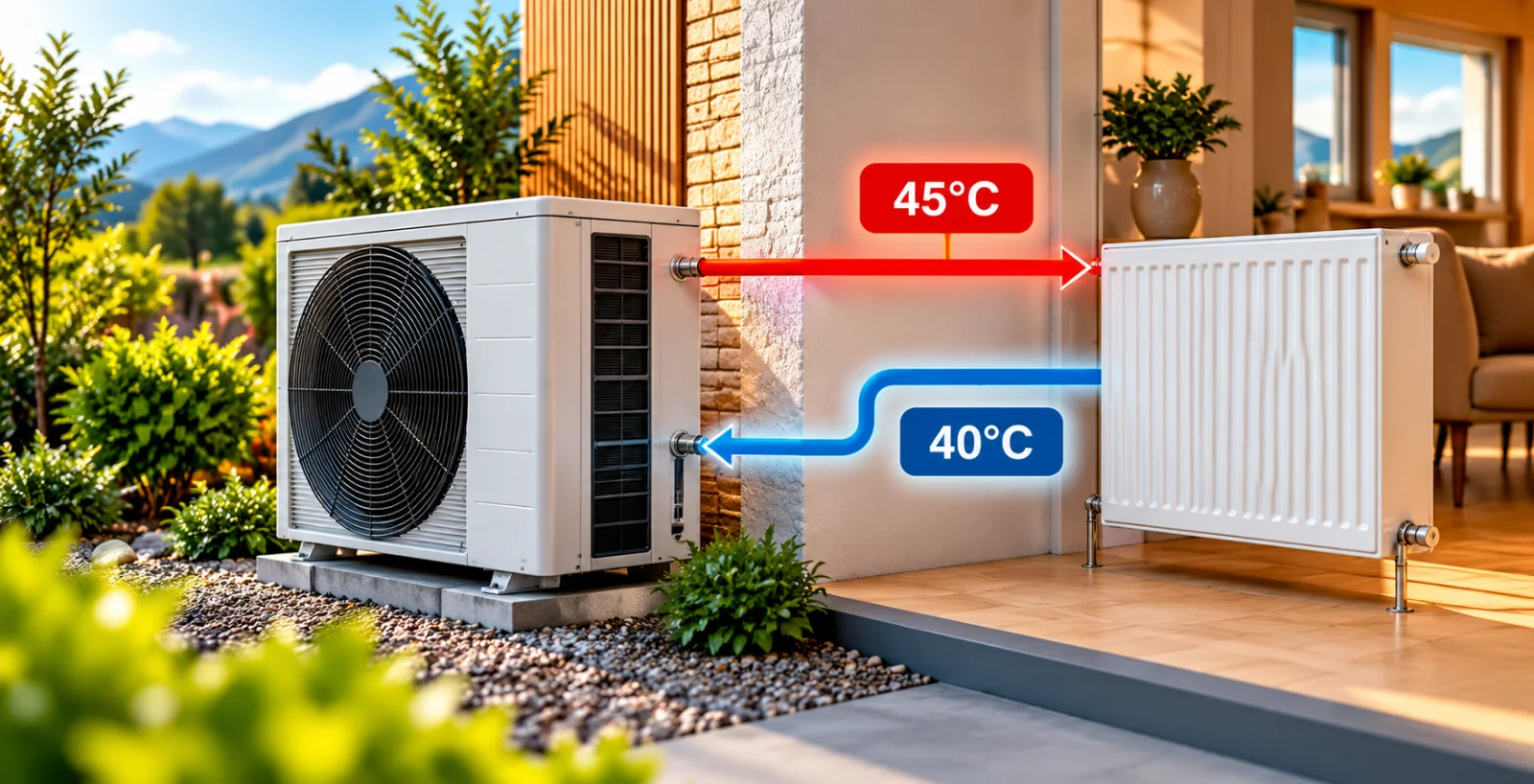
Replacing a conventional oil or gas boiler with an air-to-water heat pump is an increasingly attractive option for homeowners looking to modernize their heating systems.
But can a heat pump operate efficiently with existing radiators? Must every radiator be replaced? And why do some installations consume more electricity than expected?
The answer depends primarily on building heat loss, radiator heat output and the water temperatures required to maintain comfortable indoor conditions.
Why Does Flow Temperature Matter?
Traditional radiator systems have often been designed for relatively high water temperatures, sometimes around 70–75°C.
Air-to-water heat pumps can operate at different temperatures, but generally achieve better efficiency when supplying lower-temperature water.
Producing hotter water requires the refrigeration cycle to operate across a greater temperature lift. Consequently, the coefficient of performance (COP) usually decreases as the required flow temperature increases, assuming comparable conditions.
A system that can meet heating demand at 45°C will therefore often allow more efficient operation than one requiring 60°C. Actual performance depends on the heat pump model, outdoor temperature and installation characteristics.
Can Existing Radiators Work at 45°C?
Yes, provided they can deliver enough heat to the rooms.
Radiator heat output changes with the temperature difference between the radiator and the surrounding air. As heating-water temperatures fall, radiator output also falls.
A radiator that worked adequately with a high-temperature boiler may therefore be insufficient when connected to a lower-temperature heat pump.
Practical Example: A 2,000 W Radiator
Consider a radiator rated at 2,000 W under 75/65/20°C conditions: 75°C flow, 65°C return and 20°C room temperature.
Using an illustrative radiator exponent of n = 1.3, approximate outputs are:
| Operating conditions | Approximate heat output |
|---|---|
| 75/65/20°C | 2,000 W |
| 55/45/20°C | 1,030 W |
| 45/40/20°C | 710 W |
At 45°C flow and 40°C return, the radiator may deliver only around one-third of its original rated output.
Important: These figures are illustrative. Actual radiator performance depends on its design and certified manufacturer data. Accurate sizing requires the appropriate technical specifications and calculation method.
When Can Existing Radiators Be Retained?
Existing radiators can remain in place when their available heat output meets the calculated heating requirement of each room at the proposed water temperatures.
This is more likely in well-insulated buildings, properties with modern windows, or installations where radiators were originally oversized.
In older buildings with significant heat losses, larger radiators or higher water temperatures may be required.
The correct decision should be based on room-by-room heat-loss calculations and verification of radiator output.
Why Can Electricity Consumption Increase?
Higher electricity consumption is not necessarily caused by the age of the radiators. Several factors may contribute.
1. Excessively High Flow Temperature
Operating continuously at unnecessarily high water temperatures generally reduces heat pump efficiency.
2. Insufficient Radiator Capacity
When radiators cannot provide sufficient heat at lower temperatures, raising the flow temperature may improve room heating but often reduces efficiency.
3. Incorrect Weather Compensation
Weather compensation adjusts the heating-water temperature according to outdoor conditions. An incorrectly configured heating curve may keep the water hotter than necessary.
4. High Building Heat Loss
Poor insulation, uncontrolled air leakage and inefficient windows increase the amount of heat required to maintain indoor comfort.
5. Frequent Electric Backup Heating
Prolonged operation of an auxiliary electric resistance heater can significantly increase electricity consumption.
6. Hydraulic System Problems
Inadequate water flow, poor hydraulic balancing and incorrect circulation pump settings can affect heat distribution and system operation.
How Much Does Efficiency Affect Electricity Consumption?
The coefficient of performance (COP) describes the ratio between useful heat delivered and electricity consumed under specified operating conditions.
To illustrate the effect of average efficiency, consider a home requiring 12,000 kWh of useful heating energy during a heating period.
| Average effective performance ratio | Electricity required |
|---|---|
| 4.0 | 3,000 kWh |
| 3.0 | 4,000 kWh |
| 2.5 | 4,800 kWh |
The difference between the first and third scenarios is 1,800 kWh of electricity.
These values are hypothetical and illustrate the relationship between delivered heat and electrical consumption. Actual seasonal performance depends on climate, system controls, auxiliary heating and other operating conditions. A single instantaneous COP value should not be used to predict annual consumption.
Do All Radiators Need to Be Replaced?
Not necessarily. In many installations, only selected radiators may need upgrading.
For example, a bedroom with relatively low heat loss may work well with its existing radiator, while a large living room with extensive glazing may require a higher-output emitter.
Potential improvements include larger radiators, suitable low-temperature fan-assisted emitters, better building insulation, improved hydraulic balancing and optimized weather compensation.
Replacing every radiator without a proper assessment may result in unnecessary costs.
What Should Be Checked Before Installation?
A qualified heating professional should assess:
- Room-by-room design heat losses.
- Existing radiator dimensions and certified heat outputs.
- Required flow and return temperatures.
- Heat pump capacity at local design outdoor temperatures.
- Hydraulic compatibility and minimum flow requirements.
- Weather compensation and system controls.
- Any need for auxiliary heating.
These checks help establish whether the existing heating system can maintain comfort without unnecessarily high operating temperatures.
Frequently Asked Questions
Can a heat pump work with old radiators?
Yes. Existing radiators can be used if they provide sufficient heat output at the selected operating temperatures.
Do I need to replace every radiator?
No. Some radiators may already be suitable, while others may require upgrading. Room-by-room calculations are essential.
Is 45°C flow temperature better than 60°C?
Lower flow temperatures generally improve heat pump efficiency, provided the radiators can still meet the building's heating demand.
Can I install a heat pump without a heat-loss calculation?
Skipping a proper technical assessment increases the risk of incorrect equipment selection, insufficient heating and higher running costs.
Conclusion
A heat pump can operate efficiently with existing radiators, but compatibility should be verified through appropriate calculations.
Successful operation depends not only on selecting the right heat pump but also on matching it to the building's heat demand and existing heat distribution system.
A professional assessment can help preserve suitable radiators, avoid unnecessary replacement costs and support efficient long-term heating.
References
- Energy Saving Trust – Air Source Heat Pumps
- U.S. Department of Energy – Air-Source Heat Pumps
- EN 442 – Radiators and convectors
- EN 12831-1 – Energy performance of buildings: Method for calculation of the design heat load