
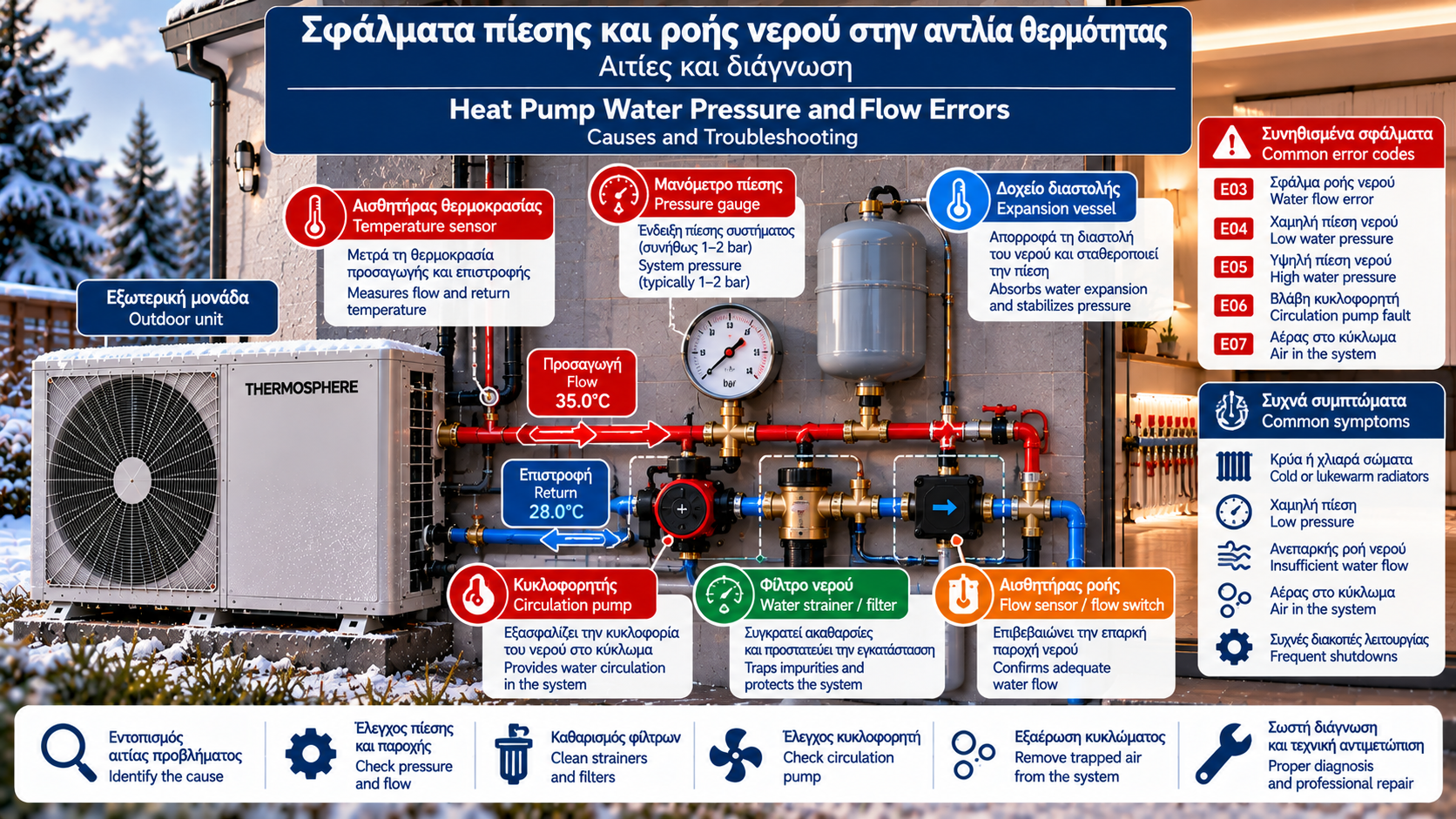
Heat Pump Water Pressure and Flow Errors: Causes and Troubleshooting
Proper water circulation is essential for the safe and efficient operation of air-to-water and water-to-water heat pumps.
Water transfers heat from the heat pump to radiators, underfloor heating circuits or domestic hot water systems, depending on the installation design.
When water pressure falls outside the permitted range or water flow becomes insufficient, the heat pump may reduce output, display an error code or shut down.
However, low water pressure and low water flow are not the same problem.
Understanding this distinction helps prevent incorrect interventions and unnecessary component replacement.
1. What Is the Difference Between Water Pressure and Flow?
Pressure describes the mechanical state of water within the circuit and is commonly displayed in bar.
Flow rate describes the volume of water passing through a point per unit of time, usually expressed in litres per minute (L/min) or cubic metres per hour (m³/h).
A closed heating system may have normal static pressure but inadequate water circulation.
For example, a circuit may show 1.5 bar while water flow remains insufficient because of a closed valve or blocked filter.
Similarly, very low filling pressure may create operating problems even if the circulation pump is running.
A normal pressure reading does not prove that water circulation is adequate.
2. Why Does a Heat Pump Require Minimum Water Flow?
The heat exchanger transfers energy from the refrigeration circuit to the water.
Adequate water flow is required for proper heat transfer.
If flow becomes too low, possible consequences include:
An excessive flow-to-return temperature difference.
Unstable operation.
Reduced heating output.
Protective functions activating.
Operating shutdowns.
Low-flow error codes.
Minimum flow requirements are specified by the manufacturer and vary by model and operating conditions.
There is no universal flow rate suitable for every heat pump.
3. What Water Pressure Is Normal?
Suitable system pressure depends on:
Installation height.
Pressure gauge position.
Circuit configuration.
Expansion vessel.
Operating temperatures.
Manufacturer requirements.
In many domestic installations, cold-system pressure is approximately within the 1–2 bar range.
This is only an illustrative range, not a universal filling instruction.
The correct value must be confirmed from the installation design and technical documentation.
4. Why Does Water Pressure Drop?
Possible causes include:
Leaks from pipes or fittings.
Leaking valves or components.
Water loss through a safety relief valve.
Expansion vessel problems.
Air being removed after initial filling.
Insufficient initial filling.
Other hydraulic component faults.
A small pressure change between cold and warm operation is normal.
Persistent pressure loss, however, requires investigation.
Repeatedly adding water without identifying the cause is not an appropriate long-term solution.
5. How Does the Expansion Vessel Affect Pressure?
Water expands as it heats up.
The expansion vessel accommodates part of this volume change and helps keep system pressure within acceptable limits.
If the vessel is incorrectly adjusted, undersized or faulty, symptoms may include:
Excessive pressure rise during heating.
Safety relief valve discharge.
Water loss.
Low pressure after cooling.
Frequent refilling requirements.
Diagnosis requires checking vessel pre-charge, available expansion volume and component condition according to manufacturer instructions.
6. What Is a Low-Flow Error?
A low-flow error occurs when the controller cannot confirm the required water circulation.
Depending on the equipment, flow may be monitored using:
A flow switch.
A quantitative flow sensor.
Another manufacturer-defined circulation monitoring method.
The heat pump may shut down to protect the heat exchanger and associated components.
A low-flow error does not necessarily mean that the sensor has failed.
The system may genuinely have inadequate circulation.
7. Blocked Water Strainers and Filters
Water filters help protect the installation from particles and contamination.
Over time, they may collect:
Corrosion particles.
Sludge.
Installation debris.
Metallic particles.
Other circuit contaminants.
If hydraulic resistance increases significantly, water flow may decrease.
Possible symptoms include:
Flow errors.
Insufficient heating.
An unusual flow-to-return temperature difference.
Protective shutdowns.
Cleaning should follow the specified safe isolation and depressurization procedure and be performed by an appropriately competent person.
8. What Does a Magnetic Filter Do?
A magnetic filter or separator captures ferromagnetic particles circulating in the water.
This can help protect:
Circulation pumps.
Heat exchangers.
Valves.
Other hydraulic components.
However, it does not necessarily remove every type of contamination.
Effective protection depends on appropriate system design, suitable equipment and regular maintenance.
9. Air Trapped in the Hydraulic Circuit
Trapped air can interfere with water circulation.
Common symptoms include:
Noise in pipes.
Uneven heating.
Cold sections of radiators.
Unstable flow.
Circulation pump operating difficulties.
Flow-related errors.
Air may remain in the system after filling, servicing or other work.
Air removal must follow the procedures appropriate to the installation.
Some heat pumps provide a dedicated air-purging program.
10. How Can You Identify Circulation Pump Problems?
The circulation pump generates the pressure difference needed to move water through the system.
Possible symptoms of malfunction include:
Insufficient flow.
Flow error codes.
Poor heat transfer.
Unusual noises.
Repeated shutdowns.
However, a pump that is electrically operating does not necessarily provide adequate flow.
Hydraulic restrictions or incorrect settings may still be present.
Diagnosis should assess both pump operation and circuit conditions.
11. Can a Closed Valve Cause a Flow Error?
Yes.
A closed or partially closed valve can restrict circulation.
The same may happen when several heating zone valves or thermostatic radiator valves close.
Systems with variable water flow must incorporate a suitable hydraulic solution that maintains the heat pump’s required operating conditions.
Depending on system design, this may involve hydraulic separation, an appropriate bypass or another arrangement.
Components should not be added without evaluating the complete installation.
12. What Does a Large Flow-to-Return Temperature Difference Mean?
The temperature difference between flow and return water is commonly expressed as ΔT.
For example:
Flow temperature: 42°C.
Return temperature: 34°C.
Temperature difference: 8°C.
This difference depends on the heating power being transferred and the water flow rate.
At a given thermal output, lower water flow generally produces a larger temperature difference.
However, ΔT alone is not sufficient for diagnosis.
It must be interpreted together with operating conditions and manufacturer specifications.
13. How Are Water Flow and Heating Output Related?
For water, a useful approximate relationship is:
Thermal power (kW) ≈ 1.163 × Flow rate (m³/h) × ΔT (°C)
For example:
Flow rate = 1.5 m³/h.
ΔT = 5°C.
Then:
Thermal power ≈ 1.163 × 1.5 × 5 = 8.72 kW.
This is an approximate calculation based on typical water properties.
Water-glycol mixtures require different fluid properties.
The relationship helps explain heat transfer but does not replace proper flow measurement.
14. Why Can Flow Errors Appear After Maintenance?
After hydraulic maintenance, problems may occur if:
A valve has been left closed.
Air remains trapped.
A filter has not been correctly reinstalled.
System filling is incomplete.
The air-purging procedure has not been completed.
Before assuming a pump or sensor failure, the hydraulic circuit should be checked following the maintenance work.
15. Could the Flow Sensor Be Faulty?
Yes.
A flow sensor may develop electrical or mechanical faults.
However, an incorrect reading must be distinguished from genuinely inadequate water flow.
A technician may compare:
Controller readings.
Circulation pump operation.
Water temperatures.
Independent flow measurements, where available.
Manufacturer requirements.
Replacing a sensor without confirming the cause may not resolve the problem.
16. Practical Example: Pressure Is Normal but a Flow Error Appears
Consider the following:
Pressure gauge: 1.5 bar.
The heat pump displays a low-flow error.
The circulation pump appears to be running.
Heating stops.
The correct response is not to add water simply because a flow error has appeared.
A technician should investigate:
Valve positions.
Filter restrictions.
Trapped air.
Circulation pump performance.
Actual flow compared with requirements.
Flow sensor operation.
This example illustrates why pressure and flow must be assessed separately.
17. Practical Example: Pressure Rises Excessively During Heating
Suppose system pressure is normal when cold but rises excessively as water temperature increases.
Possible causes include:
Insufficient expansion volume.
Incorrect expansion vessel pre-charge.
Expansion vessel failure.
Unsuitable initial filling pressure.
If the safety relief valve discharges water, pressure may subsequently fall when the system cools.
Correct diagnosis requires evaluating the installation rather than repeatedly refilling it.
18. Common Symptoms and Possible Causes
Symptom | Possible causes |
Low water pressure | Leakage, water loss, filling condition |
Excessive pressure rise during heating | Expansion vessel, initial filling pressure |
Low-flow error | Filter, valves, air, pump, sensor |
Noise in pipework | Trapped air, flow velocity, hydraulic problems |
Cold radiators | Inadequate circulation, closed zones |
Large flow-to-return ΔT | Reduced flow or operating conditions |
Error after maintenance | Air, closed valve, incomplete filling |
Normal pressure but low flow | Hydraulic restriction, pump, sensor |
This table is illustrative and does not replace professional diagnosis.
19. What Can Homeowners Check Safely?
Without opening electrical or hydraulic components, homeowners can:
Record the exact error code.
Read the displayed system pressure, if available.
Observe whether pressure changes significantly.
Look for obvious external leaks.
Note unusual noises.
Record whether the problem began after maintenance.
Determine whether all rooms are affected.
Provide these details to a technician.
Do not open pressurized filters, access electrical components or bypass protective devices.
20. When Is a Technician Needed Immediately?
Professional assessment is required when:
Pressure repeatedly drops.
Low-flow errors recur.
Significant leakage is present.
The safety relief valve discharges frequently.
The circulation pump behaves abnormally.
The heat pump repeatedly shuts down.
Electrical hazards are suspected.
The installation cannot maintain the required flow.
All corrective work should follow manufacturer instructions and system requirements.
21. How Can Pressure and Flow Problems Be Prevented?
Preventive maintenance may include:
Checking system pressure.
Inspecting the expansion vessel.
Checking for leaks.
Servicing filters.
Assessing water quality.
Verifying water circulation.
Checking circulation pumps.
Inspecting valves and zone actuators.
Confirming appropriate hydraulic balancing.
Reviewing stored error codes.
Maintenance intervals and procedures depend on the manufacturer and operating conditions.
22. Frequently Asked Questions
Why Does My Heat Pump Show Low Water Pressure?
Possible causes include leakage, water loss, expansion vessel problems or insufficient filling.
How Many Bar Should a Heat Pump Have?
There is no universal value. Many domestic systems operate at approximately 1–2 bar when cold, but the correct pressure depends on system design and manufacturer requirements.
Why Is There a Flow Error When Pressure Is Normal?
Because static pressure does not prove that water is circulating adequately.
Could a Blocked Filter Be Responsible?
Yes. A blocked filter can increase hydraulic resistance and reduce flow.
Can Trapped Air Stop Heating?
Yes. Air can interfere with circulation and cause operating problems.
How Do I Know if the Circulation Pump Is Faulty?
Possible symptoms include inadequate flow, flow errors and unusual noises. Technical confirmation is required.
Why Does Pressure Rise When Water Heats Up?
Thermal expansion causes a normal pressure change. Excessive increases may indicate expansion vessel or filling-pressure problems.
Can I Clean the Filter Myself?
Only if the manufacturer explicitly permits it and you understand the safe procedure. Filters may contain hot, pressurized water.
Why Does Pressure Keep Falling After Refilling?
Possible leaks, safety valve discharge and expansion vessel problems must be investigated.
Does a Flow Error Mean the Flow Sensor Needs Replacing?
Not necessarily. Actual water circulation should be verified first.
Conclusion
Water pressure and flow errors are among the most important hydraulic problems affecting heat pump installations.
Pressure relates to the condition of the closed circuit, while flow rate describes the actual movement of water.
Reliable operation requires both parameters to remain within the manufacturer’s permitted limits.
Filters, circulation pumps, valves, expansion vessels and sensors can cause similar symptoms, but they require different corrective actions.
Accurate diagnosis begins by distinguishing pressure from flow and ends by confirming the actual underlying cause.
Appropriate maintenance and professional checks help maintain reliable and safe operation.
Thermosphere.gr — Technical knowledge for heating and building systems.