
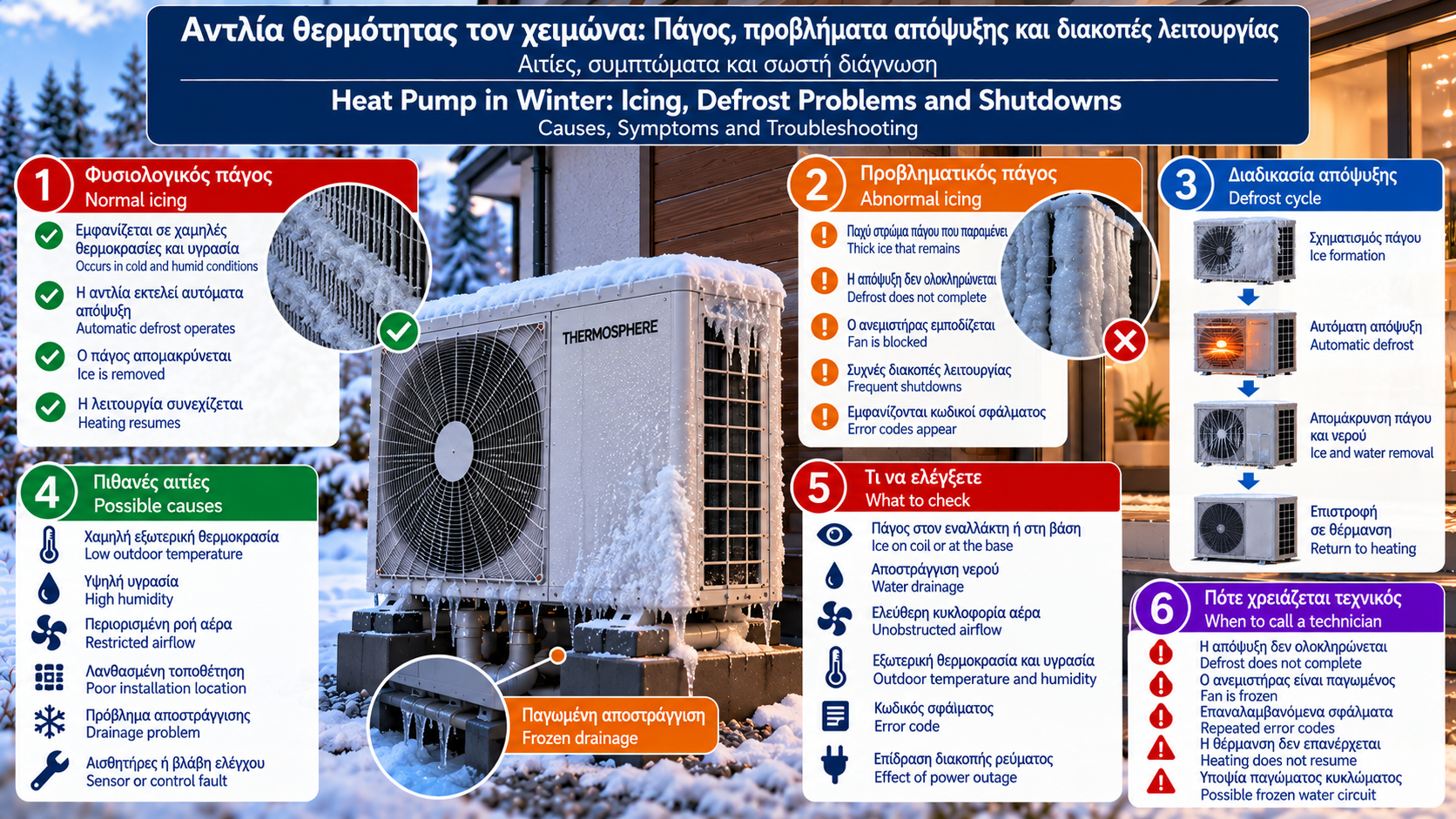
Heat Pump Icing, Defrost Problems and Winter Shutdowns: Causes and Troubleshooting
Ice formation on the outdoor unit of an air-to-water heat pump is common during winter operation.
However, it does not always indicate a fault.
Under certain temperature and humidity conditions, the outdoor heat exchanger may become covered in frost or ice even when the heat pump is operating normally.
For this reason, most modern air-to-water heat pumps include an automatic defrost function.
Problems arise when ice is not removed effectively, defrost cycles fail to complete or the unit repeatedly displays errors and stops heating the building.
In such cases, systematic troubleshooting is required.
1. When Is Ice Formation Normal?
During heating operation, the outdoor unit extracts heat from the air.
The outdoor heat exchanger surface may fall below the freezing point of water.
When sufficient moisture is present in the air, frost or ice can form.
This may occur even when outdoor air temperature is slightly above 0°C.
Ice formation is generally considered normal when:
It occurs periodically.
The unit automatically activates defrost.
Ice is removed effectively.
Heating resumes after the cycle.
No recurring error codes appear.
The presence of ice alone does not prove that the system is faulty.
2. When Does Ice Suggest a Possible Fault?
Potential warning signs include:
Thick ice that remains for an extended period.
Ice obstructing the fan.
Defrost cycles that start but do not finish.
Repeated operating shutdowns.
Significant loss of heating.
Unusual noises.
Error codes associated with unit operation.
It is important to distinguish ice on the heat exchanger from ice accumulating beneath or around the unit.
These conditions may have different causes.
3. Why Does a Heat Pump Fail to Complete Defrost?
Defrost failure may have several causes.
Examples include:
Incorrect temperature measurements.
Sensor malfunction.
Controller sequence problems.
Reduced refrigeration circuit performance.
Faults in refrigeration control components.
Insufficient available heat from the hydraulic circuit in systems that use it during defrost.
Shutdown caused by another protective function.
The exact defrost process varies by manufacturer and heat pump design.
Not every heat pump follows the same operating sequence.
4. Why Does Ice Accumulate Beneath the Outdoor Unit?
During defrost, accumulated ice melts and produces water.
This water must drain away according to the installation design.
If it remains in the base area, it may freeze again.
Possible causes include:
Inadequate drainage.
Frozen drainage routes.
Incorrect slope.
Snow accumulation.
Obstructed water outlets.
Insufficient drainage frost protection where required.
Ice may gradually build up and interfere with equipment operation.
5. Can the Outdoor Fan Become Frozen?
Yes.
Ice accumulating near the fan blades or housing may prevent rotation.
Possible symptoms include:
Unusual mechanical noise.
Fan startup failure.
Operating error codes.
Unit shutdown.
The fan should not be rotated manually, and tools should not be used to remove ice near the blades.
A qualified technician should carry out the necessary checks.
6. Why Does a Heat Pump Stop in Very Cold Weather?
A heat pump may stop for several reasons.
These include:
Protective function activation.
Conditions outside the permitted operating range.
Inadequate water circulation.
Sensor problems.
Electrical faults.
Insufficient available capacity combined with the control strategy.
Refrigeration circuit faults.
Low outdoor temperature alone does not prove a fault.
The specific model’s actual operating limits must be checked.
7. How Does Humidity Affect Ice Formation?
Temperature is not the only factor.
Air humidity significantly affects frost formation.
For example, a day at 2°C with high humidity may create more frosting conditions on the outdoor heat exchanger than a colder but very dry day.
Actual behaviour also depends on:
Heat exchanger temperature.
Airflow.
Compressor operation.
Defrost control strategy.
Defrost behaviour should therefore not be judged from outdoor temperature alone.
8. Can Poor Installation Location Cause Problems?
Yes.
Outdoor unit placement affects airflow and water drainage.
Problems may occur when:
The unit is too close to a wall.
Air inlet or outlet openings are obstructed.
Discharged cold air recirculates into the intake.
Snow accumulates around the unit.
The mounting base is unsuitable for local conditions.
Defrost water cannot drain properly.
Required clearances and installation conditions are specified by the manufacturer.
9. Why Does Heating Temporarily Stop During Defrost?
Many air-to-water heat pumps perform defrost by reversing the refrigeration cycle.
During this process, some available heat is used to remove ice from the outdoor heat exchanger.
Space heating may therefore decrease or pause temporarily.
This does not necessarily indicate a fault.
However, extended interruptions or repeated unsuccessful defrost cycles require investigation.
10. Can Low Water Flow Affect Defrost?
Yes, in certain system configurations.
If a heat pump uses heat from the hydraulic circuit during defrost, inadequate water flow or insufficient available thermal energy may affect the process.
Possible causes include:
Blocked filters.
Trapped air.
Closed valves.
Circulation pump problems.
Unsuitable hydraulic configuration.
Assessment must follow the specific heat pump design.
11. What Happens During a Power Outage in Freezing Weather?
A power outage may disable:
Circulation pumps.
Electric frost protection heaters.
Control systems.
Active protection functions.
In some installations, especially monobloc units with outdoor water pipework, the hydraulic circuit may freeze.
Frost protection must be considered during system design.
Depending on the installation, it may involve a suitable antifreeze mixture, frost protection valves or other solutions.
Each method has limitations and must be compatible with manufacturer instructions.
12. Can Hot Water Be Used to Melt the Ice?
Pouring hot or boiling water onto an outdoor unit without explicit manufacturer guidance is not recommended.
Potential risks include:
Thermal stress to components.
Water refreezing.
Water entering unsuitable areas.
Slippery conditions around the unit.
Additional equipment damage.
Sharp tools, open flames and unauthorized de-icing chemicals must also be avoided.
Correct treatment depends on the cause of ice accumulation.
13. Why Does the Heat Pump Fail Only on Very Cold Days?
A malfunction may become noticeable only under particular conditions.
For example:
Building heating demand increases.
Available heat pump capacity changes.
Defrost becomes more frequent.
Drainage problems become more apparent.
Inadequate water circulation affects operation more severely.
Specific protective functions activate.
Recording outdoor temperature when the problem occurs can help with diagnosis.
14. How Can Normal and Abnormal Defrost Be Distinguished?
Observation | Possible interpretation |
Periodic frost formation | Often normal |
Ice clears after defrost | Indicates effective operation |
Temporary heating reduction | May be normal |
Ice remains after repeated cycles | Possible fault |
Ice obstructs the fan | Professional inspection required |
Repeated error codes | Diagnosis required |
Ice accumulates beneath the unit | Possible drainage issue |
Prolonged loss of heating | Further investigation required |
This table is illustrative.
15. Practical Example: Ice Builds Up Every Night
Suppose the outdoor unit operates normally during the day but has substantial ice accumulation beneath it each morning.
The heat pump performs defrost, but the resulting water does not drain effectively.
Overnight, the water freezes again.
A technician should examine:
The drainage route.
Base slope.
Possible obstructions.
Local freezing conditions.
Whether the specified drainage frost protection is adequate.
Replacing a defrost sensor is not necessarily the correct solution.
16. Practical Example: The Unit Freezes and Shuts Down
Suppose the outdoor unit becomes covered in ice and repeatedly displays an error.
Heating stops, and the unit does not resume normal operation.
Diagnosis should include:
The exact error code.
Outdoor heat exchanger condition.
Fan operation.
Sensor operation.
Water circulation where relevant to defrost.
Refrigeration circuit performance.
Actual temperature and humidity conditions.
Repeatedly restarting the unit without identifying the cause should be avoided.
17. What Can Homeowners Check Safely?
Without opening the unit, homeowners can:
Observe whether ice is on the coil or beneath the unit.
Record whether defrost completes.
Visually check for snow or objects blocking airflow.
Record error codes.
Note outdoor temperature.
Observe whether heating resumes.
Check whether the problem recurs in similar weather.
Do not use tools to remove ice from the fan or heat exchanger.
18. When Is a Technician Needed Urgently?
Professional inspection is required when:
Ice obstructs the fan.
Defrost fails to complete.
Error codes recur.
Heating does not resume.
Severe mechanical noise occurs.
Frozen water pipework is suspected.
The unit has sustained ice damage.
Electrical hazards are suspected.
If a frozen pipe is suspected, do not attempt to force circulation or restart the system without professional assessment.
19. How Can Winter Problems Be Prevented?
Prevention depends on:
Correct outdoor unit placement.
Unrestricted airflow.
Appropriate drainage.
Protection of outdoor water pipework.
Proper hydraulic operation.
Clean heat exchanger surfaces.
Sensor and control checks.
Suitable maintenance.
Compliance with manufacturer instructions.
Frost protection is particularly important in areas with frequent freezing conditions and possible power outages.
20. Frequently Asked Questions
Is It Normal for a Heat Pump to Ice Up?
Yes. Frost or ice formation on the outdoor heat exchanger is normal under suitable cold and humid conditions.
Why Does Defrost Run Above 0°C?
Because the heat exchanger surface may be below freezing even when outdoor air temperature is higher.
Why Does Heating Stop During Defrost?
Some systems temporarily use heat to remove ice from the outdoor heat exchanger.
Why Does Ice Remain After Defrost?
Possible causes include drainage, control, sensor or defrost performance problems.
Can Ice Damage the Fan?
Yes. Contact with accumulated ice can cause mechanical stress or damage.
Why Does the Unit Stop Only When It Is Very Cold?
A protective function may activate, or a problem may become apparent only at low temperatures.
Can I Pour Hot Water Over the Ice?
Not without explicit manufacturer guidance, as this may create additional risks.
How Is a Monobloc Heat Pump Protected Against Freezing?
Through a properly designed hydraulic frost protection strategy suitable for the installation.
Can a Power Outage Cause Freezing?
Yes, particularly when protection depends on electrically powered pumps or heaters.
When Should I Call a Technician?
When ice does not clear, error codes recur, the fan is obstructed or heating fails to resume.
Conclusion
Ice formation on an outdoor heat pump unit is not automatically a sign of failure.
Automatic defrost is a normal part of winter operation for air-to-water heat pumps.
Problems arise when defrost cannot complete, ice accumulates uncontrollably or the unit repeatedly shuts down.
Accurate troubleshooting must consider ice formation, drainage, water circulation, installation conditions and error codes together.
Correct installation, preventive maintenance and timely professional intervention reduce the risk of winter faults and help maintain reliable heating.
Thermosphere.gr — Technical knowledge for heating and building systems.