
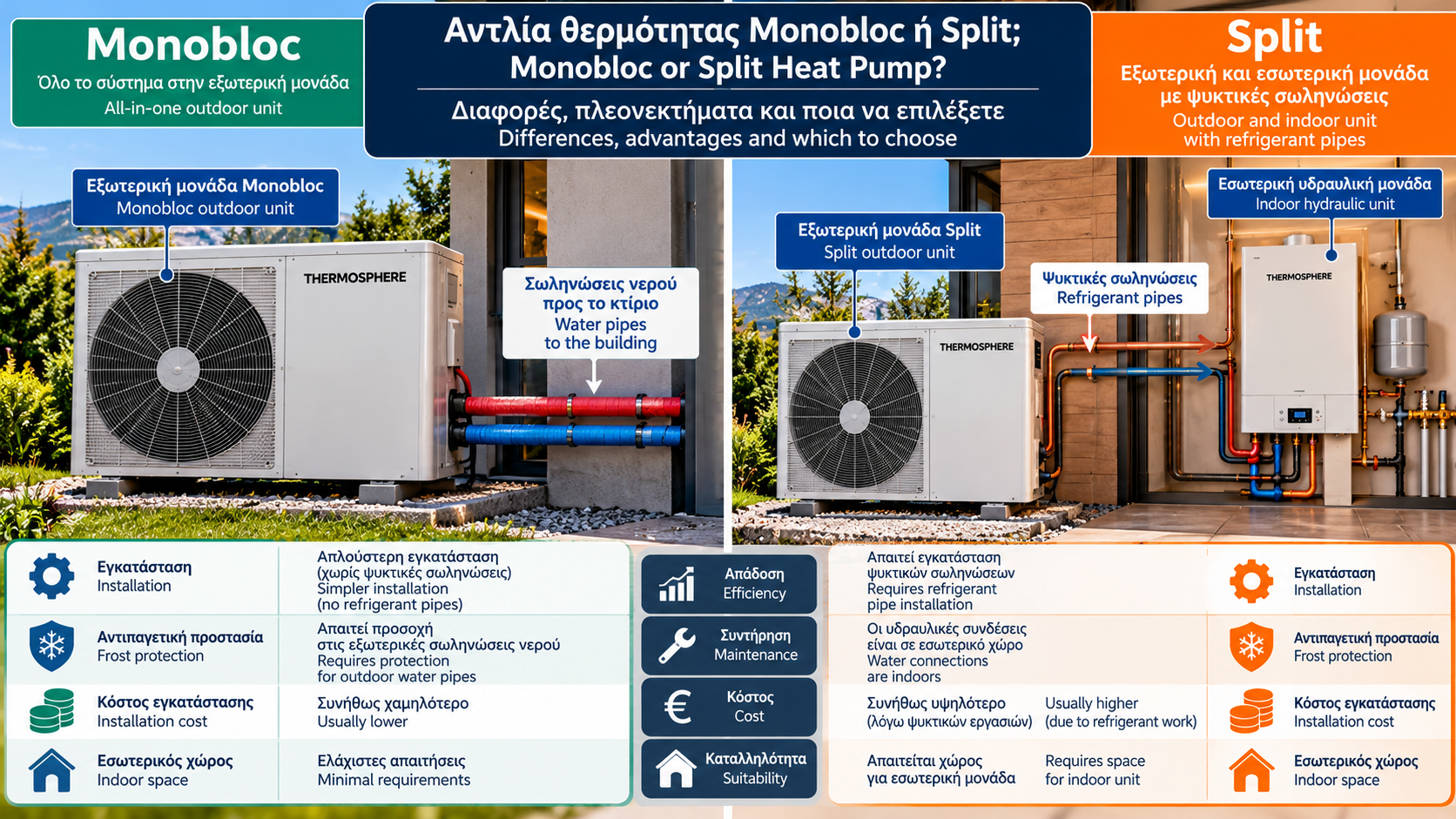
Monobloc vs Split Heat Pumps: Differences, Advantages and Which to Choose
Choosing between a Monobloc and a Split heat pump is an important decision when designing an air-to-water heating system.
Both technologies extract heat from outdoor air and transfer it to water for space heating through radiators, underfloor heating or compatible terminal units.
However, they differ in refrigerant circuit arrangement, pipework, installation requirements and frost protection.
Neither configuration is universally better. The appropriate choice depends on the building, climate, installation conditions and manufacturer specifications.
1. What Is a Monobloc Heat Pump?
In a typical air-to-water Monobloc heat pump, the refrigerant circuit and refrigerant-to-water heat exchanger are housed within the outdoor unit.
Water pipes connect the outdoor unit to the building’s heating system.
Depending on the design, additional indoor equipment may include a buffer vessel, circulation pump, expansion vessel, three-way valve or domestic hot water cylinder.
Advantages of Monobloc Systems
The main refrigerant circuit is generally factory-assembled and sealed.
Field-installed refrigerant lines between the outdoor unit and building are usually unnecessary.
Some installation stages may be simpler.
Indoor hydraulic arrangements can be configured to suit the project.
Disadvantages of Monobloc Systems
Outdoor water pipes require suitable insulation.
Frost protection is particularly important in cold climates.
Extended power outages may create additional freeze-related risks.
Pipe lengths and hydraulic pressure losses must be considered.
2. What Is a Split Heat Pump?
A typical Split air-to-water heat pump consists of an outdoor unit and an indoor hydraulic unit connected by refrigerant pipework.
The refrigerant-to-water heat exchanger is generally located indoors.
This differs from systems that use a separate indoor hydraulic module connected to an outdoor Monobloc by water pipes. Having two physical units does not automatically make a system a refrigerant Split configuration.
Advantages of Split Systems
Most water-side connections can be located indoors.
Heating water does not normally circulate between the outdoor and indoor units.
The arrangement can suit buildings with available indoor technical space.
Some models integrate hydraulic components or domestic hot water storage.
Disadvantages of Split Systems
Refrigerant pipe installation requires specialist procedures.
Maximum pipe lengths and elevation differences must be respected.
Refrigerant work requires appropriately qualified and, where applicable, certified personnel.
Space is required for the indoor unit.
3. Monobloc vs Split: Main Differences
Feature | Monobloc | Split |
Main refrigerant-to-water heat exchanger | Usually outdoors | Usually indoors |
Connection to building | Water pipework | Refrigerant pipework |
Outdoor heating-water circuit | Usually present | Usually absent |
Outdoor water frost protection | Particularly important | Usually less relevant |
Field-installed refrigerant lines | Usually not required | Required |
Indoor equipment | Depends on design | Indoor unit required |
Efficiency | Model-dependent | Model-dependent |
These descriptions represent common configurations. Specific products may differ.
4. Which Type Is More Efficient?
Monobloc or Split construction does not determine efficiency by itself.
Actual performance depends on:
Outdoor air temperature.
Required water supply temperature.
Refrigeration cycle design.
Part-load performance.
Defrost operation.
System heat losses.
Control settings.
Meaningful comparisons should use performance data measured or declared under equivalent conditions, including COP and SCOP.
It is technically incorrect to claim that all Monobloc heat pumps outperform Split models, or vice versa.
5. Which Is Better in Freezing Conditions?
Monobloc systems commonly circulate heating water through outdoor pipework.
That water must be protected against freezing during low outdoor temperatures and potentially during extended power interruptions.
Depending on manufacturer requirements, protection measures may include:
Appropriate pipe insulation.
Frost protection controls.
Approved antifreeze valves.
Compatible antifreeze solutions and hydraulic arrangements.
Provisions for power interruptions.
Glycol is not universally mandatory. Its compatibility, concentration, viscosity and impact on performance must be evaluated.
In a typical Split system, the main heating-water circuit remains indoors. This reduces a particular outdoor freezing risk but does not eliminate every frost protection requirement.
6. Which Is Easier to Install?
Monobloc units can simplify certain installation stages because refrigerant connections between outdoor and indoor units are generally unnecessary.
However, proper hydraulic design, adequate water flow, insulation and frost protection remain essential.
Split systems require refrigerant pipe installation and associated commissioning procedures.
Both configurations require professional design, safe electrical connections and appropriate commissioning.
7. Which Has Lower Installation Costs?
There is no universal answer.
Total project cost may include:
Outdoor unit.
Indoor module or additional hydraulic equipment.
Pipework and insulation.
Refrigerant installation work where applicable.
Electrical work.
Frost protection measures.
Hydraulic modifications.
Commissioning.
A lower equipment price does not necessarily result in a lower installed system cost.
Compare quotations for equivalent heating capacities, functions and installation requirements.
8. Which Is Better for Existing Radiators?
Suitability depends mainly on building heat losses and the water temperatures required by the radiators.
Both configurations can work with suitable radiator systems.
Before selecting a unit, evaluate:
Building heat losses.
Existing radiator capacity.
Required supply temperature.
Heat pump output at design conditions.
Expected energy performance.
Choosing Monobloc or Split does not replace a heating system assessment.
9. Which Is Better for Underfloor Heating?
Underfloor heating generally operates at lower water temperatures than many conventional radiator systems.
This can improve heat pump efficiency regardless of whether the unit is Monobloc or Split.
Correct equipment selection, hydraulic design and weather-compensated controls are more important than the configuration label.
10. What About Domestic Hot Water?
Both configurations can produce domestic hot water if supported by the model.
A suitable system may require:
Domestic hot water storage.
Three-way valve.
Temperature sensors.
Priority control.
Appropriate hygiene and temperature management functions.
Some Split indoor units integrate hot water cylinders, but integrated indoor solutions are also available with Monobloc-based systems.
11. Which Requires More Maintenance?
There is no general rule that Monobloc systems need less servicing than Split systems.
Maintenance requirements depend on the manufacturer, refrigerant, equipment configuration and operating conditions.
Monobloc installations require particular attention to outdoor water pipework and frost protection.
Split installations require attention to refrigerant pipework and the inspections specified for the equipment.
12. What About Refrigerants?
Modern heat pumps use different refrigerants depending on the model.
Refrigerant selection affects:
Safety requirements.
Permitted installation arrangements.
Maintenance procedures.
Certification requirements.
Equipment placement restrictions.
For example, R290 (propane) is flammable and requires compliance with specific safety instructions and installation clearances.
Manufacturer instructions and applicable regulations always take priority.
13. Monobloc or Split for a Detached House?
Both configurations may be suitable for a detached house with adequate outdoor space.
Monobloc can be practical when minimising field-installed refrigerant connections is a priority.
Split can be practical when a suitable indoor technical area is available and most water-side components are intended to remain indoors.
The decision should consider accessibility, pipe routes, noise, frost protection and total cost.
14. Monobloc or Split for an Apartment?
Apartments may present additional constraints:
Limited outdoor space.
Outdoor unit placement requirements.
Distances from neighbouring properties.
Noise.
Pipe routing.
Indoor equipment space.
Building rules and required permissions.
Suitability depends on the overall feasibility of a safe and compliant installation, not merely on the Monobloc or Split designation.
15. Five Common Selection Mistakes
1. Choosing based only on equipment price.
Installation and additional equipment costs are overlooked.
2. Underestimating freezing risks.
Particularly for exposed Monobloc hydraulic pipework.
3. Comparing different performance conditions.
COP and heating capacity figures should be compared under equivalent conditions.
4. Ignoring pipework limitations.
Split systems have refrigerant pipe length and elevation restrictions, while Monobloc systems require consideration of hydraulic losses and insulation.
5. Selecting without a heat loss calculation.
Correct sizing is more important than the configuration name.
16. Frequently Asked Questions
Is Monobloc Better Than Split?
Not necessarily. The best choice depends on the building, climate, installation and specific model.
Does a Monobloc Need Glycol?
Not always. Frost protection must follow the manufacturer’s instructions.
Does a Split Heat Pump Use Less Electricity?
Not inherently. Compare specific products under equivalent operating conditions.
Can a Monobloc Be Connected to a Buffer Tank?
Yes, where required by the system design or manufacturer instructions.
Does Split Installation Require a Specialist?
Refrigerant circuit installation and servicing require appropriate technical competence and applicable certifications.
Which Is Better for Very Cold Areas?
Compare available heating capacity and efficiency at the design outdoor temperature, along with the installation’s frost protection strategy.
Can Split Heat Pumps Produce Domestic Hot Water?
Yes, when supported by the model and connected to suitable equipment.
Conclusion
Monobloc and Split heat pumps operate according to the same fundamental thermodynamic principles, but their component arrangements and building connections differ.
Monobloc systems can simplify some installation stages, while requiring careful attention to outdoor water pipework and freezing risks.
Split systems generally place the refrigerant-to-water heat exchanger indoors, but require correctly installed refrigerant connections.
The right choice depends on system design, technical specifications, safety and total installed cost—not simply on whether the unit is labelled Monobloc or Split.
Thermosphere.gr — Technical knowledge for heating and building systems.