
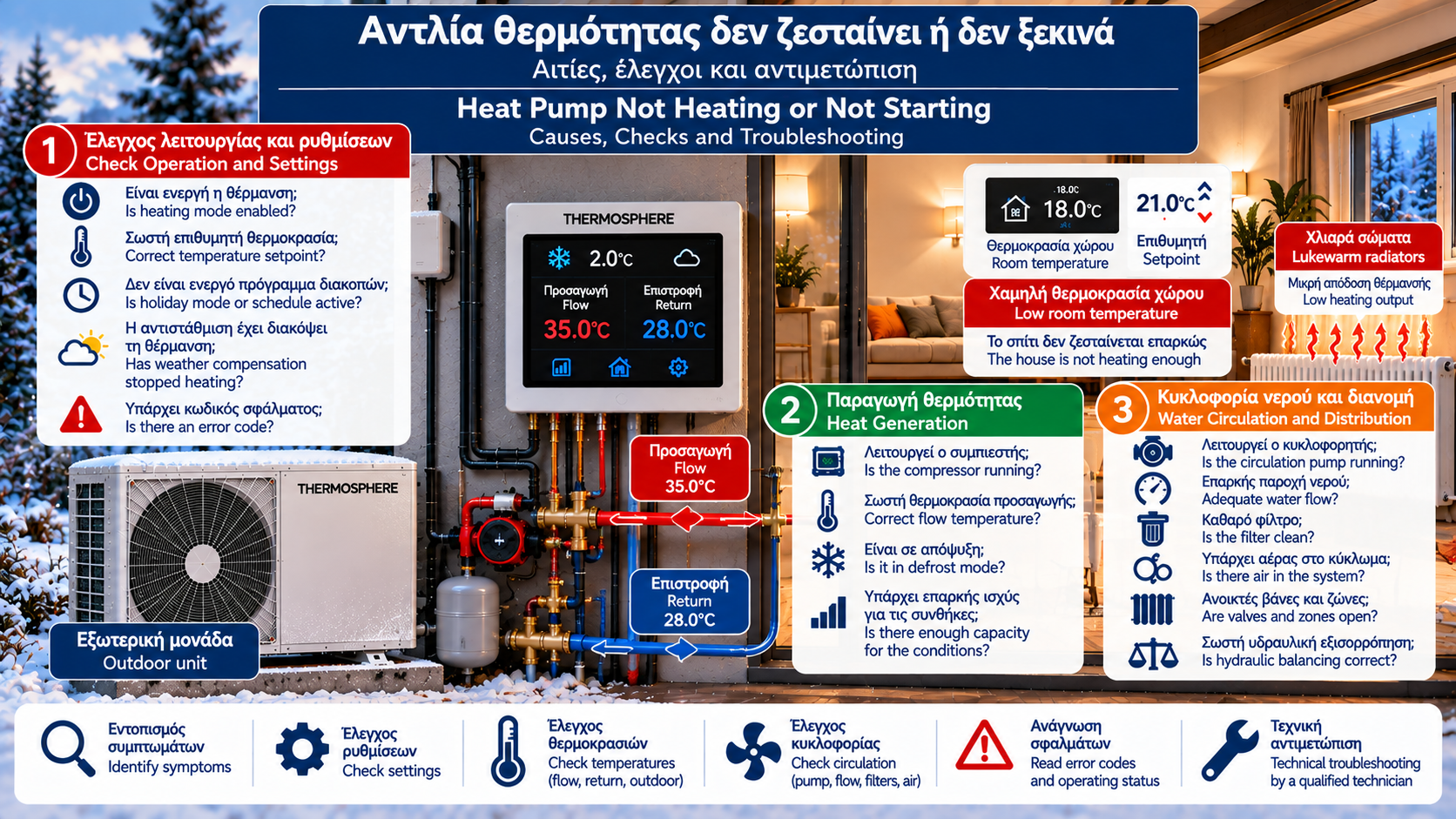
Heat Pump Not Heating or Not Starting: Causes, Checks and Troubleshooting
A heat pump may display normal information on its controller while the house remains cold. In other situations, the outdoor unit may not start at all, or the compressor may run without achieving the desired indoor temperature.
This does not necessarily mean the heat pump has a serious mechanical fault.
The problem may involve the thermostat, operating schedule, weather compensation, water circulation or the building’s actual heating demand.
There are also situations where the cause lies in the compressor, refrigeration circuit or electronic protection systems.
The important first step is to distinguish between three different conditions:
The heat pump is not receiving a heating demand.
The heat pump receives a demand but cannot start.
The heat pump operates but does not provide sufficient heat.
This distinction is essential for accurate troubleshooting.
1. How Do You Know There Is a Real Problem?
Before assuming that a fault exists, it is important to understand normal heat pump operation.
Unlike many conventional boilers, heat pumps often operate with lower heating-water temperatures and longer running periods.
Therefore, a radiator that feels lukewarm does not necessarily mean the system is failing.
The main question is whether the building can maintain the desired indoor temperature.
For example, if the thermostat is set to 21°C and the home remains at 21°C, the installation may be operating correctly even when the radiators feel relatively cool.
However, if the indoor temperature remains at 17°C despite continuous heating demand, further investigation is required.
2. The Heat Pump Does Not Start
When heating does not start, the first step is to confirm whether the system has actually received an operating command.
Possible causes include:
Heating mode is disabled.
Thermostat setpoint is too low.
Holiday mode is active.
A time schedule is preventing heating.
The system is set to domestic hot water only.
Outdoor temperature is above the heating shutdown threshold.
A protective start delay is active.
An error code is preventing operation.
Initial checks should be performed through the normal user interface.
There is no need to open equipment covers or access electrical components.
3. The Thermostat Is Not Requesting Heating
A thermostat may display room temperature correctly without sending a heating demand.
For example:
Actual room temperature: 20°C.
Desired temperature: 19°C.
In this situation, heating is not required.
However, if the desired temperature is 22°C and the room is at 18°C, a heating demand would normally be expected, provided the thermostat’s operating mode and schedule allow it.
In multi-zone systems, the demand signal may pass through a central controller.
A thermostat fault, closed zone or communication problem may prevent the signal from reaching the heat pump.
Electrical verification should be performed by a qualified technician.
4. Weather Compensation Has Disabled Heating
Many heat pumps use weather compensation.
The controller adjusts the target heating-water flow temperature according to outdoor conditions.
The system may also have an outdoor temperature threshold above which space heating is disabled.
For example, an installation may be configured to stop requesting heating when outdoor temperature exceeds a selected value.
If this setting is unsuitable for the building, insufficient heating may occur during spring or autumn.
There is no universally correct shutdown temperature.
The setting should reflect the building’s requirements and the manufacturer’s instructions.
5. The Display Works but the Outdoor Unit Does Not Start
An active controller display does not prove that the compressor should be running.
The heat pump may be in:
Standby with no heating demand.
A compressor protection delay.
Domestic hot water priority mode.
A defrost cycle.
A restricted operating state.
A protective shutdown.
If the display shows a specific status or error code, consult the documentation for the exact model.
Repeated restarting is not an appropriate troubleshooting method.
6. The Heat Pump Runs but Does Not Heat the House
This is one of the most common complaints.
The compressor may be operating, water may be circulating and the system may be producing heat, but the indoor temperature still fails to rise.
Possible causes include:
Flow temperature is too low.
Weather compensation settings are unsuitable.
Water flow is insufficient.
Poor hydraulic balancing.
Undersized radiators.
High building heat losses.
Restricted heat pump output.
Refrigeration circuit problems.
Incorrect backup heater operation, where applicable.
Correct diagnosis must consider both the heat pump and the entire heating installation.
7. Heating-Water Flow Temperature Is Too Low
Flow temperature is the temperature of the water leaving the heat pump towards the heating system.
If it is lower than the temperature required by the heat emitters under current conditions, the home may not receive enough heat.
For example, radiators designed for higher operating temperatures may provide insufficient output with 30°C flow water.
By contrast, properly designed underfloor heating may operate effectively at similar or lower temperatures.
There is no single flow temperature suitable for every building.
Requirements depend on:
Building heat losses.
Radiator or emitter size.
Outdoor temperature.
Desired indoor temperature.
Water flow.
Increasing flow temperature without assessment may reduce energy efficiency.
8. The Heat Pump Produces Hot Water but the Radiators Stay Cold
If the heat pump reports an appropriate flow temperature but the radiators remain cold, the problem may involve water distribution.
Possible causes include:
Closed valves.
Closed heating zone valves.
Circulation pump problems.
Air trapped in the system.
Blocked filters.
Incorrect three-way valve position.
Unsuitable hydraulic connections.
Heat generation and heat distribution are separate functions.
A heat pump may produce heat without delivering it effectively to the rooms.
9. Why Might Water Circulation Be Insufficient?
Adequate water flow is essential for heat transfer.
Reduced circulation may result from:
Air in the hydraulic circuit.
Blocked strainers.
Partially closed valves.
Circulation pump faults.
Incorrect pump settings.
Closed heating zones.
Poor hydraulic design.
Some heat pumps display low-flow errors.
Others may experience protective shutdowns or unstable operation.
Flow should be evaluated against the manufacturer’s requirements.
10. Low Water Pressure
In closed heating circuits, water pressure must remain within the installation’s permitted operating range.
Very low pressure may affect operation or activate protective functions.
However, filling pressure and water flow are not the same thing.
A system may have normal static pressure but inadequate circulation.
Correct pressure depends on building height, system design and manufacturer requirements.
Water should not be repeatedly added without investigating why pressure is falling.
11. Only Some Rooms Are Heating
When certain rooms are warm while others remain cold, the problem may involve water distribution.
Possible causes include:
Poor hydraulic balancing.
Closed thermostatic radiator valves.
Faulty zone actuators.
Air in individual circuits.
Undersized heat emitters.
Different heat losses between rooms.
Increasing the flow temperature for the entire building is not necessarily the correct solution.
Water distribution should be checked first.
12. The Heat Pump Struggles in Very Cold Weather
The output of an air-to-water heat pump is influenced by outdoor temperature.
As outdoor temperature decreases, available heating capacity may also decrease, depending on the model and operating conditions.
At the same time, the building’s heating demand generally increases.
If available heat pump output falls below the building’s requirements, indoor temperature may drop.
Important factors include:
Available heating capacity at the actual outdoor temperature.
Required water flow temperature.
Building heat losses.
Defrost operation.
Correct operation of supplementary heating, where specified.
Difficulty maintaining temperature during extreme weather does not automatically indicate equipment failure.
13. Can Defrost Cause a Temporary Reduction in Heating?
Yes.
During defrost, an air-to-water heat pump may temporarily use heat to remove ice from its outdoor heat exchanger.
This can reduce the heat available for space heating for a short period.
Periodic defrosting under suitable weather conditions is normal.
However, excessively frequent or prolonged defrost cycles, especially when accompanied by persistent heating problems, require technical assessment.
14. Domestic Hot Water May Have Priority
Many installations give domestic hot water production priority over space heating.
When the hot water cylinder requires heating, a three-way valve may temporarily direct heat towards the cylinder.
During this process, radiators may stop receiving heated water.
This can be normal operation.
However, unusually long domestic hot water cycles may indicate incorrect settings, a cylinder sensor problem or another component fault.
15. Is the Heat Pump Undersized or Oversized?
Heat pump sizing has a major influence on system performance.
An undersized heat pump may not meet building heat losses under design conditions.
An oversized heat pump may cycle frequently when heating demand falls below its minimum output.
Therefore, both insufficient and excessive capacity can create operating problems.
Assessment should use a building heat loss calculation and manufacturer performance data at the required water temperatures.
16. Could the Refrigeration Circuit Be Responsible?
Yes, but it should not automatically be assumed to be the cause.
Refrigeration circuit problems can restrict heating output or cause protective shutdowns.
Possible causes include:
Refrigerant leakage.
Compressor problems.
Expansion valve malfunction.
Sensor faults.
Abnormal operating pressures.
Refrigeration control problems.
Diagnosis requires appropriate equipment and specialist knowledge.
Refrigerant must not be added arbitrarily, and refrigerant pipework should not be opened by unqualified persons.
17. Why Should You Avoid Constantly Increasing the Temperature?
When a home remains cold, increasing the flow temperature may seem like the obvious solution.
It can help when the existing setting is genuinely too low.
However, it does not correct problems such as:
Closed valves.
Insufficient circulation.
Thermostat faults.
Poor hydraulic balancing.
Insufficient available heating capacity.
Higher flow temperatures also generally reduce heat pump COP.
The correct approach is to identify the underlying cause rather than repeatedly increasing settings.
18. Practical Example: The Heat Pump Runs but the House Stays at 18°C
Consider the following conditions:
Desired indoor temperature: 21°C.
Actual indoor temperature: 18°C.
Compressor operating.
Outdoor temperature: 2°C.
Radiators feel lukewarm.
A structured investigation might proceed as follows.
Step 1: Confirm continuous heating demand.
Step 2: Compare target and actual heating-water flow temperatures.
Step 3: Verify adequate water circulation.
Step 4: Determine whether the radiators can deliver sufficient heat at the current water temperature.
Step 5: Compare available heat pump output with the building’s heat losses.
This example demonstrates why diagnosis must consider more than a single setting.
19. Symptoms and Possible Causes
Symptom | Possible causes |
Heating does not start | Thermostat, schedule, standby mode, protective state |
Display works but compressor does not run | No demand, delay, error, domestic hot water priority |
Heat pump runs but home remains cold | Low flow temperature, insufficient output, circulation, heat losses |
Water is hot but radiators are cold | Valves, circulation pump, three-way valve, zones |
Some rooms remain cold | Balancing, air, valves, emitter capacity |
Heating output drops in freezing weather | Available capacity, defrost, heating demand |
Heating pauses during hot water production | Possibly normal domestic hot water priority |
Frequent starts and stops | Low load, thermostat, settings, water flow |
This table provides initial guidance and does not replace professional diagnosis.
20. What Can Homeowners Check Safely?
Before calling a technician, homeowners can perform several simple checks:
Confirm that heating mode is enabled.
Check the thermostat setpoint.
Review holiday modes and operating schedules.
Record any error codes.
Note the outdoor temperature.
Check the displayed flow temperature, if available.
Determine whether all rooms or only some rooms are affected.
Check whether the system is producing domestic hot water.
Look for obvious external water leaks.
Record when the problem began.
Do not open electrical covers, bypass protective devices or work on the refrigeration circuit.
21. When Is a Technician Required?
Professional assistance is needed when:
Error codes recur.
The home cannot reach its desired temperature despite continuous operation.
Insufficient water flow is suspected.
Unusual noises occur.
Visible leakage is present.
The compressor fails to start despite confirmed heating demand.
Operating temperatures appear abnormal.
Refrigeration or electrical faults are suspected.
If smoke, a burning smell or visible electrical hazards are present, follow safe shutdown instructions and seek qualified assistance immediately.
22. Frequently Asked Questions
Why Is My Heat Pump Running but Not Heating?
Possible causes include low flow temperature, insufficient water circulation, poor heat distribution or inadequate available heating capacity.
Why Won’t My Heat Pump Start Even Though It Has Power?
Power availability does not guarantee heating demand. Check the thermostat, operating schedule, protective states and controller information.
Is It Normal for Radiators to Feel Lukewarm?
Yes, provided the system maintains the desired indoor temperature.
Why Won’t My Home Reach 21°C?
Possible causes include unsuitable weather compensation, insufficient heating capacity, high building heat losses or water distribution problems.
Why Does Heating Stop When the Hot Water Cylinder Is Being Heated?
Many systems prioritize domestic hot water. Temporary interruptions to space heating may be normal.
Could the Circulation Pump Be Responsible?
Yes. Inadequate water flow can prevent heat from reaching the rooms effectively.
Should I Increase the Flow Temperature?
Only if the current setting is genuinely insufficient. Repeated increases without diagnosis may raise electricity consumption.
Why Does My Heat Pump Struggle During Freezing Weather?
Available heating output may decrease while building demand increases. Defrost operation may also affect performance.
Could There Be a Refrigerant Problem?
Yes, but confirmation requires specialist diagnosis. Refrigerant should never be added without identifying the actual cause.
When Should a Heat Pump Be Replaced?
Insufficient heating does not automatically justify replacement. System design, settings, maintenance and actual available capacity should be evaluated first.
Conclusion
When a heat pump fails to start or cannot heat a building adequately, the cause is not necessarily the compressor or refrigeration circuit.
Many problems involve heating demand, weather compensation, flow temperature or water circulation.
Troubleshooting should begin with basic operating conditions and proceed systematically towards more specialized technical checks.
The key is not simply to establish that the heat pump is failing to heat, but to identify whether the problem lies in control, heat generation or heat distribution.
This approach helps prevent unnecessary repairs, incorrect adjustments and avoidable component replacements.
Thermosphere.gr — Technical knowledge for heating and building systems.