
# Reverse Osmosis (RO): Working Principle, Membranes and Industrial Applications
## What Is Reverse Osmosis?
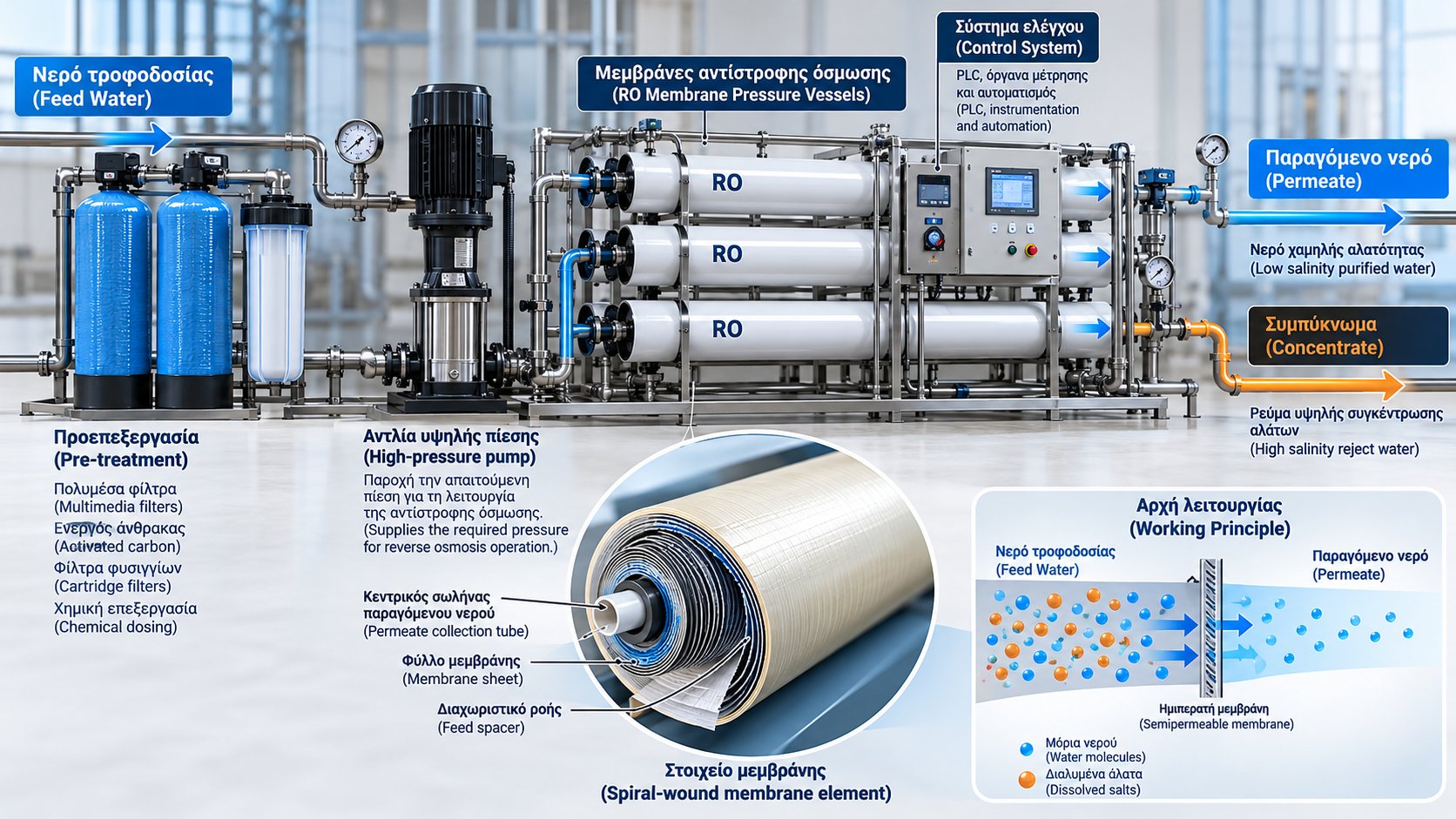
Reverse osmosis (RO) is a pressure-driven membrane separation technology widely used to remove dissolved salts and many other contaminants from water.
It plays an essential role in industrial water treatment, boiler feedwater preparation, desalination, food and beverage processing, and the production of high-purity process water.
Unlike conventional particle filtration, reverse osmosis can substantially reduce the concentration of dissolved ionic substances.
The process uses a semipermeable membrane and applied hydraulic pressure to separate incoming water into two streams: purified water (permeate) and a concentrated reject stream (concentrate).
## 1. Working Principle of Reverse Osmosis
### Natural Osmosis
In natural osmosis, water tends to move across a suitable semipermeable membrane from a solution with a lower dissolved-solute concentration toward a solution with a higher dissolved-solute concentration.
This movement is driven by the difference in chemical potential and is associated with osmotic pressure.
### Reverse Osmosis
Reverse osmosis reverses the net direction of water transport by applying hydraulic pressure to the more concentrated solution.
When the applied transmembrane hydraulic pressure difference exceeds the opposing osmotic pressure difference, a net water flux can occur toward the permeate side.
A simplified relationship is:
Jw = A × (ΔP − Δπ)
Where:
- Jw = Water flux through the membrane
- A = Membrane water permeability coefficient
- ΔP = Hydraulic pressure difference
- Δπ = Osmotic pressure difference
This relationship illustrates why higher feedwater salinity generally increases the pressure required to achieve a given permeate flux.
RO membranes reject a large proportion of dissolved ions and many other contaminants, although rejection performance varies by substance, membrane type and operating conditions.
## 2. The Three Main Water Streams
A reverse osmosis system has three fundamental process streams.
### Feed Water
Feed water is the incoming water supplied to the RO system, normally after suitable pretreatment.
Its quality directly influences membrane performance, chemical consumption, operating pressure and cleaning frequency.
### Permeate
Permeate is the water that passes through the RO membrane.
It normally contains substantially lower concentrations of dissolved salts than the feed water.
Permeate quality is commonly assessed using electrical conductivity, total dissolved solids (TDS) and application-specific quality parameters.
### Concentrate
Concentrate, also called reject water or brine, contains most of the dissolved substances rejected by the membranes.
Its concentration generally increases as system recovery increases.
The concentrate stream must be managed according to the water chemistry, discharge requirements and applicable environmental regulations.
## 3. Reverse Osmosis Membrane Technology
Modern industrial RO installations commonly use thin-film composite (TFC) membranes with a polyamide selective layer.
These membranes are designed to provide high salt rejection while maintaining useful water permeability.
### Spiral-Wound Membranes
Spiral-wound membrane elements are widely used in industrial applications.
They contain membrane sheets, feed spacers and permeate collection materials wrapped around a central permeate collection tube.
The elements are installed inside pressure vessels, often with multiple elements connected in series within each vessel.
### Membrane Selection
Membrane selection depends on:
- Feedwater salinity and composition
- Required permeate quality
- Operating pressure
- Water temperature
- Required production capacity
- Fouling potential
- Chemical compatibility
- Energy efficiency
Membranes designed for brackish water and seawater applications have different operating characteristics.
Polyamide membranes are particularly sensitive to oxidants such as free chlorine. Suitable dechlorination is therefore essential whenever oxidants are present in the feed.
## 4. Main Components of an Industrial RO System
A typical industrial reverse osmosis installation may include the following equipment.
### Pretreatment System
Pretreatment protects the RO membranes from suspended solids, colloids, scaling and biological fouling.
Depending on feedwater quality, it may include multimedia filtration, activated carbon, ultrafiltration, softening, antiscalant dosing or other processes.
### Cartridge Filters
Cartridge filters are commonly installed upstream of the high-pressure pump to capture residual particulate matter.
Their filtration rating must be selected according to the system design and membrane manufacturer's recommendations.
### High-Pressure Pump
The high-pressure pump supplies the pressure needed to overcome osmotic pressure and membrane hydraulic resistance.
Its operating point must match the required flow, pressure and system efficiency.
### Membrane Pressure Vessels
Pressure vessels house the RO membrane elements and withstand the specified operating pressure.
They must be suitable for the system pressure rating and operating environment.
### Instrumentation and Control
Important monitoring parameters include:
- Feed pressure
- Concentrate pressure
- Permeate pressure
- Feed and permeate flow
- Concentrate flow
- Feed and permeate conductivity
- Water temperature
- Differential pressure
- System recovery
Industrial installations frequently use PLC-based automation for monitoring, control, alarms and protective shutdowns.
### Cleaning-in-Place System
A dedicated cleaning-in-place (CIP) system may be provided to remove accumulated deposits from membrane surfaces.
Cleaning chemicals, temperature, pH and circulation conditions must remain within the membrane manufacturer's limits.
## 5. Operating Pressure
Operating pressure is one of the most important parameters in reverse osmosis.
The required pressure depends on feedwater salinity, membrane permeability, temperature, system recovery and desired permeate production.
Indicative operating pressure ranges include:
- Brackish water RO: approximately 10–25 bar
- Seawater RO: approximately 55–80 bar
These are illustrative ranges rather than universal design limits.
Actual operating pressures can fall outside these ranges depending on the feedwater composition, equipment and system configuration.
The design pressure must be determined using membrane performance calculations and manufacturer specifications.
## 6. Water Recovery Rate
Recovery describes the percentage of feedwater converted into permeate.
Recovery (%) = (Permeate Flow / Feed Flow) × 100
### Example
Consider an RO system operating with:
- Feedwater flow: 10 m³/h
- Permeate flow: 7.5 m³/h
- Concentrate flow: 2.5 m³/h
Recovery = (7.5 / 10) × 100
Recovery = 75%
This means that 75% of the incoming water becomes permeate and 25% leaves as concentrate.
Increasing recovery reduces concentrate volume but also increases dissolved-solute concentrations on the feed side.
Excessive recovery can increase the risk of mineral scaling, concentration polarization and membrane fouling.
The acceptable recovery rate must therefore be established from feedwater analysis, scaling calculations and membrane design limitations.
## 7. Salt Rejection
Salt rejection measures the membrane's ability to prevent dissolved salts from passing into the permeate.
Salt Rejection (%) = [1 − (Cp / Cf)] × 100
Where:
- Cp = Permeate salt concentration
- Cf = Feedwater salt concentration
For a meaningful calculation, both concentrations must refer to the same constituent or comparable TDS measurements.
### Example
Feedwater TDS: 2,000 mg/L
Permeate TDS: 20 mg/L
Salt Rejection = [1 − (20 / 2,000)] × 100
Salt Rejection = 99%
This indicates a 99% reduction in the measured salt concentration between feedwater and permeate.
Actual rejection depends on membrane characteristics, pressure, temperature, feedwater chemistry and membrane condition.
Electrical conductivity is frequently used as a practical operating indicator, but conductivity and TDS are not identical measurements.
## 8. Industrial Applications of Reverse Osmosis
### Boiler Feedwater Treatment
Reverse osmosis is widely used to reduce dissolved salts in boiler makeup water.
Lower salinity helps reduce the burden on downstream water treatment processes and supports boiler water quality management.
Depending on boiler pressure and required water quality, additional treatment such as electrodeionization or ion exchange may be necessary.
RO alone does not guarantee compliance with every boiler feedwater specification.
### Industrial Process Water
Manufacturing facilities use RO systems where controlled water quality is important for production consistency, equipment protection and process reliability.
### Food and Beverage Industry
Reverse osmosis can be incorporated into water treatment processes for beverage production, ingredient water preparation and other applications requiring controlled water quality.
Systems must comply with applicable hygiene and product quality requirements.
### Pharmaceutical Industry
RO may form part of a validated pharmaceutical water generation system.
Additional purification, sanitization and monitoring stages are selected according to the required water grade and applicable standards.
### Desalination
Reverse osmosis is a major technology for converting brackish water and seawater into usable freshwater.
Seawater desalination installations may also incorporate energy recovery devices to reduce specific energy consumption.
## 9. Factors Affecting RO Performance
Several operating conditions influence membrane performance.
### Water Temperature
Higher temperature generally increases membrane water permeability.
However, changes in temperature can also affect salt passage and must be considered when evaluating performance.
### Feedwater Quality
High suspended solids, colloidal contamination, organic matter and microorganisms can increase fouling potential.
### Scaling
Scaling occurs when sparingly soluble salts precipitate and accumulate on membrane surfaces.
Common scaling risks include calcium carbonate, calcium sulfate, barium sulfate and silica-related deposits, depending on water chemistry.
### Fouling
Fouling may involve particulate, colloidal, organic or biological deposits.
It can reduce normalized permeate flow, increase differential pressure and affect permeate quality.
### Membrane Damage
Chemical oxidation, mechanical damage or deterioration of seals can cause increased salt passage.
Changes in performance should be assessed using normalized operating data rather than raw flow or pressure readings alone.
## 10. Operational Monitoring and Maintenance
Reliable RO operation requires systematic monitoring and preventive maintenance.
Important practices include:
- Recording flow, pressure, conductivity and temperature
- Monitoring normalized permeate flow
- Tracking normalized salt passage
- Monitoring feed-to-concentrate differential pressure
- Maintaining suitable pretreatment performance
- Checking chemical dosing systems
- Preventing oxidant exposure of sensitive membranes
- Performing membrane cleaning when justified by performance trends
- Following manufacturer shutdown and preservation procedures
Cleaning should not be based solely on a fixed calendar interval.
Many membrane manufacturers provide performance-based cleaning criteria, often involving changes in normalized permeate flow, salt passage or differential pressure.
The specific thresholds and cleaning procedures must follow the installed membrane manufacturer's instructions.
## 11. Limitations of Reverse Osmosis
Reverse osmosis is highly effective for many dissolved contaminants, but it does not remove every substance equally.
Some dissolved gases and small neutral molecules may pass through RO membranes to a significant extent.
Although RO membranes provide an important physical barrier to microorganisms, membrane integrity, seals, downstream contamination and system hygiene must be considered.
RO treatment alone should not be treated as an unconditional guarantee of microbiological safety.
The final water treatment process must be designed around the required water quality and intended application.
## Conclusion
Reverse osmosis is one of the most important membrane technologies used in modern industrial water treatment.
Its effectiveness depends on the combined performance of membrane elements, pretreatment equipment, hydraulic design, instrumentation and operating procedures.
Understanding operating pressure, water recovery, salt rejection and membrane fouling is essential for achieving reliable production, consistent water quality and efficient operation.
A correctly designed and maintained RO system can provide high-quality process water while supporting long-term operational reliability.
Thermosphere.gr – Technical Knowledge for Professionals.