
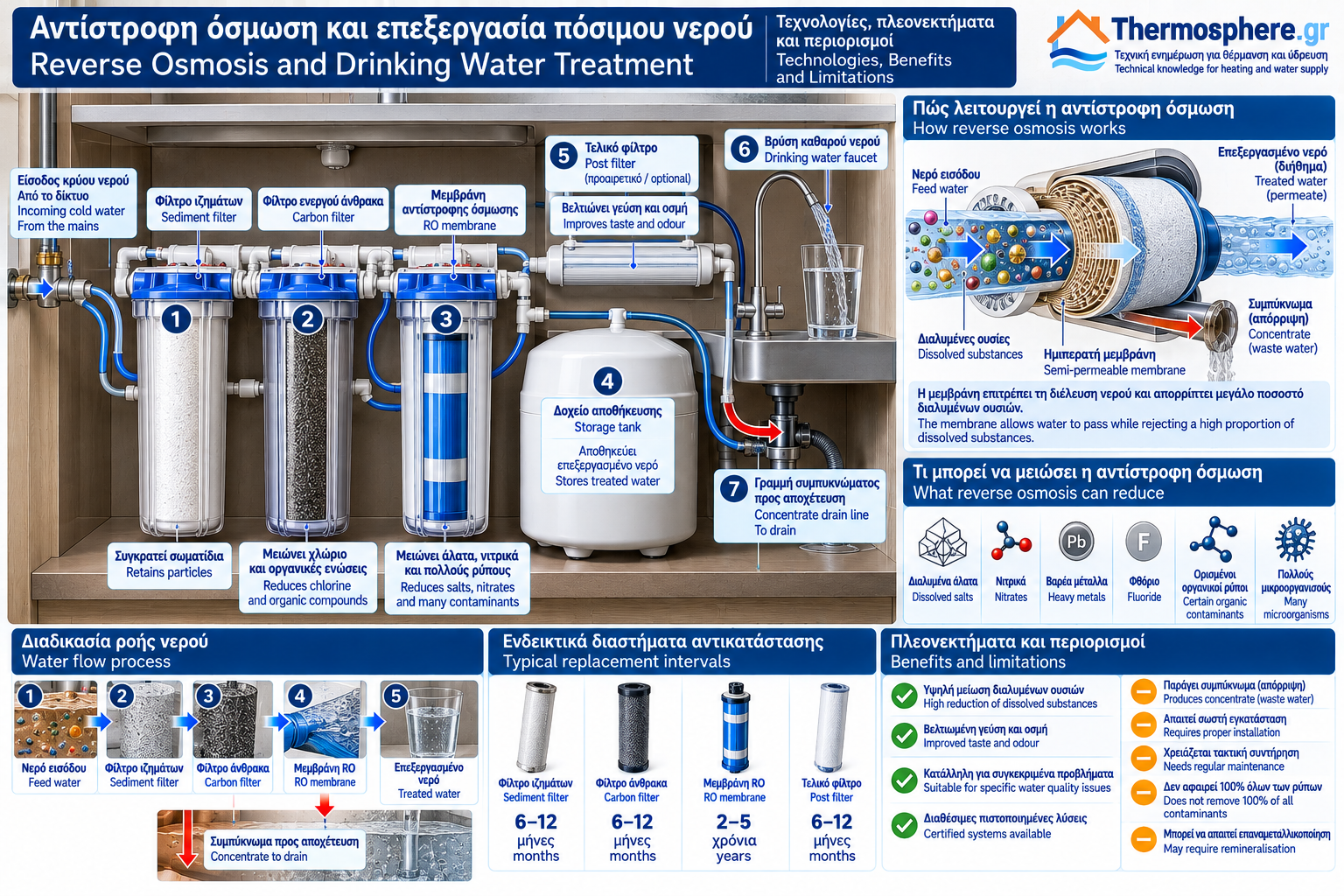
Reverse Osmosis and Drinking Water Treatment: Technologies, Benefits and Limitations
Reverse osmosis is one of the most important water treatment technologies when the reduction of specific dissolved substances, such as salts and certain chemical contaminants, is required.
The technology is used in residential drinking water systems, commercial installations, industrial processes and desalination plants.
However, reverse osmosis is not necessary in every household. System selection should be based on actual water quality, the contaminants that need to be reduced and the verified performance of the equipment.
This guide explains the operating principle, main components, installation requirements, performance and maintenance of reverse osmosis systems.
1. What Is Reverse Osmosis?
Reverse osmosis (RO) is a membrane separation process that uses a semipermeable membrane.
In natural osmosis, water tends to move through a suitable membrane toward the side with a higher concentration of dissolved substances.
In reverse osmosis, pressure greater than the relevant osmotic pressure difference is applied to drive water toward the lower-concentration side.
The membrane allows a substantial portion of the water to pass while rejecting a high proportion of many dissolved substances.
The process produces two streams:
Permeate: the treated water.
Concentrate: the stream carrying substances rejected by the membrane.
Reverse osmosis is not simply conventional filtration with extremely small pores. Its operation depends on membrane properties, pressure and the transport mechanisms of water and dissolved substances.
2. How Does a Residential RO System Work?
A typical residential reverse osmosis system is installed under the kitchen sink and supplies a dedicated drinking water faucet.
Depending on the design, it may include:
Sediment prefilter.
Activated carbon prefilter.
Reverse osmosis membrane.
Storage tank or direct-flow configuration.
Final filter or other treatment stage where specified.
Concentrate flow restrictor and suitable valves.
Booster pump where necessary.
Water enters the pretreatment stages, passes through the membrane and is separated into treated water and concentrate.
Final water quality depends on the entire system, not just the membrane.
3. Why Are Prefilters Necessary?
Prefilters protect the membrane against substances that may reduce performance or cause premature damage.
Sediment Prefilter
This stage retains suspended particles such as sand, rust and other solid debris.
Activated Carbon Prefilter
Many residential systems use activated carbon to reduce free chlorine and selected organic compounds.
Chlorine can damage certain membranes, particularly polyamide membranes.
However, pretreatment must match the feedwater chemistry and membrane type.
The presence of a carbon filter does not automatically guarantee the removal of all chemical contaminants.
4. What Can Reverse Osmosis Reduce?
Reverse osmosis can significantly reduce many dissolved substances.
Depending on system design and certified performance, it may be used to reduce:
Many dissolved salts.
Nitrates.
Certain heavy metals.
Fluoride.
Selected additional inorganic or organic contaminants.
Removal performance is not identical for all substances.
It depends on the membrane, temperature, pressure, pH, contaminant concentration and operating conditions.
Some small, neutral or volatile compounds may exhibit limited rejection by particular membranes.
No RO system should automatically be assumed to remove 100% of every contaminant.
Where a specific water quality issue exists, the system’s declared and verified contaminant reduction claims must be checked.
5. Does Reverse Osmosis Remove Bacteria and Viruses?
An intact, properly operating RO membrane can provide a substantial physical barrier to many microorganisms.
However, the microbiological safety of the final water does not depend solely on the theoretical membrane barrier.
Important factors include:
Membrane integrity.
Incoming water quality.
Connection integrity.
Storage tank condition.
Downstream faucets and tubing.
Maintenance and system hygiene.
Microbiologically unsafe water requires an appropriately designed and verified treatment strategy, potentially including additional disinfection.
A standard residential RO system should not automatically be regarded as a complete solution for every microbiological contamination problem.
6. What Is Salt Rejection?
Salt rejection describes the reduction in concentration of a selected dissolved substance across the membrane.
For a particular constituent, rejection may be expressed as:
Rejection (%) = [1 − (Permeate concentration / Feed concentration)] × 100
Where:
Permeate concentration is the concentration in treated water.
Feed concentration is the concentration in incoming water.
Example
Suppose a constituent has:
Feed concentration: 500 mg/L.
Permeate concentration: 25 mg/L.
Then:
Rejection = [1 − (25 / 500)] × 100 = 95%.
This is an illustrative calculation, not a guaranteed membrane performance value.
TDS measurements may help monitor overall system behaviour, but they do not demonstrate the removal of every individual contaminant.
7. Operating Pressure and Booster Pumps
Pressure is a critical factor in reverse osmosis operation.
When available pressure is insufficient, treated water production may decrease and system performance may be affected.
Some systems use a dedicated booster pump.
Required operating pressure varies according to:
Membrane type.
Dissolved substance concentration.
Water temperature.
Desired production capacity.
System configuration.
Pressure must remain within the manufacturer’s specified limits.
8. How Much Water Does Reverse Osmosis Discharge?
Concentrate production is a normal characteristic of reverse osmosis.
Water recovery is defined as:
Recovery (%) = (Permeate flow / Feed flow) × 100
For example, if a system uses 10 litres of feedwater and produces 3 litres of permeate:
Recovery = 30%.
The remaining 7 litres form the concentrate stream.
Actual recovery depends on the model, pressure, temperature, storage configuration and operating conditions.
There is no universal wastewater ratio applicable to every RO system.
9. Tank-Based vs Tankless RO Systems
Systems with Storage Tanks
These systems store treated water so that it is available when the faucet is opened.
Advantages include:
Immediate access to stored treated water.
The possibility of using a smaller production membrane in some applications.
Limitations include:
Additional space requirements.
Hygiene and maintenance needs.
Performance dependence on tank pressure.
Direct-Flow Systems
Direct-flow systems produce water on demand, often using higher-capacity membranes and, in many cases, a pump.
Their advantages and limitations depend on the particular design, electrical requirements and installation conditions.
Removing the storage tank does not eliminate maintenance requirements.
10. Is Remineralisation Necessary?
Reverse osmosis reduces many dissolved ions, including minerals such as calcium and magnesium.
Some systems incorporate a remineralisation or pH-adjustment stage.
Such treatment may be used to modify specific characteristics of the final water.
However, not every RO system requires the same additional stage, and remineralisation does not automatically resolve every water quality concern.
Final water composition must be evaluated according to the intended use and drinking water suitability requirements.
11. Correct Reverse Osmosis Installation
Installation must follow manufacturer instructions and applicable plumbing requirements.
Important steps include:
Checking feedwater quality and pressure.
Confirming system suitability.
Safely connecting to the cold-water supply where specified.
Installing prefilters and the membrane correctly.
Connecting the concentrate drain with appropriate backflow protection.
Installing the storage tank or pump where required.
Checking for leaks.
Flushing and commissioning according to the manual.
Verifying treated water quality using appropriate testing methods.
The drain connection must not allow contaminated wastewater to flow back into the treatment system.
12. Reverse Osmosis System Maintenance
Maintenance is essential for maintaining performance and hygiene.
Typical requirements include:
Prefilter replacement.
Membrane performance checks.
Operating pressure verification.
Inspection of tubing and connections.
Storage tank maintenance where fitted.
Cleaning or sanitisation according to manufacturer instructions.
Appropriate testing of treated water quality.
Replacement intervals depend on the specific equipment and incoming water quality.
There is no single universal maintenance schedule for every RO system.
13. Common Reverse Osmosis Problems
Low Water Production
Possible causes include:
Low inlet pressure.
Clogged prefilters.
Membrane fouling.
Low water temperature.
Storage tank or pump problems.
Increased Conductivity or TDS
This may indicate reduced membrane performance, sealing problems or changes in feedwater quality.
Appropriate inlet and outlet measurements are needed to investigate the cause.
Continuous Flow to Drain
Possible causes include valve faults, pressure problems or normal operation under particular conditions.
Water Leaks
Leaks require immediate isolation and inspection of fittings, tubing and system components.
14. Certifications and Water Quality Requirements
For residential reverse osmosis systems, NSF/ANSI 58 is an important evaluation standard.
However, certification must be verified for the exact model and specific performance claims.
Within the European Union, drinking water quality is governed by applicable legislation and national implementing requirements.
Materials in contact with drinking water must also be suitable for their intended use.
A general product marking or marketing claim does not prove that a system removes every possible contaminant.
15. When Is Reverse Osmosis Worth Installing?
An RO system may be useful when:
There is a documented need to reduce specific dissolved contaminants.
Feedwater characteristics require suitable membrane treatment.
The selected system has verified performance for the intended purpose.
Suitable pressure and maintenance conditions are available.
Water consumption and overall costs have been considered.
If public drinking water meets applicable quality requirements and there is no identified treatment need, reverse osmosis is not automatically necessary.
Conclusion
Reverse osmosis is an effective technology for reducing many dissolved water constituents when the system is properly selected, installed and maintained.
Actual performance depends on membrane characteristics, feedwater quality, pressure and the operation of the other treatment stages.
Choosing the right reverse osmosis system should be based on a genuine treatment requirement and verified performance—not on the assumption that all water needs the same technology.
This article provides general technical information. Drinking water safety concerns require appropriate water quality testing and evaluation by qualified professionals.
Thermosphere.gr — Technical knowledge for heating, water supply and modern plumbing systems.