
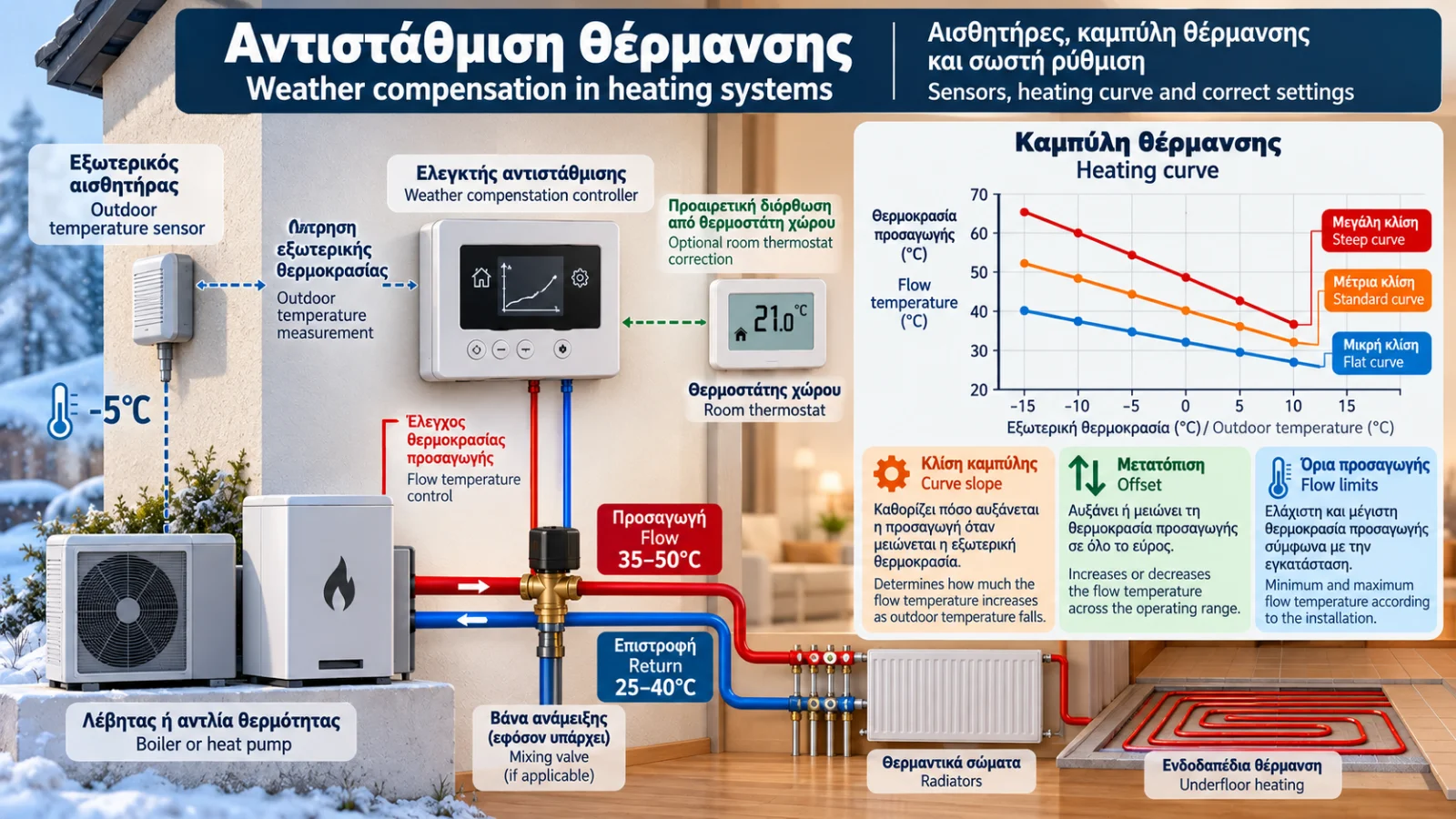
Weather Compensation in Heating Systems: Sensors, Heating Curves and Correct Settings
Weather compensation is one of the most important methods of automatically controlling heating-water temperature in modern heating installations.
Instead of operating continuously at a fixed flow temperature, a weather-compensated system adjusts the target water temperature according to outdoor conditions and, in some installations, indoor temperature feedback.
This control method is used with boilers, heat pumps, radiators and underfloor heating systems.
When correctly configured, weather compensation can improve thermal comfort, reduce unnecessarily high water temperatures and support more efficient heating operation.
However, there is no universal heating curve suitable for every building. The appropriate settings depend on building heat losses, heat emitter characteristics, room-temperature requirements and the heating source.
This Thermosphere.gr technical guide explains the operating principles of weather compensation, the role of temperature sensors, heating-curve adjustments and common troubleshooting considerations.
1. What Is Weather Compensation?
Weather compensation is a heating-control strategy that adjusts the target heating-water flow temperature according to outdoor conditions.
Its basic principle is straightforward.
As outdoor temperature decreases, a building generally loses more heat to its surroundings.
To compensate for these losses, the heating system may need to supply water at a higher temperature.
When outdoor temperatures rise, heating demand generally decreases, allowing a lower flow temperature.
The relationship between outdoor temperature and target flow temperature is described by a heating curve.
Weather compensation does not directly measure the building's heat losses. Instead, it uses a control model based on measured temperatures and configured parameters.
2. How Does Weather Compensation Work?
A weather-compensation controller receives temperature information from an outdoor sensor.
It calculates the target heating-water flow temperature according to the selected heating curve.
Depending on the installation, the controller may regulate:
The target water temperature of a boiler.
The target flow temperature of a heat pump.
A motorised mixing valve.
Heating-circuit pumps and associated controls, where supported.
For example, a particular installation might require 35°C heating water when outdoor temperature is 12°C, but 45°C water when outdoor temperature falls to 2°C.
These values are illustrative and are not recommended settings for every building.
3. What Is a Heating Curve?
A heating curve represents the relationship between outdoor temperature and the required heating-water flow temperature.
A typical heating-curve diagram uses:
Horizontal axis: outdoor temperature.
Vertical axis: target flow temperature.
As outdoor temperature decreases, the target flow temperature generally increases.
Many controllers allow adjustments to the curve's slope and offset.
Other systems use predefined curves or allow the installer to specify operating points.
Manufacturers do not necessarily use identical numerical scales or adjustment methods.
4. Example Heating Curve
The following table illustrates a hypothetical relationship between outdoor temperature and target flow temperature.
Outdoor temperature | Example flow temperature |
|---|---|
+15°C | 30°C |
+10°C | 35°C |
+5°C | 40°C |
0°C | 45°C |
−5°C | 50°C |
This is an educational example rather than a recommended configuration.
Underfloor heating may require substantially lower water temperatures, while radiator systems may need different values depending on their sizing.
Some controllers also use nonlinear curves, minimum and maximum flow-temperature limits, or automatic heating shutdown above a selected outdoor temperature.
5. Understanding Heating-Curve Slope
The slope determines how strongly target flow temperature changes when outdoor temperature changes.
A steeper curve produces a greater increase in flow temperature as outdoor conditions become colder.
A flatter curve produces a smaller change.
When Should the Slope Be Adjusted?
If rooms remain comfortable during mild weather but become too cold during very cold weather, the curve may be too flat.
If rooms become excessively warm mainly during cold weather, the curve may be too steep.
However, before adjusting the slope, other causes should be considered, including inadequate circulation, air trapped in the system and incorrectly operating radiator valves.
6. Understanding Heating-Curve Offset
Heating-curve offset, sometimes called a parallel shift, increases or decreases target flow temperature across much of the operating range.
If rooms remain slightly too cold during both mild and cold weather, an upward adjustment may be appropriate.
If rooms remain consistently too warm, a downward adjustment may be required.
The exact behaviour of this setting varies between manufacturers and control systems.
7. The Role of the Outdoor Temperature Sensor
The outdoor sensor measures ambient temperature and provides essential information to the weather-compensation controller.
Correct sensor placement is important.
Locations affected by the following should generally be avoided:
Direct sunlight.
Warm air discharged from windows or ventilation openings.
Chimneys or nearby heat sources.
Heat-producing equipment.
Local conditions that do not represent outdoor air temperature.
A north-facing or northwest-facing wall is often suitable where recommended by the manufacturer.
The final mounting position and height must follow the equipment's installation instructions.
8. Is an Indoor Temperature Sensor Necessary?
Not always.
Basic weather compensation can operate using an outdoor sensor and heating-water temperature feedback.
However, some controllers also use indoor temperature measurements to provide room-temperature influence or correction.
This can help account for factors that outdoor temperature alone cannot fully represent, including:
Solar heat gains.
Internal heat gains.
Changes in occupancy.
Differences between calculated and actual room temperature.
The strength of indoor correction must be configured appropriately to avoid excessive changes in heating-water temperature.
9. Weather Compensation with Condensing Boilers
In compatible condensing boilers, weather compensation can reduce the target flow temperature when outdoor conditions allow.
Lower heating-water temperatures may help maintain lower return-water temperatures.
This is particularly relevant because lower return temperatures can encourage condensation of water vapour in the flue gases, supporting efficient condensing operation.
Actual efficiency depends on boiler design, fuel, hydraulic conditions and operating temperatures.
Weather compensation alone does not guarantee a particular percentage of energy savings.
10. Weather Compensation with Heat Pumps
Heating-water flow temperature is an important factor affecting heat pump efficiency.
In general, when a heat pump can meet heating demand at a lower flow temperature, its coefficient of performance may improve.
Weather compensation allows the target water temperature to follow changing outdoor conditions.
However, the heating curve must still provide sufficient heat during the coldest design conditions.
An excessively low curve may leave rooms underheated.
An excessively high curve may increase electricity consumption.
The objective is to identify a curve that maintains comfort without unnecessarily increasing water temperature.
11. Weather Compensation with Radiators
In radiator installations, the required flow temperature depends on:
Radiator size and type.
Room heat losses.
Indoor temperature.
Water flow rate.
Return-water temperature.
Larger or appropriately sized radiators can often deliver the required heat at lower flow temperatures.
Smaller radiators may require higher water temperatures during cold conditions.
Heating-curve settings must therefore reflect radiator capacity and building requirements rather than outdoor temperature alone.
12. Weather Compensation with Underfloor Heating
Underfloor heating generally operates at lower flow temperatures than many conventional radiator systems.
It also has significant thermal inertia.
Changes in heating-water temperature may therefore take considerable time to affect room temperature.
Weather compensation can support gradual adjustment to outdoor conditions.
However, the installation must respect the applicable limits for floor surface temperature, floor construction and heating-system components.
Increasing the curve without considering these limits may cause overheating.
13. How Does Weather Compensation Work with a Room Thermostat?
Weather compensation and room thermostats do not necessarily perform the same function.
Weather compensation primarily determines the target heating-water temperature based on outdoor conditions.
A room thermostat measures indoor temperature.
Depending on system design, it may:
Enable or interrupt heating demand.
Limit room overheating.
Provide feedback to adjust the heating curve.
Work with a multi-zone heating controller.
In some installations, frequent interruptions from a basic room thermostat can interfere with the intended operation of weather compensation.
The manufacturer's recommended control strategy should therefore be followed.
14. How to Adjust a Heating Curve Correctly
Heating-curve optimisation requires a gradual approach and observation of building performance.
Step 1: Check the Heating Installation
Before changing settings, confirm that:
Circulation pumps operate correctly.
Water circulation is adequate.
Radiators or underfloor circuits function properly.
Temperature sensors provide plausible readings.
Room thermostats and valves are not preventing meaningful assessment.
Step 2: Select an Initial Curve
The initial setting should follow manufacturer guidance and reflect the characteristics of the heating installation.
Step 3: Monitor Indoor Temperatures
Observe whether rooms maintain the desired temperature under different outdoor conditions.
Step 4: Adjust the Offset
If rooms are consistently too warm or too cold across different weather conditions, consider an offset adjustment.
Step 5: Adjust the Slope
If the temperature error changes significantly as outdoor temperature changes, the slope may need adjustment.
Step 6: Allow the System to Stabilise
After each adjustment, allow sufficient time for indoor temperatures to stabilise.
High-inertia systems may require a longer observation period.
Changing several parameters simultaneously makes troubleshooting more difficult.
15. Signs of an Incorrect Heating Curve
Observation | Possible cause to investigate |
|---|---|
Rooms become too cold mainly during very cold weather | Curve slope may be too low |
Rooms overheat mainly during very cold weather | Curve slope may be too high |
Rooms are consistently slightly cold | Curve offset may be too low |
Rooms are consistently too warm | Curve offset may be too high |
Large indoor temperature fluctuations | Control interaction, thermal inertia or inappropriate settings |
Only certain rooms are underheated | Possible local hydraulic or heat-emitter issue |
These observations are diagnostic clues, not definitive proof of a particular fault.
Sensor accuracy, water circulation and hydraulic balancing should be checked before changing the heating curve.
16. Common Weather-Compensation Mistakes
Setting the Curve Too High
The heating system may produce unnecessarily hot water during many operating conditions.
Setting the Curve Too Low
The system may fail to maintain comfort, especially during cold weather.
Incorrect Outdoor Sensor Placement
Sunlight or nearby heat sources may distort temperature measurements.
Changing Settings Too Frequently
Building thermal inertia can delay the response to an adjustment.
Ignoring Flow-Temperature Limits
Minimum and maximum flow temperatures must be appropriate for the heating source and distribution system.
Overlooking Thermostatic Radiator Valves
If many valves continuously restrict flow, heating-curve assessment can become difficult.
Adjusting the Curve Without Checking Hydraulics
Weather compensation cannot independently correct poor circulation or inadequate hydraulic balancing.
17. Frequently Asked Questions
What Is Weather Compensation in Simple Terms?
It is the automatic adjustment of heating-water temperature according to outdoor conditions.
Does Weather Compensation Always Reduce Energy Consumption?
Not necessarily. It can improve efficiency when correctly configured and matched to the heating system, but actual results depend on the installation.
Is an Outdoor Temperature Sensor Required?
Conventional weather-compensation systems use outdoor temperature measurements. Some modern controllers may support alternative data sources where specifically designed to do so.
What Is the Best Heating Curve?
There is no universal best curve. The correct setting depends on building heat losses, heat emitters and the heating source.
Is Weather Compensation the Same for Boilers and Heat Pumps?
The basic principle is similar, but suitable flow temperatures and control strategies may differ significantly.
Should I Remove the Room Thermostat When Using Weather Compensation?
Not necessarily. Many installations combine weather compensation with indoor temperature control. The correct arrangement depends on system design and manufacturer guidance.
Conclusion
Weather compensation allows heating systems to adjust flow temperature according to changing outdoor conditions rather than continuously operating at a fixed high temperature.
Heating-curve settings, outdoor sensor placement and coordination with room thermostats are essential for effective operation.
Correct configuration should be based on technical documentation, building characteristics and gradual observation rather than arbitrary temperature settings.
The objective is not simply to achieve the lowest possible water temperature, but the lowest suitable flow temperature that reliably meets the building's heating demand.
Technical References and Further Reading
EN 12098 series: Controls for heating systems.
EN ISO 52120-1: Energy performance of buildings — Contribution of building automation, controls and building management.
CIBSE Guide H: Building Control Systems.
Official boiler, heat pump and weather-compensation controller manuals: Manufacturer-specific heating curves, sensor installation requirements and control parameters.
Technical note: Example temperatures in this article are for explanation only and must not be treated as model-specific configuration instructions. Actual settings must comply with the equipment manufacturer's requirements.
Thermosphere.gr — Technical knowledge for heating and building systems.